You’re checking your Seller Central dashboard obsessively. Your prices are competitive. Your reviews look solid. Your inventory is stocked. Yet somehow, your sales have plateaued—or worse, they’re sliding backward while you watch helplessly.
Here’s what most Amazon sellers don’t realize: the metrics you see in your dashboard represent only a fraction of what Amazon’s algorithm actually evaluates. Beneath the surface, dozens of hidden factors are quietly determining whether your products thrive or languish in search results.
Amazon’s A10 algorithm has become remarkably sophisticated. It leverages AI and machine learning to evaluate seller and product quality in ways that never show up in your standard reports. These invisible signals can make or break your business, and most sellers don’t even know they exist.
This isn’t about paranoia—it’s about understanding the complete picture. The sellers who consistently outperform their competition aren’t just optimizing what they can see. They’re aware of and actively managing the factors that operate in the shadows.
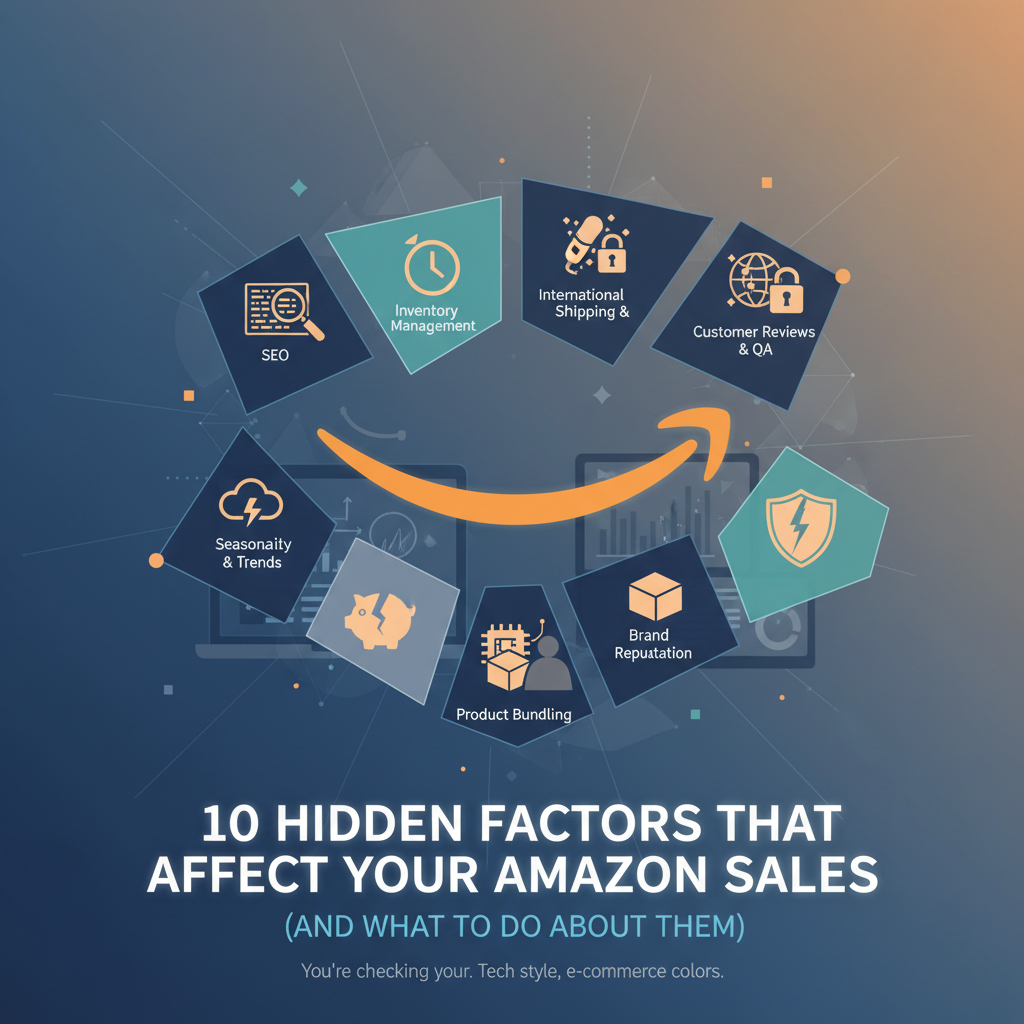
Let’s pull back the curtain on the ten hidden factors that are affecting your Amazon sales right now.
1. Session Percentage: The Conversion Signal Amazon Watches Closely
Unit Session Percentage measures how many visitor sessions result in a purchase. While technically visible in your Business Reports, most sellers either ignore it or don’t understand its algorithmic weight.
Here’s why it matters: Amazon compares your session percentage not just to overall category averages, but to direct competitors selling similar products. If your conversion lags behind competing ASINs, you lose ranking—even if your absolute numbers seem acceptable.
Category benchmarks vary significantly:
- Electronics & Home & Kitchen: 8-12% (higher competition depresses rates)
- Health & Household: 10-15% (strong conversion categories)
- Fashion & Apparel: 6-10%
- General merchandise: 10-12%
Products with below-average session percentages get algorithmically demoted, creating a vicious cycle: lower rankings lead to worse traffic quality, which further depresses conversion, which triggers more ranking losses.
2. Mobile-Specific Performance Metrics
Amazon evaluates mobile performance as its own distinct signal, separate from desktop. Your aggregate metrics don’t show this breakdown clearly, meaning a listing can be underperforming specifically on mobile without you ever noticing.
Mobile commerce now dominates Amazon shopping behavior. If your listing isn’t optimized for small screens—with images that work at thumbnail size, easily scannable bullet points, and mobile-friendly A+ Content—you’re losing sales invisibly.
Access your Business Reports and filter by device type. Many sellers discover their mobile conversion rates are 30-50% lower than desktop, revealing major optimization gaps they never knew existed.
3. Search Intent Matching and Contextual Relevance
Amazon’s A10 algorithm now understands buyer intent and context, not just keyword matching. A search for “shoes for a wedding” doesn’t just surface products containing those exact words—it evaluates whether your product actually fits that use case.
Traditional keyword research tools don’t capture intent matching. Sellers focus on keyword density while Amazon’s AI evaluates semantic relevance. Keyword stuffing no longer works; products that naturally fit buyer intent get ranked higher.
The strategic implication is clear: your listing content needs to address actual use cases, pain points, and buyer scenarios—not just include target keywords mechanically.
4. External Traffic Quality Score
Amazon heavily weights external traffic in its algorithm, but not all external traffic is equal. The platform evaluates the quality and engagement of visitors you bring from outside sources.
Quality indicators Amazon tracks include:
- Bounce rate from external visitors
- Time on page for external vs. internal traffic
- Conversion rate of external traffic sources
- Return rates from externally-sourced customers
- Whether external visitors browse multiple products or just one
High-quality external traffic that converts well signals broader market appeal, triggering organic ranking improvements. Poor-quality external traffic—high bounce, low conversion—can actually hurt your rankings. Driving random traffic from social media isn’t enough; you need qualified, interested visitors who engage meaningfully.
5. Return Rate and the Low Return Badge
Amazon has introduced a badge highlighting products with low return rates, creating significant competitive advantages for quality products. The badge doesn’t appear on all products or to all customers—Amazon deploys it selectively, and many sellers don’t know if they qualify.
Products with low return rates receive multiple benefits:
- The visible low return badge (a powerful trust signal)
- Algorithmic ranking boosts
- Better Buy Box share
- Protection from the “high return rate” warning that directs shoppers to competitors
High return rates trigger hidden penalties beyond missing the badge—reduced Buy Box share, search suppression, and in some categories, Amazon actively suggests lower-return alternatives directly on your listing page.
6. Geolocation and Inventory Proximity
Amazon’s algorithm now factors in where your inventory is located relative to customers when determining Buy Box winners and search rankings. When multiple sellers have similar pricing and metrics, Amazon favors the one whose inventory can reach the customer fastest.
This gives multi-warehouse FBA sellers invisible advantages over those with inventory in a single location. Sellers using multiple fulfillment centers strategically positioned across the country gain competitive edges in local markets that their competitors never see.
This factor has become increasingly weighted as Amazon pushes faster delivery promises. Same-day and next-day delivery capabilities now significantly influence who wins the Buy Box.
7. Customer Q&A Section Engagement
The Q&A section below your listing isn’t just for customer service—it’s now a ranking and conversion factor. Most sellers treat Q&A as passive, responding only when questions appear. They don’t realize Amazon evaluates Q&A activity as a product quality and seller engagement signal.
Studies show listings with Q&A sections filled out addressing real customer pain points achieve 8.3% higher conversion rates. Amazon tracks how quickly sellers respond to questions, whether questions get answered at all, the quality and helpfulness of answers, and whether common questions indicate listing deficiencies.
Proactive sellers seed their Q&A sections with common questions and comprehensive answers, improving both conversion and algorithmic scoring.
8. Repeat Purchase Rate and Customer Retention
Amazon tracks whether customers who buy your product come back to buy it again or purchase other products from your brand. This metric isn’t displayed in standard Seller Central reports, but it heavily influences Buy Box allocation and organic rankings.
The logic is straightforward: repeat purchases signal product quality and customer satisfaction more reliably than reviews. Amazon interprets high repeat rates as a strong quality indicator, granting preferential treatment in Buy Box allocation, organic search rankings, the recommendation engine, and eligibility for promotional programs.
This matters most for consumables and products with natural repurchase cycles—supplements, pet supplies, beauty products—but affects all categories to some degree.
9. Time-in-Stock Consistency (The Reliability Score)
Amazon tracks your historical inventory reliability—not just whether you’re in stock now, but your pattern of availability over time. The “in-stock head start” and reliability scoring operate invisibly in the algorithm.
Sellers who frequently go out of stock build a reliability penalty that persists even after restocking. Your rankings don’t fully recover immediately because Amazon’s algorithm remembers your unreliability. Conversely, sellers who maintain consistent inventory over months and years build “reliability equity” that gives them algorithmic advantages over competitors with similar current metrics but spotty availability histories.
Amazon has reduced FBA capacity allocations and reactivated ASIN-level restock limits, making inventory consistency harder to maintain and amplifying the importance of this hidden factor.
10. Title Suppression and Compliance Violations
Amazon has quietly cracked down on non-compliant product titles and listing elements, causing search suppression that’s often invisible to sellers. Products get suppressed without clear notification—sellers see traffic drops but don’t realize their listings are being hidden.
Common suppression triggers include:
- Title length exceeding category limits
- Prohibited phrases or promotional language in titles
- Special characters or emojis
- ALL CAPS text
- Price or promotional claims in product details
- Missing required attributes for the category
Unlike account suspensions that are obvious, search suppression happens gradually. Your listing remains active and appears searchable to you, but real customers rarely see it in results. If you’ve experienced unexplained traffic drops, search for your exact product title—if you don’t appear despite being in stock, you may be suppressed.
How These Hidden Factors Interact and Compound
The real complexity comes from how these factors interact. Low mobile conversion reduces your overall session percentage. Poor return rates damage your repeat purchase rate. Title suppression tanks your traffic, making all other optimization irrelevant. Inconsistent inventory prevents you from building the reliability score needed for top rankings.
You can’t optimize for these factors individually—they form an interconnected system where weakness in one area cascades through others. The sellers who win are those who build operational excellence across all dimensions, creating virtuous cycles rather than downward spirals.
Taking Control of What You Can See—Starting with Pricing
Understanding hidden factors is essential, but so is mastering the visible ones. Among these, pricing remains one of the most powerful levers you can pull—and one of the most commonly mismanaged.
Many of these hidden factors connect directly to pricing strategy. Your session percentage depends partly on price competitiveness. Your Buy Box share—which affects nearly everything else—hinges on pricing alongside fulfillment and metrics. Even your ability to maintain consistent inventory ties to pricing decisions that affect cash flow and turnover.
This is exactly where Zupricer becomes invaluable. Our intelligent repricing platform helps you optimize the pricing factor while freeing up time and mental energy to address the hidden factors that require strategic attention. By automating competitive repricing with built-in profit protection, Zupricer ensures you’re never losing Buy Box share to pricing gaps while you focus on mobile optimization, Q&A engagement, return rate reduction, and inventory consistency.
The sellers who thrive on Amazon in 2025 are those who understand both the visible and invisible forces shaping their success—and who use the right tools to manage each effectively. With Zupricer handling your pricing strategy intelligently, you can turn your attention to the hidden factors that your competitors don’t even know exist.