Here’s a reality check most Amazon sellers don’t want to hear: while you’re sleeping, eating dinner, or enjoying your weekend, your competitors’ prices are adjusting automatically—often within minutes of market changes. Meanwhile, your listings sit static, quietly losing Buy Box share and sales.
The gap between manual and automated repricing has never been wider. With Amazon’s buy box algorithm growing more sophisticated and competition intensifying across virtually every category, the sellers still adjusting prices by hand are fighting with one arm tied behind their back. The frustrating part? Many don’t even realize they’re losing until the damage is done.
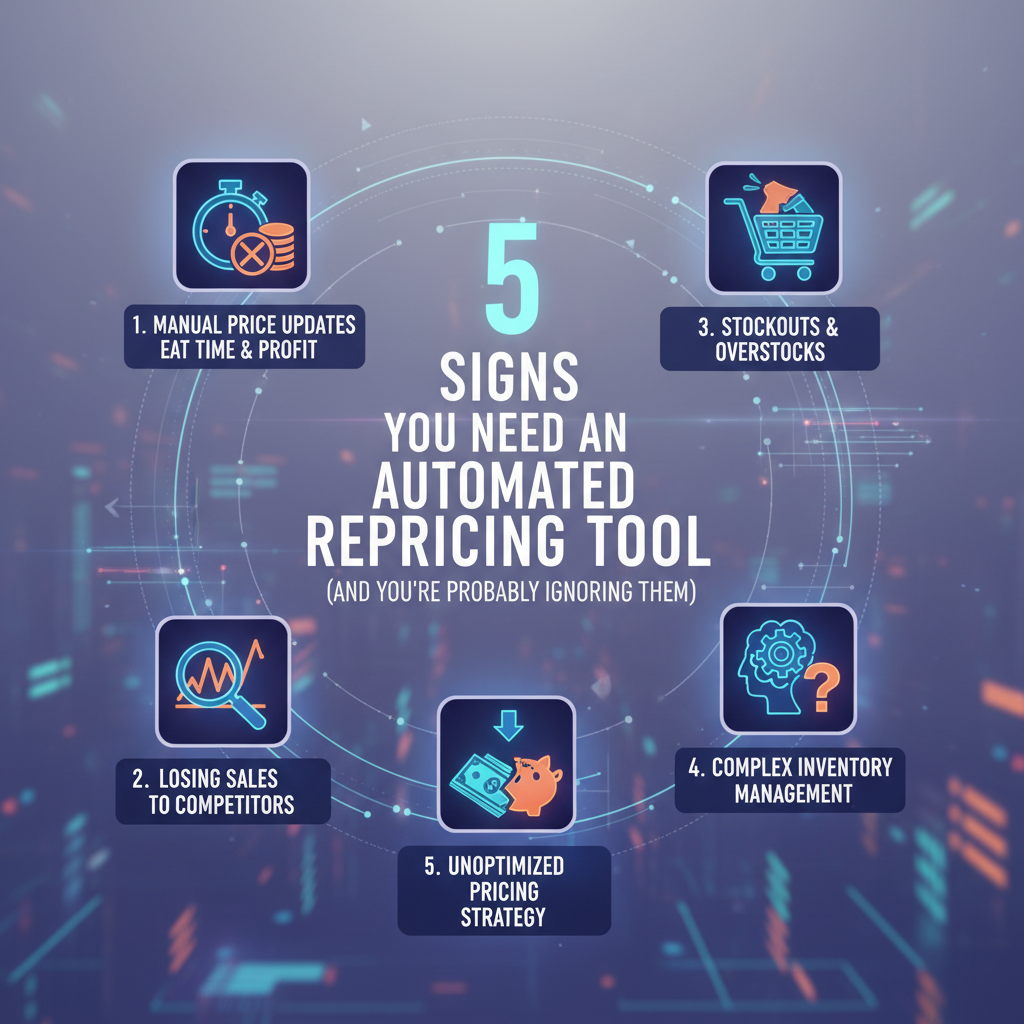
If you’ve been on the fence about automated repricing, these five signs should tell you everything you need to know. Recognize even one of them, and it’s time to make the switch.
Sign #1: Your Buy Box Win Rate Is Stuck Below 50%
Let’s start with the metric that matters most. Approximately 82-90% of all Amazon sales flow through the Buy Box. On mobile—where more shoppers browse every year—that percentage climbs even higher. If you’re not winning the buy box, you’re practically invisible.
The problem with manual repricing and Buy Box capture comes down to one word: speed.
When a competitor drops their price at 2 AM on a Tuesday, automated repricers respond within minutes. Manual sellers? They might not notice until the next afternoon—if they notice at all. During that gap, you’re hemorrhaging sales to competitors who showed up while you were away.
Warning Signs You’re Losing the Buy Box Battle
- Your Buy Box percentage hovers below 50% on competitive listings
- You notice competitors winning the Buy Box during evenings, weekends, or holidays
- You frequently discover competitor price changes hours or days after they happened
- You’re losing the Buy Box by just pennies on multiple products
Sellers who switch to automated repricing consistently report 15-40% improvements in buy box wins. That’s not a marginal gain—it’s transformational. More Buy Box wins mean more sales, and more sales compound into serious revenue growth.
Sign #2: You’re Spending 10+ Hours Weekly Adjusting Prices
Time is the hidden cost of manual repricing that most sellers dramatically underestimate.
Think about what manual repricing actually requires: checking competitor prices across all your listings, analyzing whether adjustments make sense, calculating the right price points, logging into Seller Central, making the updates, verifying they saved correctly—then doing it all again a few hours later because the market moved.
For a seller with just 50 SKUs trying to stay competitive, the math is brutal. Even a quick 5-minute check per product, done twice daily, adds up to over 8 hours. That’s obviously impossible to maintain, so corners get cut. Some products get attention; others get neglected. Gaps emerge. Profits leak.
The Real Cost: What You’re Not Doing
Every hour spent on manual repricing is an hour you can’t invest in activities that actually grow your business:
- Product sourcing: Finding your next profitable winner
- Supplier negotiations: Improving your cost basis
- Listing optimization: Converting more browsers to buyers
- PPC management: Maximizing your advertising ROI
- Customer service: Building the reviews and ratings that boost Buy Box eligibility
Sellers using automated repricing reclaim 10-20+ hours weekly. That time can go toward strategic work that creates lasting competitive advantage—or simply toward having a life outside your Amazon business.
Sign #3: Your Catalog Has Grown Past 50 SKUs
Manual repricing doesn’t scale. Period.
When you had 15 products, you could keep track of competitor prices in your head. You knew which listings needed attention and when. But somewhere around 50 SKUs, everything breaks down. The workload exceeds what any human can reasonably manage, and the consequences show up fast.
What Happens When You Can’t Keep Up
- Selective neglect: You focus on top sellers while lower-volume products drift into uncompetitive territory
- Inconsistent pricing: Some SKUs get updated daily, others weekly, others… when you remember
- Multiplying errors: More manual updates mean more opportunities for costly mistakes
- Artificial growth limits: You stop adding products because you can’t manage the pricing on what you already have
The challenge compounds if you sell across multiple Amazon marketplaces. Managing pricing manually on Amazon US is hard enough. Add UK, Germany, and Canada, and you’re looking at 4x the workload with currency fluctuations and regional competition thrown into the mix.
Automated repricing scales effortlessly. Whether you have 100 SKUs or 10,000, the system applies consistent strategy across your entire catalog without additional time investment from you.
Sign #4: Pricing Mistakes Are Eating Into Your Profits
Humans make errors. It’s not a character flaw—it’s biology. And manual repricing involves exactly the kind of repetitive, detail-oriented work where mistakes happen most often.
The errors come in several flavors, and all of them cost money:
Common Manual Repricing Mistakes
- Data entry disasters: Typing $2.49 when you meant $24.99 (yes, this happens more than sellers admit)
- Fee miscalculations: Forgetting to account for FBA fees, referral percentages, or storage costs
- Wrong product updates: Changing prices on the wrong listing, especially with similar variants
- Timing failures: Missing a competitor’s price drop for days, losing sales the entire time
- Strategic blunders: Matching a competitor who’s liquidating inventory at unsustainable prices
Automated systems eliminate these errors through consistency. They calculate prices using the same logic every time, factor in all relevant fees automatically, and execute updates via API without any manual data entry. Built-in safeguards like minimum price floors prevent catastrophic mistakes from ever going live.
If you’ve ever sold something at a loss because of a pricing error—or discovered you’d been overpriced for a week while competitors captured your sales—you already know why this matters.
Sign #5: Your Margins Are Shrinking While Sales Stay Flat
This might be the most insidious sign because it’s the hardest to notice until significant damage is done.
The pattern is familiar: a competitor drops their price, so you match them to keep the Buy Box. Another competitor undercuts, so you go lower. The cycle continues until everyone’s margins are razor-thin—and you’re not even sure you’re making money anymore.
Why Manual Repricing Leads to the Race to the Bottom
Without automated profit protection, sellers fall into predictable traps:
- Reactive matching: Responding to every competitor price change without considering whether it makes sense
- No profit floors: Nothing stopping you from pricing below your actual costs
- Poor competitive intelligence: Matching sellers who are liquidating, running promotions, or simply making bad decisions
- Hidden cost creep: Amazon fees change, supplier costs rise, but your pricing formulas stay the same
Modern automated repricers include sophisticated profit protection. They calculate your true landed cost—including all Amazon fees—and set dynamic minimum prices that guarantee your target margins. They identify competitors in liquidation mode and don’t match unsustainable prices. They optimize for total profitability rather than just winning the Buy Box at any cost.
Sellers using automated repricing with proper profit floors report 5-15% margin improvements. When your system actively protects profitability while maintaining competitiveness, the gradual margin erosion stops.
The ROI Reality: Can You Afford NOT to Automate?
The common objection to automated repricing is cost. Quality tools run anywhere from $50 to $300+ monthly depending on catalog size and features. That’s real money, especially for smaller sellers watching every expense.
But consider the math:
- A 15% improvement in Buy Box win rate typically drives 10-12% sales growth
- On $50,000 monthly revenue, that’s $5,000-6,000 in additional sales
- At 15% profit margin, you’re looking at $750-900 in extra monthly profit
- Minus the $200 repricer cost, you’re still up $550-700 per month—plus 15+ hours of time back
Most sellers see positive ROI within the first month. The payback period is typically 2-4 weeks.
Meanwhile, the cost of NOT automating includes lost sales from poor Buy Box capture, wasted hours on manual updates, pricing errors that drain profits, and the competitive disadvantage that grows wider every month as more of your competitors make the switch.
Automatic Repricing in Practice: Tying the Five Signs Together
Step back from the individual signs for a moment, and a pattern emerges: every single one of them traces back to the absence of automatic repricing. A stalled Buy Box win rate, hours lost to manual updates, a catalog that’s outgrown what one person can track, costly pricing mistakes, and shrinking margins are not five separate problems—they’re five symptoms of the same root cause.
Once automatic repricing is in place, the fix isn’t partial. The same system that keeps you winning the buy box around the clock is also the system eliminating data-entry errors, scaling cleanly past 50 SKUs, and enforcing the profit floors that stop margin erosion. It’s also worth remembering that the buy box algorithm itself keeps evolving, which means a static, one-time manual price rarely stays competitive for long even if it was correct the day you set it.
This is exactly the gap a properly configured repricer is built to close — not by reacting to one symptom at a time, but by addressing the underlying speed and consistency problem that manual pricing simply cannot solve at scale.
Time to Stop Leaving Money on the Table
If you recognized yourself in any of these five signs—struggling with Buy Box capture, drowning in manual price updates, outgrowing your catalog management capacity, making costly errors, or watching margins slip away—the message is clear. Manual repricing has become a liability, not just an inconvenience.
The sellers winning on Amazon today have moved past the question of whether to automate. They’re focused on optimizing their automation, squeezing every advantage from tools that work around the clock while they focus on strategic growth.
That’s exactly where Zupricer comes in. Built specifically to address these challenges, Zupricer delivers intelligent automated repricing that captures more Buy Box wins, protects your profit margins, scales effortlessly with your catalog, and eliminates the errors and time drain of manual pricing. Instead of fighting fires, you get to focus on building your business. Let Zupricer handle the prices—and let your competition wonder how you suddenly got so fast.