You sourced what looked like a profitable product. You ran the numbers. The margins looked solid. Then, somewhere between shipping your inventory to FBA and actually getting it live, the price cratered by 30%. Sound familiar?
This is the race to the bottom in action—and in 2025, it’s claiming more Amazon businesses than ever. With seller fees climbing, new tariffs hitting margins this August, and competition intensifying across nearly every category, the sellers who survive aren’t the ones who win every price war. They’re the ones smart enough not to fight them in the first place.
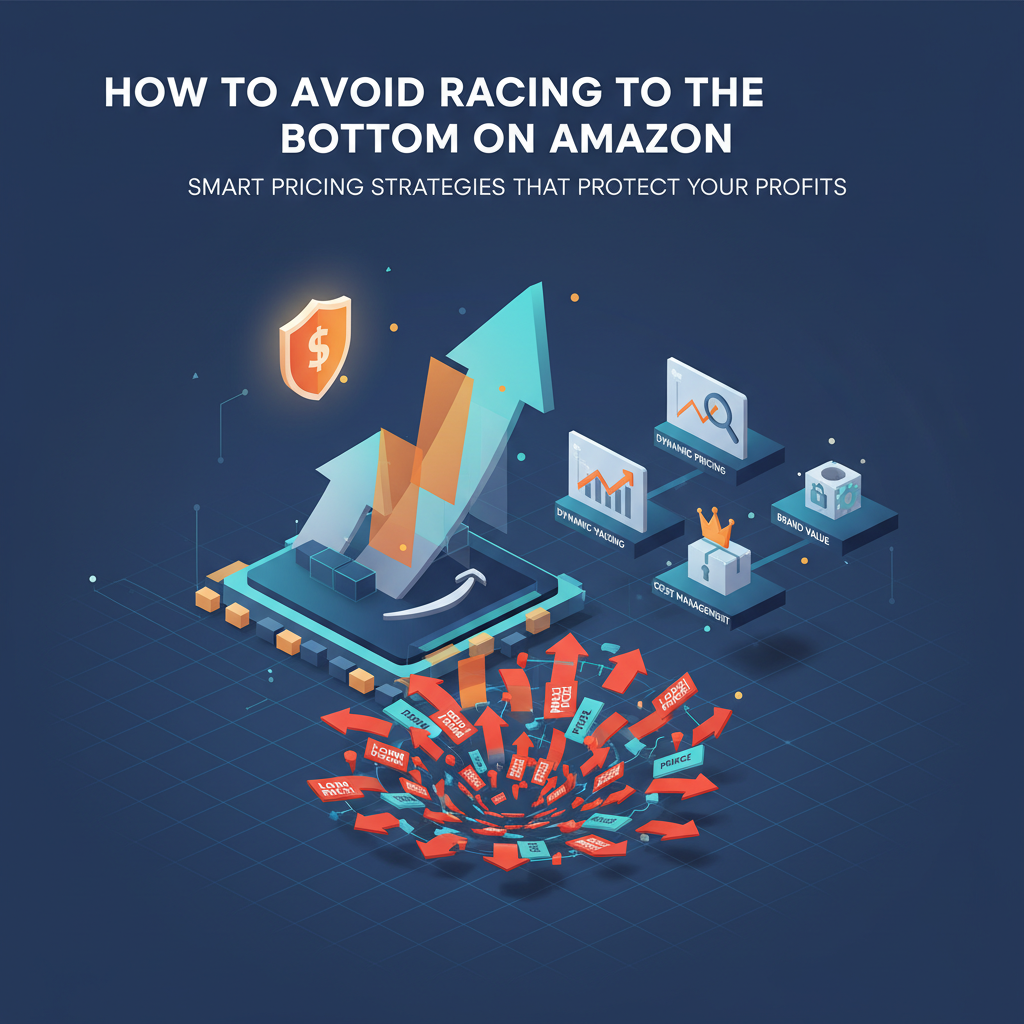
The race to the bottom happens when multiple sellers on the same listing continuously undercut each other to win the buy box. It’s a domino effect that destroys profitability for everyone involved. But here’s what most sellers don’t realize: this trap is entirely avoidable. You just need to stop playing by the wrong rules.
Why Sellers Get Trapped in the First Place
Understanding why the race to the bottom happens is the first step to avoiding it. Several forces push sellers into this destructive pattern:
- Buy Box obsession: The belief that you must win the Buy Box at any cost to generate sales
- Blind automated repricing: Tools configured to match or undercut competitors without strategic limits
- Competitive fear: Anxiety that raising prices means losing all sales entirely
- Short-term thinking: Prioritizing immediate volume over sustainable profitability
- Lack of differentiation: When products are identical, price becomes the only competitive lever
The financial damage goes far beyond immediate margin loss. Working capital gets trapped in low-margin inventory. Cash flow suffers despite decent sales volume. You can’t invest in growth, marketing, or product development. Eventually, the business simply can’t sustain operations—all because of pricing decisions that felt necessary at the time.
Set Strategic Price Floors (And Never Break Them)
Dynamic pricing remains essential in 2025, but the strategy has matured significantly. The focus has shifted from winning every Buy Box opportunity to winning profitable Buy Box opportunities. There’s a massive difference.
The most successful sellers configure their repricing with these priorities:
- Hard price floors: Calculate minimum acceptable prices that maintain target margins, including ALL costs—referral fees, FBA fees, storage, advertising, returns, and payment processing
- Customized pricing rules: Never rely on default settings that ignore profitability
- Defined competitive parameters: Specify which competitors to follow and which to ignore entirely
- Regular monitoring: Review performance and refine rules based on actual results
The critical mindset shift: accept temporary Buy Box loss rather than unprofitable sales. A sale that loses money is worse than no sale at all. Your price floor isn’t a suggestion—it’s the line that keeps your business alive.
Use Bundling to Escape Direct Competition
Product bundling has emerged as one of the most effective ways to sidestep price competition entirely. When you create a unique bundle, you’re not competing on an existing listing where everyone races to the bottom. You’ve created a new listing where you set the market price.
Effective bundle types include:
- Multi-packs: 3-packs or 6-packs of consumable items
- Product + accessory combinations: Main item with complementary add-ons
- Complete solution bundles: Everything needed for a specific task or project
- Variety packs: Different colors, scents, or variations together
- Starter kits: Beginner-friendly collections for new hobbyists or users
The strategic advantage is clear: bundling increases your average order value while making direct price comparison impossible. Combined with Subscribe & Save options, you can secure long-term customer loyalty and predictable revenue—two things that dramatically reduce your vulnerability to price wars.
Know Which Competitors to Ignore
Not all competitors deserve a response. In fact, following certain sellers will destroy your margins faster than anything else. Learn to identify who you’re actually competing against:
Competitors to avoid following:
- Liquidators: Sellers dumping inventory at any price just to exit
- Predatory pricers: Well-capitalized sellers deliberately triggering price wars to exhaust smaller competitors
- Desperate sellers: Those making irrational pricing decisions under financial pressure
- Short-term arbitrage sellers: They’ll be gone soon and aren’t sustainable competition
Competitors worth monitoring:
- Professional brands: Established sellers with consistent, sustainable strategies
- Market leaders: High-volume sellers with proven business models
- Strategic pricers: Those who maintain profitability while competing effectively
Sometimes the best strategy is to set your prices at a profitable level and wait for desperate competitors to run out of stock. Once they’re gone, you capture sales at margins that actually sustain your business. This requires patience—but patience is cheaper than bankruptcy.
Counter Predatory Pricing Tactics
Some sophisticated sellers actually weaponize the race to the bottom. They drop prices aggressively, knowing smaller competitors will follow. Those smaller sellers exhaust their inventory at thin margins, then the predator raises prices by 20-30% and captures the market while everyone else scrambles to restock.
You have three options when facing predatory pricing:
Option 1: Don’t participate. Maintain profitable pricing, accept the temporary sales decline, keep your inventory, and re-capture the market when the predator raises prices. You’ll have stock when they’ve trained the market to pay more.
Option 2: Strategic inventory management. Monitor competitor inventory levels, reduce your exposure during active price wars, and stockpile for the recovery period when margins return.
Option 3: Differentiation escape. Create unique bundles the predator can’t match. Build brand value that justifies higher pricing. Focus on a different customer segment entirely. Make price wars irrelevant to your business.
Win the Buy Box Without Being Cheapest
Here’s something many sellers don’t fully appreciate: the buy box algorithm considers multiple factors beyond price. This creates real opportunities to win without racing to the bottom.
Key non-price Buy Box factors to optimize:
- Fulfillment method: FBA provides significant Buy Box advantage over merchant-fulfilled
- Performance metrics: Order defect rate under 1%, late shipment rate under 4%, cancellation rate under 2.5%
- Inventory availability: Consistent stock levels signal reliability to Amazon’s algorithm
- Customer service: Response times under 24 hours, high resolution rates, positive feedback
- Listing quality: Professional images, A+ Content, detailed descriptions, video content
Many sellers obsess over price while completely neglecting these factors. By excelling at non-price elements, you can win the Buy Box at higher prices than competitors who focus solely on being cheapest. The math works in your favor when you stop fighting the wrong battle.
Adopt a Value-Based Pricing Mindset
The fundamental shift needed to escape the race to the bottom is moving from cost-plus pricing to value-based amazon pricing.
The old approach (leads to race to bottom):
- Calculate your costs
- Add desired margin
- Match or undercut competitors
- Watch margins erode
The value-based approach (maintains profitability):
- Identify customer pain points and needs
- Determine the value your product provides
- Price based on value delivered
- Differentiate to justify premium positioning
This requires investment in product differentiation, professional photography, compelling A+ Content, brand building, and customer service excellence. But these investments compound over time, creating competitive moats that price-cutters simply cannot cross.
Recent analysis confirms what smart sellers already know: pricing is the single highest-leverage profit lever available. A $2 price increase on a $25 product can add $1.70 net to your margin. That’s dramatically easier than cutting costs or increasing volume by equivalent amounts. But you can only access this lever if you’re not trapped in the race to the bottom.
Making the Shift Stick
Avoiding the race to the bottom isn’t a one-time decision—it’s an ongoing discipline. Track profit per unit, not just sales volume. Monitor your Buy Box win rate at profitable prices. Watch inventory turn rates and customer acquisition costs. Adjust strategy based on profitability metrics, not vanity metrics.
The sellers who thrive in 2025 understand something their struggling competitors don’t: the race to the bottom is optional. You can choose not to participate. You can set strategic floors and maintain them. You can differentiate, bundle, and build value that transcends price competition.
The question isn’t whether you can afford to stop racing to the bottom. The question is whether you can afford to keep participating.
This is exactly where Zupricer transforms how you approach Amazon pricing. Unlike basic repricing tools that chase every competitor into unprofitable territory, Zupricer is built around margin protection and intelligent competitive response. With customizable price floors, smart competitor filtering, and profit-first automation, Zupricer helps you stay competitive without sacrificing the margins your business needs to grow. Stop racing to the bottom—and start pricing for profitability with Zupricer.