Picture this: you go to bed with a $15 profit margin on your best-selling product. You wake up to discover your repricing tool dropped the price by 40% overnight while chasing a competitor who was liquidating inventory. Your margin? Gone. Your profit for the entire month? Damaged.
This nightmare scenario happens to Amazon sellers every single day—and it’s completely preventable. The culprit isn’t automated repricing itself. It’s repricing without proper guardrails.
Minimum and maximum price rules (also called floor and ceiling prices) are the boundaries that keep your repricing automation from going off the rails. With Amazon fees continuing to climb and new tariff pressures hitting margins this August, these rules aren’t just helpful—they’re the difference between a sustainable business and a cash-bleeding operation that looks busy but never turns a real profit.
The good news? Setting these rules correctly isn’t complicated. You just need to understand the math, the strategy, and the common pitfalls that trip up most sellers.
What Are Minimum and Maximum Price Rules?
Before diving into calculations, let’s clarify what we’re actually setting up:
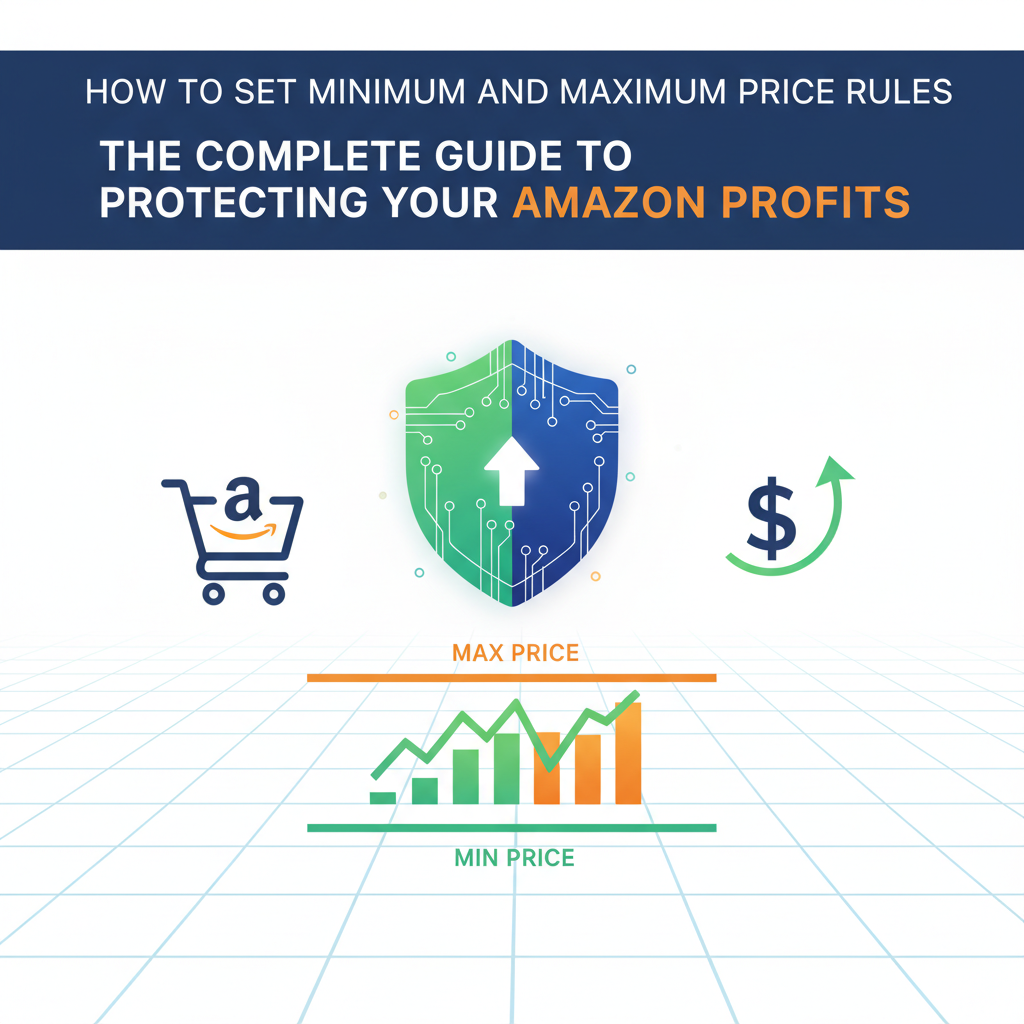
Minimum Price (Floor): The absolute lowest price you’re willing to accept for a product. This protects your profit margins from erosion and prevents your repricing tool from chasing competitors into unprofitable territory. Your floor is based on your cost structure and required margins—not what competitors are doing.
Maximum Price (Ceiling): The highest price you’ll list a product for. This prevents you from pricing so high that you lose all competitiveness, even during periods when competitors are out of stock. Your ceiling is based on market dynamics and customer price sensitivity.
Here’s what proper min/max rules give you:
- Automatic protection of profitability, even while you sleep
- Freedom from following desperate competitors into price wars
- Strategic boundaries that maintain business control with automation
- Long-term sustainability instead of volume without profit
Without these rules, automated repricing becomes a liability rather than an asset. Your tools work against you, driving prices below profitability and participating in destructive price wars you never agreed to join.
How to Calculate Your Minimum Price (Floor)
Your minimum price is the most critical number in your repricing strategy. Set it too high and you lose competitiveness. Set it too low and you destroy profitability. Here’s how to get it right.
Step 1: Calculate Every Cost Per Unit
Most sellers underestimate their true costs. Include everything:
Product and Inventory Costs:
- Wholesale or manufacturing cost per unit
- Shipping to Amazon FBA (inbound shipping prorated per unit)
- Prep and labeling costs
- Import duties or tariffs (especially relevant with current tariff changes)
Amazon Fees:
- Referral fee (typically 15% of sale price, varies by category)
- FBA fulfillment fee (varies by size and weight tier)
- Monthly storage fees (prorated per unit based on time in warehouse)
- Long-term storage fees if applicable
- Return processing fees for categories with free returns
Additional Costs Often Forgotten:
- Average advertising cost per unit (total PPC spend ÷ units sold)
- Return and damaged inventory rate (typically 2-5%)
- Software and tool costs prorated per unit
Step 2: Determine Your Required Margin
Industry benchmarks for healthy amazon margins in 2025:
- Minimum acceptable: 10-15% (survival mode—not sustainable long-term)
- Healthy target: 15-25% (sustainable growth territory)
- Optimal: 25-35% (strong profitability with room for investment)
Step 3: Apply the Formula
Here’s the calculation that accounts for percentage-based fees:
Minimum Price = (Total Fixed Costs) ÷ (1 – Referral Fee % – Desired Margin % – Returns %)
Example: Product cost $10.00 + FBA fulfillment $3.50 + storage $0.30 + advertising $2.00 = $15.80 in fixed costs. With a 15% referral fee, 20% desired margin, and 3% returns rate:
Minimum Price = $15.80 ÷ (1 – 0.15 – 0.20 – 0.03) = $15.80 ÷ 0.62 = $25.48
Round up to $25.99 for pricing psychology, and that’s your floor.
Common Calculation Mistakes That Destroy Margins
Even experienced sellers make these errors when setting price floors:
Forgetting percentage-based fees scale with price. Referral fees are calculated on the sale price, not your cost. When you lower your price, the dollar amount of the referral fee decreases, but the percentage stays constant. Your formula must account for this relationship.
Ignoring advertising costs. PPC spend is a real cost that must be covered by each sale. Calculate your average ad cost per unit by dividing total ad spend by total units sold. If you’re spending $2,000 on ads to sell 500 units, that’s $4 per unit that needs to be in your minimum price calculation.
Underestimating returns and damages. Even with FBA handling fulfillment, some percentage of units get returned or damaged. If you’re not tracking this, assume 3-5% and factor it into your pricing.
Overlooking seasonal storage spikes. Q4 storage fees are significantly higher than the rest of the year. Long-term storage fees can eliminate margins entirely on slow-moving inventory. Build a buffer into your minimum price to absorb these fluctuations.
Setting Your Maximum Price (Ceiling)
While the minimum price protects profitability, the maximum price keeps you competitive. Set it too high and you’ll never reach it—missing opportunities when competitors run out of stock. Set it appropriately and you capture premium pricing during favorable market conditions.
Approach 1: Competitive-Based Maximum
- Research the typical buy box price range for your ASIN
- Set your maximum at 10-20% above the typical competitive range
- This allows you to capture sales during low-competition periods without pricing so high you get zero sales
Approach 2: Value-Based Maximum
- Determine the perceived value your product delivers to customers
- Set maximum based on value rather than competition
- Works best for branded or differentiated products with strong listings
Approach 3: Profit-Optimized Maximum
- Test different price points to find where daily profit peaks
- Balance higher margins against lower sales velocity
- Requires ongoing testing and adjustment but maximizes total profit
Also remember Amazon’s own validation rules: your maximum price cannot exceed 6x the ASIN’s recent sales price, or $200—whichever is higher. Keep this in mind when setting ceilings.
Coordinating Amazon Limits with Your Repricing Tool
Here’s something many sellers don’t realize: Amazon Seller Central has its own min/max price validation that operates independently of your repricing software. You need both systems aligned.
Critical coordination steps:
- Set your repricing tool’s min/max prices based on your profitability calculations
- Ensure Amazon Seller Central’s min/max prices align with your repricing limits
- Account for shipping costs when setting Amazon’s limits (reduce your max price by shipping amount)
- Audit both systems monthly to ensure they remain consistent
If your repricing tool and Amazon’s limits don’t match, you can end up with prices that technically comply with one system but violate the other—creating errors and pricing inconsistencies.
Static vs. Dynamic Price Rules: Which Approach Works Best?
Static Rules use fixed minimum and maximum prices that don’t change regardless of market conditions. They’re simple to implement, predictable, and work well for stable product categories with consistent cost structures.
Dynamic Rules adjust based on market conditions—your minimum might be calculated as “cost + 15% margin” rather than a fixed dollar amount. When costs change, your floor automatically adjusts. These work better for volatile categories, seasonal products, and sellers with sophisticated data analysis capabilities.
The Hybrid Approach (Recommended): Combine both strategies. Set a hard minimum based on profitability requirements (static floor you never break), but use a dynamic maximum based on competitive range. Review and adjust quarterly, or immediately when cost structures change significantly.
Best Practices for Managing Your Price Rules
Review monthly at minimum. Cost structures change. Fees increase. Suppliers adjust pricing. A minimum price that protected margins three months ago might be losing money today. Set a calendar reminder to audit your price rules every month.
Update immediately when major changes occur. Amazon fee announcements, supplier cost changes, new tariffs, or major competitors entering/exiting the market all require immediate rule updates—not waiting for your monthly review.
Document your methodology. Write down exactly how you calculate minimum prices, what margin targets you use by category, and who has authority to change rules. This prevents confusion and ensures consistency, especially if you have team members or VAs involved in pricing decisions.
Monitor the right signals. If you’re constantly hitting your minimum price, it might be set too low for the competitive environment—or you’re in a market that can’t support your margin requirements. If you never reach your maximum price, you might be leaving money on the table during favorable conditions.
Applying Rules to Different Scenarios
High-competition commodity products: Set minimum at cost + 10-12% margin (accepting thinner margins for volume). Maximum at competitive median + 5%. Reprice frequently (30-60 minutes) and configure stop rules when minimum is reached.
Branded or differentiated products: Set minimum at cost + 20-25% margin (protecting premium positioning). Maximum based on value rather than competition. Reprice less frequently and focus on non-price Buy Box factors.
Seasonal products: Use tiered minimums that adjust as the season progresses—higher margins early season, gradually decreasing to liquidation margins as season ends. Build these rule changes into your calendar.
New product launches: Accept lower margins temporarily (cost + 5-8%) to build velocity and reviews. Set a firm exit date to increase minimums to sustainable target margins. Never let “temporary” launch pricing become permanent.
Conclusion: Turn Pricing Rules into Your Competitive Advantage
Setting proper minimum and maximum price rules transforms repricing from a potential liability into a genuine competitive advantage. You get the speed and responsiveness of automation without the risk of pricing yourself into losses. Your business operates within strategic boundaries you’ve consciously chosen, not boundaries dictated by whatever your competitors happen to do.
The sellers who thrive aren’t those winning every Buy Box opportunity—they’re those winning profitable Buy Box opportunities. That distinction is everything.
This is exactly where Zupricer delivers exceptional value. With intuitive minimum and maximum price configuration, margin-based rule options, and intelligent repricing that respects your profitability requirements, Zupricer ensures your pricing automation works for your business—not against it. Set your guardrails once, and let Zupricer handle the rest while protecting every dollar of margin you’ve calculated. Stop repricing blind, and start repricing with Zupricer.