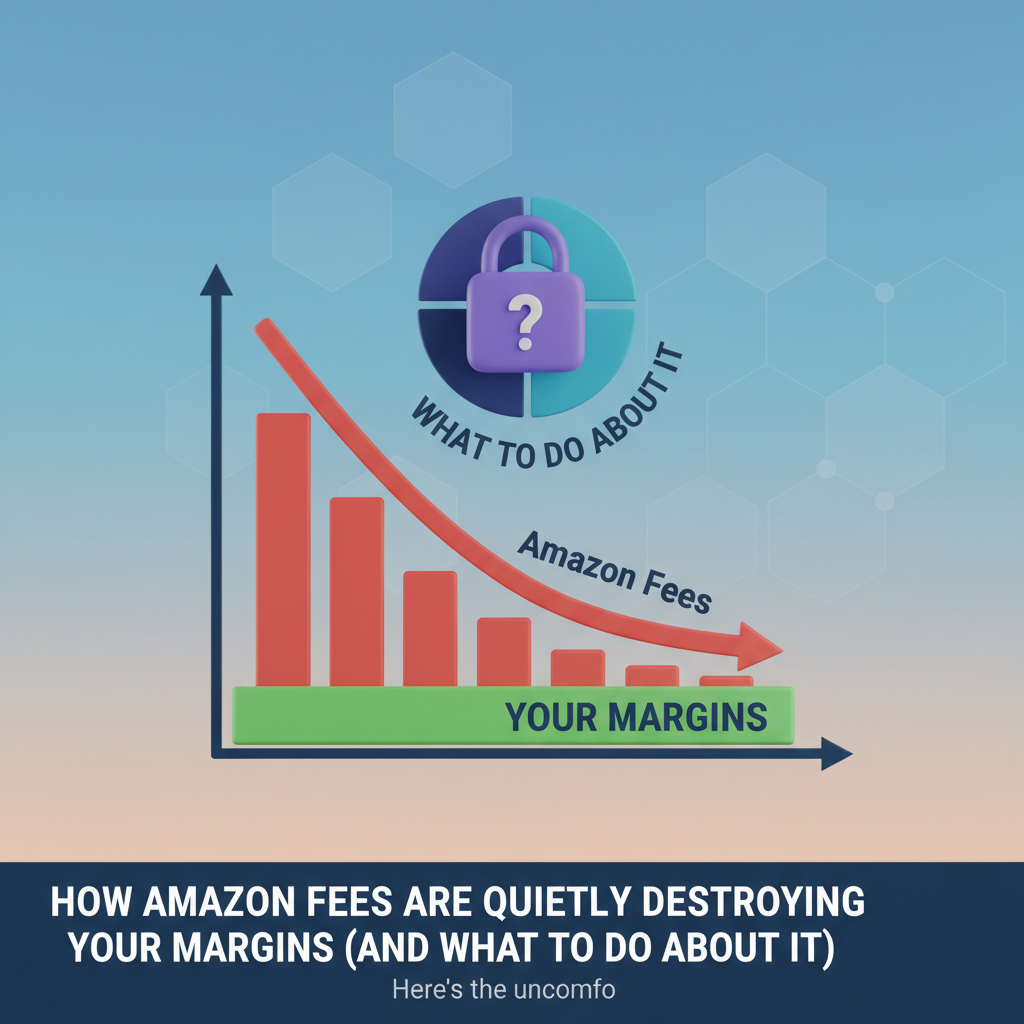
Here’s the uncomfortable truth that too many Amazon sellers learn too late: you can have great products, strong sales velocity, and glowing reviews—and still be losing money on every single unit you sell. The culprit? Fees that weren’t properly factored into your pricing strategy.
Amazon’s fee structure in 2025 has become increasingly complex. While the company announced a “fee freeze” on core fulfillment charges this year, that headline obscured a more complicated reality. New fees emerged, existing fees were restructured, and hidden charges continue to accumulate in ways that silently erode profitability. The sellers who thrive are the ones who understand exactly how every fee impacts their pricing—and adjust accordingly.
The math is unforgiving: every dollar in fees that isn’t offset by a price adjustment comes directly out of your profit margin. Yet raising prices isn’t always possible in competitive categories. This tension defines Amazon selling today, and navigating it successfully requires a sophisticated understanding of the fee-to-pricing relationship.
The Complete Fee Structure You’re Actually Paying
Most sellers know about referral fees and fulfillment fees. Far fewer understand the full scope of charges eating into their margins. Let’s break down everything you’re actually paying:
The Obvious Fees
- Referral fees: 8-15% of your sale price depending on category (non-negotiable, applies to everyone)
- FBA fulfillment fees: $3.22 to $10+ per unit based on size and weight tiers
- Monthly storage fees: $0.87 to $2.40+ per cubic foot, significantly higher during Q4
- Professional seller subscription: $39.99/month (must be prorated across units for accurate calculations)
The Hidden Fees That Accumulate
- Long-term storage fees: Penalties for inventory sitting over 365 days
- Aged inventory surcharges: Additional charges for slow-moving stock
- Low-inventory-level fees: Charges when stock falls below optimal thresholds
- Return processing fees: Per-unit charges when customers return items
- Refund administration fees: Percentage of refund amount you don’t recover
- Removal and disposal fees: Costs to retrieve or destroy unsold inventory
New sellers are frequently caught off guard by these hidden charges. A product that looked profitable on paper becomes a margin-killer once long-term storage fees, return processing, and refund administration costs are factored in.
How Fees Directly Impact Your Pricing Math
Fees affect your pricing in two critical ways that demand different strategic responses.
Impact #1: Your Price Floor Rises
Fees establish the absolute minimum price you can charge without losing money. Your break-even calculation must account for every fee:
Break-Even Price = (COGS + Fixed Costs) ÷ (1 – Referral Fee % – Variable Cost %)
When fees increase and you don’t adjust pricing, your break-even point rises. Products that were profitable become margin-negative. This is how sellers end up losing money on every sale without realizing it.
Impact #2: Margin Compression
Even if you remain technically profitable after fee increases, your margin percentage shrinks unless you raise prices proportionally. Consider this example:
- Original scenario: $30 sale price, $18 in costs/fees, $12 profit (40% margin)
- After $1.50 fee increase: $30 sale price, $19.50 in costs/fees, $10.50 profit (35% margin)
- Result: 5 percentage point margin compression without changing anything
This compression happens gradually and often goes unnoticed until margins have eroded to unsustainable levels.
The 2025 Fee Environment: What’s Really Happening
Amazon’s announced “fee freeze” for 2025 requires context. Yes, core FBA fulfillment fees were frozen at 2024 levels. Some referral fees in certain categories even decreased slightly. But the net effect varies dramatically by category and business model because new and restructured fees continue to emerge.
Strategic Price Thresholds Now Matter
One significant development: Amazon updated fulfillment fee calculations to include price brackets, not just size and weight. This creates strategic pricing thresholds where small price changes trigger different fee tiers.
Sellers are now repricing strategically around the $10 threshold—sometimes $9.99 outperforms $10.99 not just psychologically, but economically. Products in the $10-$50 range see fulfillment fee increases averaging $0.08 per unit when crossing certain price points.
Inbound Placement Adjustments
Starting January 2025, Amazon reduced inbound placement fees for high-volume and bulky products by $0.58 per unit. If you’re in those categories, this creates a strategic choice: maintain current pricing and pocket the improved margins, or reduce prices to gain competitive advantage.
Why Low-Price Products Face the Biggest Challenge
The fee structure fundamentally favors higher-priced products. Here’s the math that explains why:
Percentage-based fees (referral fees) scale proportionally—a 15% fee is 15% whether your product costs $10 or $100.
Fixed fees (fulfillment, storage) remain constant regardless of price. A $3.50 fulfillment fee represents 35% of a $10 product but only 3.5% of a $100 product.
Let’s run the numbers on a $12 product:
- Referral fee (15%): $1.80
- Fulfillment fee: $3.50
- Storage (prorated): $0.20
- Total fees: $5.50
- Remaining for COGS + profit: $6.50
If your COGS exceeds $4-5, this product is marginal or outright unprofitable. Low-price-point products require extremely tight cost control and high volume to be viable in the current fee environment.
Strategic Pricing Responses That Actually Work
Strategy 1: Optimize Around Fee Tiers
With price brackets now affecting fulfillment fees, test pricing just below thresholds. A product at $10.50 might perform better at $9.99—not just for conversion psychology, but because it saves $0.08 in fees. The $0.43 price reduction only costs $0.35 in actual revenue, and may increase conversion enough to improve total daily profit.
Strategy 2: Implement Margin-Based Dynamic Pricing
Instead of static prices, set minimum margin thresholds that account for current fees. Your repricing tool calculates the minimum acceptable price based on real-time costs. When fees change, prices automatically adjust to protect profitability.
Strategy 3: Optimize Your Product Mix
The fee structure favors certain product characteristics:
- Higher price points (fixed fees become smaller percentage)
- Smaller, lighter items (lower fulfillment fees)
- Fast-moving inventory (minimizes storage accumulation)
- Low-return categories (avoids return processing fees)
Evaluate your entire catalog through this lens. Discontinue products where fees make profitability impossible. Source new products optimized for the current fee structure.
Strategy 4: Time Your Inventory Strategically
Q4 storage fees are significantly higher than the rest of the year. This should factor into your pricing—higher prices during peak season aren’t just about demand, they’re about covering increased costs. Send inventory just before you need it. Minimize warehouse time during expensive periods.
Fee Optimization Beyond Pricing Adjustments
Smart sellers don’t just adjust prices to accommodate fees—they actively work to reduce fees themselves.
Size Tier Optimization
Product classification into size tiers dramatically affects fulfillment fees. Even small dimensional changes can shift tiers. Reducing packaging to drop from large standard to small standard tier might save $1.50 per unit—money that can fund lower prices or higher margins.
Inventory Velocity Management
Faster inventory turnover reduces storage fee accumulation. Consider aggressive pricing on slower SKUs, liquidation before long-term storage kicks in, and just-in-time inventory for predictable products. Smaller, more frequent shipments often cost less than sitting on aging inventory.
The Quarterly Review System You Need
Amazon updates fees multiple times per year, typically with 60-90 days notice. Static pricing in this dynamic environment is a recipe for margin erosion. Implement systematic quarterly reviews:
- Q1: Analyze Q4 fee changes impact, reset post-holiday pricing, optimize for lower storage fees
- Q2: Mid-year fee assessment, summer adjustments, Q4 inventory planning
- Q3: Pre-holiday strategy, Q4 storage fee preparation, margin protection planning
- Q4: Monitor elevated storage costs, peak season optimization, plan Q1 adjustments
When fee changes are announced, immediately recalculate break-even prices for all products. Identify the SKUs most impacted. Develop your pricing response before changes take effect—not after your margins have already been hit.
The Competitive Response Trap
When fees increase, your competitors face the same pressure. But not all respond intelligently. Some raise prices proportionally (follow them). Some absorb increases hoping to gain market share (evaluate their sustainability). Some are liquidating inventory and will be gone in weeks (ignore them entirely).
The mistake is following competitors blindly. They may not understand their true costs. They may be operating at a loss. Price based on your economics, not competitor ignorance. Use repricing rules that identify and exclude obvious liquidators from your competitive set.
Conclusion: Fee Awareness Is Profit Protection
The relationship between amazon fees and pricing strategy couldn’t be more direct: every fee dollar that isn’t offset by pricing comes straight from your profit. There’s no escaping this math—only strategic choices about how to respond.
The sellers who maintain profitability in 2025’s fee environment share common practices: they calculate comprehensively (including amazon fees), monitor continuously (fees change regularly), optimize strategically (reducing fees where possible), and review systematically (quarterly at minimum).
This is precisely why tools like Zupricer have become essential for serious Amazon sellers. With intelligent repricing that accounts for your complete fee structure, minimum margin protection, and real-time adjustments as costs change, Zupricer ensures your pricing strategy actually reflects your economics—not guesswork. Stop letting fees silently destroy your margins. Let Zupricer build fee awareness directly into every pricing decision you make.