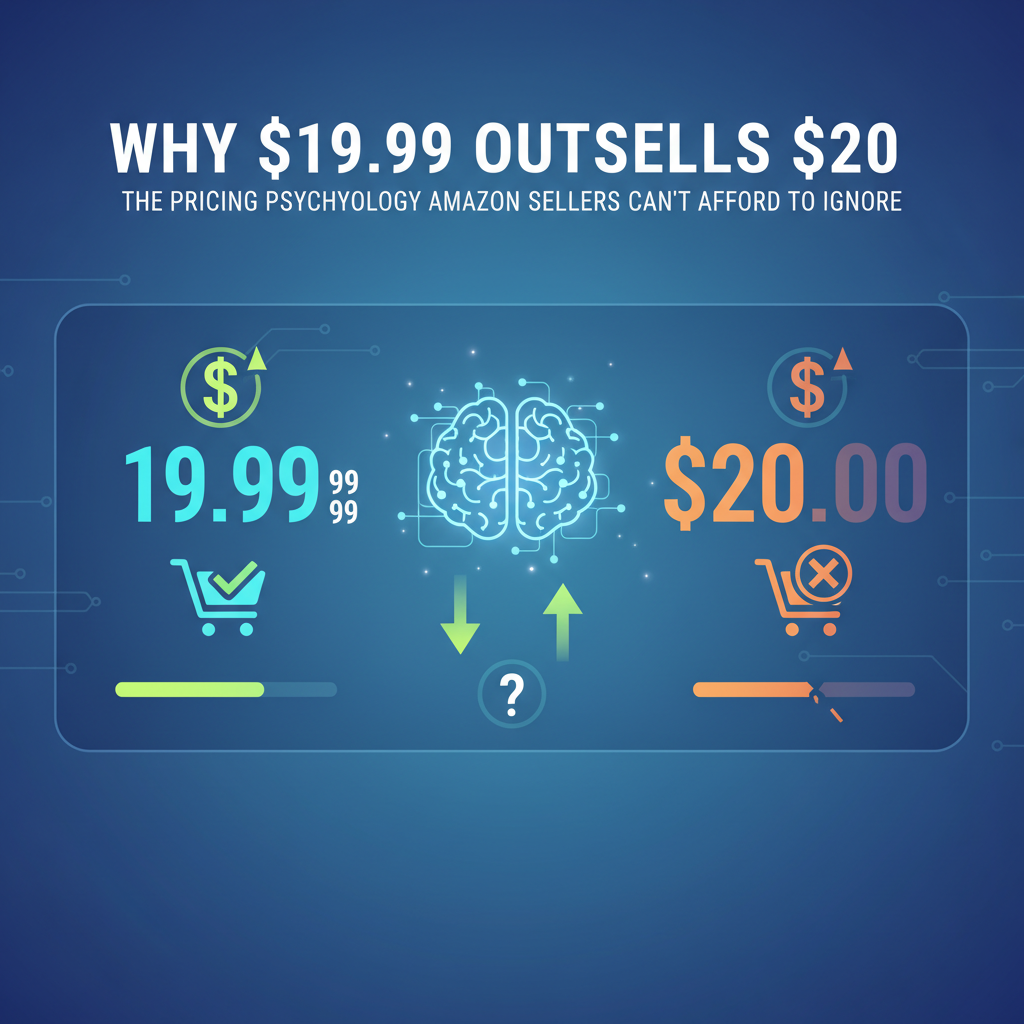
Here’s a question that should keep you up at night: why do two identical products, priced just one cent apart, convert at dramatically different rates? The answer lies in the messy, irrational, beautifully predictable realm of human psychology—and understanding it is worth a 10-25% revenue increase according to Harvard Business Review research from 2025.
Most Amazon sellers treat pricing as a math problem. Calculate costs, add desired margin, check competitor prices, done. But this approach ignores a fundamental truth about how humans actually make purchasing decisions. Customers don’t see numbers—they see stories. They feel emotions. They make snap judgments in milliseconds, then spend the next few seconds constructing rational justifications for decisions their brains already made.
The sellers crushing it on Amazon right now understand something their competitors don’t: price is a communication tool, not just a number. Every digit you choose sends a message about quality, value, and urgency. Get it right, and browsers become buyers. Get it wrong, and you’re invisible—or worse, you’re the option that “feels” overpriced even when you’re objectively cheaper.
The Science of How Buyers Actually See Prices
Your brain processes prices the same way it reads sentences—left to right. This creates what researchers call the “left-digit effect,” and it’s more powerful than most sellers realize.
When a customer sees $19.99, their brain anchors to that first digit: “nineteen.” When they see $20.00, they anchor to “twenty.” The difference is a single penny, but the perceived difference is an entire magnitude. The University of Chicago confirmed this in 2025 research showing that charm pricing increases conversion rates by 8-12% for products under $100.
This happens in milliseconds—before any conscious thought occurs. The emotional reaction to the price precedes the rational evaluation. By the time a customer is reading your bullet points or comparing features, they’ve already formed an impression of whether your product is “expensive” or “affordable.”
What This Means for Your Pricing Strategy
- $19.99 genuinely feels cheaper than $20.00 despite being virtually identical
- $99 creates a psychological barrier that $100 crosses into “expensive” territory
- $4.95 keeps you in the “$4 range” while $5.00 moves you to a new mental category
This isn’t subtle manipulation—it’s how human cognition works. Fighting it is pointless. Leveraging it is profitable.
Charm Pricing: Why .99 Still Dominates in 2025
You’d think customers would have caught on by now. Everyone knows the .99 trick, right? Yet it continues to work because the left-digit effect isn’t a conscious choice—it’s hardwired. Knowing about the illusion doesn’t make it disappear.
Current data shows charm pricing remains one of the most effective psychological tactics available to Amazon sellers. The 8-12% conversion rate improvement for sub-$100 products is too significant to ignore, especially in competitive categories where margins are tight.
When Charm Pricing Works Best
- Mass-market products where price sensitivity is high
- Impulse purchases that don’t require extensive research
- Products under $100 where the left-digit effect is strongest
- Competitive categories where small perception shifts matter
When to Skip the .99
Charm pricing can actually backfire for luxury or prestige products. That .99 ending signals “bargain” and “discount”—exactly the opposite of what premium brands want to communicate. If you’re selling a $200 artisanal product, $200.00 conveys quality in a way $199.99 undermines. Round numbers signal confidence and premium positioning.
Amplifying Charm Pricing
Smart sellers don’t use charm pricing in isolation. Research confirms that combining charm pricing with limited-time offers or coupons strengthens buyer urgency, creating faster conversions. A $19.99 price tag plus a Lightning Deal countdown plus an “Only 5 left” message creates multiple psychological triggers firing simultaneously—each amplifying the others.
Anchor Pricing: Making Your Price Feel Like a Steal
Anchoring is perhaps the most powerful psychological principle in pricing. The concept is simple: expose customers to a high reference point first, and your actual price feels like a bargain by comparison.
According to 2025 research in the Journal of Marketing Research, anchor pricing increases perceived value by 22-35% compared to displaying only the sale price. That’s not a minor improvement—it’s the difference between customers feeling like they’re paying full price versus feeling like they’re getting a deal.
How Amazon Enables Anchor Pricing
- Strikethrough pricing: The “was $X, now $Y” format is Amazon’s most powerful anchor mechanism
- List Price reference: Shows your MSRP as the anchor, with current price below
- Coupon badges: Display savings against your regular price
- Historical price tracking: Amazon sometimes shows “Was: $X” based on your past pricing
The Ethical Anchor Approach
Here’s where many sellers go wrong: they inflate their “original” price to make discounts look more impressive. This violates Amazon’s policies, erodes customer trust, and ultimately backfires. The smart approach is different.
Instead of asking “what’s the highest anchor I can get away with,” ask “what pricing structure best communicates my product’s value while maximizing profit?” Ground your reference price in legitimate MSRP or actual sales history. Use periodic promotions to create genuine perceived value. The anchor should be real—customers aren’t stupid, and fake discounts damage your brand long-term.
The Decoy Effect: Engineering Customer Choice
The decoy effect is subtle, powerful, and underutilized by most Amazon sellers. It works by introducing a third option that makes your target product look like the obvious choice.
How Decoy Pricing Works
Present three variations:
- Basic option: $29.99 with minimal features
- Decoy: $49.99 with slightly better features (disproportionately expensive)
- Premium target: $59.99 with significantly better features
Customers compare the premium option to the decoy. They see that for just $10 more than the mediocre middle option, they get substantial improvements. The premium suddenly looks like the smart choice—even though without the decoy, many would have chosen the basic option.
Amazon-Specific Applications
Multi-pack variations are perfect for decoy pricing:
- Single unit: $19.99
- 2-pack (decoy): $35.99 ($17.99 each—minimal savings)
- 3-pack (target): $49.99 ($16.66 each—clearly better value)
The 2-pack exists primarily to make the 3-pack look like the intelligent choice. This is related to the “compromise effect”—consumers naturally gravitate toward middle options, perceiving them as the safest, most balanced choice. Structure your variations to make your highest-margin option the obvious middle ground.
Scarcity and Urgency: The FOMO Factor
Loss aversion is one of the most powerful forces in human psychology. We’re wired to fear missing out more than we desire gaining something new. Amazon’s interface is designed to leverage this through multiple urgency mechanisms.
Amazon’s Built-In Urgency Triggers
- “Only X left in stock” creates immediate scarcity anxiety
- “Order within X hours” for delivery deadlines adds time pressure
- Lightning Deal countdowns combine limited quantity with limited time
- Coupon expiration dates create artificial deadlines
- “78% claimed” indicators show social proof plus scarcity
Strategic Implementation
“Only 3 left” is dramatically more powerful than “Only 47 left.” Low numbers trigger immediate action because the perceived competition for a scarce resource is more intense. When combined with charm pricing and promotional messaging, these triggers compound—each element amplifying the psychological impact of the others.
However, a critical warning: permanent urgency tactics destroy credibility. If everything is always “limited time” and every deal is “ending soon,” customers learn to ignore your signals. Use scarcity genuinely and rotate tactics to maintain effectiveness.
Trust Signals and Price Perception
Here’s something many sellers miss: price perception doesn’t exist in isolation. The same $39.99 price tag feels completely different depending on context. A product with 4.8 stars and 2,000 reviews at $39.99 feels like fair value. The same product with 12 reviews at $39.99 feels risky—maybe overpriced.
What Affects Price Perception
- Review count and rating: High social proof enables premium pricing
- Amazon’s Choice badge: Signals algorithm endorsement, reduces price resistance
- Best Seller rank: Social proof that others chose this product
- Prime eligibility: Commands 10-15% price premium over non-Prime options
- Photography quality: Premium images justify premium prices
This creates a strategic challenge for new products. Without social proof, you struggle to command premium prices. But without volume, you can’t build social proof. Many successful sellers launch at lower prices to build velocity and reviews, then gradually increase pricing as trust signals accumulate.
Category-Specific Psychology
Different product categories respond to different psychological triggers. What converts in electronics may fail in luxury goods.
Electronics and Gadgets
Charm pricing works powerfully here. Technical specifications help justify premium positioning. Bundle psychology (accessories included) increases perceived value. Limited edition messaging creates urgency for new releases.
Beauty and Personal Care
Prestige pricing works for luxury brands—round numbers signal quality. Bundle pricing is extremely effective (skincare routines, hair care sets). Subscription psychology works for regular-use items. Comparison to salon prices creates powerful anchors.
Home and Kitchen
Set and bundle pricing dominates. Charm pricing is universal. Decoy effects work well with size variations. Durability and quality claims justify premium positioning.
The Testing Imperative
Pricing psychology isn’t set-it-and-forget-it. What works changes based on season, competition, and evolving customer expectations. Q4 holiday shopping shifts psychology toward gift-giving (prestige pricing works better, bundle appeal increases). Q1 post-holiday shifts toward value-seeking (charm pricing more effective, liquidation psychology acceptable).
Test systematically: $19.99 vs. $20.00, different anchor levels, promotion frequency and depth. Measure conversion rate as your primary metric, but also track total profit per day (conversion × margin) to ensure you’re optimizing for the right outcome.
Conclusion: Psychology-Driven Pricing Requires Psychology-Aware Tools
Understanding pricing psychology is essential, but implementing it at scale across hundreds or thousands of SKUs is a different challenge entirely. You can know that $19.99 outperforms $20.00, that anchoring increases perceived value by 22-35%, and that scarcity triggers compound with charm pricing—but manually optimizing every product to leverage these principles is impractical.
This is precisely why sophisticated sellers turn to Zupricer. Our intelligent repricing system doesn’t just match competitor prices—it understands the psychological principles that drive conversion. From optimizing price endings to strategic positioning within competitive sets, Zupricer ensures your pricing communicates the right message to every customer, every time. Because in a marketplace where perception is reality, your pricing tool should understand psychology as well as mathematics. That’s the Zupricer difference.