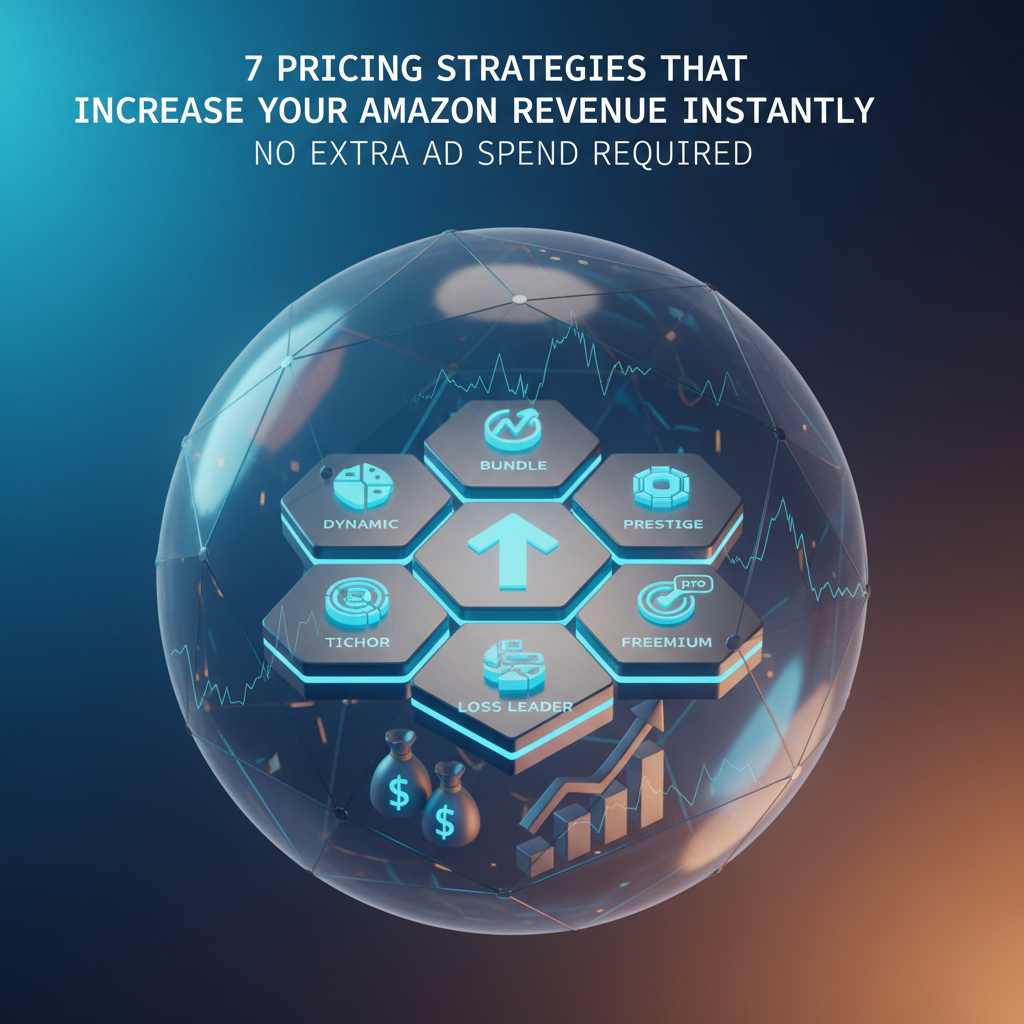
Here’s something most Amazon sellers get wrong: they think growing revenue requires spending more on advertising, sourcing new products, or somehow magically attracting more traffic. But the fastest path to revenue growth is sitting right in front of you—it’s your pricing strategy.
Businesses implementing smart pricing tools in 2025 are seeing up to 10% revenue boosts and 15% improvements in profit margins. Not over months. Not after expensive consultants. These results happen within days, sometimes hours, of making strategic pricing changes.
The truth is, you’re probably leaving thousands of dollars on the table every month because of how your products are priced—not because the prices are wrong, but because you’re not using pricing strategically. Let’s fix that.
Why Revenue-Focused Pricing Matters Right Now
Before we dive into tactics, let’s be clear about what we’re optimizing for. Revenue growth isn’t the same as profit maximization. Sometimes you need cash flowing in—for inventory purchases, to hit stakeholder targets, or because Amazon’s algorithm rewards sales velocity. When revenue is the priority, these strategies deliver.
The key insight: instant revenue growth comes from optimizing what you already have. Your existing traffic, your current products, your established customer base. Strategic pricing adjustments extract more value from every visitor who’s already finding your listings.
Strategy #1: Dynamic Pricing for Buy Box Dominance
If you’re not winning the Buy Box, you’re not really selling. Winning the Buy Box can increase your sales by 300-500%—and dynamic pricing is how you capture it consistently without racing to the bottom.
How It Works
Dynamic pricing automatically adjusts your prices based on real-time market conditions:
- Competitor goes out of stock? Your price rises to capture the premium window
- Competitor drops price? You adjust just enough to stay competitive
- High-demand period detected? Prices optimize for maximum revenue capture
The math is compelling: if your product currently generates $10,000 per month with a 40% Buy Box win rate, increasing that to 70% through dynamic pricing means an instant $3,000 monthly revenue boost—with zero additional ad spend.
Implementation
Set your pricing rules with clear boundaries: minimum price equals your cost plus acceptable margin (protect your floor), maximum price reflects the true value ceiling. Then let automation do the heavy lifting while you focus on other parts of your business.
Strategy #2: Psychological Pricing That Converts
Psychological pricing works because human brains are predictably irrational about numbers. These tactics improve conversion rates on your existing traffic—pure revenue gain with no price reduction required.
Charm Pricing
Change $30 to $29.99. Simple, but research shows it delivers 8-12% conversion rate increases on products under $100. Your customers perceive “$29” even though they’re paying essentially the same amount.
Anchor Pricing
Show a reference price alongside your actual price. Instead of just “$39.99,” display “~~$59.99~~ $39.99” to create perceived value. Studies show this increases perceived value by 22-35%—same actual price, higher conversion rate.
Decoy Pricing
This one’s clever. Structure your product options like this:
- Single unit: $19.99
- 2-pack: $37.99 (the decoy—minimal savings)
- 3-pack: $49.99 (the target—clear value)
Without the decoy, 80% of customers buy singles. With it, 40% shift to the 3-pack. On 100 customers, that’s a revenue jump from $2,599 to $3,379—a 30% instant lift.
Strategy #3: Strategic Product Bundling
Bundling increases what each customer spends per transaction without requiring new customer acquisition. It’s one of the fastest AOV (Average Order Value) boosters available.
Bundle Structures That Work
Curated bundles combine a main product with complementary accessories—the “complete kit” approach. A yoga mat alone sells for $39.99. Bundle it with a block and strap for $64.99, and customers see clear value (individual items total $74.97). You’ve just increased revenue per customer by $25.
Volume bundles offer quantity discounts that push customers toward larger purchases:
- 1-pack: $24.99
- 3-pack: $64.99 ($21.66 each)
- 6-pack: $119.99 ($20 each)
Even modest bundle adoption—say 20% of customers choosing the 3-pack instead of singles—drives a 5% overall revenue lift. Create the bundle listing today; revenue impact shows within 24-48 hours.
Strategy #4: The Free Shipping Threshold Trick
This might be the fastest revenue increase you can implement. If you currently offer free shipping on all orders, you’re missing an easy win.
Here’s the formula: calculate your current AOV, then set your free shipping threshold 15-25% above it. If customers average $45 per order, set the threshold at $55.
What happens next is predictable: customers hate “losing” free shipping more than they dislike spending extra money. Research shows 60% of customers will add items to reach the threshold, averaging $12 in additional purchases.
The math: 1,000 monthly customers × 60% adding items × $12 average addition = $7,200 in instant monthly revenue increase. Display a progress bar showing “Add $8.50 to qualify for free shipping!” and watch it work.
Strategy #5: Tiered Pricing Architecture
The Good-Better-Best framework guides customers toward higher-value purchases while keeping entry points for price-sensitive buyers.
The Structure
- Basic tier ($29.99): Entry price point, core functionality only
- Premium tier ($49.99): 40-60% higher, additional features, positioned as “best value”
- Deluxe tier ($89.99): 2-3x basic, comprehensive package
Why It Works
The deluxe tier makes premium look reasonable. Most customers gravitate toward the middle option—which is significantly higher than what you’d earn from a single-tier offering.
Without tiering: 100 customers × $39.99 = $3,999 revenue
With tiering: 40 choose basic + 45 choose premium + 15 choose deluxe = $4,798 revenue
That’s a 20% revenue increase from the same number of customers.
Strategy #6: Time-Limited Urgency Pricing
Urgency converts browsers into buyers. Lightning Deals and flash sales leverage FOMO (fear of missing out) to accelerate purchase decisions.
The numbers tell the story: a product selling 20 units daily at $45 generates $900. During a Lightning Deal at $38, that same product might sell 85 units for $3,230—a 259% daily revenue increase.
Scarcity messaging works similarly. “Only 3 left in stock” or “12 people viewing this item” increases conversion rates by 15-30%. Implement stock counters on high-traffic products and watch revenue climb.
Important caveat: don’t overuse urgency tactics. Constant promotions train customers to wait for deals and damage brand perception. Strategic, occasional urgency delivers the biggest impact.
Strategy #7: Subscribe & Save for Recurring Revenue
For consumable products, Subscribe & Save transforms one-time purchases into predictable recurring revenue streams.
Compare the models: A one-time purchase at $30 with a 10% chance of repeat = $33 total customer value. But a Subscribe & Save customer at $27 (10% discount) who averages 5 deliveries before canceling? That’s $135 in customer lifetime value—a 309% increase.
Setup is straightforward, the first subscriptions start capturing immediately, and revenue compounds monthly as your subscriber base grows.
Your Implementation Roadmap
The difference between sellers who grow and those who stagnate isn’t knowledge—it’s execution speed. Here’s how to capture revenue this week:
Day 1: Implement charm pricing across your catalog, set a free shipping threshold 20% above current AOV, and enable automated repricing with margin floors. Expected impact: 5-8% revenue lift.
Days 2-3: Create your first product bundles, add anchor pricing to listings, and implement tiered pricing on key products. Expected additional impact: 8-12% cumulative lift.
Week 1: Test a Lightning Deal, implement quantity discounts, and add cross-sell automation. Expected total impact: 15-25% revenue increase.
Track your results religiously: total revenue, AOV, conversion rate, Buy Box win rate. These metrics tell you what’s working and where to double down.
The Execution Gap
Most sellers read articles like this, nod along, and then… do nothing. They return to manually checking competitor prices, guessing at optimal price points, and leaving money on the table.
The sellers who win in 2025 implement fast, test constantly, and use automated systems for consistent execution. They understand that every day without these strategies in place is revenue lost forever.
That’s exactly why we built Zupricer. Our intelligent repricing platform automates the strategies outlined here—dynamic Buy Box capture, margin protection, competitive positioning—while you focus on growing your business. Because understanding pricing strategy is valuable, but executing it consistently at scale is where real revenue gets made. Stop leaving money on the table and let Zupricer put these revenue-boosting strategies to work for you automatically.