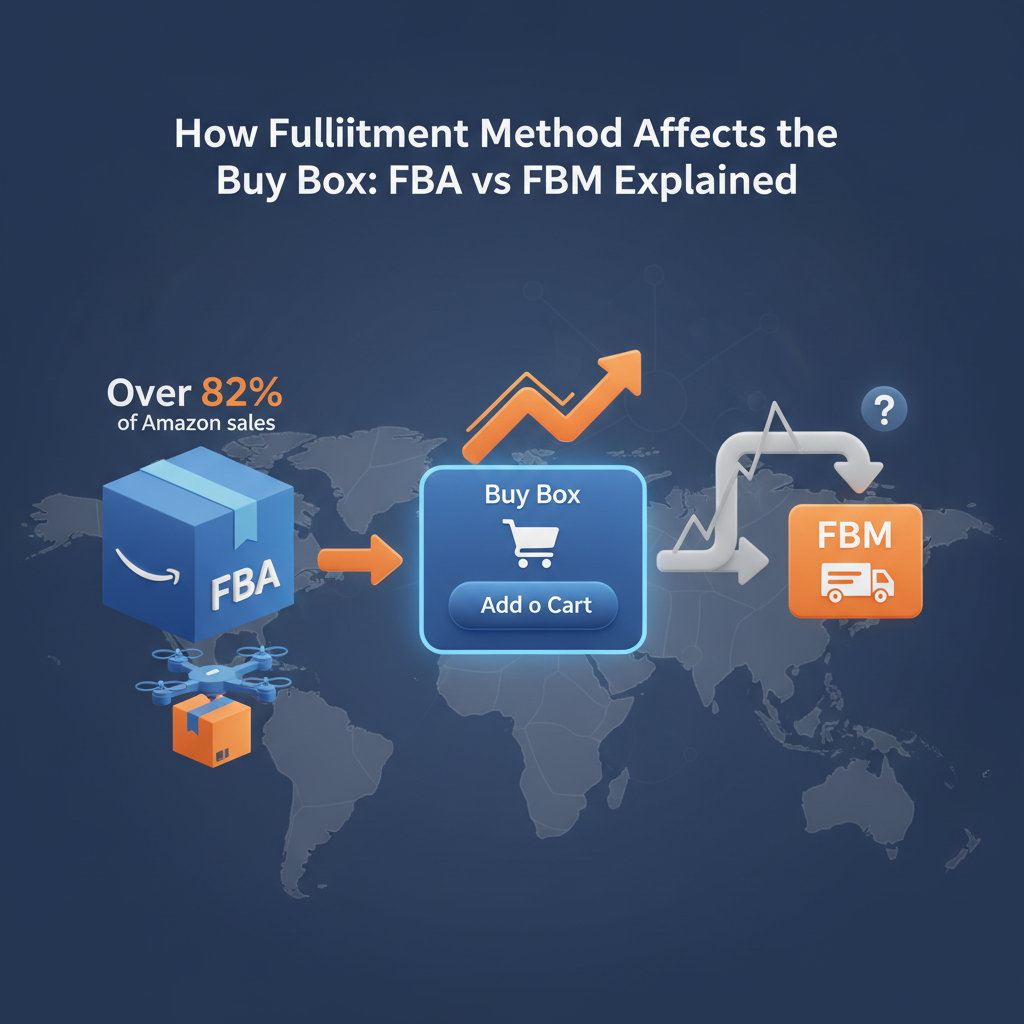
Over 82% of Amazon sales flow through that little “Add to Cart” button we call the Buy Box. If you’re not winning it, you’re essentially invisible to the majority of shoppers.
But here’s what many sellers get wrong: they think winning the Buy Box is purely about having the lowest price. It’s not. Your fulfillment method plays a massive role in whether Amazon’s algorithm chooses your offer over a competitor’s—sometimes even when your price is higher.
Understanding exactly how FBA, FBM, and Seller Fulfilled Prime affect your Buy Box eligibility isn’t just helpful. It’s essential for making smart decisions about your entire business model. Let’s break down what the buy box algorithm actually rewards and how you can position your fulfillment strategy for maximum Buy Box share.
The Four Pillars of Buy Box Evaluation
Before diving into fulfillment specifics, you need to understand the complete picture. Amazon’s Buy Box algorithm evaluates sellers across four weighted categories:
- Fulfillment Method – How products are shipped and delivered to customers
- Landed Price – Total cost including product price and shipping fees
- Seller Performance Metrics – Your account health indicators and track record
- Stock Availability – Inventory levels and consistency of supply
No single factor guarantees Buy Box ownership. The algorithm performs a holistic evaluation, weighing all these elements together. That said, fulfillment method carries significant weight—and choosing the right approach can give you a substantial competitive edge.
Why FBA Sellers Have a Significant Advantage
Let’s be direct: FBA sellers have a documented advantage in Buy Box competition. At equal pricing, the FBA seller wins the Buy Box almost every time. But it goes further than that.
FBA sellers regularly win the Buy Box even when their price is slightly higher than FBM competitors. An FBA seller priced 5% higher than an FBM seller will often still capture the Featured Offer. The algorithm values fulfillment reliability and speed, and FBA delivers both automatically.
Here’s why FBA carries so much weight:
- Automatic Prime badge eligibility – Prime customers see your offer as preferred
- Faster processing and delivery – Amazon’s logistics network is hard to beat
- Higher customer trust – Shoppers know what to expect from Amazon fulfillment
- Better conversion rates – Prime-eligible listings convert at higher rates
- Guaranteed fulfillment quality – Amazon handles the customer experience
For small, lightweight, high-velocity items, FBA often makes the most sense. The Prime badge drives conversions, and the Buy Box advantage helps you capture more sales even at slightly higher price points.
The Cost Reality of FBA
FBA isn’t free, and costs have been climbing. Fulfillment fees continue to increase, with small standard items seeing particularly significant jumps. Monthly storage fees add up, especially for slow-moving inventory. For products with thin margins or inconsistent sales velocity, FBA fees can eat into profitability quickly.
The question isn’t whether FBA provides Buy Box advantages—it clearly does. The question is whether those advantages justify the costs for your specific products.
Can FBM Sellers Actually Win the Buy Box?
Yes. FBM sellers absolutely can win the Buy Box. But the requirements are higher.
If you’re fulfilling orders yourself, you need exceptional performance metrics, competitive pricing, and reliable shipping operations. FBM is no longer automatically disadvantaged—but only if your delivery performance genuinely matches FBA standards.
The metrics you need to maintain as an FBM seller:
- Order Defect Rate (ODR) – Aim for under 0.5%, well below the 1% threshold
- Late Shipment Rate (LSR) – Keep it under 2%
- On-Time Delivery Rate (OTDR) – Target above 97%
- Valid Tracking Rate – Must be excellent across all shipments
Here’s the challenge: if your prices are significantly higher than FBA competitors, you’ll struggle to win the Buy Box regardless of your metrics. FBM sellers need to be more price-competitive to offset the fulfillment advantages that FBA provides automatically.
FBM works best for specific product types: large, bulky items where FBA fees would destroy margins; slow-moving inventory that would accumulate storage fees; high-margin products where you can afford competitive pricing while maintaining profitability; and products requiring special handling that FBA can’t accommodate.
Seller Fulfilled Prime: The Middle Ground
Seller Fulfilled Prime (SFP) offers an interesting alternative. It allows FBM sellers to earn the Prime badge without sending inventory to Amazon’s warehouses.
The algorithm gives advantage to both FBA and SFP sellers, putting them on more equal footing for Buy Box competition. You get Prime visibility while maintaining control over your fulfillment operations and avoiding FBA storage costs.
But SFP isn’t easy to qualify for or maintain. You must meet strict delivery performance standards, including one-day and two-day delivery speed requirements across sufficient geographic regions. Your logistics operation needs to be genuinely excellent—Amazon monitors performance closely and will remove SFP privileges if standards slip.
For sellers with robust fulfillment capabilities who want Prime benefits without FBA costs, SFP represents a compelling option. For those without sophisticated logistics operations, the requirements may be unrealistic.
How Buy Box Rotation Actually Works
Many sellers don’t realize that Amazon rotates the Buy Box among qualified sellers. You’re not necessarily competing for exclusive ownership—you’re competing for a larger share of Buy Box time.
Here’s what the rotation system does:
- Tests which offers convert best for customers across different scenarios
- Prevents monopolistic control of listings by any single seller
- Rewards multiple sellers who meet performance standards
- Optimizes for customer experience across regions and delivery speeds
A seller priced 2-3% higher with better metrics, faster shipping, or stronger seller authority can still win more Buy Box time than a cheaper competitor with weaker fundamentals. The algorithm isn’t looking for the absolute lowest price—it’s looking for the best overall customer experience.
This rotation system means your fulfillment choice affects not just whether you can win the Buy Box, but how much of the available Buy Box time you capture when competing against other qualified sellers.
Understanding Buy Box Suppression
Sometimes nobody wins the Buy Box. This is called buy box suppression, and it’s different from losing to another seller.
Suppression occurs when Amazon removes the Featured Offer entirely because no offer meets their pricing or quality threshold. Even if you’re the only seller on a listing, you can lose the Buy Box to suppression.
Common triggers for suppression include:
- Price thresholds – Amazon considers your price unreasonably high
- High return rates – Too many customers sending products back
- Negative reviews – Quality concerns reflected in customer feedback
- Delivery problems – Consistent fulfillment issues regardless of method
Your fulfillment method affects suppression risk. FBA sellers generally face lower suppression rates because Amazon controls the delivery experience. FBM sellers need to maintain tighter operational standards to avoid the performance issues that trigger suppression.
Building a Hybrid Fulfillment Strategy
About 82% of Amazon sellers rely on FBA, but many successful sellers use both fulfillment methods strategically across their product portfolio.
A hybrid approach might look like this:
- FBA for – Small, lightweight items with consistent high velocity where Prime drives conversions
- FBM for – Bulky products, slow movers, or items where FBA fees would destroy profitability
- Mixed approach – Some sellers use both methods for the same product, maintaining FBM backup when FBA inventory runs low
The key is matching your fulfillment choice to each product’s characteristics and margin structure. A blanket “FBA everything” or “FBM everything” approach leaves money on the table.
Practical Steps for New Sellers
If you’re newer to Amazon, here’s encouraging news: new sellers with Professional accounts can absolutely win the Buy Box. It requires competitive pricing, good performance metrics, and adequate inventory—but it’s achievable.
Using FBA significantly helps new sellers compete because it immediately provides fulfillment credibility that would otherwise take months to build. You must maintain ODR below 1% from the start, and building seller authority takes time, but the path is clear.
For new sellers, FBA often makes sense initially because it removes fulfillment as a competitive disadvantage while you build your account history and seller authority.
Making Fulfillment Work for Your Buy Box Strategy
Your fulfillment method is a critical Buy Box factor, but it works in combination with pricing, metrics, and inventory management. FBA provides substantial advantages but comes with real costs. FBM sellers can compete effectively with exceptional metrics and competitive pricing. Seller Fulfilled Prime offers a middle path for those with strong logistics capabilities.
The most important thing is matching your approach to your specific products and maintaining excellent performance regardless of which method you choose.
Of course, choosing the right fulfillment method is only part of the equation. Your pricing strategy needs to work hand-in-hand with your fulfillment choice to maximize Buy Box share while protecting margins. That’s where Zupricer comes in—our intelligent repricing solution helps you find the optimal price point for your fulfillment method, whether you’re leveraging FBA’s advantages to price higher or competing aggressively as an FBM seller. Stop guessing at the right price and let Zupricer’s automated repricing keep you competitive around the clock.