For years, Amazon sellers have treated the Buy Box algorithm like some kind of mystical force—unpredictable, unknowable, and seemingly random in its decisions. But here’s the thing: it’s not magic. It’s math. And in 2025, we understand that math better than ever before.
If you’re selling on Amazon, the Buy Box isn’t just important—it’s everything. Over 80% of all Amazon purchases flow through that little white box on the right side of the product page. Miss the Buy Box, and you’re essentially asking customers to hunt for you among a list of “Other Sellers.” Spoiler alert: most of them won’t bother.
What makes February 2025 a particularly critical time to understand this algorithm? Amazon quietly rolled out significant changes to how the Buy Box algorithm weighs different factors at the start of this year. The old playbook—slash your prices and hope for the best—no longer works the way it used to. In fact, sellers who haven’t adapted to these changes are already watching their Buy Box share evaporate.
In this deep dive, we’re going to crack open Amazon’s “black box” and show you exactly how the algorithm makes its decisions, what factors matter most in 2025, and what you can do to consistently win that coveted position.
The Big Picture: How Amazon’s Buy Box Algorithm Actually Makes Decisions
Let’s start with a fundamental truth that many sellers miss: the Buy Box algorithm isn’t trying to find the “best” seller in some abstract sense. It’s trying to predict which seller will deliver the best customer experience for each specific transaction.
Amazon’s entire business model rests on customer trust. When a shopper clicks “Add to Cart,” Amazon is essentially vouching for whoever wins that Buy Box. If the order arrives late, damaged, or not at all, the customer blames Amazon—not some third-party seller they’ve never heard of.
This is why the algorithm evaluates multiple factors simultaneously and makes real-time decisions. It’s not a simple ranking system. It’s a predictive model that asks: “Which seller is most likely to make this customer happy?”
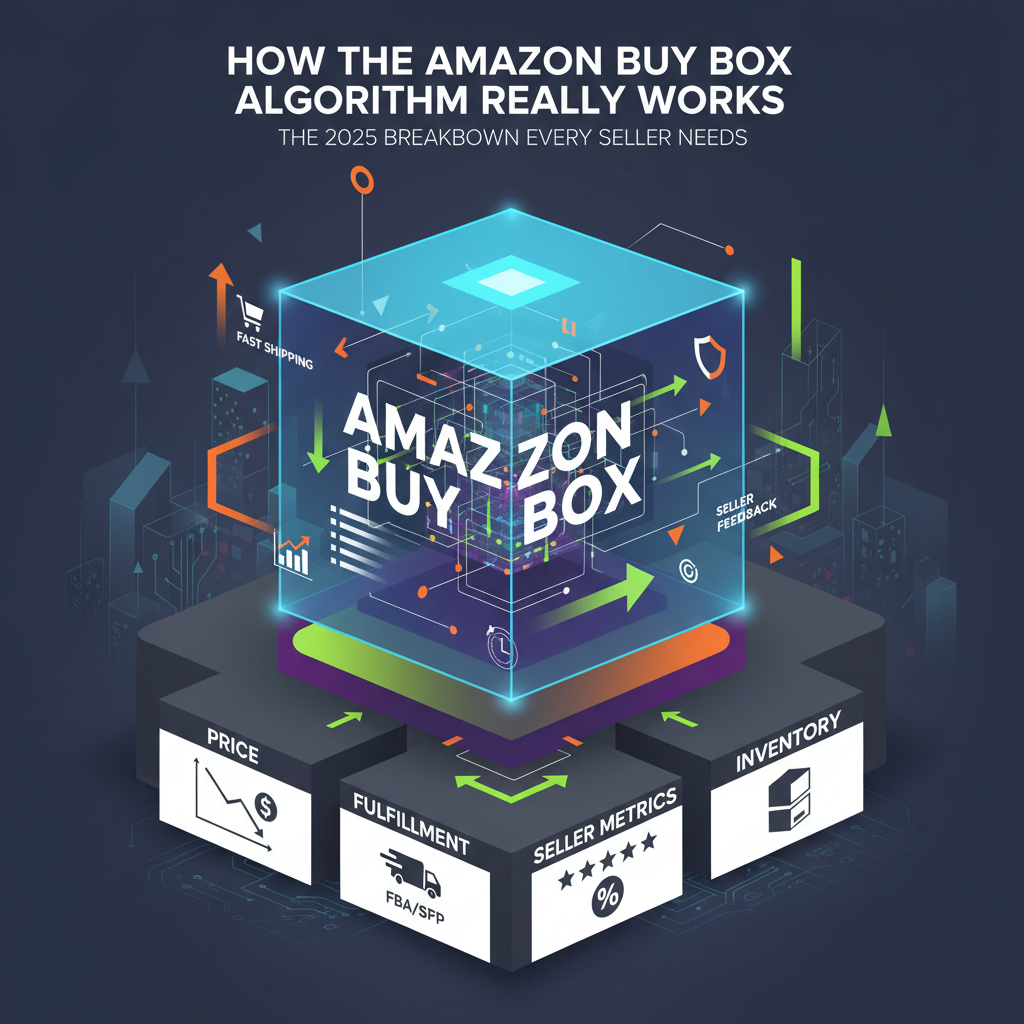
The algorithm considers:
- Your ability to deliver quickly and reliably
- Your pricing competitiveness
- Your historical performance metrics
- Your inventory depth and reliability
- Your account standing and track record
- Hidden engagement signals most sellers don’t even know exist
Each factor carries a different weight, and those weights have shifted dramatically in 2025. Let’s break down exactly what’s changed.
The 2025 Algorithm Shift: Delivery Speed Is Now King
Here’s the biggest news for Amazon sellers this year: delivery speed has become the single most important factor in the Buy Box algorithm.
According to data from seller communities and platform testing, delivery speed and fulfillment method now account for approximately 25-30% of the algorithm’s weighting. That’s nearly double what it was previously, when delivery factors hovered around 15%.
What does this mean in practical terms?
FBA Sellers Have a Bigger Advantage Than Ever
If you’re using Fulfillment by Amazon, you’re starting with a significant head start. Amazon trusts its own fulfillment network implicitly—they know exactly when packages will arrive, how they’ll be handled, and that Prime customers will get their expected two-day (or faster) delivery.
This doesn’t mean FBM (Fulfilled by Merchant) sellers can’t win the Buy Box. But the bar is higher than it’s ever been. You need:
- Same-day or next-day dispatch capabilities
- Delivery windows that match or beat FBA timelines
- Impeccable tracking and delivery confirmation
- Seller Fulfilled Prime status (if you can qualify)
Why Amazon Made This Change
The shift toward delivery speed reflects Amazon’s broader strategic priorities. They’ve spent billions building out their logistics network, and they want that investment to pay off through customer satisfaction. Fast delivery isn’t just a nice feature anymore—it’s become a core expectation that Amazon is willing to algorithmically enforce.
For sellers, the message is clear: if you can’t deliver fast, you’d better be exceptional in every other area. And even then, you might still lose to a faster competitor.
Pricing in 2025: Still Critical, But No Longer Dominant
For years, conventional wisdom held that the lowest price wins the Buy Box. Period. Many sellers built their entire strategy around aggressive repricing, racing to the bottom to capture that featured position.
That approach is increasingly outdated.
Price weighting in the algorithm has decreased from approximately 35% to a lower percentage in 2025. This doesn’t mean pricing doesn’t matter—it absolutely does. But it means you can no longer win on price alone, and you don’t necessarily need the absolute lowest price to win.
What the Algorithm Actually Evaluates
When it comes to pricing, the algorithm looks at your landed price—the total cost to the customer including shipping. A $25 item with $5 shipping is algorithmically equivalent to a $30 item with free shipping. Many sellers miss this distinction and wonder why their “lower” prices aren’t winning.
More importantly, the algorithm considers price in context with other factors. A seller with stellar metrics, FBA fulfillment, and deep inventory can often win the Buy Box at a price point slightly higher than a competitor with weaker credentials.
The Competitive Range Concept
Rather than requiring the absolute lowest price, Amazon looks for pricing that falls within a competitive range. If the lowest offer is $24.99 and you’re at $25.49 with better metrics, you’re still in the game. If you’re at $29.99, you’re probably not.
The exact boundaries of this “competitive range” vary by category, price point, and competitive intensity on the listing. But the principle holds: you need to be competitive, not necessarily cheapest.
Seller Performance Metrics: The Foundation Everything Else Builds On
Think of your seller performance metrics as the foundation of your Buy Box eligibility. Without a solid foundation, nothing else you do matters. You could have the fastest shipping and the lowest prices in your category, but if your metrics are in the red, the algorithm won’t even consider you.
The Metrics Amazon Watches Most Closely
Order Defect Rate (ODR): This is the percentage of orders that result in negative feedback, A-to-Z Guarantee claims, or credit card chargebacks. Amazon wants this well below 1%. Exceed that threshold, and Buy Box eligibility disappears.
Valid Tracking Rate: For FBM sellers, this measures how often you provide valid tracking information. Amazon expects this near 95% or higher. Every shipment without proper tracking hurts your standing.
On-Time Delivery Rate: Late shipments are one of the fastest ways to tank your Buy Box share. The algorithm tracks whether your orders arrive within the promised delivery window.
Cancellation Rate: If you’re canceling orders because you can’t fulfill them, Amazon notices. Keep this below 2.5% at absolute maximum—lower is always better.
Late Shipment Rate: Distinct from delivery rate, this measures whether you ship on time. Even if the carrier delays the package, a late shipment on your end is your responsibility.
Newer Metrics Gaining Weight in 2025
Customer Service Responsiveness: How quickly do you respond to buyer messages? Amazon is increasingly factoring response times into algorithmic decisions.
Return Rate: Products with high return rates may see reduced Buy Box share, even if the returns aren’t the seller’s fault. This is newer to the algorithm and represents Amazon’s focus on overall customer satisfaction.
Negative Feedback Rate: Your overall seller rating needs to stay above 90% positive. Drop below this threshold, and you may lose Buy Box eligibility even on listings where you’re the only seller.
The Hidden Triggers: Customer Engagement Signals Most Sellers Don’t Know About
Here’s where things get interesting. Recent analysis has revealed that Amazon factors in customer engagement signals that they don’t publicly disclose. These “hidden triggers” can make the difference between winning and losing the Buy Box, especially when competing against sellers with similar pricing and metrics.
Review Velocity
Products that are steadily gaining authentic reviews receive an algorithmic boost. Note the emphasis on “steadily” and “authentic”—sudden spikes in reviews (which might indicate manipulation) don’t help and may actually trigger scrutiny.
This factor rewards sellers who consistently deliver great products and customer experiences that naturally generate positive reviews over time.
Repeat Purchase Rates
If customers who buy from you come back to buy again, Amazon notices. High repeat purchase rates signal customer satisfaction in a way that single transactions can’t. This metric particularly matters for consumable products and categories where repeat purchasing is common.
Customer Feedback Trends
The algorithm doesn’t just look at your overall feedback rating—it looks at the trajectory. Are your ratings improving, stable, or declining? A seller with a 94% rating that’s trending upward may be viewed more favorably than one with a 96% rating that’s been dropping.
Response to Negative Feedback
How you handle negative feedback matters. Sellers who actively respond to and resolve customer complaints demonstrate the kind of customer-centric behavior Amazon wants to reward.
Understanding Buy Box Rotation: Why Multiple Sellers Can “Win”
A common misconception is that one seller “wins” the Buy Box and holds it until someone beats them. The reality is more nuanced: Amazon rotates the Buy Box among eligible sellers based on a variety of factors.
How Rotation Actually Works
When multiple sellers have competitive pricing and similar performance metrics, Amazon doesn’t simply give the Buy Box to one of them permanently. Instead, it rotates the featured position among qualified sellers.
However—and this is crucial—the rotation isn’t equal. A seller with slightly better metrics might get the Buy Box 60% of the time while a competitor gets it 40% of the time. The algorithm rewards incremental improvements with incremental gains in Buy Box share.
Real-Time Adjustments
The Buy Box can shift multiple times per hour. Price changes, inventory fluctuations, and even competitor activity can trigger reassessment. This is why manual price monitoring is essentially impossible at scale—by the time you notice a change and respond, the situation may have shifted again.
Geographic Factors
Here’s something many sellers don’t realize: different customers might see different Buy Box winners for the same product. A customer in Seattle might see a different featured seller than a customer in Miami, based on which seller can deliver faster to each location.
This geographic component of Buy Box assignment has become more pronounced as Amazon has expanded its regional fulfillment capabilities.
When the Buy Box Disappears: Understanding Suppression
Sometimes no one wins the Buy Box. Instead, customers see a “white box” with just a “See All Buying Options” button. This is buy box suppression, and it’s devastating for conversion rates.
What Triggers Suppression
Excessive pricing: If your price significantly exceeds the list price (MSRP) recorded in Amazon’s catalog, the Buy Box may be suppressed entirely. Amazon doesn’t want to feature what appears to be price gouging.
Price volatility: Wild price swings can trigger algorithmic review and suppression. If your price jumps 50% overnight and drops again, Amazon may temporarily remove the Buy Box.
External price matching: Amazon monitors prices across the web. If you’re selling the same product cheaper on your own website or other marketplaces, Amazon may suppress the Buy Box to avoid appearing non-competitive.
Poor seller metrics across all sellers: If every seller on a listing has concerning metrics, Amazon may suppress the Buy Box rather than feature anyone.
The Impact of Suppression
When the Buy Box is suppressed, conversion rates plummet. You’ve essentially added a mandatory extra step to the purchasing process. Some customers will click through and choose a seller, but many will simply leave.
The silver lining: strong product listings, solid reviews, and competitive shipping can still generate some sales even with a suppressed Buy Box. But it’s a fraction of what you’d earn with normal Buy Box functionality.
Competing Against Amazon Retail: The Ultimate Challenge
When Amazon itself sells a product through Amazon Retail, third-party sellers face their toughest competition. Amazon Retail dominates the Buy Box 70-90% of the time (or more) on listings where they’re active.
Why? Because Amazon controls both pricing and fulfillment directly. They can set their price knowing their exact costs, and they can guarantee fulfillment through their own network. The algorithm naturally favors this level of control and reliability.
When Third-Party Sellers Can Win
Your best opportunity to win the Buy Box against Amazon Retail is during their stockouts. Amazon’s inventory isn’t infinite, and when they run out, the Buy Box passes to third-party sellers.
Some sellers also find success by offering bundle variations or product configurations that Amazon Retail doesn’t carry. You’re not competing directly—you’re offering something different.
Conclusion: Mastering the Algorithm Requires Mastering Your Pricing
The Amazon Buy Box algorithm in 2025 is sophisticated, multi-dimensional, and constantly evolving. Success requires excellence across delivery speed, competitive pricing, seller performance, inventory management, and increasingly, customer engagement signals that most sellers don’t even know exist.
But here’s the challenge: you can’t manually optimize all these factors simultaneously, especially pricing. While you’re focused on improving your metrics or managing inventory, your competitors are adjusting their prices in real-time. The Buy Box shifts, and you miss it.
This is exactly why smart sellers are turning to automated repricing solutions. And when it comes to intelligent, algorithmic repricing built specifically for Amazon’s Buy Box competition, Zupricer stands out as the solution designed for 2025’s reality.
Zupricer doesn’t just chase the lowest price—it understands that winning the Buy Box requires a nuanced approach that considers your metrics, your margins, and your competition’s complete picture. It makes real-time pricing adjustments that keep you competitive without destroying your profitability.
The algorithm never sleeps, and neither does your competition. With Zupricer, your pricing strategy doesn’t have to sleep either. You can focus on the factors that require human attention—customer service, inventory planning, product selection—while Zupricer handles the complex, real-time calculations that determine your Buy Box share.
The sellers who thrive on Amazon in 2025 won’t be the ones working hardest. They’ll be the ones working smartest, with the right tools doing the heavy lifting. Let Zupricer be your unfair advantage in the Buy Box battle.