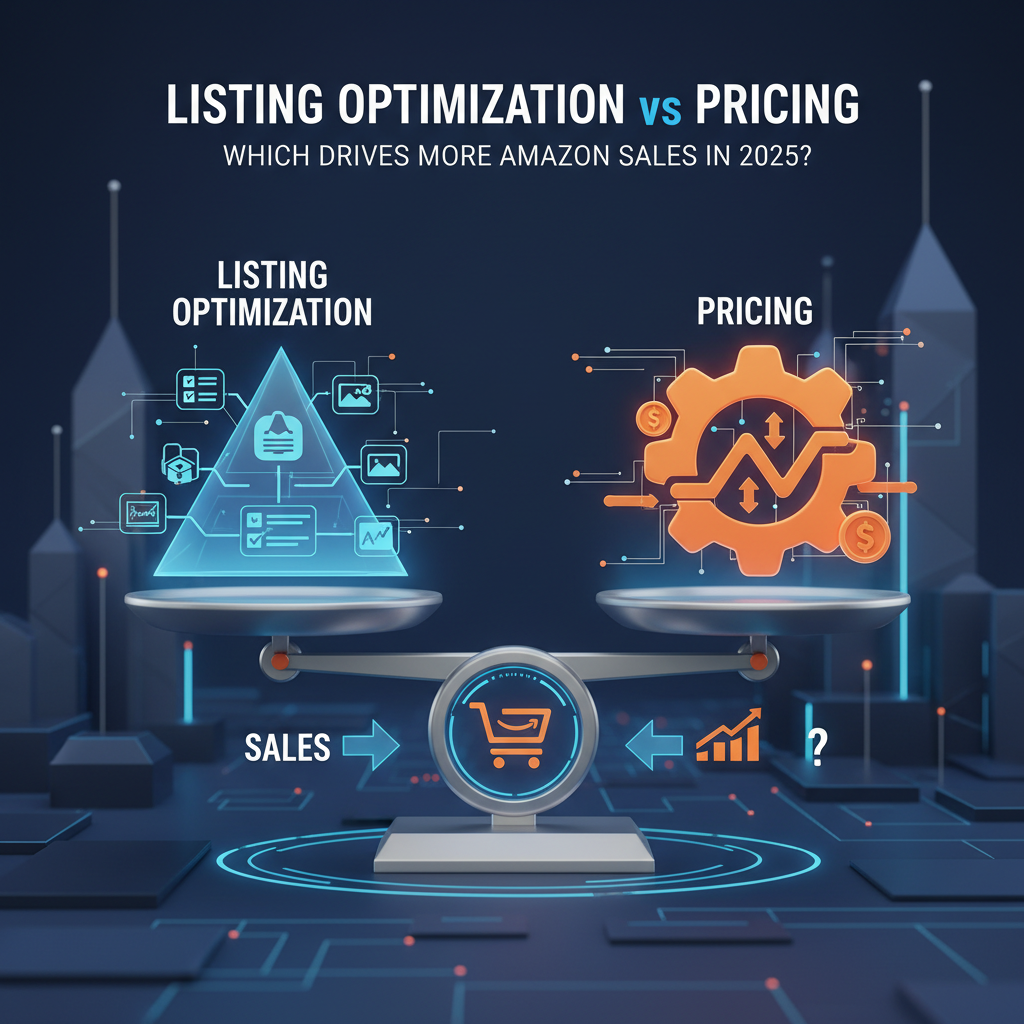
It’s the question that sparks heated debates in Amazon seller communities everywhere: should you focus on perfecting your listings or nailing your pricing strategy? Spend any time in seller forums and you’ll find passionate advocates on both sides—some swearing that killer images and A+ Content are the key to success, others insisting that competitive pricing is all that really matters.
Here’s what the data actually shows in 2025: this isn’t an either-or question. But understanding how these two factors interact—and which one deserves your attention first—can mean the difference between a thriving Amazon business and one that struggles to gain traction.
Let’s break down what’s really happening with Amazon’s algorithm and how smart sellers are approaching both listing optimization and pricing to maximize results.
How Amazon’s Algorithm Evaluates Your Success in 2025
Amazon’s A10 algorithm has evolved significantly, and understanding its priorities helps clarify the optimization vs. pricing debate.
The algorithm now heavily emphasizes AI-driven ranking through tools like Amazon Rufus, which means the platform understands buyer intent and context—not just simple keyword matching. What does this mean for sellers? Amazon now prioritizes:
- Click-Through Rate (CTR): Are shoppers clicking on your listing from search results?
- Conversion Rate (CVR): Once they click, are they buying?
- Sales velocity: Are you generating consistent, steady sales?
- Customer engagement: How long do shoppers spend on your listing? Are they scrolling through your images and A+ Content?
- Seller authority: Your overall track record and performance metrics
Notice something? Both listing optimization AND pricing directly impact these metrics. Your listing quality affects CTR and engagement. Your pricing affects conversion rates and sales velocity. They’re two sides of the same coin.
Amazon Listing Optimization Pricing: Making the Case for Each
Before deciding where to focus your energy, it helps to see the strongest argument for each side laid out on its own terms — because the honest truth about amazon listing optimization pricing is that neither factor wins the debate outright. Each one solves a different half of the same problem.
The Case for Listing Optimization: Why It’s Your Foundation
Listing optimization determines whether customers find your product, click on it, and ultimately feel confident enough to buy. Without it, even the best price in the world won’t save you.
The numbers speak clearly:
- Sellers implementing comprehensive optimization strategies have achieved 35% conversion rate increases within 60-day periods
- Properly optimized content frameworks have driven 40% increases in sales velocity within 90 days
- A+ Content alone has been proven to boost conversion rates by 5-10%
Critical optimization elements for 2025:
Mobile-first design is non-negotiable. Over 70% of Amazon customers now shop on their phones. If you’re only checking your listings on desktop, you’re missing how most customers actually experience your product page.
Visual content quality matters more than ever. You need professional, high-resolution images across all 7-9 available slots. Include lifestyle images showing products in use, infographics that communicate key benefits quickly, and video content—which is increasingly important for conversion.
Keyword strategy requires finesse. Amazon’s AI detects and penalizes keyword stuffing. Front-load primary keywords in titles while maintaining readability. Integrate keywords naturally in bullet points. Use backend search terms strategically for terms that don’t fit organically in visible content.
A+ Content isn’t optional anymore. If you’re Brand Registered and not using A+ Content, you’re leaving a 5-10% conversion boost on the table. Enhanced product descriptions, comparison charts, and branded visuals create the professional presentation that supports premium positioning.
The Case for Pricing: Your Gateway to 90% of Sales
Here’s the brutal truth about Amazon: approximately 90% of sales go through the Buy Box. If you’re not winning the Buy Box, you’re fighting over scraps—no matter how beautiful your listing looks.
Amazon’s Buy Box algorithm has evolved, with the price competitiveness threshold widening to 2-3% (previously 1%). But pricing still remains a primary factor in Buy Box eligibility, alongside:
- Fulfillment method: FBA significantly improves your odds
- Seller performance metrics: Order Defect Rate, on-time shipping, response times
- Inventory availability: Consistent stock levels matter
- Price parity: Listing higher prices on Amazon than other platforms triggers Buy Box suppression
Why pricing strategy is critical:
Without competitive pricing, you cannot consistently winning buy box. Without the Buy Box, you lose access to 90% of potential sales. Even perfectly optimized listings fail without Buy Box access.
Pricing also directly impacts conversion rates. Overpricing reduces conversions, which damages organic ranking. But underpricing leaves money on the table and reduces the profitability you need to sustain and grow your business.
The challenge? Competitors adjust prices constantly. Buy Box share fluctuates throughout the day. Manual price monitoring simply isn’t practical at scale—by the time you notice a competitor has undercut you, you’ve already lost hours of potential Buy Box wins.
The Flywheel Effect: How Optimization and Pricing Work Together
The smartest Amazon sellers understand that listing optimization and pricing aren’t competing priorities—they’re interconnected parts of a system that creates compounding benefits.
Here’s how the flywheel works:
- Your optimized listing improves click-through rates from search results
- Competitive pricing wins the Buy Box and improves conversion rates
- Higher sales velocity signals quality to Amazon’s algorithm
- Improved organic ranking increases visibility
- More visibility drives more sales, further improving ranking
- Better ranking reduces dependency on advertising
- Reduced ad costs improve profit margins, enabling more competitive pricing
Listing optimization enables better pricing because higher conversion rates from better listings justify slightly higher prices. Professional presentation supports premium positioning. Enhanced content differentiates your products, reducing pure price competition.
Pricing enables listing performance because competitive pricing wins Buy Box, sending traffic to your optimized listing. More traffic at competitive prices increases sales velocity. Increased velocity improves organic ranking, which amplifies everything you’ve done to optimize.
Which Should You Prioritize First?
While both matter, the sequence of your focus depends on your current situation.
Start With Listing Optimization If…
- You have a new product with no sales history
- Your conversion rate is below 8-10%
- You’re getting traffic but few sales
- Your images, copy, or A+ Content are weak
- You haven’t optimized for mobile viewing
- Your keyword strategy is unclear or outdated
Focus on Pricing If…
- Your listing is well-optimized but you’re not winning Buy Box
- Your conversion rate is healthy (10-15%+) but sales are stagnant
- Competitors consistently undercut your price
- You’re losing Buy Box share throughout the day
- Your price is significantly above market average
- You’re using static pricing in a dynamic competitive environment
The logic is simple: optimize first so that when you do attract traffic, those visitors convert into customers. Then layer in smart pricing strategy to maximize that foundation’s potential.
Common Mistakes That Kill Your Results
Listing Optimization Mistakes
- Building listings for desktop only when 70%+ of customers shop on mobile
- Keyword stuffing that Amazon’s AI detects and penalizes
- Ignoring A+ Content and leaving conversion boosts on the table
- Poor image quality that fails the first-impression test
- Static content that never gets updated based on performance data
Pricing Mistakes
- Static pricing in dynamic markets where competitors adjust constantly
- Ignoring Buy Box algorithm changes and the 2-3% threshold
- Price parity violations that trigger Buy Box suppression
- Racing to the bottom and destroying margins
- Manual monitoring that can’t keep pace with real-time competitive changes
The Bottom Line: You Need Both, But Pricing Never Sleeps
The data is clear: listing optimization can improve conversion rates by 35-40% when done properly. Competitive pricing determines access to 90% of sales by controlling buy box wins. Neither works without the other.
Here’s what separates struggling sellers from successful ones: understanding that while listing optimization can be done in focused sprints, pricing requires constant attention. Your competitors aren’t checking prices once a day—they’re adjusting in real-time. Buy Box share shifts hour by hour. The seller who optimized their listing last month but hasn’t touched their pricing strategy is watching sales slip away right now.
This is exactly why smart sellers pair their optimization efforts with intelligent repricing solutions. Zupricer handles the pricing side of the equation automatically—monitoring your competition, adjusting your prices to maximize Buy Box wins, and protecting your margins around the clock. While you focus on creating compelling listings, improving your images, and crafting A+ Content that converts, Zupricer ensures your pricing strategy never falls behind.
Because in 2025, you don’t have to choose between great listings and smart pricing. You need both. And with the right tools handling the dynamic pricing challenge, you can focus your energy on the optimization work that truly requires human creativity and judgment.