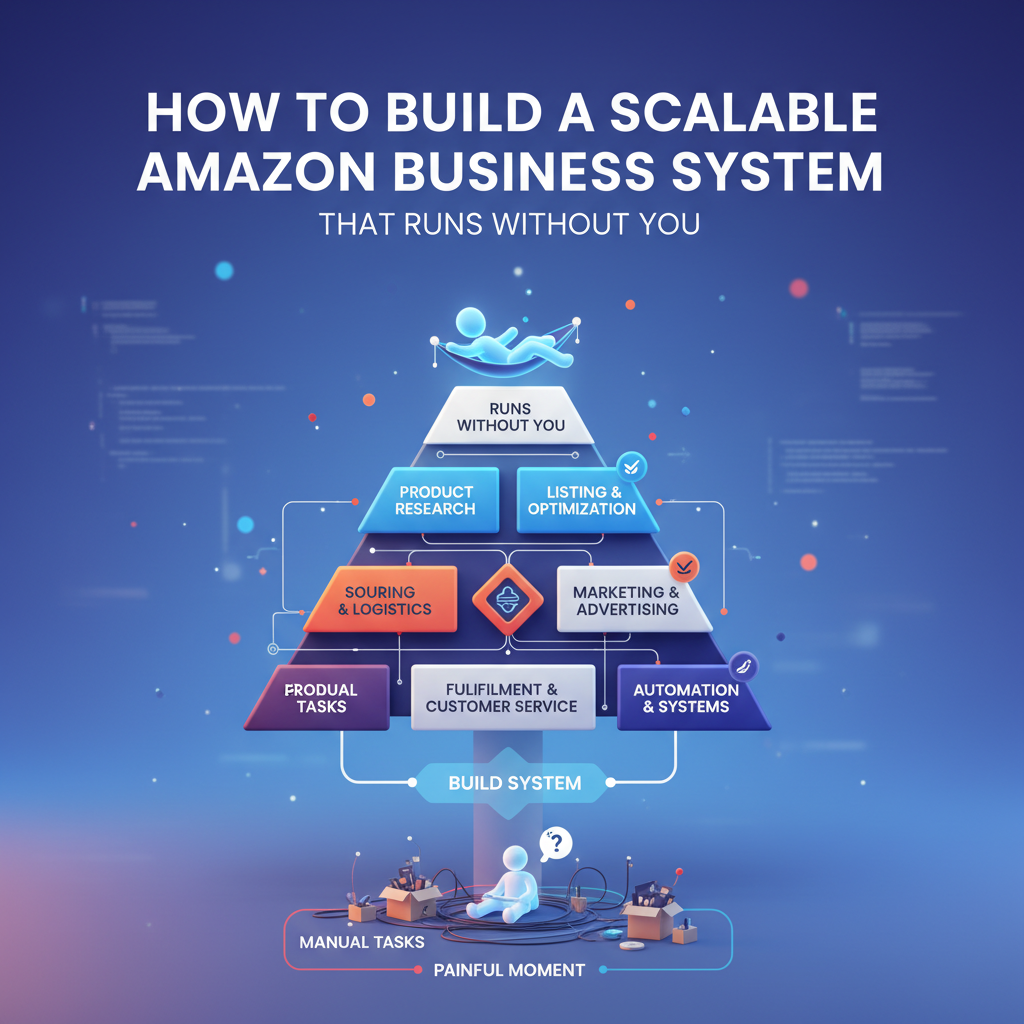
There’s a painful moment every Amazon seller hits eventually: the realization that you’ve built yourself a job, not a business. You’re working 60-hour weeks, checking Seller Central at midnight, manually adjusting prices, answering customer emails, and watching competitors while your family sleeps. Revenue is growing, but so is your exhaustion—and somehow, profit margins keep shrinking.
Here’s the truth that separates sellers who scale from sellers who burn out: scaling equals systems. Without documented processes, automation tools, and clear operational frameworks, growth doesn’t create wealth—it creates chaos.
As of April 2025, the Amazon marketplace demands more from sellers than ever. Fees are at historic highs. Competition is fierce. Customer expectations are relentless. The sellers who thrive aren’t working harder than everyone else—they’re working smarter through systems that operate whether they’re at their desk or on vacation.
Top performers report saving 10-15 hours per week through systematic automation and delegation. That’s not a minor efficiency gain—that’s the difference between drowning in operations and actually building a business. Let’s break down exactly how to build those systems.
The Foundation: Standard Operating Procedures (SOPs)
Everything scalable starts with documentation. SOPs transform your business knowledge from being locked inside your head into repeatable processes anyone can follow. Without them, you can’t delegate effectively, you can’t maintain consistency, and you remain the bottleneck for every decision.
Think of SOPs as your business’s operating manual. They answer the question: “If I disappeared tomorrow, could someone else run this?”
Critical areas requiring documented SOPs:
- Product Research: Criteria for evaluating opportunities, supplier vetting process, sample ordering procedures, negotiation frameworks
- Inventory Management: Reorder point calculations, forecasting methodology, FBA inbound procedures, stranded inventory resolution
- Listing Management: Creation checklists, keyword research process, image standards, A+ Content workflows, optimization schedules
- Customer Service: Response templates, escalation procedures, refund decision trees, negative feedback protocols
- PPC Management: Campaign structure standards, bid adjustment rules, negative keyword workflows, performance review schedules
- Financial Tracking: Profit calculation methodology, expense categorization, monthly reconciliation, cash flow monitoring
The key insight: you can’t automate or delegate what you haven’t documented. Always create the SOP first, then hand it off. Your first version won’t be perfect—and that’s fine. Create version 1.0, use it, improve it. Done beats perfect every time.
Automation: Making Technology Do the Heavy Lifting
Manual processes don’t scale. Period. Every hour you spend on repetitive tasks is an hour not spent on strategy, product development, or growth. In 2025, sophisticated automation tools exist for nearly every operational function.
Essential automation categories:
- Profit Tracking: One case study showed a seller managing 50 SKUs gaining back 12+ hours weekly by switching from spreadsheets to automated tracking. Real-time profitability data enables faster, better decisions.
- Inventory Forecasting: Tools using probabilistic algorithms analyze historical sales, account for seasonality, and predict optimal reorder points—preventing both stockouts and excess inventory that kills cash flow.
- PPC Management: Automated bid systems adjust keywords based on performance data, maximize ROI within budget constraints, and optimize spend 24/7 without manual intervention.
- Repricing: Dynamic pricing tools monitor competitors in real-time and adjust prices automatically, maintaining Buy Box ownership while protecting margin floors.
- Review Requests: Automated systems ensure consistent customer follow-up, handle timing compliance, and maximize review generation without manual tracking.
The automation hierarchy to follow: Start manual to understand the process → Document it in an SOP → Automate or delegate based on complexity → Monitor performance → Continuously optimize.
Don’t over-complicate early. You don’t need enterprise-level tools when you have 10 SKUs. Scale your systems as your business scales.
Strategic Delegation: Freeing Yourself From Operations
Delegation isn’t about dumping tasks—it’s a strategic skill that most Amazon sellers never formally learned. The goal is focusing your time on high-leverage activities while others handle operational execution.
Tasks to delegate first (low-risk, high-frequency):
- Customer service responses using templates
- Listing updates and maintenance
- PPC campaign monitoring and reporting
- Inventory spreadsheet updates
- Initial product research screening
- Competitor monitoring
- Order processing and tracking
Tasks to keep (high-leverage, strategic):
- Strategic product selection decisions
- Major supplier negotiations
- Financial planning and analysis
- Strategic pricing decisions
- Brand development direction
- Business growth strategy
- System design and optimization
The delegation framework: Start small with 10-15 hours weekly. Provide clear SOPs as training materials. Review work regularly at first. Gradually expand responsibilities as competence grows. Virtual assistants from different time zones can even provide round-the-clock coverage if needed.
Critical mindset shift: if you insist on approving every minor decision, you’ll always be the constraint. Build systems that empower your team to act within defined parameters.
Data-Driven Operations: Running on Metrics, Not Gut Feelings
Scalable businesses run on data. Successful sellers in 2025 use analytics to drive every major decision, not intuition or hope.
Product performance metrics to track:
- SKU-level profitability (not just revenue—actual profit after all costs)
- Inventory turnover rate
- Return rate by product
- Customer service burden per SKU
- PPC efficiency (ACoS, TACoS, ROAS)
Business health metrics:
- Overall profit margin
- Cash flow and runway
- Days of inventory on hand
- Inventory-to-sales ratio
Operational efficiency metrics:
- Time spent on various activities
- Task completion rates without owner involvement
- Error rates in key processes
- Automation effectiveness
Pro tip: Create a single dashboard showing your most critical metrics at a glance. Many sellers waste time checking 20+ different reports daily. Consolidate into one view that shows what actually matters for decisions.
Cash Flow Management: The Silent Business Killer
Cash flow problems kill more Amazon businesses than lack of sales. Inventory represents your largest cash investment, making optimization critical for survival—not just growth.
Smart sellers in 2025 aren’t just scaling revenue—they’re controlling inventory efficiency. Treat cash flow management as a core competency, not an afterthought.
The 8 cash flow levers:
- Inventory turnover optimization: Don’t tie up capital in slow-moving products just to have a large catalog
- Payment term negotiation: Push for net 30 or net 60 with suppliers where possible
- Fee reduction strategies: Optimize packaging, master inventory placement, reduce long-term storage
- Pricing optimization: Dynamic pricing that maximizes margin while maintaining competitiveness
- Product portfolio rationalization: Cut underperformers that drain cash
- Forecasting accuracy: Better predictions prevent both stockouts and excess inventory
- Strategic financing: Use inventory financing for proven products during growth phases
- Expense discipline: Regular review and optimization of all business costs
Overestimating demand results in long-term storage fees for inventory sitting in Amazon warehouses. Underestimating creates stockouts that kill momentum and ranking. Use forecasting tools to find the optimal balance.
The Implementation Roadmap: 12 Months to Scalability
Phase 1: Foundation (Months 1-3)
Month 1 focuses on auditing and documenting. List every regular task you perform. Track where your time actually goes—you’ll be surprised. Begin documenting high-frequency tasks as SOPs.
Month 2 implements basic automation: profit tracking, automated review requests, repricing software, basic reporting dashboards, inventory alerts.
Month 3 brings first delegation: hire a VA for low-risk tasks, delegate customer service and listing updates, start with 10-15 hours weekly, refine SOPs based on real experience.
Phase 2: Optimization (Months 4-6)
Expand automation with PPC tools, advanced forecasting, and automated financial reporting. Increase delegation to include inventory management and PPC monitoring. Review and update all SOPs. Identify remaining bottlenecks.
Phase 3: Scaling (Months 7-12)
Launch new products using your validated systems. Expand your team with specialized roles. Build redundancy in critical positions. By month 12, your business should run with minimal daily involvement—team handles 80% of operations while you focus on strategy.
Measuring Scalability Success
How do you know your systems are working? Track these indicators:
- Time metrics: Hours on operational tasks should decrease; hours on strategic activities should increase
- Financial metrics: Profit margin should improve as systems eliminate waste; revenue per hour of your time should increase dramatically
- Operational metrics: Task completion without owner involvement; error rates decreasing with SOPs
- Growth metrics: New products launched successfully per quarter; markets expanded into
Building Systems That Scale Your Pricing
Of all the systems requiring automation, pricing deserves special attention. It’s the lever with the most immediate impact on profitability, yet it’s impossible to manage manually at scale. Competitors adjust prices constantly. Buy Box algorithms evaluate offers around the clock. Market dynamics shift faster than any human can track.
This is precisely where Zupricer becomes the cornerstone of your scalable system. While you focus on strategy, product development, and business growth, Zupricer handles the relentless tactical work of competitive pricing automatically. It monitors competitor movements in real-time, adjusts your prices to win and maintain Buy Box ownership, and respects your margin floors to ensure profitability never gets sacrificed for sales velocity.
Building a scalable Amazon business means building systems that work without your constant attention. With Zupricer managing your pricing strategy 24/7, you remove one of the biggest operational burdens from your plate—and gain the freedom to actually run your business instead of being run by it.