Let’s be honest: if you’re still manually checking competitor prices in 2025, you’re already losing.
Your competitors change their prices multiple times per day. Promotional windows open and close within hours. Stock availability shifts constantly. And while you’re copying prices into a spreadsheet, automated systems are adjusting competitor listings in real-time—capturing sales that could have been yours.
The math is brutal. Checking prices manually once daily means missing roughly 95% of price changes. That’s not a slight disadvantage—it’s a fundamental competitive handicap that no amount of hard work can overcome.
But here’s the good news: automated competitor price tracking has become accessible to sellers of every size. The tools available today range from $9/month entry-level solutions to enterprise-grade platforms with AI-powered analytics. The key isn’t just tracking prices—it’s turning that intelligence into action automatically.
Let’s break down exactly how to set this up for your business.
What Modern Price Tracking Actually Does
Forget the simple price alerts of five years ago. Today’s competitor monitoring tools are comprehensive intelligence platforms that track far more than just numbers on a page.
At the core, these systems use web scraping technology to systematically extract pricing data from competitor websites and marketplaces. But the sophistication goes much deeper:
- Real-time pricing across multiple platforms — Amazon, Walmart, eBay, competitor websites, and regional marketplaces
- Stock availability monitoring — knowing when competitors run out gives you pricing power
- Historical trend analysis — identifying seasonal patterns and promotional cycles
- MAP violation detection — automatic alerts when retailers break minimum advertised price agreements
- Promotional tracking — capturing discounts, coupons, and limited-time offers
The best platforms analyze thousands of data points daily, delivering actionable insights about competitor pricing, product demand, stock levels, and market trends. This isn’t just data collection—it’s competitive intelligence that drives real decisions.
Why Automation Has Become Non-Negotiable
The business case for automated price tracking is now overwhelming. AI-driven price monitoring tools deliver measurable results: businesses using them report up to 10% revenue increases and 15% improvements in profit margins.
But the real argument isn’t about gains—it’s about survival. Manual monitoring has fundamental limitations that automation eliminates:
- Scale impossibility — tracking 50 competitors across 500 products requires thousands of daily checks
- Human error accumulation — manual data entry corrupts the very decisions it’s supposed to inform
- Response delays — by the time you spot a competitive price change manually, the opportunity has passed
- Opportunity cost — hours spent checking prices are hours not spent on strategy, marketing, or customer service
The businesses winning today have integrated price monitoring into their daily operations. It’s not a reporting function—it’s an operational backbone that connects directly to repricing decisions, inventory management, and strategic planning.
How Automated Tracking Actually Works
Understanding the technical foundation helps you choose better tools and set realistic expectations.
The Data Collection Process
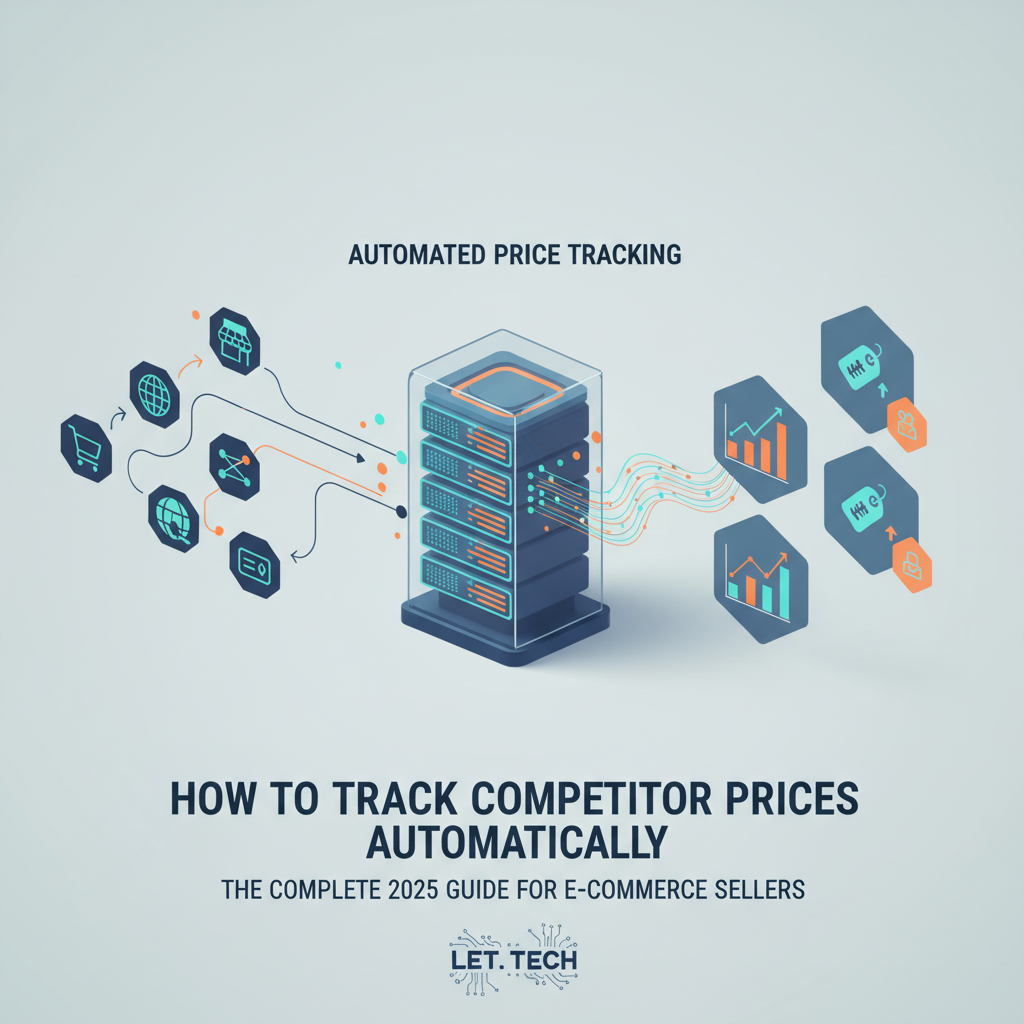
Most price monitoring tools follow a similar workflow:
- Target identification — you define competitor product URLs and pages to monitor
- Data extraction — scraping bots visit pages and pull pricing, availability, and product information
- Normalization — raw data gets cleaned and standardized for meaningful comparison
- Change detection — systems identify when prices, stock status, or other parameters shift
- Alert generation — notifications trigger based on your configured thresholds
Monitoring Frequency Matters
Leading platforms offer different monitoring architectures. Continuous monitoring checks competitors at scheduled intervals—hourly, every few hours, or more frequently for critical products. Advanced event-driven systems detect changes as they happen rather than waiting for the next scheduled check.
For Amazon sellers specifically, real-time monitoring is essential for Buy Box competition. Price changes that would take hours to detect manually get captured instantly, enabling immediate response.
Choosing the Right Tool for Your Business
The price monitoring market in 2025 offers options across every budget and capability level. Here’s how to navigate the choices:
Budget-Friendly Options ($9-50/month)
ChangeTower starts at just $9/month and covers the basics: website change detection, price monitoring, stock tracking, and alerts. Perfect for small businesses testing automated tracking for the first time.
Pricefy at $49/month adds API access and exports, better suited for sellers wanting to integrate data with other systems.
Professional-Grade Platforms ($50-200/month)
Prisync has become a favorite among Shopify and WooCommerce users. Starting at $99/month, it offers real-time tracking, dynamic pricing automation, MAP monitoring, and clean dashboards. The integration ecosystem is particularly strong.
PriceShape focuses on ease of use—quick setup, simplified interface, and accessible pricing for retailers who want results without complexity.
Enterprise Solutions (Custom Pricing)
Omnia Retail delivers robust rule-based automation and enterprise-grade reliability for large retailers focused on competitive tracking and real-time price alignment.
Wiser offers a comprehensive suite combining competitive data, pricing automation, and analytics—essentially a one-stop shop for mid-market to enterprise brands.
Quicklizard brings AI and machine learning into the equation, enabling sophisticated multi-channel price adaptation using both rules and predictive models.
Selection Criteria
Match your tool to these factors:
- Product volume — how many SKUs need tracking?
- Competitor count — how many competitors matter?
- Update frequency — how fast does your market move?
- Integration needs — does it connect to your existing platforms?
- Geographic coverage — do you need multi-market tracking?
Implementation: Getting Started Right
Setting up automated price tracking effectively requires more than just signing up for a tool. Follow this structured approach:
Step 1: Define Your Tracking Objectives
Before configuring anything, clarify what you’re trying to achieve. Which competitors actually matter? (Hint: not all of them.) Which products are truly price-sensitive? What response time do you need?
Establish success metrics upfront: price competitiveness targets, margin protection thresholds, and market share objectives.
Step 2: Map Your Competitive Landscape
Categorize competitors by priority:
- Primary — direct competitors with significant market share who frequently win your target customers
- Secondary — similar products with overlapping markets
- Aspirational — market leaders to benchmark against
- Emerging — new entrants worth watching
Then match your products to competitor equivalents. Exact SKU matches are ideal, but close substitutes and category benchmarks work for comparison when identical products aren’t available.
Step 3: Configure Smart Alerts
Effective alerting prevents both information overload and missed opportunities. Configure notifications for:
- Price changes exceeding specific thresholds (e.g., 5%+ drops)
- Stock availability changes (especially competitor stockouts)
- MAP violations requiring action
- New competitors entering your category
Step 4: Test Before Trusting
Verify data accuracy by manually checking tracked prices against actual competitor sites. Ensure product matching is correct and stock status tracking works properly. Never automate repricing based on unverified data.
Avoiding the Common Pitfalls
Automated price tracking creates new challenges even as it solves old ones. Watch out for these issues:
The Price War Spiral
Automated repricing can trigger destructive races to the bottom where competitors continuously undercut each other. Protect yourself with minimum margin floors, price change velocity limits, and strategic delays before responding to changes. Sometimes the smart move is not matching a competitor’s desperate price cut.
Data Accuracy Problems
Scraped data isn’t always perfect. Websites change structures, anti-scraping technologies interfere, and product matching can fail. Implement validation checks, cross-reference multiple sources for critical products, and conduct regular accuracy audits.
Multi-Channel Complexity
Tracking and coordinating prices across Amazon, Walmart, your own website, and other channels creates operational complexity. Use unified monitoring across all channels, but implement channel-specific rules—amazon pricing strategies often differ from direct-to-consumer approaches.
Answering the Practical Questions Sellers Actually Ask
Stepping back from the technical setup covered above, it’s worth addressing the specific questions that bring most sellers to this topic in the first place.
If you’re asking how to check competitor pricing across multiple marketplaces automatically, the answer lives in the “Multi-Channel Complexity” section above: unified monitoring across Amazon, Walmart, and your own site, paired with channel-specific rules rather than one blanket setting. The best way to track competitor pricing across multiple sites follows the same logic — a single dashboard pulling from every marketplace you sell on, rather than juggling separate tools per channel.
When it comes to what’s genuinely the best competitor price monitoring software in 2025, there isn’t one universal answer — it depends on the budget tier and complexity covered in the “Choosing the Right Tool” section earlier, whether that’s a $9/month starter tool or an enterprise platform with AI-driven multi-channel adaptation. The core question of how to track competitor pricing automatically really comes down to the same five-step data collection process outlined above: target identification, extraction, normalization, change detection, and alerting — all running without you touching a spreadsheet.
For sellers running their own site alongside a marketplace presence, online store competitor sale tracking deserves the same promotional-tracking rigor described in the “What Modern Price Tracking Actually Does” section — discounts and limited-time offers move just as fast as base prices, sometimes faster. And whether your instinct is to check competitor pricing daily out of habit, or you’re aiming for the event-driven, real-time competitive pricing tracking described under “Monitoring Frequency Matters,” the honest answer is that daily checks are already behind the curve for anything Buy Box-related — the sellers winning are the ones who’ve moved past checking altogether and let the system watch continuously instead.
Turning Intelligence Into Action
Data without action creates no value. The real power of automated tracking comes from integration with your broader operations:
- Dynamic repricing — automatically adjust your prices based on competitive intelligence using configurable rules
- Inventory coordination — price based on your stock position, not just competitor prices
- Marketing alignment — coordinate promotions with competitive intelligence
- Strategic planning — use historical data to forecast and prepare for seasonal patterns
The businesses creating real competitive advantages have built integrated systems where intelligence flows automatically from monitoring through decision-making to execution. Manual operators simply cannot match this speed and precision.
Transform Your Pricing Strategy Today
Automated competitor price tracking has become table stakes for e-commerce success. The question isn’t whether to implement it—it’s how sophisticated your capabilities are compared to competitors who’ve already made the investment.
The critical success factors are clear: choose tools that match your scale and requirements, focus on actionable intelligence rather than data hoarding, balance automation with strategic oversight, and continuously refine based on results.
For Amazon sellers specifically, where Buy Box competition makes amazon pricing particularly critical, the right repricing solution can transform your competitive position overnight. That’s exactly what Zupricer delivers.
Zupricer combines intelligent competitor monitoring with automated amazon repricing, giving you real-time competitive intelligence and instant response capabilities in one integrated platform. While competitors manually check prices or struggle with disconnected tools, Zupricer keeps you ahead of every market shift—automatically adjusting your prices to maximize buy box wins while protecting your margins.
Stop watching competitors win sales that should be yours. Let Zupricer turn competitive intelligence into competitive advantage.