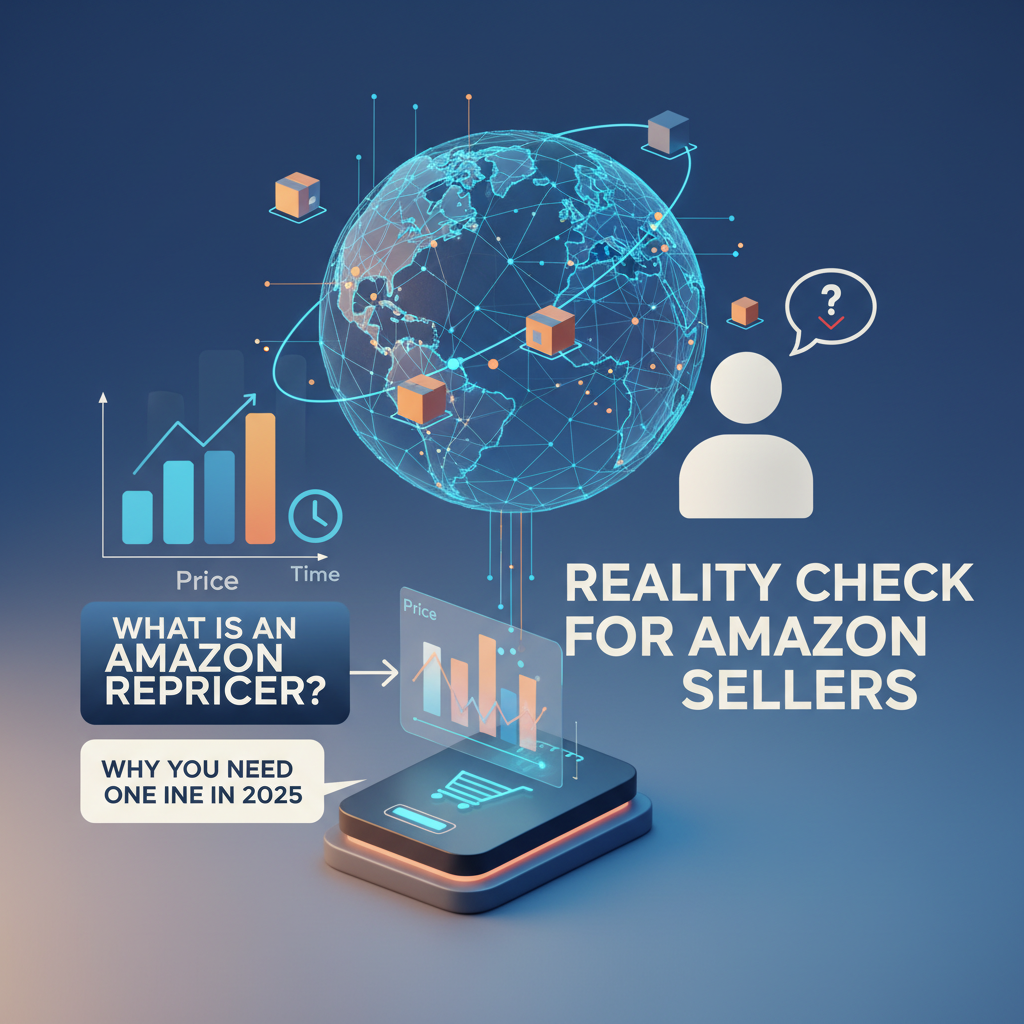
Here’s a reality check for Amazon sellers: while you’re sleeping, eating dinner, or taking a well-deserved weekend break, your competitors are adjusting their prices. Not manually—they’ve automated that process. And every time their prices shift to capture the Buy Box while yours stay static, you’re losing sales.
If you’ve noticed your Buy Box percentage declining, sales dropping despite solid reviews, or you’re spending hours each week manually updating prices across hundreds of SKUs, you’re experiencing the symptoms of a problem that has one clear solution: an amazon repricer.
But what exactly is a repricer, and why has it become non-negotiable for serious sellers in 2025? Let’s break it down completely.
What Exactly Is an Amazon Repricer?
An Amazon repricer is software that automatically adjusts your product prices in real time based on rules you define, market conditions, and competitor activity. Think of it as your always-on pricing analyst that monitors the marketplace 24/7 and makes intelligent pricing decisions on your behalf.
Instead of logging into Seller Central multiple times daily to check competitor prices and manually updating your listings, a repricer handles this continuously—responding to market changes in minutes rather than hours or days.
How Modern Repricers Actually Work
The technology behind repricing tools follows a straightforward workflow:
- Data Collection: The repricer pulls competitor prices, Buy Box ownership data, and key metrics for your ASINs through Amazon’s API
- Analysis: Your predefined rules, profit requirements, and current market conditions are evaluated against this data
- Price Adjustment: Based on the analysis, prices automatically update on your listings
- Continuous Monitoring: The cycle repeats constantly—some advanced tools update every few minutes
Modern repricers in 2025 come in three main varieties: rule-based systems that follow your exact instructions, AI-driven tools that use machine learning to optimize dynamically, and hybrid models that combine both approaches for maximum flexibility.
The Buy Box: Why Pricing Automation Matters So Much
You can’t understand why repricers matter without understanding the Buy Box. That prominent “Add to Cart” button on every Amazon product page? It drives an estimated 80%+ of all Amazon sales. If you’re not winning the Buy Box, you’re essentially invisible to most shoppers.
Multiple factors influence Buy Box eligibility—seller performance metrics, fulfillment method, inventory availability, and shipping speed all play roles. But price remains one of the most significant factors you can directly control.
Here’s the problem: your competitors know this too. They’re constantly adjusting prices to capture Buy Box share. If you’re not keeping pace in real time, you’re bringing a knife to a gunfight.
Five Critical Reasons You Need a Repricer in 2025
1. Manual Repricing Is Functionally Impossible at Scale
Let’s do some honest math. If you have 200 active listings and spend just two minutes checking and potentially adjusting each one daily, that’s nearly seven hours of work—every single day. And that assumes competitors only change prices once daily, which they don’t.
The marketplace moves too fast for manual management:
- Competitor prices shift multiple times throughout each day
- Amazon operates 24/7, including when you’re offline
- Manual reaction time is measured in hours; automated response happens in minutes
- Scaling your catalog means exponentially more pricing work
Without automation, you’re perpetually behind—either priced too high and losing sales, or priced too low and sacrificing profit you could have captured.
2. Buy Box Win Rates Directly Impact Revenue
A repricer’s primary job is maximizing your Buy Box capture rate while maintaining profitability. Even modest improvements translate to significant revenue gains.
Consider this: if your Buy Box win rate increases from 40% to 55% on a product selling 100 units monthly at $25, that’s potentially 15 additional sales—$375 in extra monthly revenue from a single SKU. Multiply that across your catalog, and the numbers become compelling quickly.
3. Protection Against Destructive Price Wars
Aggressive competitors can tank profitability for everyone if you’re not careful. Intelligent repricers include essential safeguards:
- Minimum price floors: Never sell below your break-even point
- Maximum price ceilings: Avoid overpricing that kills conversion
- Profit margin protection: Ensure every sale meets your financial targets
- Velocity controls: Limit how quickly prices can drop to prevent spiral races
These guardrails let you stay competitive without getting dragged into irrational pricing battles that benefit no one.
4. Time Savings That Actually Matter
The hours saved on manual price monitoring aren’t just about convenience—they represent opportunity cost. Time spent checking competitor prices is time not spent on:
- Sourcing new products
- Optimizing listings for better conversion
- Building supplier relationships
- Developing marketing strategies
- Actually growing your business
Sellers consistently report saving 10-20+ hours weekly after implementing automated repricing. That’s essentially a part-time job worth of time redirected toward higher-value activities.
5. Data-Driven Strategic Intelligence
Beyond automated price changes, modern repricers provide valuable business intelligence:
- Competitor pricing patterns and strategy identification
- Optimal price point analysis for maximum sales velocity
- Market condition monitoring and demand fluctuation tracking
- Margin expansion opportunity identification
- Comprehensive performance reporting
This data enables smarter decisions across your entire business, not just pricing.
Repricing Strategies: Finding Your Approach
Not all repricing strategies work for every product or situation. Understanding your options helps you configure tools effectively:
Competitive Repricing adjusts prices based directly on competitor activity—matching, undercutting by fixed amounts, or staying within competitive ranges. Best for high-competition listings where Buy Box capture is the priority.
Sales Velocity-Based Repricing responds to how fast products are selling, lowering prices on slow movers and raising them on hot sellers. Ideal for strategic inventory management.
Profit-Centric Repricing prioritizes maintaining target margins above all else, factoring in all costs including amazon fees, shipping, and advertising. Perfect for sellers focused on bottom-line profitability.
AI-Driven Dynamic Repricing uses machine learning to optimize across multiple factors simultaneously—demand signals, competition intensity, inventory levels, and market conditions. Best for sophisticated sellers wanting maximum optimization with minimal manual intervention.
Essential Features to Demand From Any Repricer
When evaluating repricing solutions, certain capabilities are non-negotiable:
- Real-time updates: Minutes, not hours, between price checks
- Min/max price controls: Absolute protection for your margins
- Buy Box optimization: Specifically engineered for Buy Box capture
- FBA and FBM awareness: Different strategies for different fulfillment methods
- Bulk management: Efficiently handle large catalogs
- Custom rules: Flexibility to match your business requirements
Advanced features worth considering include AI-powered predictive pricing, inventory-aware strategy adjustments, detailed competitor analysis, and robust performance analytics.
Common Repricing Mistakes That Cost Sellers Money
Even with powerful tools, poor configuration leads to poor results. Avoid these common errors:
Skipping minimum price floors can result in selling at a loss during aggressive price wars. Always set absolute minimums based on your true all-in costs.
Ignoring total costs when setting rules is equally dangerous. Your minimum price must account for product cost, Amazon fees, shipping, returns, and advertising—not just wholesale price.
The set-it-and-forget-it approach undermines even the best repricer. Market conditions change, costs fluctuate, and competition evolves. Regular review and adjustment keep your strategies effective.
Over-aggressive undercutting sacrifices profit unnecessarily. Dropping $2 below competitors when $0.25 would win the Buy Box just as effectively leaves money on the table.
Applying uniform strategies across all products ignores that different items have different competitive dynamics. A one-size-fits-all approach almost always underperforms product-specific optimization.
The ROI Reality: What Repricers Actually Deliver
Let’s talk numbers. Quality repricing tools typically cost between $50-$300 monthly for most sellers. What do they deliver in return?
- 15-30% increase in Buy Box win rate
- 10-25% increase in overall sales volume
- 5-15% improvement in profit margins through optimization
- 10-20+ hours saved weekly on manual pricing tasks
- Reduced pricing errors and missed opportunities
Most sellers report positive ROI within the first month, particularly those with 100+ active listings, competitive categories, and products experiencing regular price fluctuations.
Do You Actually Need a Repricer?
Honest assessment time. You likely need automated repricing if:
- You manage 50+ active listings
- You sell in competitive categories with frequent price changes
- Your Buy Box percentage is declining or inconsistent
- You’re spending significant time on manual price adjustments
- Sales are dropping despite quality products and reviews
- Competitors are clearly using automation against you
Conversely, repricing automation may be unnecessary if you have fewer than 10 unique products, face no direct competition, or sell proprietary items with stable pricing.
Your Competitive Advantage Starts With Smart Pricing
The Amazon marketplace in 2025 rewards sellers who combine competitive pricing with operational efficiency. Manual repricing isn’t just time-consuming—it’s a competitive disadvantage when your rivals are responding to market changes in real time while you’re still updating spreadsheets.
An Amazon repricer isn’t an expense; it’s an investment in your business’s ability to compete effectively, protect margins, and scale sustainably.
Ready to stop leaving money on the table? Zupricer delivers intelligent Amazon repricing that balances aggressive Buy Box capture with profit protection. Our platform combines powerful automation with the flexibility serious sellers need—real-time adjustments, customizable strategies, and comprehensive analytics that turn pricing from a daily burden into a competitive advantage. Stop competing with one hand tied behind your back. Let Zupricer handle your pricing optimization while you focus on growing your business.