Here’s a question that separates thriving Amazon sellers from struggling ones: Are you still pricing your products the same way you did three years ago?
If you’re manually setting prices and updating them weekly—or worse, monthly—you’re not just leaving money on the table. You’re handing it directly to competitors who’ve already figured out that the pricing game has fundamentally changed.
The numbers paint a stark picture. The global AI-powered dynamic pricing market hit $7.6 billion this year and is racing toward $29.4 billion by 2034. That’s a 16.2% compound annual growth rate—the kind of explosive adoption that signals a fundamental shift in how retail operates, not a passing trend.
But here’s what most pricing guides won’t tell you: dynamic pricing isn’t automatically better than static pricing. The right choice depends entirely on your specific business context. Let’s break down both approaches so you can make an informed decision—rather than just following the crowd.
What Static Pricing Actually Offers (And Why Some Sellers Still Choose It)
Static pricing is exactly what it sounds like: you set a price, and it stays there until you manually decide to change it. This was the default approach for decades, and dismissing it entirely would be a mistake.
The genuine advantages of static pricing include:
- Simplicity: No software subscriptions, no algorithm monitoring, no technical infrastructure required
- Customer trust: Some buyers appreciate knowing exactly what they’ll pay without worrying about prices fluctuating
- Brand consistency: Luxury and premium brands often use static pricing to reinforce quality perception
- Predictable margins: Financial planning becomes straightforward when prices don’t move
- Lower operational overhead: No need for dedicated pricing analysts or repricing tool management
Static pricing still makes sense for specific situations: custom or made-to-order products, professional services with established rate cards, B2B contracts with negotiated terms, and brands where price consistency signals quality.
However—and this is critical—static pricing becomes increasingly problematic when you’re selling commodity products in competitive marketplace environments. On Amazon, where prices change millions of times daily and the buy box algorithm actively favors competitive pricing, static pricing puts you at a structural disadvantage that no amount of product quality or customer service can overcome.
The Real Costs of Sticking With Static Pricing on Marketplaces
The disadvantages of static pricing become severe in competitive e-commerce:
- Lost Buy Box: Amazon’s algorithm favors sellers with competitive, responsive pricing—static prices often lose Featured Offer placement to dynamic competitors
- Missed profit opportunities: When demand spikes or competitors run out of stock, static pricing can’t capture customers’ increased willingness to pay
- Inventory nightmares: No pricing lever to accelerate slow-moving stock before storage fees pile up, or to protect limited inventory from selling out too quickly
- Competitive blindness: When a competitor drops price by $2, you won’t know (or respond) until hours or days later—by then, you’ve lost sales you’ll never recover
- Margin erosion: To compensate for inflexibility, static pricers often price lower than necessary as a buffer, leaving margin on the table during normal conditions
The harsh reality: on Amazon and similar marketplaces, static pricing isn’t a strategic choice anymore—it’s a competitive handicap.
How Dynamic Pricing Actually Works in 2025
Dynamic pricing adjusts your prices automatically based on real-time market conditions. Modern systems consider multiple variables simultaneously:
- Competitor prices: Monitored continuously, often every 2-5 minutes
- Inventory levels: Both yours and competitors’
- Demand signals: Sales velocity, search trends, seasonal patterns
- Time factors: Day of week, time of day, proximity to events like Prime Day
- Profit floors: Ensuring you never sell below your minimum acceptable margin
The technology has evolved considerably. Today’s dynamic pricing systems fall into several categories:
Rule-based pricing follows predefined logic: “Match the lowest competitor” or “Stay $0.50 below Buy Box price.” It’s transparent and predictable but limited in sophistication.
Machine learning-based pricing uses algorithms that learn from historical data, predict demand, and optimize for specific goals like profit maximization or market share growth. These systems improve over time as they process more data.
Real-time pricing makes sub-minute adjustments, responding instantly to market changes. This is essential for highly competitive categories where seconds matter.
The Measurable Benefits of Going Dynamic
The evidence supporting dynamic pricing adoption is substantial:
- Profit increases of 10-13% with proper implementation, according to industry research
- Revenue gains of 10-30% reported by Amazon sellers who switched from manual to dynamic repricing
- Time savings of 10-20+ hours weekly on pricing tasks alone
- Improved inventory turnover through price-based demand management
- Higher Buy Box win rates leading to increased visibility and sales
Beyond the numbers, dynamic pricing enables strategic capabilities that static pricing simply can’t match:
- Inventory-aware pricing: Automatically raise prices when stock runs low to maximize margin on remaining units; drop prices on slow movers before storage fees compound
- Competitive intelligence: Understand competitor patterns and respond strategically rather than reactively
- Multi-channel coordination: Maintain consistent competitive positioning across Amazon, Walmart, eBay, and your own website
- Event optimization: Automatically adjust for Prime Day, holidays, and seasonal demand without manual intervention
The Death of Traditional Pricing Psychology
One fascinating development: traditional pricing psychology tactics are losing effectiveness in marketplace environments. Remember when every price ended in .99 because it supposedly felt cheaper? That matters less now.
Why? Several factors:
- Algorithms don’t care about psychology: They optimize for actual performance metrics, producing prices like $24.73 or $18.41
- Customers have adapted: After years of seeing Uber surge pricing and fluctuating airline tickets, consumers accept that prices vary
- Competition operates at the penny level: On marketplaces, the difference between winning and losing a sale often comes down to cents, not psychological thresholds
- Fee structures create odd prices: Platform fees, FBA costs, and margin requirements naturally produce non-traditional price points
The old rules don’t apply the way they used to. What matters now is competitive positioning, margin protection, and speed of response—not whether your price ends in .99.
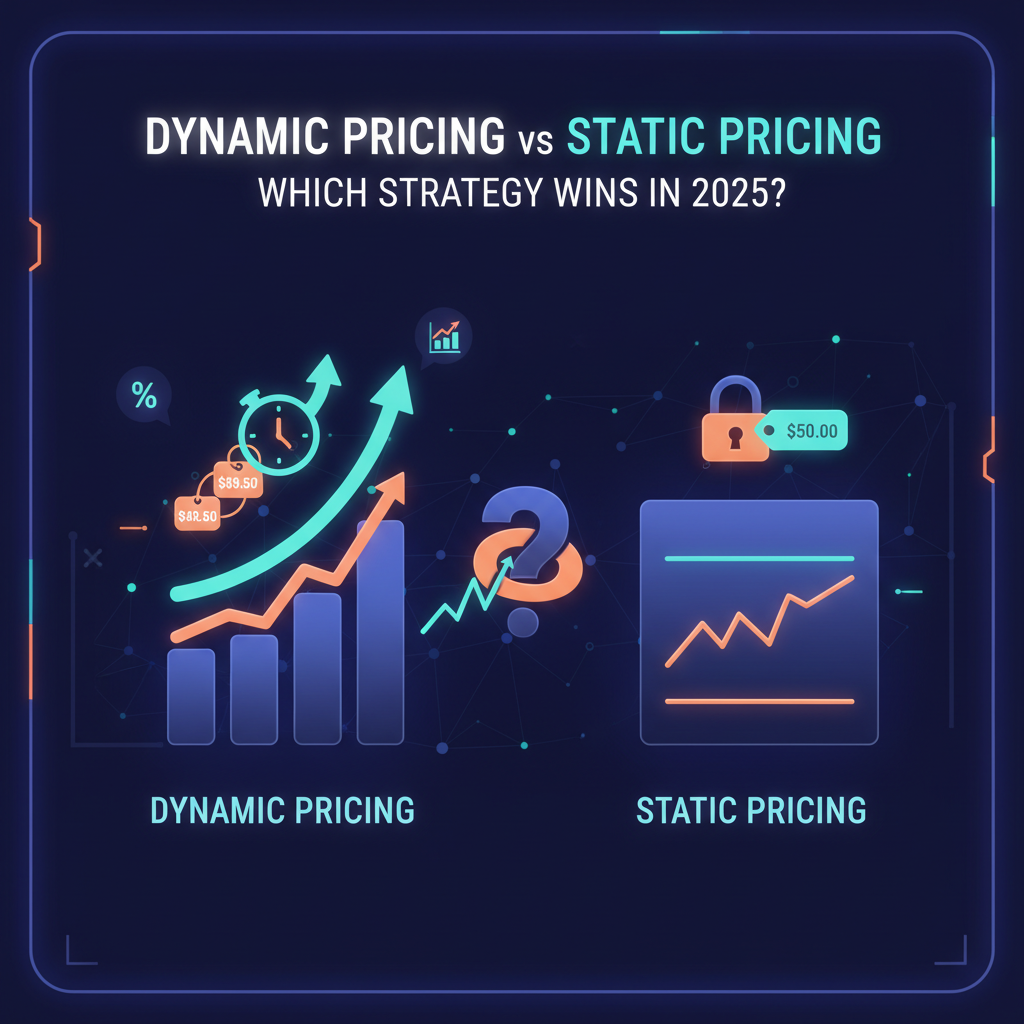
Static Pricing vs. Dynamic Pricing: Definitions, Key Differences, and Which Wins in 2025
Before deciding which direction to take your catalog, it helps to distinguish between static and dynamic pricing strategy in plain terms, because a lot of sellers use the words loosely without knowing exactly what separates the two.
The static pricing definition is straightforward: a fixed price that stays the same regardless of demand, competition, or timing, until someone manually changes it. Static pricing meaning, in practice, comes down to stability—your static price today is your static price next month unless you go in and edit it yourself. This is sometimes called a static rate, and a static market is simply one where most sellers are operating this way, with prices that barely move.
Dynamic pricing vs static pricing comes down to one core distinction: dynamic systems adjust automatically, in real time, based on live signals like competitor moves, inventory levels, and demand. Static cost structures stay fixed no matter what’s happening around them, while dynamic product pricing solutions recalculate constantly, sometimes every few minutes. This is the same mechanism that powers dynamic repricing tools on marketplaces like Amazon.
| Factor | Static Pricing | Dynamic Pricing |
|---|---|---|
| Price Changes | Manual, infrequent | Automatic, continuous |
| Responsiveness | None to competitor moves | Reacts within minutes or seconds |
| Best Fit | Custom goods, B2B, brand-consistent pricing | Marketplaces, commodity products, high SKU counts |
| Risk | Lost Buy Box, margin erosion over time | Race-to-the-bottom if guardrails are missing |
| Static rates vs dynamic rates | Fixed regardless of market conditions | Tied to real-time supply and demand signals |
Static discounts vs dynamic discounts follow the same logic on the promotional side: a static discount is a fixed percentage or dollar amount applied uniformly, while a dynamic discount adjusts based on factors like inventory age, customer behavior, or competitor activity. It’s worth noting there’s also a difference between dynamic pricing and price optimization—dynamic pricing is the mechanism that changes the price, while price optimization is the broader analytical process of figuring out what that price should actually be to maximize a specific outcome, whether that’s profit, volume, or Buy Box share.
When people search for dynamic pricing vs fixed pricing in retail pros and cons, the honest answer is that neither wins universally—fixed pricing offers predictability and low overhead, dynamic pricing offers responsiveness and margin capture, and the right dynamic static pricing strategies for your business usually blend both depending on the product line. This is exactly the kind of nuanced execution that Zupricer is built to handle: rather than forcing an all-or-nothing switch, Zupricer lets you apply dynamic logic where it earns the most, while leaving static, brand-sensitive SKUs untouched. Among the best automated pricing strategies 2025 has to offer, that kind of selective, guardrail-protected automation is what separates sellers who scale profitably from sellers who just automate blindly.
Finding the Right Approach for Your Business
Before jumping into dynamic pricing, answer these questions honestly:
What’s your competitive environment? Selling commoditized products against dozens of competitors on Amazon? Dynamic pricing is essential. Selling unique handmade items on your own website? Static pricing may work fine.
What’s your catalog size? Managing 500+ SKUs makes dynamic pricing ROI compelling through time savings alone. With fewer than 50 products in low-competition categories, the calculus changes.
What are your technical resources? Quality repricing tools cost $100-300/month, and someone needs to monitor and optimize them. If that’s feasible, dynamic pricing becomes accessible.
What’s your brand strategy? Premium positioning may benefit from price consistency. Value positioning typically benefits from competitive optimization.
Many successful sellers use hybrid approaches: dynamic pricing for commodity products, static pricing for branded or differentiated items; aggressive automation on marketplaces, more conservative approaches on brand websites.
Implementing Dynamic Pricing Without Destroying Your Margins
The biggest fear sellers have about dynamic pricing—racing to the bottom and destroying margins—is legitimate but avoidable with proper setup:
- Calculate true costs first: Include COGS, FBA fees, referral fees, estimated advertising costs, and overhead before setting any prices
- Establish non-negotiable profit floors: Your repricing tool should never drop below your minimum acceptable margin, regardless of competitive pressure
- Use SKU-specific strategies: High-margin products can compete more aggressively than low-margin commodities
- Monitor regularly: Automation doesn’t mean abandonment—review performance weekly and adjust parameters as needed
- Start with a pilot: Test on 10-20 products before rolling out to your full catalog
The sellers who get burned by dynamic pricing typically skip the profit floor step or set it incorrectly. With proper guardrails, dynamic pricing optimizes within the boundaries you define—it doesn’t override your business judgment.
The Verdict: Context Determines Strategy
Is dynamic pricing “better” than static pricing? That’s the wrong question. The right question is: which approach fits your specific situation?
Choose dynamic pricing when:
- You sell on Amazon, Walmart, eBay, or similar competitive marketplaces
- Your products compete with multiple other sellers
- Buy Box win rate directly impacts your sales volume
- You have 50+ SKUs that require regular price management
- Your margins can support reasonable repricing tool costs
Consider static pricing when:
- You sell unique, differentiated products with limited direct competition
- Your brand strategy depends on price consistency
- You primarily sell through your own website rather than marketplaces
- You operate in regulated industries with pricing restrictions
- Your technical resources genuinely can’t support dynamic tools
For most Amazon sellers reading this, the trajectory is clear: dynamic pricing has become essential infrastructure, not optional enhancement. The question isn’t whether to adopt it, but how to implement it effectively.
This is exactly where Zupricer delivers. Rather than choosing between basic rule-following or expensive enterprise solutions, Zupricer offers intelligent Amazon repricing that protects your margins while maximizing competitive positioning. With robust profit floor protection, inventory-aware pricing strategies, and real-time competitive response, Zupricer handles the complexity of dynamic pricing while you focus on growing your business. Because in today’s marketplace environment, the pricing strategy that wins isn’t the one that’s simplest or most sophisticated—it’s the one that’s smartest about protecting profit while staying competitive. That’s what modern repricing should deliver.