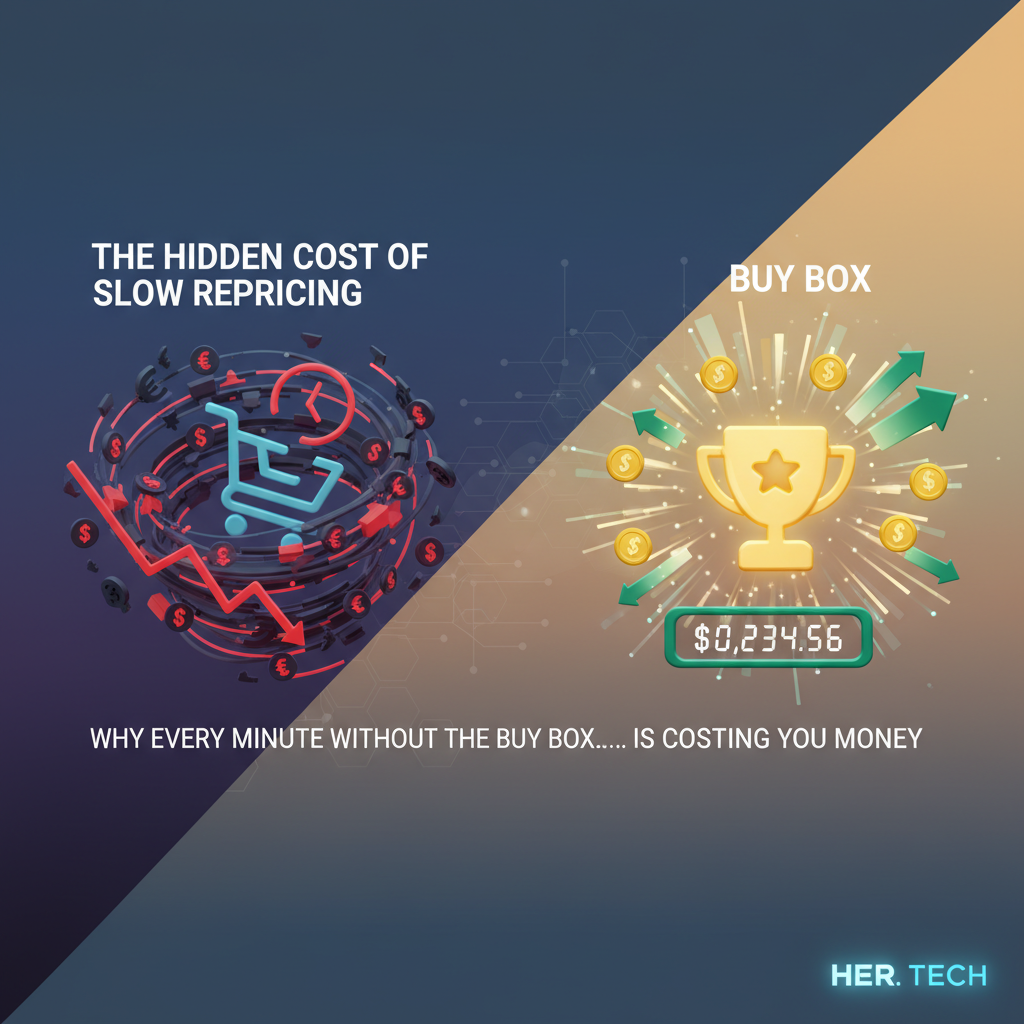
Here’s a scenario that plays out thousands of times every day on Amazon: A competitor drops their price by fifty cents. Your repricing tool—set to update every 30 minutes—doesn’t catch it until the next cycle. In that half hour, you’ve lost the Buy Box, missed a dozen potential sales, and watched your competitor capture revenue that should have been yours.
Most sellers obsess over product sourcing, listing optimization, and advertising spend. But there’s a silent profit killer lurking in their operations that rarely gets the attention it deserves: repricing speed. And the data we’re seeing in 2025 makes the cost of ignoring this issue painfully clear.
Industry research now shows that sellers using repricers with sub-5-minute update cycles achieve 23% higher Buy Box win rates than those relying on slower systems. That’s not a minor optimization—that’s the difference between a thriving Amazon business and one that’s constantly struggling to keep up.
Understanding Why Speed Matters More Than Ever
Let’s start with a fundamental truth about selling on Amazon: over 82% of all sales flow through the Buy Box. If you’re not in that coveted position, you’re essentially invisible to most shoppers. They see the “Add to Cart” button, click it, and your competitor gets the sale.
What many sellers don’t fully appreciate is how dynamic the Buy Box really is. In competitive categories, ownership can change hands multiple times per hour. Amazon’s algorithm operates in real-time, constantly evaluating which seller deserves that prime placement based on price, fulfillment method, seller metrics, and stock availability.
When your repricing tool updates every 15, 30, or 60 minutes, you’re essentially bringing a knife to a gunfight. Your competitors with faster systems are responding to market changes instantly while you’re still operating on outdated price data.
The Direct Costs You’re Already Paying
The most obvious cost of slow repricing is lost sales. But let’s put some real numbers around this to understand the true impact:
- Lost Buy Box time: In high-competition categories with 10+ sellers, slow repricing can mean losing 40-60% of potential sales opportunities during peak hours
- Margin erosion: Slow systems often overcompensate by dropping prices more aggressively than necessary, eroding 3-7% in margin compared to faster, more precise systems
- Peak period losses: During evenings, weekends, and promotional periods, every minute without the Buy Box represents revenue that can never be recovered
Consider a product that generates $100 in daily sales when you hold the Buy Box. If slow repricing causes you to lose that position for just 4 hours during peak shopping time, you could be leaving $20-30 on the table—every single day. Over a month, that’s $600-900 per SKU. Multiply that across your catalog, and the numbers become staggering.
The Hidden Costs Nobody Talks About
Beyond the obvious sales losses, slow repricing creates a cascade of secondary problems that compound over time:
Inventory Management Nightmares
When products don’t sell as quickly as they should, your inventory sits longer in Amazon’s warehouses. This triggers a chain reaction:
- Extended storage times increase FBA storage fees
- Products risk becoming aged inventory subject to even higher fees
- Poor inventory turnover ties up working capital
- Cash flow problems limit your ability to invest in new products
Algorithmic Penalties
Amazon’s algorithm doesn’t just look at your current price—it evaluates your overall performance patterns. Slow repricing creates inconsistent sales velocity, which signals to Amazon that your listing might not deserve prominent placement. The result?
- Lower organic search rankings
- Reduced algorithmic preference in Buy Box rotation
- Decreased visibility even when your price is competitive
- A downward spiral that becomes increasingly difficult to escape
Price Positioning Problems
Slow systems create a frustrating pattern: they drop prices too late (missing opportunities) and raise them too late (leaving money on the table). When a competitor’s unsustainably low price disappears, a fast repricer captures that margin improvement immediately. A slow one? It might take 30 minutes to notice—that’s 30 minutes of selling at a lower price than necessary.
Time-Based vs Event-Based Repricing: A Critical Distinction
Understanding the technical differences between repricing approaches helps explain why speed varies so dramatically between tools.
Time-based repricing operates on fixed intervals—checking competitor prices every 15, 30, or 60 minutes and adjusting accordingly. It’s simple and predictable, but it’s also blind to everything happening between those intervals. For stable, low-competition categories, this might be acceptable. For anything remotely competitive, it’s a liability.
Event-based repricing responds immediately when something changes in the market. A competitor adjusts their price? The system reacts within minutes or even seconds. Stock levels change? Pricing adapts instantly. This approach requires more sophisticated technology, but it’s become the standard for serious sellers in 2025.
The industry consensus is clear: event-based or hybrid systems with sub-5-minute updates are no longer premium features—they’re baseline requirements for competitive selling.
Calculating Your True Cost of Slow Repricing
Want to understand what slow repricing is actually costing your business? Here’s a framework to calculate it:
- Step 1: Identify your average hourly sales per product when you hold the Buy Box
- Step 2: Track how many hours per day you lose the Buy Box due to delayed price responses
- Step 3: Multiply lost hours by average hourly sales by your profit margin
- Step 4: Add storage fee increases from slower inventory turnover
- Step 5: Factor in margin erosion from aggressive pricing overcompensation
Most sellers who complete this exercise are shocked to discover they’re losing thousands of dollars monthly to a problem they didn’t even know they had.
What Fast Repricing Actually Requires
Achieving sub-5-minute repricing isn’t just about choosing the right software—it requires specific technical infrastructure:
- Direct API integration with Amazon Seller Central for real-time data access
- Sophisticated data processing capabilities to analyze market conditions instantly
- Event-triggered systems that respond to changes rather than waiting for scheduled updates
- Instant price update delivery to ensure changes take effect immediately
- Intelligent algorithms that optimize pricing without overreacting to temporary fluctuations
Not all repricing tools are built equal. Many advertise “real-time” capabilities but actually operate on much slower cycles under the hood. When evaluating solutions, ask specifically about update frequency and whether the system uses event-based triggers.
Strategic Recommendations for Different Seller Types
The right approach to repricing speed depends on your business model and competitive environment:
For high-volume sellers: Sub-5-minute repricing should be non-negotiable. The potential losses from slow updates far exceed any tool costs. Prioritize event-based repricing for your highest-velocity SKUs and monitor Buy Box win rates as a key performance metric.
For growing sellers: Start by implementing fast repricing on your top 20% of products—the ones driving most of your revenue. Track how sales velocity changes after upgrading, then expand to your full catalog as the ROI becomes clear.
For all sellers: Recognize that repricing speed affects everything else in your business. It’s not just about winning the Buy Box today—it’s about maintaining the sales velocity that keeps your rankings high and your inventory moving efficiently.
The Bottom Line: Speed Is No Longer Optional
The hidden cost of slow repricing isn’t really hidden anymore—not if you know where to look. It shows up in your lost Buy Box time, your inflated storage fees, your eroded margins, and your declining search rankings. It compounds daily, quietly draining profitability from your business while you focus on more visible problems.
The sellers who thrive on Amazon in 2025 understand that repricing speed is foundational infrastructure, not an optional upgrade. They’ve done the math and realized that investing in faster repricing pays for itself many times over.
That’s exactly why we built Zupricer with speed as a core principle. Our sub-5-minute repricing cycles ensure you’re never left behind when competitors make their moves. With event-based triggers, intelligent algorithms, and direct API integration, Zupricer keeps you in the Buy Box where you belong—capturing every sale your products deserve. Stop paying the hidden cost of slow repricing and start competing at the speed the market demands.
How Amazon’s API Rate Limits Impact Your Repricing Speed
Understanding the technical constraints behind repricing speed helps explain why not all “real-time” claims are equal. Amazon’s Selling Partner API (SP-API) imposes strict rate limits that directly affect how quickly repricing tools can update your prices.
The Product Pricing API, which most repricing tools rely on, allows only 0.5 requests per second with a burst capacity of 1. This is considered very restrictive compared to other API endpoints. The Orders API is even more limited at 0.0167 requests per second—essentially one request per minute sustained.
Amazon uses a token bucket algorithm to manage these limits, where the restrictions vary by endpoint, seller tier, marketplace, and even time of day. This means that during peak periods, API throttling can slow down even the most sophisticated repricing systems.
Some advanced repricing solutions work around these constraints by using the Reports API instead of individual API calls, which has more generous rate limits. This architectural choice is one reason why certain tools can achieve faster update cycles than others, even when all are technically accessing the same Amazon data.
Comparing Popular Repricing Tools and Their Update Frequencies
Not all automated repricing solutions deliver the same performance. Here’s what the research reveals about actual update speeds:
- Event-based systems: Respond in approximately 2-5 seconds to marketplace changes, offering the fastest reaction times
- Premium time-based tools: Update every 2-3 minutes, providing near-real-time adjustments
- Standard time-based tools: Check competitor prices every 15-20 minutes
- Budget solutions: May update only every 30-60 minutes, leaving significant gaps in market coverage
When evaluating Amazon repricing options, ask vendors specifically about their update frequency during peak hours. Some tools slow down during high-traffic periods due to API constraints, while others maintain consistent performance regardless of marketplace activity.
When Slower Repricing Might Be Acceptable
While speed is critical for most sellers, there are specific scenarios where sub-5-minute updates may not be necessary. Understanding these exceptions helps you allocate resources more effectively across your catalog.
Private label products in low-competition niches often don’t require aggressive time-based repricing. If you’re the only seller or one of just two or three competitors, prices typically don’t change frequently enough to justify premium repricing speeds. In these cases, investing your budget in marketing rather than ultra-fast repricing often delivers better returns.
Wholesale sellers with established brand relationships may also find that standard repricing intervals work adequately. When you’re selling products where prices don’t fluctuate dramatically throughout the day, a 15-minute update cycle might capture most opportunities without the added cost of faster systems.
High-margin specialty items with limited competition can often maintain the Buy Box without aggressive repricing. If your profit margins are 40-50% and you face minimal competition, the incremental benefit of faster repricing may not justify the investment.
However, even in these scenarios, monitoring your Buy Box win rate remains essential. If you notice declining performance, faster repricing might become necessary as competition increases.
Measuring Your Current Repricing Performance
You can’t improve what you don’t measure. Here are the key metrics every Amazon seller should track to evaluate repricing effectiveness:
Buy Box percentage: This is your most critical metric. Top-performing sellers typically achieve 70-90% Buy Box ownership in stable categories. If you’re consistently below 60%, your repricing strategy needs attention.
Sell-through rate: Track how quickly inventory moves compared to your historical averages. Slower inventory turnover often indicates you’re losing the Buy Box during critical selling windows.
Profit margin trends: Monitor whether your average margins are declining over time. Slow repricing often leads to overcompensation—dropping prices more than necessary to regain lost ground.
Response time to competitor changes: Manually test how long it takes your repricing tool to react when a competitor adjusts their price. If it’s longer than 5 minutes, you’re operating at a competitive disadvantage.
Most sellers discover significant performance gaps when they start tracking these metrics systematically. The data often reveals that what seemed like a minor repricing delay is actually costing thousands in monthly revenue.