Let’s face it: if you’re selling on Amazon in 2025, you’re not just competing against a few other sellers anymore. You’re battling algorithms, razor-thin margins, and competitors who update their prices every few minutes. With the Buy Box controlling approximately 82% of Amazon sales, your pricing strategy isn’t just important—it’s everything.
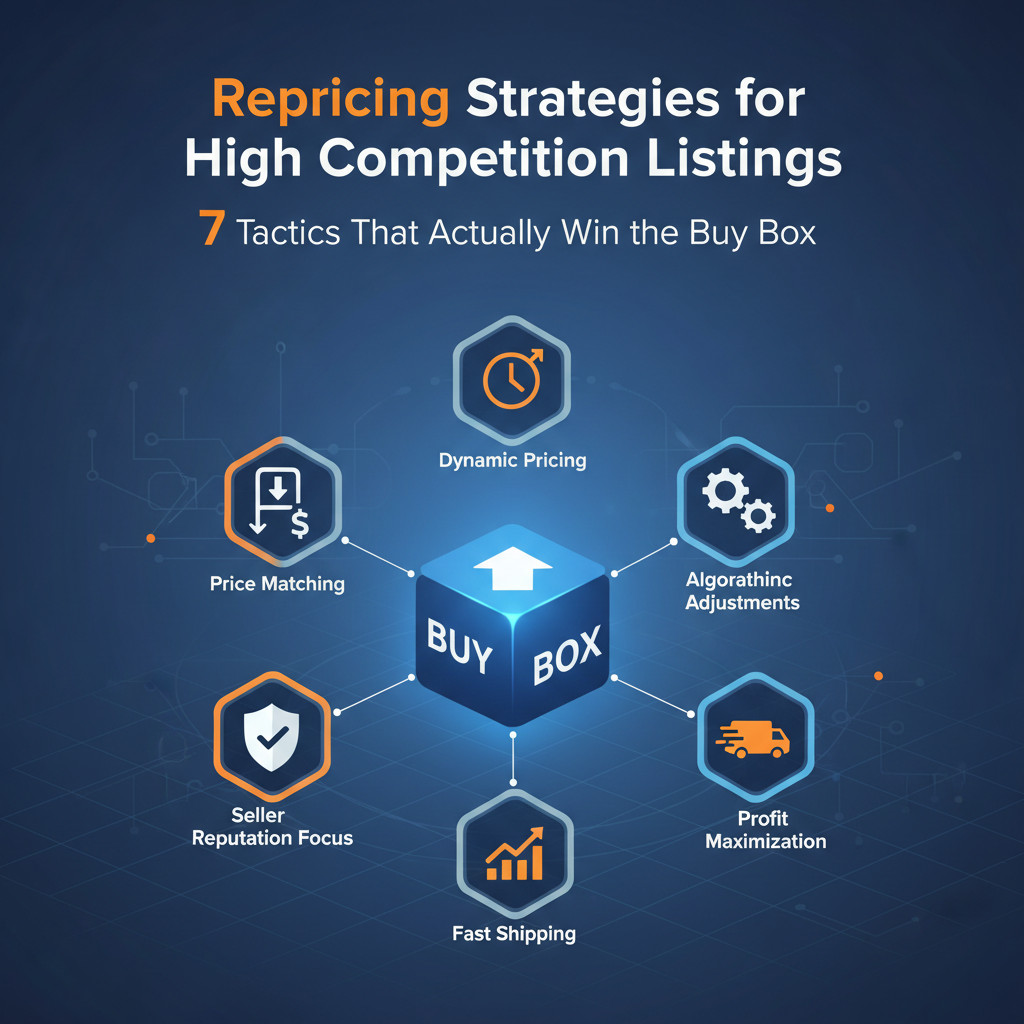
The days of manually adjusting prices or using simple rule-based repricing are fading fast. Today’s high-competition listings demand sophisticated strategies that balance winning the buy box with actually making money. In this guide, we’ll break down the seven most effective repricing strategies that top sellers are using right now, plus the technical standards you need to implement them successfully.
Why Traditional Repricing No Longer Works
Here’s the uncomfortable truth: blindly undercutting your competitors is a race to the bottom. It might win you the Buy Box temporarily, but it destroys your margins and trains customers to expect rock-bottom prices. The smartest sellers in 2025 have moved beyond this approach entirely.
According to a McKinsey survey, over 40% of companies have now adopted AI tools for pricing analysis. The AI-based dynamic pricing tool market was valued at $468 million in 2024 and is projected to reach $765 million by 2032. This isn’t a trend—it’s a fundamental shift in how competitive pricing works.
So what strategies are actually delivering results in high-competition categories? Let’s dive in.
1. AI-Powered Game Theory Repricing
This is the most sophisticated approach available today, and it’s transforming how sellers compete. Rather than simply reacting to competitor prices, game theory algorithms analyze and profile your competitors’ behavior patterns.
The system categorizes competitors into two types:
- Cooperative competitors: Those who price at or above your price point
- Uncooperative competitors: Those who consistently undercut you
By understanding these patterns, the algorithm optimizes your prices to maximize ROI rather than just chasing the lowest price. This means you might hold a slightly higher price against cooperative competitors while being more aggressive with chronic undercutters. The result? Better margins without sacrificing Buy Box share.
2. Buy Box Targeting Strategy
Sometimes you need velocity over margin. The Buy Box targeting strategy is your go-to aggressive approach when inventory needs to move—fast.
Here’s how it works:
- Position your price $0.02 to $0.10 below the current Buy Box holder
- Deploy this strategy when inventory ages to 60-120 days old
- Always set manual maximum price limits to prevent catastrophic pricing errors
- Use it strategically, not as your default approach
This isn’t about long-term profit optimization—it’s about velocity. When you’ve got aging stock eating up storage fees, sometimes the smartest move is to clear it out and reinvest that capital into faster-moving products.
3. The Liquidation Strategy
Think of this as Buy Box targeting’s more aggressive cousin. Liquidation pricing is designed to clear aging inventory at breakeven or minimal profit, and there’s actually a smart business case for it.
The math is simple: holding dead stock for a year ties up capital that could be generating returns elsewhere. A well-executed liquidation strategy lets you complete your inventory cycle in approximately 45 days instead of watching products gather dust.
The cycle looks like this:
- Liquidate aging inventory at breakeven
- Reinvest capital into new, higher-potential inventory
- Apply AI-optimized pricing to new inventory for higher ROI
- Repeat the cycle faster than competitors
The sellers who understand this aren’t afraid of breakeven liquidations—they see it as strategic capital reallocation.
4. Inventory-Aware Dynamic Pricing
Your pricing strategy should know what your warehouse knows. Inventory-aware pricing makes real-time adjustments based on stock levels and storage age, integrating directly with your seller platform.
This approach serves two critical functions:
- Preventing stockouts: When inventory runs low on high-velocity items, prices automatically increase to slow demand and protect your listing
- Accelerating clearance: When stock is aging or overstocked, prices drop to increase velocity before storage fees eat your margins
The best implementations connect directly to Seller Central, monitoring real-time stock levels and adjusting pricing accordingly without any manual intervention.
5. Fulfillment-Type Differentiation
Not all competitors are created equal in Amazon’s eyes. The Buy Box algorithm favors FBA (Fulfilled by Amazon) sellers, which means your competitive strategy should account for this reality.
Smart repricing tools distinguish between FBA and FBM (Fulfilled by Merchant) competitors when making pricing decisions. If you’re an FBA seller competing against FBM sellers, you may be able to maintain a slightly higher price and still win the Buy Box due to Amazon’s preference for Prime-eligible inventory.
Conversely, if you’re an FBM seller, you’ll need to be more aggressive on price to overcome the fulfillment disadvantage. Understanding this dynamic lets you price strategically rather than blindly.
6. Time-Based Pricing Rules
Consumer behavior isn’t constant throughout the day or week, and your pricing shouldn’t be either. Time-based pricing rules let you capture demand during peak shopping hours while protecting margins during slower periods.
Practical applications include:
- More aggressive pricing during evening shopping hours when conversion rates peak
- Adjusted strategies for weekend versus weekday shopping patterns
- Seasonal pricing rules that activate automatically during high-demand periods
- Flash sale pricing that reverts automatically after specified windows
The key is automation. Manual price changes can’t keep up with these patterns, but scheduled rules can execute flawlessly around the clock.
7. Margin-Based Floor Protection
Every other strategy we’ve discussed comes with a critical caveat: you need guardrails. Margin-based floor protection ensures that no matter how aggressive your repricing becomes, you never sell at an unprofitable price.
Best-in-class implementations offer:
- Minimum price rules at both catalog and individual SKU levels
- Margin-based floors that account for all costs, not just product cost
- Time-based overrides for strategic promotions
- Alerts when prices hit floor levels
This is your safety net. Without it, aggressive algorithms and competitive pressure can push prices into unprofitable territory before you even notice.
Technical Implementation: Getting the Details Right
Having the right strategy means nothing if your technical execution falls short. In high-competition categories, repricing frequency should be every 2-5 minutes. Anything slower, and you’re losing Buy Box share to competitors who respond faster to price changes.
You’ll also need robust alert systems that notify you of:
- Prices hitting minimum floors
- Unusual competitive activity (potential price wars)
- Dramatic changes in sales velocity
- Buy Box losses on key products
Finally, remember that no repricing tool can overcome fundamental seller metric problems. You still need optimized listings, sufficient inventory, and solid performance metrics. Repricing amplifies good fundamentals—it can’t replace them.
Putting It All Together
The most successful sellers in high-competition categories don’t rely on a single repricing strategy. They segment their inventory and apply different approaches based on product performance, inventory age, and margin requirements.
New, high-margin products might use AI-powered game theory to maximize profit. Aging inventory transitions to Buy Box targeting, then liquidation if necessary. Throughout it all, margin floors protect profitability while fulfillment-type differentiation and time-based rules optimize for real-world competitive dynamics.
If managing all of this sounds complex, that’s because it is. This is exactly why Zupricer was built—to give Amazon sellers enterprise-level repricing intelligence without the enterprise-level complexity. Our platform combines AI-powered optimization, intelligent competitor analysis, and comprehensive floor protection into a single solution that works around the clock to win you the Buy Box while protecting your profits.
Ready to stop racing to the bottom and start pricing strategically? Discover how Zupricer can transform your competitive positioning in even the most crowded categories.
Understanding Your True Product Costs: The Foundation of Profitable Repricing
Before implementing any repricing strategies, you need to know your actual break-even point. Too many Amazon sellers set minimum prices based on product cost alone, completely ignoring the dozen other fees Amazon charges. This oversight leads to “profitable” sales that actually lose money.
Here’s the complete formula for calculating your true minimum price:
Minimum Price = (Product Cost + FBA Fee + Inbound Shipping + Returns Provision + Target Margin) ÷ (1 – Referral Fee %)
Let’s break down each component. Product cost includes what you paid your supplier plus any prep costs. FBA pricing includes both fulfillment fees and monthly storage charges, which vary by size tier and season. Inbound shipping covers the cost to get products into Amazon’s warehouses. Returns provision should account for your category’s typical return rate—electronics might need 5-8%, while grocery items need less. Your target margin is the profit you actually want to make, not just break even.
The referral fee percentage varies by category, typically ranging from 8% to 15%. This is why you divide by (1 – referral rate) rather than simply adding it—the fee is calculated on the final sale price, not your cost.
Competitor Analysis: Know Who You’re Really Fighting
Effective competitive pricing requires understanding your competition beyond just their current prices. Start with Amazon’s built-in tools: the “Manage All Inventory” section shows whether you currently hold the Featured Offer, while the “Pricing Health” dashboard highlights listings where your price isn’t competitive.
For deeper intelligence, consider third-party tools. Keepa tracks historical price data, revealing competitor pricing patterns over weeks and months. This helps you identify sellers who consistently hold higher prices versus those racing to the bottom. Jungle Scout and Helium 10 provide competitive research capabilities, showing estimated sales volumes and revenue at different price points.
When analyzing competitors, filter by seller metrics. A seller with 85% positive feedback shouldn’t dictate your pricing strategy—they’re unlikely to win the buy box consistently anyway. Focus on high-performing sellers (95%+ positive ratings) who represent your real competition.
Seller Performance Metrics: The Buy Box Eligibility Requirements You Can’t Ignore
Price is only one factor in Amazon repricing success. Without meeting Amazon’s performance thresholds, even the lowest price won’t win you the Buy Box. Here are the non-negotiable metrics:
- Order Defect Rate (ODR): Must stay below 1%
- Late Shipment Rate: Keep it under 4%
- Pre-Fulfillment Cancellation Rate: Below 2.5%
- Valid Tracking Rate: Above 95%
- Customer Feedback Score: Aim for 95%+ positive ratings
These metrics matter more than many sellers realize. A Prime seller with 97% positive feedback can win the Buy Box at prices 5-15% above lower-rated competitors. This is why margin protection strategies work—you don’t always need the lowest price if your seller metrics are strong.
Avoiding Price Wars: Strategic Responses to Aggressive Competitors
Price wars destroy profitability for everyone involved. When a competitor drops their price by $2, your automated repricer might respond by dropping $2.05, triggering their repricer to drop another $2, and suddenly you’re both selling at a loss.
The solution is strategic floor protection combined with competitor filtering. Set SKU-level price floors based on your true cost calculation, not arbitrary percentages. Configure your repricer to ignore sellers below certain feedback thresholds—if someone with 70% positive feedback drops to an unprofitable price, let them have those sales. They won’t last long anyway.
Implement ceiling-hunt rules when you already hold the Buy Box. If you’re winning at $24.99, there’s no reason to drop to $23.50 just because a low-rated seller listed there. Hold your price until you actually lose the Buy Box, then respond strategically.