There’s a pricing strategy that feels logical, looks smart on paper, and is slowly destroying thousands of Amazon businesses. It’s called undercutting, and if you’re doing it systematically, you’re probably watching your margins evaporate while wondering why you’re working harder than ever for less money.
Here’s the uncomfortable truth: with Amazon seller profit margins averaging just 10-20% in 2025—and facing pressure from rising fees, increased advertising costs, and intensifying competition—every dollar you shave off your price comes directly from your pocket. Not from Amazon fees. Not from your supplier’s costs. From your profit.
Let’s break down exactly why the undercutting strategy that’s supposed to help you win is actually the thing that’s killing your business.
Understanding the Race to the Bottom
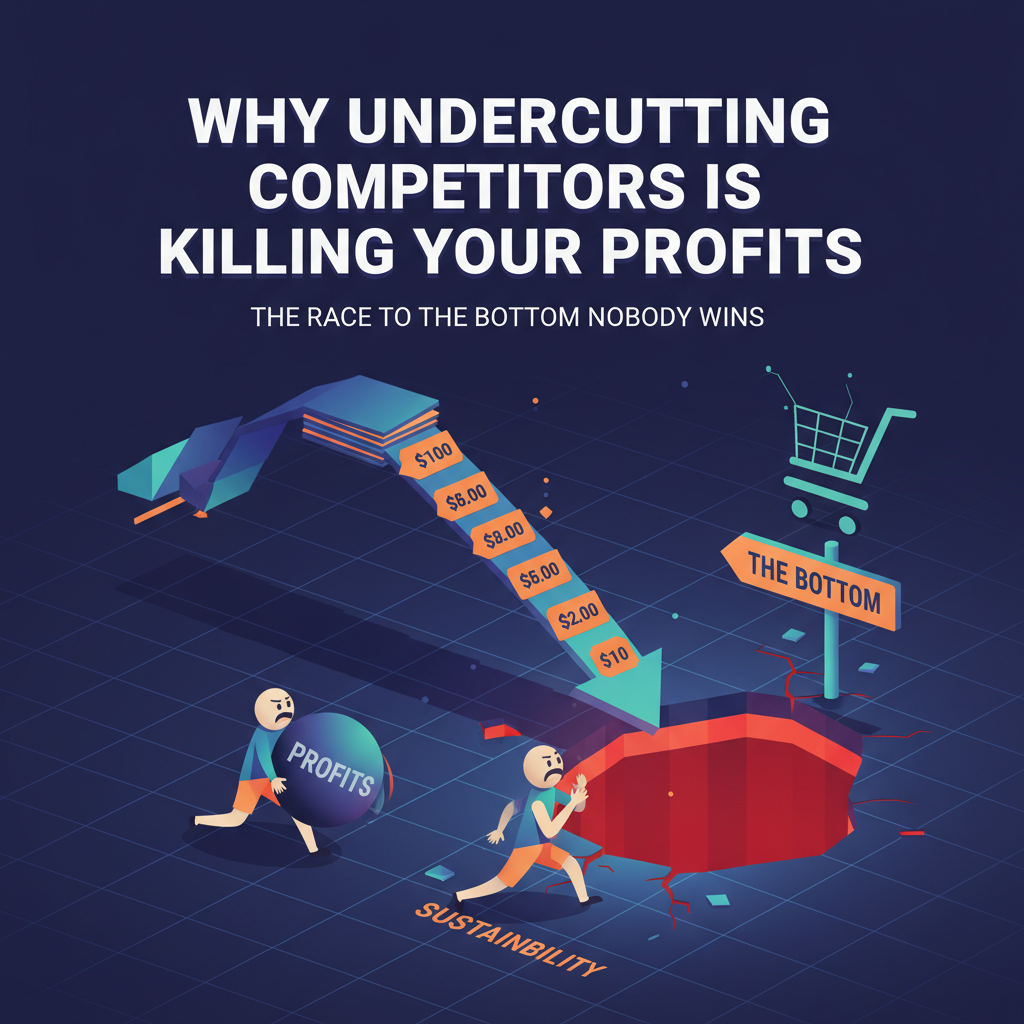
The “race to the bottom” isn’t just a catchy phrase—it’s a documented phenomenon that plays out on Amazon listings every single day. Here’s how it typically unfolds:
- Seller A drops their price by $0.50 to capture the Buy Box
- Seller B’s repricing tool immediately matches or undercuts by another $0.25
- Seller C responds with their own price cut to stay competitive
- Seller A, now losing the Buy Box, cuts again
- The cycle repeats until everyone is selling at breakeven—or worse
If you’re an Online Arbitrage or Retail Arbitrage seller, you’ve probably lived this nightmare. You source a product with a beautiful 25% margin, ship it to FBA, and by the time it’s checked in and live, the listing price has tanked. That profitable product is now a breakeven proposition at best.
The worst part? Nobody wins this game. Every seller on the listing ends up worse off, and the only beneficiary is the customer who got a deal—at your expense.
The Math That Proves Undercutting Destroys Margins
Let’s look at actual numbers to see how quickly undercutting erodes your profits. Consider a typical product scenario:
Starting position:
- Selling price: $30.00
- Amazon referral fee (15%): $4.50
- FBA fulfillment fee: $4.00
- Product cost: $15.00
- Your profit: $6.50 (21.7% margin)
After just three rounds of $0.50 undercutting:
- New selling price: $28.50
- Amazon fees: Still $8.50 total
- Product cost: Still $15.00
- Your new profit: $5.00 (17.5% margin)
That’s a 23% reduction in your profit from a price change most customers wouldn’t even notice. And here’s the critical insight: your fees don’t decrease when you drop your price. Referral fees, FBA fulfillment fees, storage fees—they all stay the same or represent a higher percentage of your now-lower revenue.
Every penny you cut comes directly from profit. There’s nowhere else for it to come from.
The Hidden Costs You’re Not Calculating
Direct margin erosion is just the beginning. Undercutting creates cascading problems that compound over time:
Capital Efficiency Collapses
When you’re selling at thin margins, you need more capital tied up in inventory to generate the same profit. That means less money available for product development, expansion, or simply weathering slow periods. Your business becomes fragile precisely when it needs to be resilient.
Advertising ROI Tanks
Your PPC costs don’t drop when your prices do. If you’re spending $3 per conversion on a product with $6.50 margin, you’re keeping $3.50. Drop that margin to $5.00 through undercutting, and suddenly you’re keeping just $2.00 per sale. Same ad spend, 43% less profit per conversion.
Storage Fees Eat What’s Left
Lower margins often push sellers to stock more inventory to maintain absolute profit numbers. More inventory means higher storage fees, which further compress already-thin margins. Add in the mid-2025 low-inventory-level surcharges, and you’re caught between two bad options.
Return Rates Increase
Here’s something most sellers don’t track: customers who buy primarily on price tend to have higher return rates and leave harsher reviews. They have unrealistic expectations because the low price signals a bargain they’re not actually getting. Those returns and negative reviews cost you far more than the marginal sales you gained.
Why Your Competitors Want You to Undercut
Some sophisticated sellers actually use undercutting as a weapon—but probably not in the way you think. Here’s the playbook:
- A well-capitalized seller with large inventory aggressively undercuts the listing
- Smaller sellers, following the price down, sell through their limited stock quickly at razor-thin margins
- Once competition has depleted their inventory, the large seller raises prices significantly
- With competitors out of stock, they capture the Buy Box at 20-30% higher margins
If you’re a smaller seller matching every price drop, you’re playing directly into this strategy. You’re exhausting your inventory and capital at terrible margins while your competitor waits patiently to profit after you’re gone.
The sellers who win this game aren’t the ones who undercut fastest—they’re the ones with the discipline and capital to wait out the price war and profit when it ends.
The Brand Damage You Can’t See Yet
Beyond immediate financial impact, chronic undercutting destroys something harder to measure but equally important: your brand value.
Pricing psychology research consistently shows that lower prices signal lower quality to customers. When you’re always the cheapest option, you’re training customers to see your products as commodities—interchangeable with whatever else is available at the lowest price.
Consider these documented effects:
- Premium pricing can increase perceived value by 22-35%
- Customers anchored to low prices resist future price increases
- Price-focused buyers show minimal brand loyalty
- Consistent discounting erodes brand equity over time
If you’re building a private label brand, this matters enormously. Every time you race to the bottom, you’re telling customers your product isn’t worth more than your competitors’. That’s a hard message to reverse.
What Smart Sellers Do Instead
The most profitable Amazon sellers in 2025 have abandoned the undercutting mentality entirely. Here’s what they focus on instead:
Value-Based Pricing
Price based on the value you deliver, not what competitors charge. Invest in superior listing quality—better images, compelling A+ Content, video demonstrations. Give customers reasons to choose you beyond price.
Differentiation Over Price Competition
Create advantages competitors can’t easily copy: unique bundles, superior packaging, enhanced product features, exclusive designs. When you’re genuinely different, you’re not competing on the same axis as everyone else.
Strategic Repricing with Hard Floors
Use repricing tools intelligently—not to undercut automatically, but to optimize within profitable boundaries. Set margin-based minimum prices and never violate them, even if it means temporarily losing the Buy Box.
Competitor Intelligence
Not all competitors are the same. Some are chronic undercutters you should never follow down. Others are strategic pricers you can coexist with profitably. Understanding the difference is crucial.
Setting Price Floors That Actually Protect You
The single most important change you can make is establishing—and honoring—a true price floor for every product. This requires calculating your actual profitability including every cost:
- Referral fees (category-specific)
- FBA fulfillment fees
- Storage fees (including long-term if applicable)
- Advertising costs per unit
- Return and damage allowances
- Your actual product cost including shipping to Amazon
Once you know your true breakeven, add the minimum margin you need to make the business worthwhile. That’s your floor. Period. Losing the Buy Box temporarily is better than winning it unprofitably.
Breaking the Cycle for Good
The undercutting trap is seductive because it feels proactive. You’re doing something. You’re competing. You’re winning sales. But the math doesn’t lie: you’re trading dollars for pennies and calling it a strategy.
The sellers who thrive understand that pricing is about optimization, not minimization. They focus on total profit, not sales volume. They build competitive advantages that justify their prices instead of slashing prices to compensate for weak differentiation.
This is exactly where Zupricer transforms how sellers approach pricing. Instead of mindlessly chasing competitors into unprofitable territory, Zupricer’s intelligent repricing focuses on margin protection and profit optimization. With customizable price floors, competitor behavior analysis, and smart automation that knows when not to follow a price drop, Zupricer helps you stay competitive without sacrificing the profits you’ve worked so hard to build.
Stop letting undercutting kill your business. Start pricing for profit—and let Zupricer show you how.