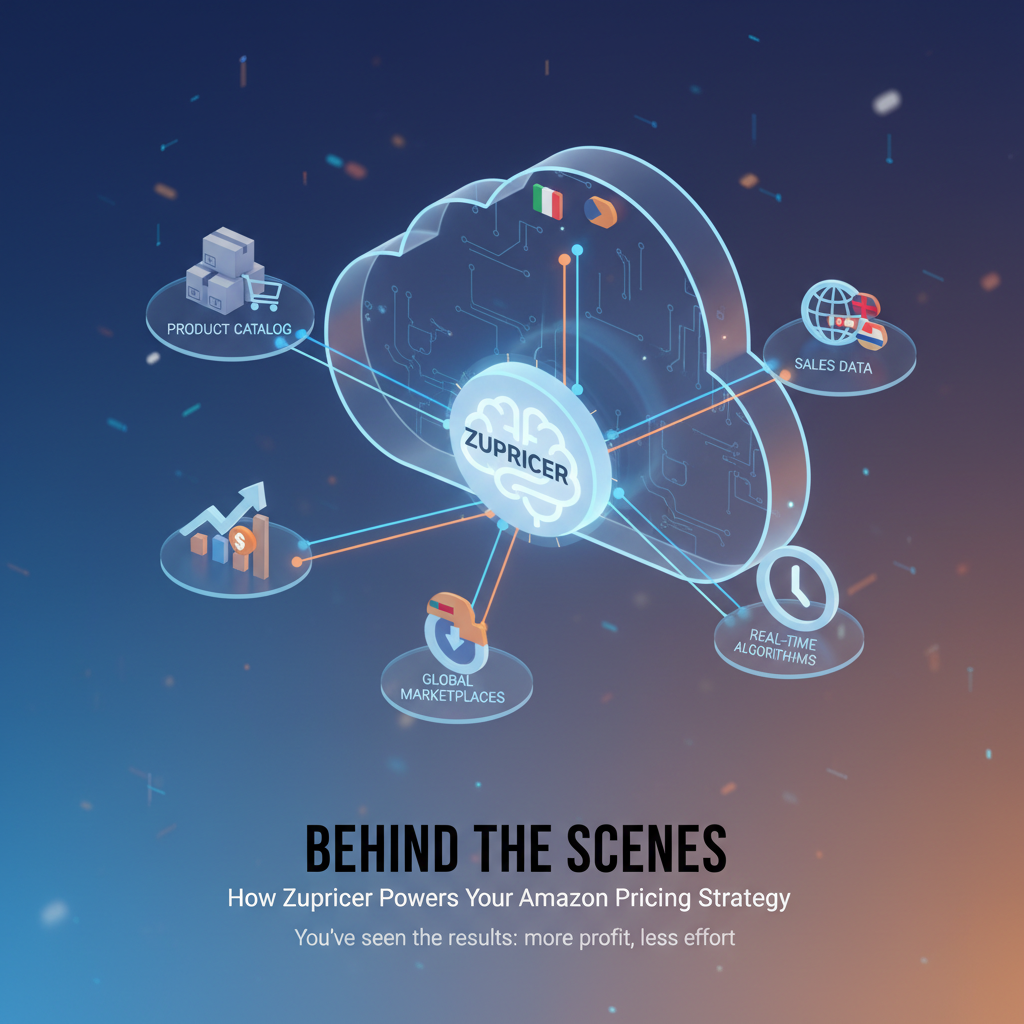
You’ve seen the results: more Buy Box wins, better margins, sales that seem to happen on autopilot. But what actually happens when you connect a repricing tool to your Amazon account? What goes on behind the scenes between the moment a competitor changes their price and when your listing automatically adjusts?
Understanding how repricing technology works isn’t just interesting—it’s strategically valuable. When you know what’s happening under the hood, you make better decisions about rule configuration, margin protection, and competitive strategy. You stop treating repricing as a black box and start leveraging it as the sophisticated business tool it truly is.
Let’s pull back the curtain on how modern repricing platforms like Zupricer actually work.
The Foundation: Connecting to Amazon’s Selling Partner API
Everything starts with Amazon’s Selling Partner API (SP-API), the official programmatic interface that allows third-party tools to communicate with Seller Central. This replaced the older Marketplace Web Services and offers improved data access, better security, and higher throughput.
When you authorize Zupricer to access your account, several things happen:
- OAuth 2.0 Authentication: You grant permission through Amazon’s Login with Amazon (LwA) system, maintaining full control over what data the repricing tool can access
- IAM Role-Based Security: Amazon requires all API calls to use role-based authentication, creating a secure connection between Zupricer and your Seller Central account
- Continuous Two-Way Communication: Once connected, the repricing tool maintains a persistent link, constantly querying for data and sending pricing updates
Through SP-API, Zupricer gains access to the Product Pricing API (competitor prices, Buy Box status, shipping costs), the Inventory API (stock levels and warehouse locations), the Orders API (sales velocity and conversion data), and the Notifications API—which is where the magic really happens.
The 90-Second Advantage
Here’s a critical detail that separates automated repricing from manual adjustments: when a competitor changes their price on your ASIN, Amazon sends a notification to connected repricing tools within 90 seconds. This event-based notification system enables near-instant competitive response that simply cannot be replicated by checking prices manually a few times per day.
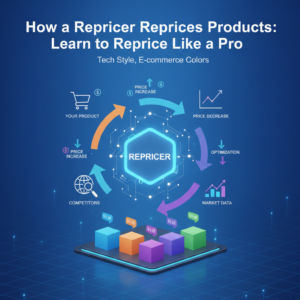
The Five-Step Repricing Workflow
Step 1: Continuous Data Collection
Zupricer constantly monitors your competitive environment, tracking:
- Competitor price changes across all your ASINs
- Current Buy Box holder and their pricing
- Inventory levels for you and your competitors
- Fulfillment methods (FBA vs. FBM) of competing offers
- Seller ratings and performance metrics
- Time-of-day and weekly sales patterns
The scale of this monitoring is staggering. Consider a seller with 1,000 SKUs facing an average of 5 competitors per product. That’s 5,000 competitive data points being updated every 10 minutes—720,000 daily checks that would be humanly impossible to replicate manually.
Step 2: Intelligent Data Processing
When a competitor price change triggers an event notification, Zupricer’s engine springs into action, analyzing multiple factors simultaneously:
- Is this competitor actually relevant? (An FBM seller with poor ratings might not threaten your FBA listing’s Buy Box position)
- What’s their total landed cost including shipping?
- Do they have sufficient inventory, or are they about to stock out?
- How does their new price compare to the current Buy Box?
- What’s their historical pricing pattern—are they a stable competitor or a liquidator?
This analysis considers your configured rules, your minimum and maximum price boundaries, your current inventory position, and your strategic objectives.
Step 3: The Pricing Decision
This is where repricing technology has transformed dramatically. Traditional rule-based systems use simple if/then logic: “If competitor price is lower than mine, match it minus $0.25.” These rules are easy to understand but fundamentally limited—they can’t optimize across multiple variables or learn from outcomes.
Modern AI-powered repricing takes a completely different approach. Instead of following rigid rules, the system optimizes for your actual business goals: maximum revenue, maximum profit margin, inventory turnover rate, or a balanced combination.
The AI components work together:
- Demand Forecasting: Analyzing historical sales data to identify price elasticity and predict optimal price points
- Pattern Recognition: Detecting time-of-day buying patterns, seasonal fluctuations, and competitor strategies
- Multi-Objective Optimization: Balancing Buy Box capture against margin protection based on current conditions
- Reinforcement Learning: Improving strategies continuously based on actual outcomes
Step 4: Price Implementation
Once the optimal price is calculated, Zupricer sends the update to Amazon via the SP-API. The process takes just minutes:
- New price calculated and verified against your boundaries
- API call sent to Amazon
- Amazon validates and applies the change
- New price goes live on your listing
Total response time from competitor change to your adjusted price: 2-5 minutes. Compare that to manual repricing where you might check prices three times daily and miss 8 hours of opportunity with each gap.
Step 5: Performance Tracking and Learning
After each pricing decision, the system tracks results: Did you win the Buy Box? For how long? What was the sales velocity at that price? What margin did you achieve? How did competitors respond?
This data feeds back into the AI engine, continuously improving future decisions. The system learns which strategies work best for your specific products, which competitors respond in predictable ways, and what price points maximize your particular objectives.
The Technology Powering the Platform
Behind Zupricer’s simple interface lies a sophisticated technology stack:
API Integration Layer
This component manages all communication with Amazon’s SP-API, handling authentication, respecting rate limits (Amazon restricts request frequency), managing errors gracefully, and processing real-time notifications. The complexity here is significant—the system must intelligently batch requests and prioritize critical data while managing thousands of API calls per minute.
Database Infrastructure
Every historical price, sales event, inventory change, and Buy Box win or loss is stored for analysis. For a platform managing thousands of seller accounts with hundreds of SKUs each, this means processing hundreds of millions of data points daily. The database architecture must be robust, scalable, and lightning-fast.
The Repricing Engine
The core algorithm combines rule-based logic with machine learning capabilities. Neural networks process multiple variables simultaneously. Decision trees map complex scenarios. Regression models predict sales outcomes at different price points. Optimization algorithms find the best price given multiple objectives. All of this must execute in seconds when competitor changes occur.
User Interface
Despite the backend complexity, what sellers see is clean and intuitive: dashboards showing Buy Box win rates, revenue and margin tracking, rule configuration interfaces, competitor filtering, alert systems, and performance analytics. The complexity operates invisibly, delivering simple outcomes.
Advanced Capabilities That Make the Difference
Inventory-Aware Pricing
Smart repricing doesn’t operate in isolation from your stock levels. When inventory drops below a certain threshold, the system can raise prices to slow velocity and prevent stockouts. When inventory is excessive and storage fees loom, it can price more aggressively to move product. This integration reduces stockout incidents by 40-60% while improving margins during low-stock periods.
Competitor Intelligence
Not all competitors matter equally. Advanced repricing tools identify new competitors on your ASINs, map their pricing strategies, detect liquidators to ignore, recognize when competitors use repricing tools themselves, and track their inventory levels. This intelligence allows strategic competition rather than blind price matching.
Scenario Simulation
Before committing to a strategy, you can test it. What if you set your minimum price at $25 versus $27? What revenue impact would you see if you only competed with FBA sellers? How would a 15% margin floor affect your Buy Box win rate? Simulation capabilities let you forecast and stress-test strategies before implementation.
Temporal Optimization
Buyer behavior changes throughout the day and week. During high-intent evening hours, the system can price for maximum margin. During comparison-shopping periods, it prices for competitiveness. This temporal intelligence adds revenue without sacrificing Buy Box presence.
Security and Reliability You Can Trust
With your business depending on continuous operation, security and uptime aren’t optional—they’re essential.
Data protection measures include encrypted API connections, secure credential storage, access controls, regular security audits, and strict compliance with Amazon’s API terms of service. Your seller data remains segregated and protected, with competitive intelligence aggregated and anonymized.
Reliability standards target 99.9% uptime (less than 9 hours of downtime annually) with redundant systems, failovers, and instant failure alerts. Because every minute of downtime means missed Buy Box opportunities and lost revenue.
From Rules to AI: The Evolution of Repricing
Understanding where repricing technology has come from helps appreciate where it is today. Early rule-based systems from 2015-2020 used simple logic that often created race-to-bottom pricing wars. Advanced rule-based tools added competitor filtering and inventory integration but still required constant manual adjustment.
Today’s AI-powered platforms represent a fundamental shift. They don’t just follow rules—they optimize for outcomes. They learn from every pricing decision, improving continuously. They balance multiple objectives simultaneously rather than pursuing a single metric blindly.
The result: AI strategies optimize for margin, revenue, or inventory goals while leveling the playing field for sellers of all sizes.
Why Understanding the Technology Matters
You don’t need to be an engineer to benefit from repricing technology, but understanding how it works makes you a better strategist. When you know that the system responds within minutes to competitor changes, you understand why manual monitoring can’t compete. When you grasp how the AI balances multiple objectives, you configure smarter rules. When you see how inventory integration works, you make better stocking decisions.
The technology is sophisticated, but the goal is simple: win more Buy Boxes, protect your margins, and scale your business without proportional increases in workload.
That’s exactly what Zupricer delivers. Built on the robust technology architecture described here—secure SP-API integration, AI-powered decision making, real-time competitive response, and inventory-aware optimization—Zupricer transforms complex pricing challenges into automated solutions. While the technology works tirelessly behind the scenes, you focus on what matters: growing your business. Ready to see the technology in action? Let Zupricer show you what’s possible when sophisticated repricing works for you around the clock.