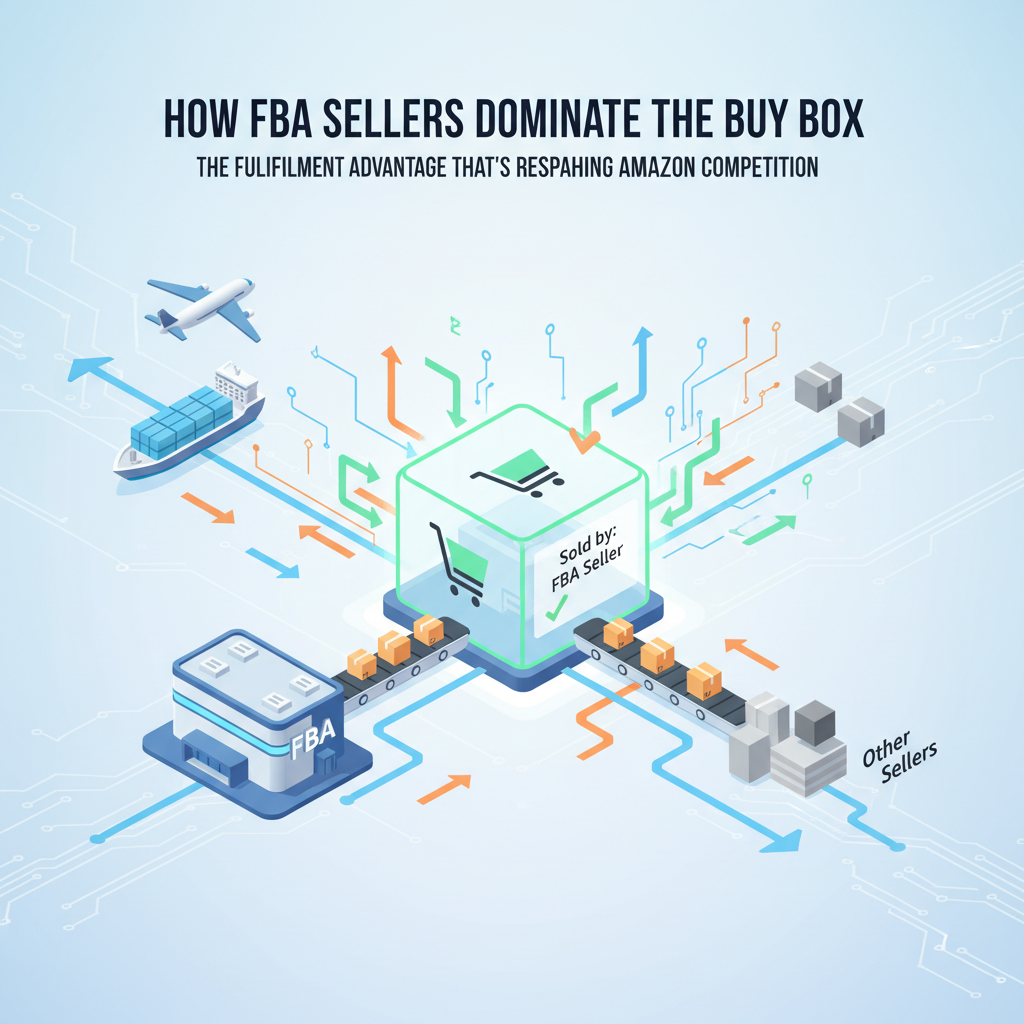
Here’s a statistic that should make every Amazon seller pay attention: FBA sellers win the buy box 70-80% more frequently than their FBM counterparts. Not 7-8% more. Seventy to eighty percent more. This isn’t a slight edge or a marginal benefit—it’s a fundamental competitive divide that determines which sellers thrive and which struggle to gain traction.
With approximately 82% of active Amazon sellers now using Fulfillment by Amazon either exclusively or as part of a hybrid model, the marketplace has rendered its verdict. FBA isn’t simply a logistics convenience anymore. It’s become a strategic imperative for anyone serious about capturing consistent Buy Box share and scaling their Amazon business.
Understanding exactly why FBA sellers dominate—and how to maximize that advantage—separates sellers who merely participate in the marketplace from those who actually win.
The Prime Effect: Why 240 Million Members Change Everything
Prime membership now exceeds 240 million globally, and these customers represent Amazon’s most valuable segment. When you use FBA, your products automatically become Prime-eligible. That single fact creates cascading advantages that compound over time.
Consider what happens when a Prime member searches for a product. Many of them filter results to show only Prime-eligible items—which means FBM sellers disappear entirely from consideration before competition even begins. Even when FBM offers appear, the Prime badge signals reliability, quality fulfillment, and hassle-free returns in ways that influence purchasing decisions at a subconscious level.
The data confirms this behavior: FBA sellers win the Buy Box 20-30% more often than FBM sellers specifically when customers prioritize Prime shipping. During peak shopping periods—Prime Day, Black Friday, the holiday season—this advantage amplifies further because delivery speed becomes even more critical to purchase decisions.
There’s also the perception factor. Even when total price is comparable between FBA and FBM offers, Prime members perceive FBA as better value because shipping appears “free.” The psychology of free shipping consistently outweighs rational price comparison.
Delivery Speed: The Algorithm Factor That Jumped From 15% to 30%
Amazon’s buy box algorithm now weights delivery speed at 25-30% of the total calculation—nearly double the approximately 15% weighting from previous years. This shift alone explains much of FBA’s growing dominance.
FBA provides inherent speed advantages that FBM sellers struggle to match:
- Guaranteed delivery windows: FBA leverages Amazon’s massive fulfillment network for predictable, reliable delivery commitments
- Same-day and next-day capabilities: Inventory distributed across multiple fulfillment centers enables ultra-fast delivery to most customers
- Geographic optimization: Amazon automatically distributes FBA inventory for optimal proximity to customer populations
The numbers tell the story clearly. Sellers offering same-day or next-day delivery see 18% higher Buy Box win rates compared to standard shipping options. FBA delivers this capability automatically through infrastructure that would cost individual sellers millions to replicate.
The Geographic Rotation Game: How Location Trumps Price
One of the most significant recent developments is geographic-based Buy Box rotation. Amazon now rotates the Buy Box based on inventory proximity to shoppers—and this changes competitive dynamics fundamentally.
Here’s how it works: if your inventory sits closer to a customer, your offer is more likely to win the Buy Box even if your price isn’t the lowest. A customer in Seattle might see Seller A win the Buy Box with inventory in a nearby fulfillment center, while a customer in New York sees Seller B win with East Coast inventory. Same product, same moment, different Buy Box winners based on geography.
FBA sellers benefit automatically from this system because Amazon distributes their inventory across fulfillment centers nationwide. Meanwhile, FBM sellers with a single warehouse location face systematic disadvantage—they can only win geographic rotation for customers near that one location.
Research shows that sellers who localize stock across multiple Amazon warehouses are outperforming competitors in Buy Box share, especially during regional sales peaks. The expected impact from geographic optimization alone is a 15-25% increase in overall Buy Box share.
The Price Premium FBA Sellers Can Command
Here’s something that surprises many sellers: FBA doesn’t require the lowest price to win the Buy Box. The competitive price threshold has widened to 2-3% compared to the previous 1% standard. This means FBA sellers can price 2-3% higher than FBM competitors and still win the Buy Box due to fulfillment advantages.
This represents a fundamental shift in marketplace dynamics. Price competitiveness still matters, but fulfillment quality increasingly outweighs marginal price differences. A seller priced slightly higher with better metrics, faster shipping, and stronger seller authority can still capture more Buy Box time than a cheaper competitor with inferior fulfillment.
The algorithm evaluates total landed cost—product price plus shipping—not just the sticker price. When Prime customers see “free” shipping on FBA offers versus $5.99 shipping on FBM offers, the FBA seller can price their product higher while still appearing more attractive.
FBM sellers without Premium Shipping now lose the Buy Box to FBA sellers at higher prices consistently. The only path to competitiveness for standard FBM is significant price cuts that sacrifice margin—a losing strategy long-term.
Performance Metrics: The Hidden FBA Advantage
FBA sellers maintain better account health metrics almost by default, and the algorithm rewards this heavily. When Amazon controls fulfillment, sellers avoid many of the performance issues that damage FBM sellers’ standing:
- Late shipment rates: Amazon controls delivery timing, eliminating this risk category
- Tracking accuracy: Amazon’s systems provide consistent, reliable tracking information
- Order defect rates: Fulfillment-related defects disappear when Amazon handles the process
- Customer service response: Amazon handles inquiries, maintaining rapid response standards
The algorithm rewards sellers who maintain ODR under 0.5%, late shipment rate under 2%, and on-time delivery rate above 97%. FBA sellers hit these thresholds almost automatically, while FBM sellers must build sophisticated logistics operations to compete.
Amazon’s standardized customer service also maintains high satisfaction scores that reflect positively on FBA sellers. Easy returns processing increases customer confidence in purchasing. These soft factors influence Buy Box allocation in ways that compound over time.
The Virtuous Cycle: How FBA Advantages Compound
FBA creates a momentum effect that amplifies initial advantages into dominant market positions:
- FBA provides Prime eligibility, which increases customer visibility
- Better visibility generates more sales volume
- More sales produce better velocity metrics and more reviews
- Better metrics earn higher Buy Box rotation share
- Higher rotation share generates even more sales
This cycle means FBA sellers who optimize properly pull further ahead over time. A 5% Buy Box advantage this month becomes 10% next month as momentum builds. Meanwhile, FBM sellers face increasing difficulty breaking into competitive listings as the gap widens.
Inventory depth plays into this cycle as well. The algorithm uses inventory levels as a reliability signal—deep inventory means low stockout risk, which earns higher Buy Box rotation share. FBA’s storage infrastructure enables maintaining 60-90 days of inventory more cost-effectively than most FBM operations, signaling reliability that the algorithm rewards with more Buy Box time.
Strategic Execution: Maximizing FBA’s Built-In Advantage
While FBA provides structural advantages, optimal Buy Box performance requires deliberate strategy:
Multi-Fulfillment Center Distribution
Don’t just send inventory to Amazon—ensure it distributes across regions. Use Amazon Warehousing and Distribution for optimal placement. Maintain inventory depth across multiple fulfillment centers to win geographic rotation consistently.
Exceed Performance Thresholds
Meeting minimum standards isn’t enough. The algorithm rewards comprehensive excellence multiplicatively. Aim for ODR well below 1%, respond rapidly to any customer inquiries that reach you, and monitor inventory levels obsessively to avoid stockouts that reduce rotation share.
Price Within the Advantage Window
Use the 2-3% pricing flexibility FBA provides. Price within range of the lowest FBA competitor—not necessarily all competitors. Test pricing levels to find the optimal balance between margin and Buy Box share. Don’t engage in race-to-bottom pricing when FBA advantages justify maintaining premium.
Optimize Listings for Conversion
Amazon runs A/B testing during Buy Box rotation. Sellers who convert better during their rotation time earn increased share. Professional mobile-optimized images, clear benefit-focused bullets, A+ Content, and strong review profiles all contribute to winning more rotation time—even at slightly higher prices.
The Reality Check: When FBA Makes Sense
FBA’s Buy Box dominance comes with trade-offs. Higher fees, less control over the fulfillment process, and strict preparation requirements mean FBA isn’t optimal for every product or business model.
The 18% of sellers using FBM exclusively typically operate in specific scenarios: oversized or heavy items where FBA fees become prohibitive, low-margin products where fees eliminate profitability, products requiring special handling, or businesses with existing sophisticated logistics infrastructure.
Sophisticated sellers increasingly adopt hybrid approaches—FBA for competitive listings where Buy Box competition is intense, FBM for low-competition products where the advantage matters less. This requires careful inventory management but optimizes both Buy Box performance and profitability across the catalog.
However, for most sellers in most categories, the math is clear: the 70-80% Buy Box advantage and resulting sales volume increase substantially outweigh incremental fulfillment costs. FBM sellers’ lower fees simply don’t compensate for reduced Buy Box access in competitive categories.
Turning FBA Advantage Into Sustainable Profit
FBA provides the fulfillment foundation for Buy Box success, but capturing maximum value requires intelligent pricing strategy. This is where many sellers leave money on the table—they have FBA’s advantages but don’t price strategically to exploit them.
The 2-3% pricing flexibility FBA provides is only valuable if you use it. Racing to match the lowest competitor price when your fulfillment advantages justify premium pricing sacrifices margin unnecessarily. Pricing too high pushes you outside the competitive window and costs Buy Box share.
Finding the optimal price point—one that maximizes both Buy Box rotation share and profit margin—requires continuous monitoring and adjustment based on competitor movements, inventory levels, and performance metrics.
This is exactly what Zupricer automates for FBA sellers. Rather than manually tracking competitor prices and guessing at optimal positioning, Zupricer’s intelligent repricing understands FBA’s structural advantages and prices accordingly. The platform identifies when you can maintain premium pricing without sacrificing Buy Box share, and when competitive pressure requires adjustment—making these decisions in real-time as market conditions shift.
FBA gives you the Buy Box advantage. Zupricer ensures you capture maximum profit from every rotation you win.