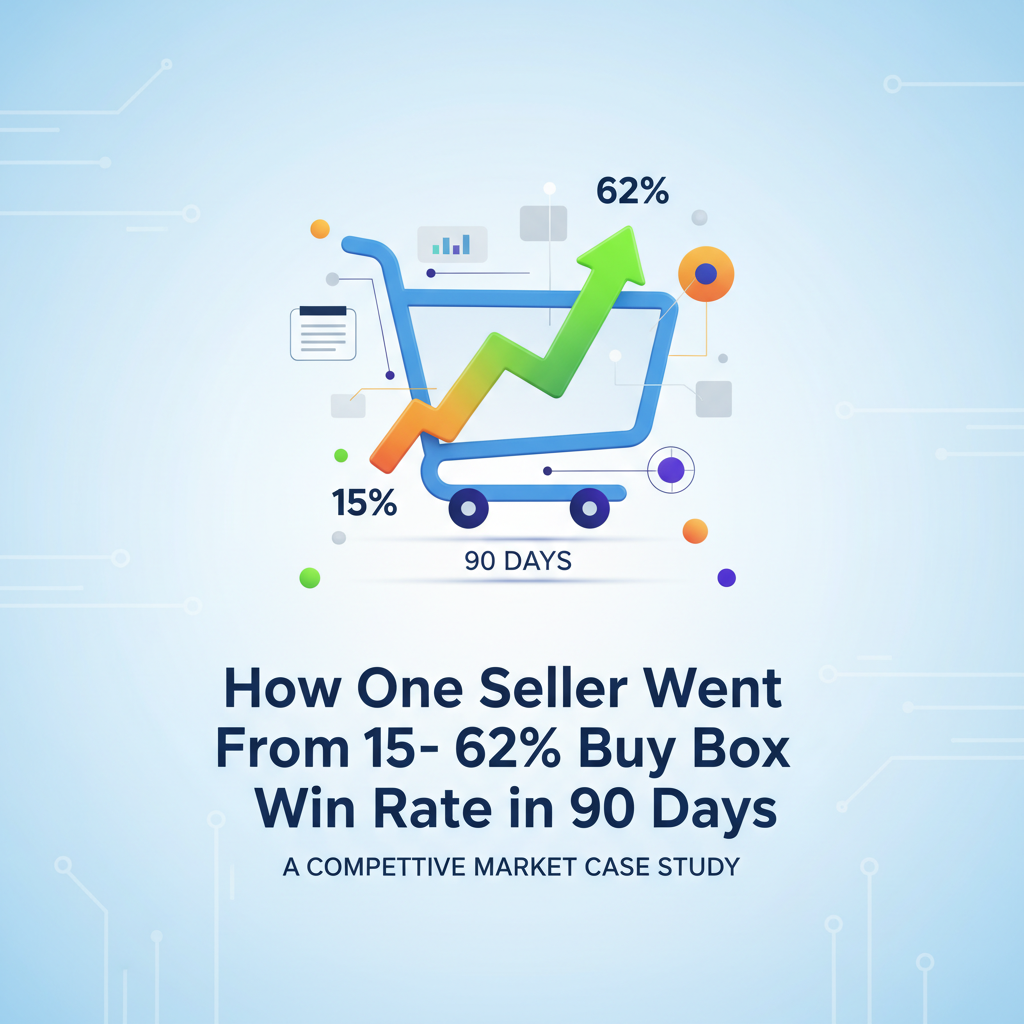
Sarah runs an electronics accessories business on Amazon. Three months ago, she was frustrated. Despite having quality products and competitive prices, she was only winning the Buy Box about 15% of the time. Eight other FBA sellers were competing on the same ASINs, and her sales were stagnating while competitors seemed to capture customer after customer.
Fast forward to today: Sarah’s Buy Box win rate sits at 62%. Her sales velocity has increased 280%. And here’s what shocked her most—her profit margins actually improved by 3.2% in the process.
Her transformation wasn’t luck or magic. It was strategy. And it’s a strategy any Amazon seller can replicate.
With approximately 90% of Amazon sales flowing through the Buy Box, understanding how to winning the buy box consistently has become the defining factor separating thriving sellers from struggling ones. The Featured Offer (as Amazon now also calls it) isn’t just important—it’s everything. And in 2025, winning it requires a completely different approach than most sellers realize.
Why Lowest Price No Longer Guarantees the Buy Box
Let’s start with the biggest misconception killing seller profitability: the belief that the cheapest price wins the Buy Box.
It doesn’t. Not anymore.
According to recent industry analysis, there’s a persistent misconception that price is the biggest factor in winning the Buy Box. In reality, the seller with the cheapest price is not guaranteed to win. Amazon’s algorithm has evolved to prioritize customer experience above pure price competition.
Here’s what the algorithm actually weighs in 2025:
- Order Defect Rate (ODR): Must be below 1%, but sellers winning consistently maintain below 0.5%
- On-Time Shipment Rate: Minimum 95%, ideal threshold 98%+
- Customer Response Time: Under 24 hours required, under 12 hours preferred
- Fulfillment Method: FBA offers significant advantage, but exceptional FBM can compete
- Price: Important, but evaluated alongside all other factors
- Geographic Proximity: New in 2025—inventory location relative to customer matters significantly
This explains why Sarah’s competitor with a 0.4% ODR consistently won the Buy Box while charging $0.30 more than sellers with a 0.9% ODR. The algorithm rewards reliability over rock-bottom pricing.
The Three-Phase Strategy That Transformed Sarah’s Business
Phase 1: Performance Metric Optimization (Weeks 1-2)
Before touching her pricing strategy, Sarah focused entirely on her seller metrics. Her starting position wasn’t terrible—ODR at 0.8%, on-time shipment at 97%, customer response time averaging 18 hours—but it wasn’t exceptional either.
The changes she implemented:
- Added weekend customer service coverage to reduce response time to under 12 hours
- Implemented proactive shipping notifications to customers
- Upgraded packaging materials to reduce damage-related claims
- Created templated responses for common questions (while personalizing each reply)
Within two weeks, her ODR dropped to 0.4%, and her response time averaged 8 hours. These improvements alone started moving the needle on her Buy Box percentage.
Phase 2: Intelligent Repricing Implementation (Weeks 2-3)
This is where most sellers go wrong. They implement repricing tools set to “match lowest price” and watch their margins evaporate while still not winning the Buy Box consistently.
Sarah took a different approach. Her repricing strategy focused on:
- Competitor filtering: Only responding to Buy Box-eligible competitors with strong metrics and meaningful inventory depth
- Floor price protection: Maintaining a 15% minimum margin regardless of competitive pressure
- Strategic positioning: Pricing within $0.25-$0.50 of the lowest buy box price rather than matching exactly
- Temporal optimization: More competitive pricing during high-traffic hours (6-10 PM), margin protection during low-traffic periods
- Anti-oscillation rules: Preventing destructive price wars by limiting adjustment frequency
The key insight: when competitors stocked out, her system automatically raised prices by 8-12% rather than leaving money on the table. This single adjustment accounted for much of her margin improvement.
Phase 3: Geographic Optimization (Weeks 3-4)
Here’s a 2025 algorithm factor many sellers overlook: geolocation-based rotation. Amazon now favors sellers whose inventory is physically closer to the customer, even if their price isn’t the absolute lowest.
Sarah distributed her inventory across three fulfillment centers—East Coast, Central, and West Coast. The result was capturing Buy Box rotation for customers in each region, rather than losing West Coast customers to competitors with local inventory.
For sellers with high-volume products, this geographic distribution has become essential. Sellers who automate pricing and inventory while localizing stock in multiple Amazon warehouses consistently outperform competitors in Buy Box share, especially during regional sales peaks.
Case Study 2: Seasonal Strategy in Household Goods
Another seller, running a household goods business with 4-6 active competitors per listing, faced a different challenge. His metrics met minimums but weren’t exceptional. His pricing was reactive—responding to competitors 2-4 hours after their changes. And he had no seasonal strategy whatsoever.
His 120-day transformation focused on:
- Pushing metrics from “acceptable” to “exceptional” (ODR from 0.8% to 0.3%, response time from 20 hours to 8 hours)
- Analyzing historical Buy Box patterns to identify seasonal opportunities
- Maintaining deeper inventory (30-45 days) versus competitors’ 15-20 days
- Tracking competitor inventory levels to identify stockout opportunities
The results: Buy Box win rate jumped from 38% to 71%. Revenue increased 185%. And by pricing strategically when competitors ran out of stock, his margins improved 6.8%.
The critical success factor? Anticipating seasonal patterns and maintaining inventory depth while competitors stocked out. When you’re the only seller with inventory during a demand spike, you set the price.
The Brand Defense Scenario: Fighting Unauthorized Resellers
Brand owners face a unique Buy Box challenge: unauthorized resellers undercutting MAP pricing and winning the Buy Box 60%+ of the time.
One brand owner we analyzed was losing approximately $45,000 monthly to this problem. Their strategy combined enforcement with optimization:
- Leveraged Amazon Brand Registry and Transparency program
- Monitored reseller metrics and reported policy violations
- Created unique bundles that resellers couldn’t match
- Maintained multi-channel price parity (critical—Amazon suppresses Buy Box if you have lower prices elsewhere)
- Distributed inventory geographically for delivery speed advantage
Within 180 days, their Buy Box win rate climbed from 35% to 78%. Two unauthorized resellers were removed through Brand Registry enforcement. And the brand recovered that $45,000 monthly revenue while protecting their pricing integrity.
The Five Fatal Mistakes Keeping You From the Buy Box
Mistake 1: Racing to the Bottom on Price
Sellers destroy their margins competing on price alone, then still lose the Buy Box to competitors with slightly higher prices but better metrics. The algorithm values reliability over cheapness.
Mistake 2: Ignoring Performance Metrics
Your ODR, late shipment rate, and response time often outweigh small price differences. A seller with a 0.4% ODR and $0.30 higher price frequently beats a seller with 0.9% ODR at the lowest price.
Mistake 3: Single Fulfillment Center Dependency
With geolocation-based rotation now influencing Buy Box assignment, inventory concentrated in one location means losing regional Buy Box opportunities to locally-positioned competitors.
Mistake 4: Manual or Set-and-Forget Pricing
Amazon’s Buy Box algorithm constantly changes. Competitors using repricing tools adjust every 5-15 minutes. Manual pricing updated once daily simply cannot compete. You’re losing Buy Box opportunities during high-traffic hours while you sleep.
Mistake 5: Stockout Vulnerability
Frequent stockouts signal unreliability to the algorithm. Even after restocking, your Buy Box eligibility remains reduced. Meanwhile, competitors capture your customers and your organic ranking suffers.
The 2025 Buy Box Winning Formula
Based on these case studies and current algorithm behavior, here’s what consistently winning the Buy Box requires:
Foundation (non-negotiable prerequisites):
- Professional selling plan with Buy Box eligible status
- FBA fulfillment or exceptional FBM metrics
- Account in good standing
Performance excellence (the price of entry):
- ODR below 0.5%
- On-time shipment above 98%
- Customer response under 12 hours
- Feedback score above 97%
Strategic advantages (the competitive edge):
- Geographic inventory distribution
- Intelligent repricing that responds in minutes, not hours
- Inventory depth preventing stockouts
- Temporal pricing strategies matching traffic patterns
- Competitor intelligence identifying stockout opportunities
The math is straightforward: Exceptional Metrics × Geographic Advantage × Smart Pricing × Inventory Reliability = 60-85% Buy Box Win Rate in competitive markets.
Notice what’s missing from that formula? “Lowest Price.” It’s a factor, yes. But it’s not the determining factor most sellers believe it to be.
Taking Action: Your Buy Box Improvement Roadmap
If you’re currently struggling with Buy Box win rates, here’s your 30-day action plan:
Week 1: Audit your performance metrics. Identify which ones fall below “ideal” thresholds and create specific plans to improve each.
Week 2: Implement intelligent repricing that filters competitors strategically, protects minimum margins, and responds to market changes in real-time.
Week 3: Analyze your inventory distribution and consider geographic optimization for high-volume products.
Week 4: Set up monitoring systems for Buy Box win rate, competitor behavior, and inventory levels. Create alerts for critical threshold breaches.
The sellers winning consistently in competitive markets treat Buy Box optimization as a strategic priority, not an afterthought. They monitor metrics weekly, use automation for speed while applying human strategy for intelligence, and continuously adapt to algorithm changes.
Turn Strategy Into Results With Zupricer
The transformation Sarah achieved—going from 15% to 62% Buy Box win rate while improving margins—required intelligent repricing that most manual processes simply can’t deliver. Responding to competitor changes in minutes rather than hours, filtering out irrelevant competitors, protecting floor prices while staying competitive, and capitalizing on stockout opportunities all demand automation built specifically for Buy Box success.
Zupricer delivers exactly this capability. With intelligent competitor filtering, real-time market response, margin protection rules, and temporal pricing optimization, Zupricer transforms the Buy Box strategies outlined in this case study into automated reality. Stop losing sales while you sleep. Stop racing to the bottom on price. Start winning the Buy Box the way successful sellers do—strategically, profitably, and consistently.
Ready to see what your Buy Box win rate could become? Try Zupricer today and join the sellers who’ve discovered that winning the Buy Box doesn’t mean sacrificing your margins—it means optimizing smarter.
Buy Box Analytics and Tracking Tools for Continuous Improvement
Winning the buy box win rate battle requires more than implementing strategies—it demands continuous monitoring and data-driven adjustments. Successful sellers track specific metrics that reveal exactly where they stand and what needs improvement.
The most critical metrics to monitor include your hourly amazon buy box percentage, competitor pricing patterns throughout the day, inventory velocity compared to competitors, and your performance metric trends over rolling 30-day periods. According to Feedvisor’s 2026 analysis, sellers who track these metrics daily achieve 23-35% higher Buy Box win rates than those who check weekly or monthly.
Amazon Seller Central provides basic Buy Box reporting, but it lacks the granularity needed for strategic optimization. Third-party analytics tools offer hourly tracking, competitor inventory monitoring, and automated alerts when your featured offer percentage drops below target thresholds. These tools identify patterns invisible in daily manual checks—like losing the Buy Box consistently during specific hours or to particular competitors.
Understanding Buy Box Rotation Patterns in Your Category
The buy box algorithm doesn’t award 100% of sessions to a single seller, even when that seller has superior metrics and pricing. Instead, Amazon rotates the buy box optimization among qualified sellers to test customer response and maintain competitive pressure.
According to Repricer.com’s 2026 research, rotation patterns vary significantly by competition level. A dominant seller with exceptional metrics might capture 85-95% of sessions, while competitive listings with 2-4 qualified FBA sellers typically see individual win rates of 20-40%. Highly competitive ASINs with 5+ sellers often distribute sessions at 12-25% per seller.
The May 2025 algorithm update increased rotation frequency among similarly qualified sellers, according to Feedvisor. This means maintaining a slight edge in any single factor—whether amazon seller metrics, delivery speed, or price—can shift your rotation percentage significantly. Sellers who previously dominated with 70-80% win rates now see 55-65% unless they continuously optimize multiple factors simultaneously.
Category-Specific Buy Box Requirements and Seasonal Patterns
While Amazon’s core algorithm applies across categories, certain product types face additional requirements. Electronics and high-value items demand lower order defect rate thresholds—often below 0.3%—because customer expectations for these purchases are higher. Consumables and grocery items prioritize expiration date management and faster delivery commitments.
Seasonal competition patterns dramatically affect competitive pricing strategies. During Q4 holiday shopping, Buy Box rotation intensifies as more sellers stock inventory and compete aggressively. According to industry analysis, sellers maintaining consistent inventory depth during peak seasons capture 15-25% higher win rates than competitors who stock out or reduce inventory to avoid long-term storage fees.
The FBA buy box advantage becomes even more pronounced during Prime Day and Black Friday. Amazon prioritizes sellers who can guarantee fast delivery during high-volume periods, effectively filtering out FBM sellers unless they maintain Seller Fulfilled Prime status with proven capacity.
Buy Box Suppression Scenarios and Recovery Strategies
Even eligible sellers occasionally lose Buy Box access entirely—a scenario called suppression. Understanding why this happens and how to recover quickly protects your revenue during critical selling periods.
Common suppression triggers include pricing significantly above Amazon’s internal reference price, violating price parity by offering lower prices on other sales channels, and listing quality issues like missing required attributes or poor images. According to Goaura’s analysis, suppression also occurs when all competing offers have poor seller metrics, causing Amazon to withhold the Buy Box entirely rather than feature an unreliable seller.
Recovery requires identifying the specific trigger. For pricing-related suppression, align your price within 10-15% of Amazon’s reference price, which typically reflects recent selling prices and competitor pricing. For price parity violations, ensure your Amazon price matches or beats prices on your website and other marketplaces. Listing quality suppression resolves by completing all required attributes and uploading high-quality images meeting Amazon’s technical specifications.
The fastest recovery comes from addressing the root cause immediately while maintaining exceptional performance metrics. Sellers who quickly identify and fix suppression issues typically regain amazon buy box eligibility within 24-48 hours, while those who delay or misdiagnose the problem can lose weeks of sales.