Here’s a number that should make every Amazon seller pause: 10-30% of products in a typical catalog are actually unprofitable once all costs are properly calculated. Not low-margin—unprofitable. Sellers discover this only after implementing proper tracking tools, often after years of unknowingly subsidizing losing products with winners.
This is the profit margin crisis hiding in plain sight across Amazon. Fees keep climbing. Competition intensifies. Ad costs creep upward. And without the right tools, sellers slowly bleed margin without understanding why their bank account doesn’t match their revenue growth.
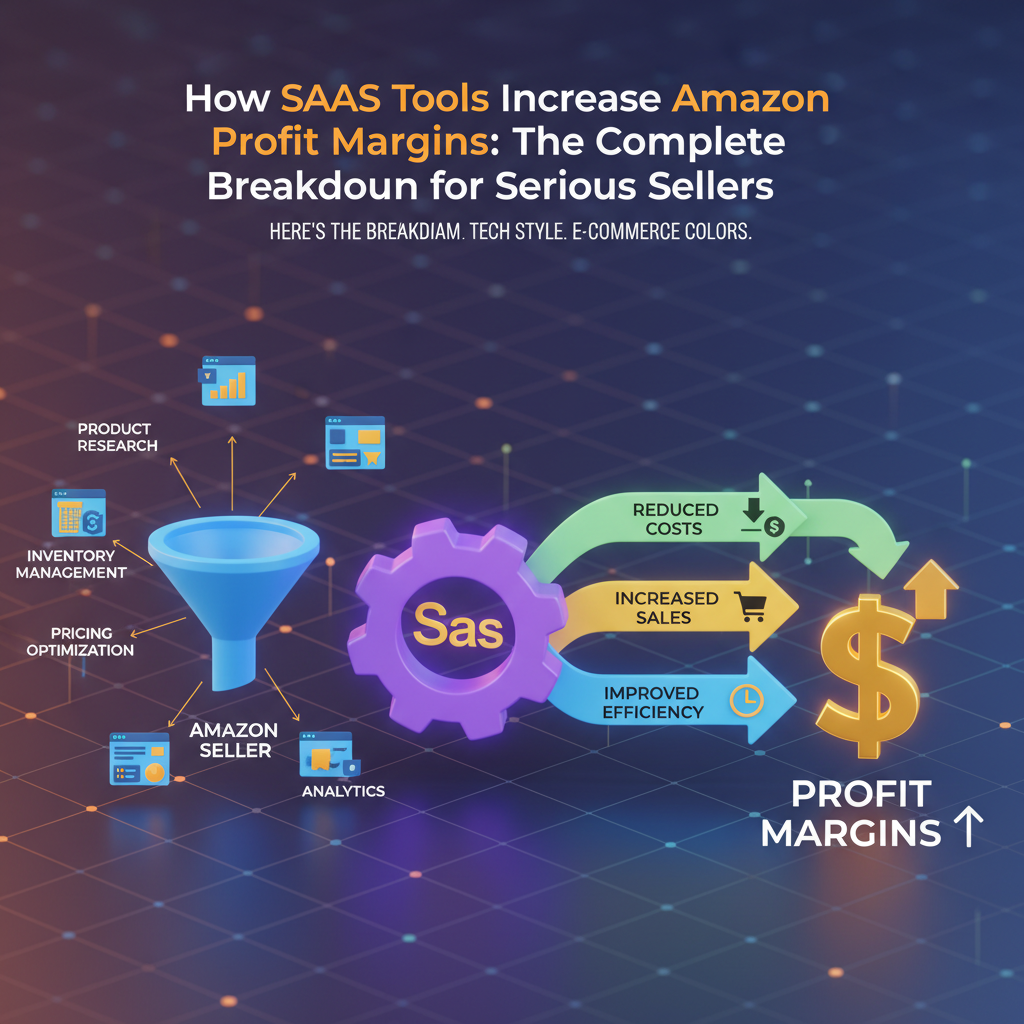
The sellers consistently hitting 20-30%+ profit margins share a common strategy: they’ve built a stack of specialized SaaS tools that automate, optimize, and protect profitability across every dimension of their business. These aren’t luxury add-ons—they’re the difference between building wealth and running an elaborate hobby.
The Hidden Margin Killers Most Sellers Miss
Amazon’s fee structure is deliberately complex. Referral fees, FBA fulfillment fees, storage costs (monthly and long-term), advertising spend, return processing, removal orders, promotional discounts—each one takes a bite. Individually, they seem manageable. Collectively, they can consume 40-50% of your sale price before you’ve accounted for product cost.
The sellers losing the margin battle typically share these characteristics:
- They calculate profitability using rough estimates rather than precise, real-time data
- They reprice manually, either too slowly or too aggressively
- They manage PPC campaigns reactively instead of strategically
- They discover inventory problems after they’ve already paid the fees
- They spend hours on tasks that software handles in seconds
Each of these gaps represents margin leakage that compounds over time. A 2% efficiency loss here, 3% there—suddenly you’re wondering why revenue grew 40% but profit barely moved.
Profit Tracking: The Foundation Everything Else Builds On
You can’t optimize what you can’t measure. This sounds obvious, yet the majority of Amazon sellers operate without accurate, real-time profit visibility at the SKU level.
What Modern Profit Analytics Tools Provide
Today’s financial tracking platforms connect directly to Seller Central and aggregate every cost affecting your bottom line:
- Complete fee capture: Every Amazon charge automatically categorized and tracked
- Landed cost calculations: Product cost, shipping, prep, and all associated expenses per unit
- Real-time margin visibility: Know your actual profit on every sale as it happens
- Product-level P&L: Identify which SKUs drive profit and which drain it
- Trend analysis: Spot margin erosion before it becomes critical
The impact is immediate. Sellers consistently report that once they implement proper tracking, they discover a significant portion of their catalog needs attention—either repricing, discontinuation, or operational changes. Addressing these margin drains typically improves overall profitability by 5-15% within the first quarter.
The Weekly Margin Review
Successful sellers build a simple discipline: weekly review of key metrics including profit margins by product, ad spend efficiency trends, inventory turnover rates, and return patterns. Fifteen minutes of review prevents thousands in margin leakage.
Automated Repricing: Protecting Margins While Staying Competitive
Pricing is where most margin destruction happens. The manual repricing trap goes like this: competitor drops price, you match to keep the Buy Box, another competitor undercuts, you go lower. Repeat until everyone’s margins evaporate.
How Smart Repricing Tools Break This Cycle
Modern repricing software approaches the problem fundamentally differently:
- Dynamic profit floors: Automatically calculate minimum prices that guarantee your target margin, accounting for all fees
- Intelligent competitor analysis: Identify which competitors to match and which to ignore (liquidators, poor-metric sellers)
- Multi-objective optimization: Balance Buy Box capture, profit margin, and inventory velocity simultaneously
- Velocity-based strategy: Price more aggressively on slow movers to free capital, protect margins on fast sellers
The results speak clearly: sellers using automated repricing with proper profit protection report 5-15% margin improvements while simultaneously increasing Buy Box win rates by 15-40%. You don’t have to choose between competitiveness and profitability—the right tool delivers both.
PPC Optimization: Turning Ad Spend from Cost Center to Profit Driver
Amazon advertising can be your most powerful growth lever or your biggest margin drain. The difference comes down to optimization sophistication.
Manual PPC management suffers from fundamental limitations: humans can’t process bid adjustments across hundreds of keywords in real-time, can’t identify patterns across campaigns at scale, and can’t react to performance changes at 2 AM. The result is wasted spend on non-converting keywords and missed opportunities on performers.
What AI-Powered PPC Tools Deliver
- Algorithmic bid management: Continuous optimization based on conversion data, not gut feeling
- Automated negative matching: Stop bleeding money on keywords that don’t convert
- Budget reallocation: Shift spend toward campaigns and keywords with proven ROI
- Dayparting optimization: Adjust bids based on time-of-day performance patterns
- Cross-campaign learning: Apply insights from one campaign to improve others
The margin impact is substantial. Effective PPC automation reduces wasted ad spend by 30-50% while maintaining or improving sales volume. For a seller spending $10,000 monthly on advertising, that’s $3,000-5,000 going back to the bottom line every month.
Inventory Management: The Silent Margin Killer
Poor inventory management destroys margins through mechanisms that don’t show up on your profit dashboard until it’s too late:
- Overstocking: Monthly storage fees eat margin; long-term storage surcharges devastate it
- Stockouts: Lost sales, damaged Buy Box eligibility, momentum killed
- Poor timing: Capital tied up in inventory that sits, unavailable for better opportunities
How Inventory Tools Protect Profitability
Modern inventory management platforms use predictive analytics to optimize stock levels:
- Demand forecasting: Predict sales velocity based on historical patterns and trends
- Reorder automation: Never miss optimal ordering windows
- Aging alerts: Get notified before long-term storage fees hit
- Liquidation recommendations: Know when clearing inventory costs less than holding it
The numbers add up fast. Reducing storage fees by 20-40% through better turnover, preventing stockouts worth 10-15% of potential sales, and freeing working capital for higher-return investments—inventory optimization often delivers the highest ROI of any tool category.
Listing Protection and Optimization: Defending Your Investment
Every optimization you make is vulnerable if your listings aren’t protected. Unauthorized changes—whether from competitors, bad actors, or Amazon’s own systems—can suppress your Buy Box eligibility or tank conversion rates without you knowing.
What Monitoring Tools Catch
- Unauthorized changes to titles, descriptions, images, or bullet points
- Buy Box suppression events
- Hijacker activity on your listings
- Pricing anomalies that indicate problems
Beyond protection, listing optimization tools help improve conversion rates through better keyword targeting, enhanced content, and competitive positioning analysis. A 5-15% conversion improvement means you need less ad spend to achieve the same sales—direct margin enhancement.
The ROI Math: Why Tool Investment Is a No-Brainer
Let’s run realistic numbers for a seller doing $100,000 monthly revenue at 20% margins ($20,000 profit):
Typical SaaS investment: $500-800/month for a comprehensive tool stack
Conservative returns:
- Profit tracking reveals and fixes margin drains: +$3,000-5,000/month
- Repricing improves margins while increasing Buy Box: +$2,000-4,000/month
- PPC optimization reduces wasted spend: +$500-1,500/month
- Inventory optimization cuts storage costs and prevents stockouts: +$1,000-2,000/month
Total monthly margin improvement: $6,500-12,500
Less tool costs: -$650
Net monthly benefit: $5,850-11,850
That’s 900-1,800% ROI. Most sellers see positive returns within the first month, with benefits compounding as tools learn and optimize over time.
Building Your Tool Stack: Where to Start
Don’t try to implement everything at once. Prioritize based on your biggest margin gaps:
Start with profit tracking if you don’t have precise, real-time visibility into SKU-level profitability. You can’t optimize what you can’t measure.
Add repricing next if you’re losing Buy Box share, spending excessive time on manual price updates, or watching margins erode from competitive pressure.
Layer in PPC optimization if you’re spending $1,000+ monthly on advertising and your ACoS exceeds 25%.
Implement inventory management as you scale and storage costs become a significant expense line.
The Competitive Reality
The sellers thriving on Amazon have moved beyond manual operations. They’ve recognized that SaaS tools aren’t an expense—they’re margin multipliers that pay for themselves many times over while freeing time for strategic work that actually grows the business.
Meanwhile, sellers clinging to spreadsheets and manual processes face structural disadvantages that widen every month. They can’t respond as fast, optimize as precisely, or protect margins as effectively. The gap compounds.
For sellers ready to take pricing optimization seriously, Zupricer delivers exactly what modern Amazon businesses need: intelligent automated repricing that protects your margins while maximizing Buy Box capture. With dynamic profit floors, smart competitive analysis, and multi-objective optimization built in, Zupricer ensures you’re never racing to the bottom or leaving money on the table. Your margins are too important to leave to manual processes—let Zupricer protect and grow them automatically.