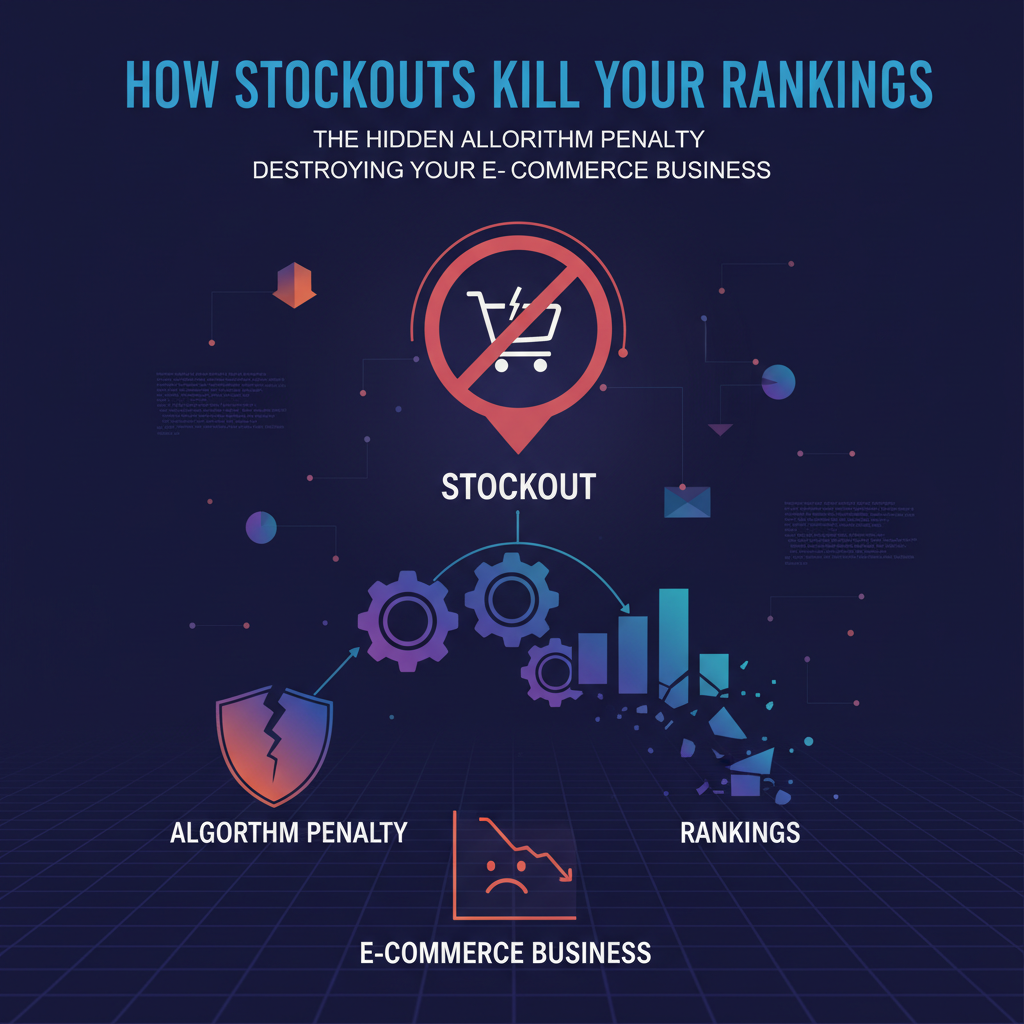
You’ve spent months optimizing your product listings, perfecting your keywords, and building up your sales history. Then, one morning, you check your inventory and realize the worst has happened—you’ve run out of stock. Within days, your hard-earned search rankings begin to plummet, and recovering them feels like starting from scratch.
If this scenario sounds familiar, you’re not alone. Stockouts remain one of the most underestimated threats to e-commerce success in 2025, and their impact on search rankings can devastate even well-established sellers. Understanding exactly how inventory gaps destroy your visibility—and what you can do about it—has become essential knowledge for any serious online seller.
The Silent Ranking Killer: Understanding the True Cost of Stockouts
Running out of stock might seem like a temporary inconvenience, a sign that your products are popular. Some sellers even view it as a badge of honor. But here’s the reality: a single stockout can damage your marketplace rankings for months, requiring significant effort and resources to rebuild what you’ve lost.
The problem extends far beyond missed sales during the out-of-stock period. Modern marketplace algorithms are designed to deliver the best customer experience possible, and showing shoppers products they can’t actually buy creates frustration. As a result, platforms like Amazon have built sophisticated systems that penalize sellers who can’t maintain consistent availability.
How Amazon’s A9 Algorithm Punishes Inventory Gaps
Sales velocity—how quickly and consistently your products sell—remains the single most influential ranking factor in Amazon’s A9 algorithm. When your inventory runs out, something catastrophic happens to this metric: it drops to zero.
This isn’t just a pause in your sales momentum. It’s a loud, negative signal that tells the algorithm your product may not be reliable enough to show to potential customers. The algorithm’s logic is straightforward: why risk displaying a product that might not be available?
What makes this particularly painful is the persistence of the penalty. Even after you’ve restocked, the algorithm doesn’t simply forgive and forget. Your product now has a history of unavailability, and rebuilding trust with the ranking system takes considerably longer than losing it.
The Hidden Penalty Effect
Think of the algorithm penalty as an invisible weight attached to your listing. After a stockout:
- Your product gets deprioritized in search results, even with inventory available
- Competitors who maintained stock capture your previous organic traffic
- The algorithm remembers your stockout history when determining future visibility
- Recovery becomes progressively harder with each subsequent stockout
The Conversion Rate Collapse
Marketplace algorithms don’t just track whether products are available—they closely monitor conversion rates. When shoppers click on your listing but can’t complete a purchase due to stockouts, your conversion rate suffers dramatically.
Here’s why this matters: platforms interpret low conversion rates as a signal that your listing isn’t meeting customer expectations. The algorithm doesn’t distinguish between a poor product description and an out-of-stock situation. It simply sees that visitors aren’t buying, and it responds by showing your listing to fewer people.
Maintaining consistent availability keeps your conversion rates stable, which in turn maintains your search visibility. It’s a virtuous cycle when things go right—and a devastating spiral when they don’t.
Where Your Customers Go When You’re Out of Stock
When a shopper ready to buy encounters your out-of-stock product, four scenarios typically unfold:
- They buy from your competitor on the same platform – This is the most common outcome and the most damaging. Your competitor gains a sale, improves their sales velocity, and strengthens their ranking position at your expense.
- They purchase from a different marketplace entirely – Sites like Walmart, Target, or specialty retailers capture the sale you’ve lost.
- They delay their purchase – Maybe they’ll come back when you’re restocked. Maybe they won’t.
- They abandon the purchase altogether – The buying impulse fades, and the sale evaporates completely.
None of these outcomes benefit your business, and all of them strengthen your competition’s position in the rankings.
The Multi-Channel Multiplication Effect
In 2025, successful e-commerce sellers operate across multiple platforms and channels. Data shows that stores with multi-platform SEO strategies see 3.5x more product discovery traffic and 2.2x higher conversion rates compared to single-channel sellers.
Stockouts don’t just affect one platform—they ripple across your entire operation:
- Sales consistency breaks down across all your channels simultaneously
- Brand credibility suffers as customers encounter unavailability regardless of where they shop
- Overall inventory performance metrics decline, affecting your standing with multiple platforms
- The recovery effort multiplies as you try to rebuild rankings everywhere at once
Protecting Your Rankings: Essential Prevention Strategies
The good news is that stockout damage is largely preventable with the right systems and strategies in place. Here’s how smart sellers protect their ranking investments:
Real-Time Inventory Visibility
You can’t manage what you can’t see. Implementing inventory management systems that provide real-time tracking across all your sales channels is no longer optional—it’s essential. When you can see exactly how much stock you have and how quickly it’s moving, you can reorder before problems arise.
Demand Forecasting
Historical sales data combined with seasonality trends helps predict when demand will spike. The sellers who maintain consistent stock during Prime Day, Black Friday, and other high-traffic periods are the ones who capture lasting ranking benefits.
Strategic Safety Stock
Maintaining buffer inventory might tie up capital, but the cost is trivial compared to the ranking damage from a stockout. Calculate your safety stock based on lead times, sales velocity, and demand variability.
Shipping and Supplier Optimization
Your supply chain is only as strong as its weakest link. Building relationships with reliable suppliers and optimizing shipping partnerships ensures inventory arrives when you need it, not days or weeks late.
Performance Metric Monitoring
Track your inventory turnover ratios, fill rates, and days-on-hand indicators religiously. These metrics provide early warning signs before stockouts occur.
The Hard Road Back: Recovery After a Stockout
Despite best efforts, stockouts sometimes happen. Recovery is possible, but it requires patience and strategic effort. Depending on your niche, reranking after going out of stock can be more challenging than achieving your initial ranking position.
That said, having inventory back in stock with suppressed rankings is still better than having no sales at all. Focus on driving traffic to your listings through PPC campaigns, social media, and external marketing while the algorithm gradually restores trust in your availability.
Conclusion: Inventory Management Is SEO Strategy
The connection between inventory management and search rankings has never been clearer. In 2025’s competitive e-commerce environment, maintaining product availability isn’t just an operational concern—it’s a fundamental SEO strategy that directly impacts your visibility and success.
The emphasis on sales velocity, conversion rates, and consistent availability in modern marketplace algorithms means every stockout carries hidden costs that far exceed the immediate lost sales. Smart sellers understand this and invest in the tools and processes needed to maintain optimal inventory levels.
This is exactly where Zupricer becomes invaluable. By providing intelligent pricing automation and real-time market monitoring, Zupricer helps Amazon sellers maintain competitive positioning while maximizing margins—giving you the revenue stability needed to invest in proper inventory management. When your pricing strategy works in harmony with your inventory strategy, you build a foundation for sustainable ranking success that competitors can’t easily disrupt.
Stop letting stockouts silently destroy the rankings you’ve worked so hard to build. With the right tools and strategies in place, consistent availability becomes your competitive advantage—and your rankings will reflect it.