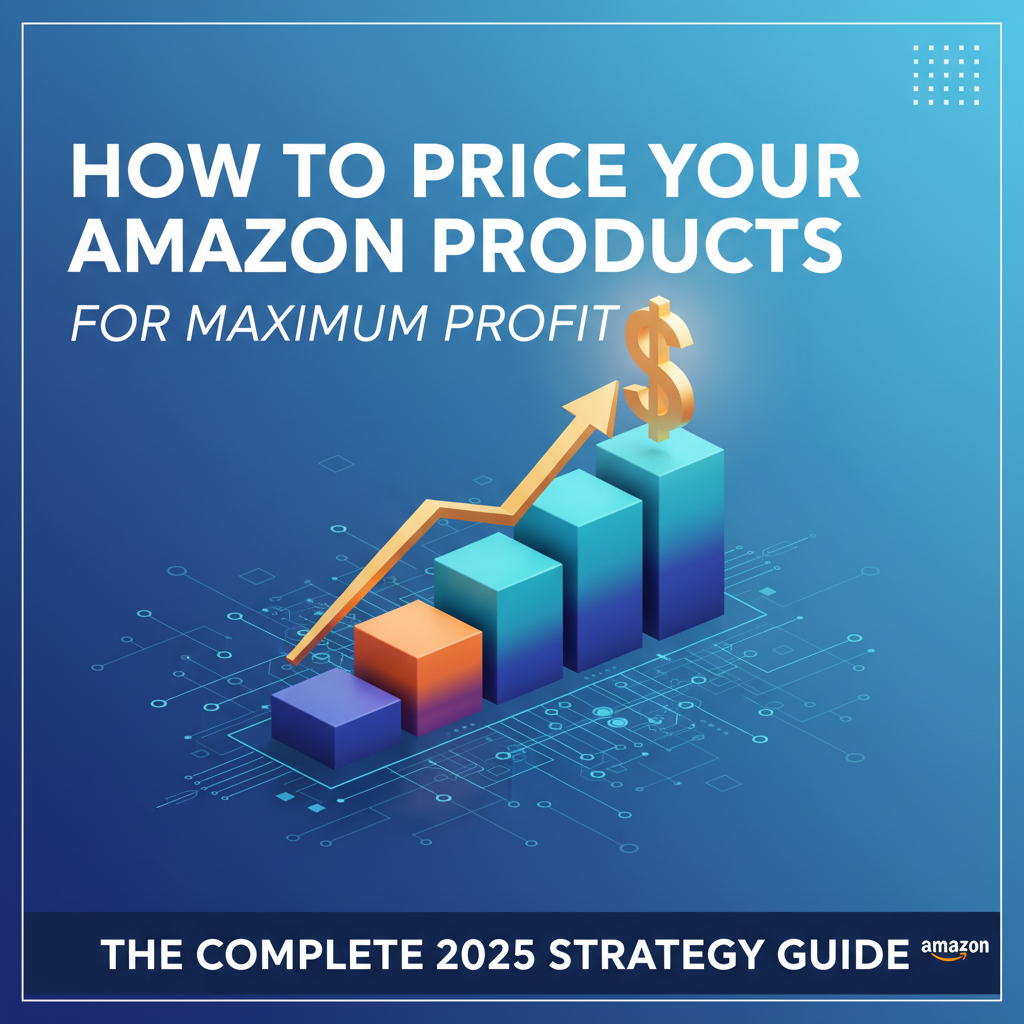
Here’s a fact that should change how you think about your Amazon business: a $2 price increase on a $25 product can add $1.70 directly to your margin. No additional advertising spend. No listing optimization. No inventory adjustments. Just strategic pricing.
Yet most sellers treat pricing as an afterthought—a quick calculation of cost plus markup, then move on to “more important” things like PPC campaigns and keyword research. That’s backwards, and it’s costing you thousands.
In 2025, Amazon sellers face a brutal combination of skyrocketing fees, aggressive competition, and tighter policy enforcement. Profitability is harder than ever to maintain. But here’s what the top performers understand: pricing is the single highest-leverage profit tool in your arsenal. Strategic pricing delivers 10-30% profit improvements with minimal operational effort—if you know how to do it right.
This guide breaks down exactly how to price your products for maximum profit, not maximum revenue or maximum volume. There’s a critical difference, and understanding it is worth real money.
The Fundamental Shift: Profit vs. Revenue
Before diving into strategies, let’s address the mindset that holds most sellers back. Maximum profit is not the same as maximum revenue.
Consider two scenarios for the same product:
- Option A: Sell 1,000 units at $25 with $5 profit each = $5,000 total profit
- Option B: Sell 800 units at $30 with $9 profit each = $7,200 total profit
Option B generates 20% less revenue but 44% more profit. Most sellers instinctively chase Option A because bigger numbers feel like success. But profit pays the bills, not revenue. Every strategy in this guide optimizes for profit dollars, not vanity metrics.
Strategy #1: Calculate Your True Costs (Most Sellers Get This Wrong)
Cost-plus pricing is the foundation, but it only works if you actually know your costs. Most sellers underestimate their true costs by 20-40%—and price accordingly, wondering why profitability feels elusive.
The Real Cost Breakdown
Here’s what a $30 product actually costs in 2025:
- Product cost: $10.00
- Shipping to FBA: $1.50
- Amazon referral fee (15%): $4.50
- FBA fulfillment: $3.50
- Storage (allocated): $0.30
- PPC cost per conversion: $4.00
- Returns (10% rate): $1.90
- Miscellaneous overhead: $0.80
- Total cost: $26.50 = $3.50 actual profit (11.7% margin)
The seller who calculated cost as just “$10 product cost” thinks they have a $20 profit and 67% margin. They price aggressively, run promotions freely, and can’t figure out why their bank account doesn’t reflect their “profitable” business.
Your minimum acceptable margins should be:
- Retail arbitrage: 30-40%
- Wholesale: 20-30%
- Private label: 35-50%
- High-volume commodity: 15-25%
These are floors, not targets. Profit maximization means exceeding these wherever possible.
Strategy #2: Shift to Value-Based Pricing
Cost-plus answers: “What does this cost me, and what markup do I need?” Value-based pricing asks a more profitable question: “What is this worth to the customer, and how do I capture that value?”
Research shows that 28% of successful e-commerce companies now prioritize customer willingness to pay over traditional cost-plus methods. They’re capturing profit that cost-plus sellers leave behind.
Finding Your Value Multipliers
Factors that increase perceived value (and justify higher prices):
- Problem-solving effectiveness
- Quality differentiation (materials, durability)
- Brand reputation and trust
- Time savings or convenience
- Unique features competitors lack
- Strong social proof (reviews, bestseller status)
Consider a premium kitchen knife. Cost-plus approach: $15 cost + 40% markup = $21 price. But if that knife lasts 5x longer than competitors, never needs sharpening, and saves 20 minutes weekly on food prep, the customer value calculation looks completely different. At a $50-75 price point, you’re still delivering massive value—and your profit jumps from $6 to $35-60 per unit.
Private label sellers have a unique advantage here because they control differentiation, quality standards, and brand positioning. Using commodity cost-plus pricing on a differentiated product is leaving money on the table.
Strategy #3: Deploy Dynamic Pricing
Static pricing is a profit leak. Markets move constantly—competitors adjust prices, inventory levels fluctuate, demand patterns shift throughout the day and week. Static pricing ignores all of this, leaving money behind at every turn.
What Dynamic Pricing Adjusts For
Competitive changes:
- Competitor price increases = opportunity to raise yours
- Competitor stockouts = temporary premium pricing window
- New competitor entry = defend position strategically
Inventory levels:
- Low inventory: Raise prices to maximize margin and slow sales
- High inventory: Lower prices to prevent storage fees
- Optimal inventory: Maintain profit-maximized pricing
Buy Box dynamics:
- Price just low enough to win the Buy Box—no lower
- When a competitor locks the Buy Box, price for profit on remaining traffic
The key principle: set margin floors and never violate them. Losing the Buy Box at an unprofitable price is better than winning it.
Strategy #4: Use Psychological Pricing Tactics
How customers perceive your price matters as much as the price itself. Small adjustments in presentation can significantly impact conversion rates without changing your actual margins.
Tactics That Work in 2025
Charm pricing: Research confirms .99 pricing increases conversions 8-12% for products under $100. $19.99 is perceived as “$19-something,” not “almost $20.” Exception: premium products benefit from round numbers that signal quality.
Anchor pricing: Showing a reference price (MSRP or was-price) increases perceived value by 22-35%. “List Price: $59.99 / Your Price: $39.99” makes customers feel they’re getting a deal, not just paying $39.99.
Decoy pricing: Structure your variations strategically:
- Single unit: $19.99
- 2-pack: $36.99 (minimal savings)
- 3-pack: $49.99 (clear value)
The 2-pack exists to make the 3-pack look like the obvious choice—and the 3-pack is your profit-maximized option.
Strategy #5: Implement Segmented Pricing
Different customers have different willingness to pay. Segmented pricing captures maximum value from each group.
Amazon-Enabled Segmentation Options
Quantity-based pricing:
- Single unit: $25 (full price for convenience buyers)
- 3-pack: $65 / $21.67 each (13% discount for volume buyers)
- 6-pack: $120 / $20 each (20% discount for bulk buyers)
Subscribe & Save:
- One-time purchase: $30
- Subscribe & Save: $25.50 (15% discount)
Subscribers get a discount but deliver predictable revenue and higher lifetime value. One-time buyers pay a premium for flexibility. You maximize profit across both segments.
Bundle segmentation: Offer your basic product at $39.99 for price-sensitive buyers, and a premium bundle at $64.99 for convenience buyers who want everything included. Same core product, different price points, higher total profit.
Strategy #6: Test and Optimize Systematically
Pricing decisions in 2025 lean heavily on analytics, elasticity modeling, and data rather than gut feelings. Maximum profit requires systematic testing to discover your optimal price points.
Understanding Price Elasticity
Price elasticity measures how volume changes when prices change. If a 10% price increase only reduces volume by 5%, your demand is inelastic—and you should raise prices further.
Example test scenario:
- Current: $30 price, 100 units/month, $5 profit/unit = $500 profit
- Test: $33 price, 90 units/month, $8 profit/unit = $720 profit
- Result: 44% profit increase despite 10% volume decrease
Most sellers never test higher prices because they fear losing sales. But many products have room for 10-20% price increases with minimal volume impact—you just have to test to find out.
The Testing Framework
Phase 1: Establish your baseline over 2-4 weeks. Phase 2: Change price only (hold ads, promotions constant) and measure for 2-4 weeks. Phase 3: If profit increased, test higher; if decreased, return to baseline. Phase 4: Retest quarterly as market conditions shift.
Strategy #7: Optimize at the Portfolio Level
Individual SKU optimization is insufficient. Portfolio-level strategy captures profit opportunities that single-product thinking misses.
Strategic Loss Leaders
Some products are more valuable as customer acquisition tools than profit centers. Product A priced at $22 with a $2 margin might seem weak—until you realize 40% of those buyers also purchase Product B at $35 with a $12 margin. Total portfolio profit exceeds what you’d get optimizing Product A in isolation.
Lifetime Value Pricing
For consumables and repeat-purchase products, first-purchase pricing should optimize for customer acquisition. A $3 profit on the first sale that leads to four additional purchases at $8 profit each creates $35 in customer lifetime value versus $8 from maximizing the first transaction.
Avoiding Profit-Destroying Mistakes
Maximizing profit also means avoiding common errors:
- The race to the bottom: Continuously matching competitor price drops until margins disappear. Set margin floors and compete on value instead.
- Discounting without analysis: A 20% discount requires a 25% volume increase just to maintain revenue—and even more to maintain profit. Most promotions don’t achieve the required lift.
- Static pricing: Set-and-forget approaches leave money on the table when competitors raise prices and lose the Buy Box when they lower them.
Conclusion: Making Profit Maximization Practical
The strategies outlined here can deliver 20-40% profit improvements—but implementation is where most sellers stall. Manual repricing can’t keep pace with dynamic markets. Spreadsheet-based cost tracking quickly becomes outdated. Testing across hundreds of SKUs is impractical without automation.
This is exactly why we built Zupricer. Our intelligent repricing platform combines dynamic pricing, margin protection, competitive intelligence, and inventory-aware adjustments into one system designed specifically for profit maximization. Zupricer doesn’t just automate price changes—it optimizes them based on the same principles top sellers use, scaled across your entire catalog. Because understanding pricing strategy is valuable, but executing it consistently is where profit actually gets made.