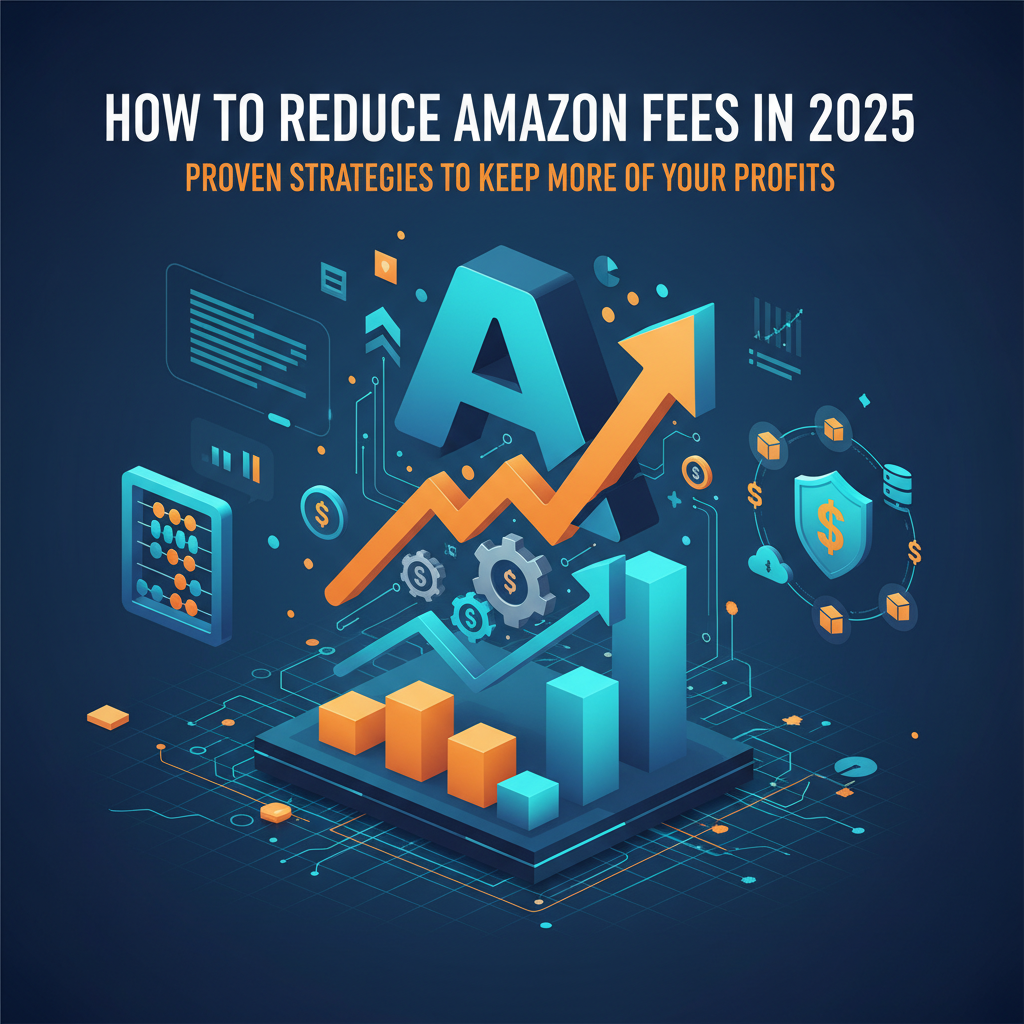
Let’s talk about the elephant in every Amazon seller’s room: fees are eating your profits alive. If you’re an FBA seller in 2025, you’re likely watching 30-40% of every sale disappear into Amazon’s fee structure before you even calculate your actual product costs. That’s not a typo—nearly half of your revenue can vanish into referral fees, fulfillment charges, storage costs, and a collection of “hidden” fees that seem to multiply every quarter.
The frustrating part? Most sellers accept these fees as unavoidable. They’re not. While you can’t eliminate Amazon fees entirely (that’s just the cost of accessing 300+ million active customers), you absolutely can optimize them strategically. The difference between sellers who barely break even and those generating healthy profits often comes down to fee management.
This guide breaks down exactly how to reduce your Amazon fees without sacrificing sales velocity or customer experience. These aren’t theoretical suggestions—they’re actionable strategies that successful sellers are using right now to protect their margins.
Understanding What You’re Actually Paying
Before you can reduce fees, you need to understand the complete picture. Many sellers focus exclusively on referral and fulfillment fees while ignoring charges that compound silently in the background.
The Primary Fee Categories
- Referral Fees: 8-15% of sale price depending on category—unavoidable regardless of fulfillment method
- FBA Fulfillment Fees: $1-$3+ per unit for standard-size products, based on size tier and weight
- Monthly Storage Fees: Charged per cubic foot, with higher rates during Q4 peak season
- Long-Term Storage Fees: Escalating charges for inventory sitting beyond specific age thresholds
The Hidden Fees That Drain Profits
- Inventory Placement Service (IPS) fees when you want shipments sent to a single warehouse
- Unplanned prep service fees when inventory doesn’t meet Amazon’s requirements
- Returns processing fees (typically equal to the original fulfillment fee)
- Removal and disposal fees for inventory you need to pull from FBA
- Inbound shipment split fees when Amazon distributes your inventory across warehouses
The true cost equation every seller should calculate: Product Cost + Amazon Fees + Advertising Costs + Returns + Storage = Your Real Cost Per Unit. If you’re not running this complete calculation, you’re flying blind.
Optimize Packaging and Dimensions: The Biggest Lever
Here’s something most sellers overlook: FBA fees are heavily driven by product size tier, not just weight. Moving a product from one size tier to a smaller one can save you dollars—not cents—per unit. At scale, this single optimization can transform your profitability.
Key Actions for Dimension Optimization
- Audit your current packaging against Amazon’s size tier thresholds
- Reduce packaging dimensions to qualify for lower tiers wherever possible
- Optimize internal product arrangement to minimize cubic volume
- Use Amazon’s measurement tools in Seller Central to validate sizing and catch overcharges
- Consider “Ships in Product Packaging” (SIPP) eligibility for discounts between $0.04 and $1.32 per unit
A practical example: if your product is packaged at 18.1 inches on one side but could fit at 17.9 inches, you might be paying large standard-size fees when you could qualify for standard-size rates. That fraction of an inch could cost you significantly on every single unit sold.
Work with your supplier or packaging vendor to explore alternatives. Sometimes a simple redesign—folding a product differently, using a more compact box, or eliminating unnecessary packaging materials—delivers immediate fee savings with zero impact on customer experience.
Master Inventory Management to Eliminate Storage Fees
Storage fees are the silent profit killer. Every day your inventory sits in Amazon’s warehouses without selling, you’re paying rent on products that aren’t generating revenue. Worse, once inventory ages past certain thresholds, long-term storage fees kick in and accelerate your losses.
Proactive Inventory Strategies
- Monitor inventory age religiously through the Manage Inventory Health page in Seller Central
- Implement just-in-time inventory strategies to minimize warehouse time
- Track inventory turnover rates and adjust reorder quantities accordingly
- Set automated alerts for inventory approaching long-term storage fee thresholds
- Use Amazon’s FBA Revenue Calculator to estimate storage costs before sending inventory
When Inventory Isn’t Moving
Don’t let slow-moving inventory drain your account. You have options:
- Amazon Outlet: Move excess inventory at discounted prices to accelerate turnover
- Liquidation Services: Recover partial value instead of paying ongoing storage fees
- Strategic Promotions: Time sales before long-term storage fee assessments
- Removal Orders: Sometimes pulling inventory out costs less than continued storage
Calculate your break-even point: when do accumulated storage fees exceed the cost of removal? Set automated removal triggers before you hit that threshold. It’s better to recover some value than to watch fees consume your investment entirely.
Prevent Unplanned Service Fees Before They Happen
Unplanned prep service fees are among the most frustrating charges because they’re entirely preventable. These fees occur when your inventory arrives at FBA warehouses without meeting Amazon’s preparation requirements, forcing Amazon to prep it for you—at premium prices.
Prevention Strategies
- Follow Amazon’s FBA Prep Guidelines meticulously—no shortcuts
- Negotiate with suppliers to prep, label, and barcode products before shipping to FBA
- Use proper labeling tools and verify barcode accuracy before shipment
- Ensure packaging meets Amazon’s specific requirements for your product category
- Conduct quality checks on inbound shipments before they leave your control
The supplier negotiation piece is crucial. Many manufacturers will prep products to your specifications at minimal additional cost—far less than Amazon charges for unplanned services. Building this into your supplier agreements upfront prevents ongoing fee leakage.
Optimize Your FBA Shipment Strategy
How you send inventory to Amazon affects multiple fee categories. Poor shipment planning means you’re paying more than necessary before your products even reach customers.
Shipment Optimization Tactics
- Use FBA Shipment Builder tools to optimize box content and minimize splits
- Send products in optimal batch sizes to reduce per-unit inbound costs
- Leverage Amazon Partner Carrier Program for discounted shipping rates to FBA warehouses
- Evaluate Inventory Placement Service strategically—sometimes distributed placement costs less than paying for single-location shipping
- Plan shipments around seasonal storage fee variations (Q4 rates are significantly higher)
The Inventory Placement Service decision deserves careful analysis. Paying to send all inventory to one warehouse might seem convenient, but if Amazon would have distributed it efficiently anyway, you’re paying for nothing. Run the numbers for your specific situation.
Reduce Returns Processing Fees
Every return hits you twice: you lose the sale and pay a returns processing fee typically equivalent to your original fulfillment fee. While you can’t eliminate returns entirely, you can reduce their frequency significantly.
Returns Reduction Strategies
- Improve product descriptions to set accurate customer expectations
- Use high-quality images from multiple angles
- Provide detailed sizing, specifications, and compatibility information
- Monitor return rates by ASIN and investigate products with unusually high returns
- Address common return reasons proactively through listing improvements
Analyze your return data for patterns. If customers consistently return a product citing “not as described,” that’s a listing problem you can fix. If returns spike after a packaging change, investigate whether products are arriving damaged. Every return you prevent is money saved on both the fee and the lost sale.
Consider Hybrid Fulfillment Models
Not every product needs to be in FBA at all times. Strategic sellers use hybrid approaches to optimize fees across their entire catalog.
Hybrid Fulfillment Options
- FBM for Low-Velocity Products: Fulfill slow-movers yourself to avoid storage fees on inventory that sits
- Third-Party Logistics (3PL): Store buffer inventory outside Amazon, replenishing FBA as needed
- Strategic FBA Usage: Keep only fast-moving inventory in FBA where the Prime badge drives sales
- Seasonal Adjustments: Shift more inventory to 3PL during Q4 when Amazon storage fees peak
The key is matching fulfillment method to product characteristics. High-velocity products that benefit from Prime visibility belong in FBA. Slow-moving items with thin margins might be more profitable fulfilled through alternative channels.
Use Data Analytics to Drive Continuous Optimization
Fee optimization isn’t a one-time project—it’s an ongoing process that requires consistent monitoring and adjustment.
Essential Analytics Practices
- Track fees as a percentage of sale price for every product
- Identify high-fee products for optimization or potential discontinuation
- Calculate true all-in cost per unit including every Amazon charge
- Build profitability dashboards that surface fee impacts clearly
- Review fee trends monthly and adjust strategies accordingly
The sellers who consistently outperform their competition treat fee analysis as a core business function, not an occasional audit. They know exactly which products are profitable after all fees and which ones look good on the surface but drain resources underneath.
Bringing It Together: A Practical Amazon Seller Cost Reduction Checklist
Everything covered above—packaging, inventory timing, unplanned prep fees, shipment planning, returns, and hybrid fulfillment—adds up to a single underlying goal: genuine amazon seller cost reduction across every line item Amazon charges you. It’s worth pulling these threads together into one practical lens, because sellers often ask how to reduce fba fees as if it were one isolated tactic, when in reality it’s the cumulative effect of several smaller decisions working together.
If your specific question is how to reduce amazon fba fees or how to lower fba fees on a per-unit basis, the highest-leverage moves are the ones already detailed earlier in this guide: getting your packaging into a smaller size tier, keeping inventory turning fast enough to avoid long-term storage charges, and preventing unplanned prep fees before they’re ever assessed. Sellers asking specifically reduce amazon fba fees as a broad goal tend to get the best results by tackling all three simultaneously rather than optimizing just one and assuming the job is done.
Shipping deserves its own callout here too. If you’re wondering how to reduce shipping costs on amazon, the Partner Carrier Program and optimal batch sizing covered in the shipment strategy section above are your first lever—but don’t overlook the seasonal dimension. Knowing how to reduce seasonal fulfillment cost matters enormously heading into Q4, when storage rates spike and shipping carriers raise their own rates in parallel. Shifting buffer inventory to 3PL ahead of peak season, exactly as described in the hybrid fulfillment section, is often the difference between a profitable Q4 and one that quietly erodes your annual margin.
Building a Comprehensive FBA Cost Optimization Framework
Most sellers approach fee reduction as a series of isolated fixes—trimming a dimension here, removing slow inventory there—but the sellers who achieve 15-25% total cost reductions within 90 days treat FBA cost optimization as a systematic framework. This means addressing multiple fee categories simultaneously rather than sequentially, because the categories interact in ways that amplify savings when optimized together.
The framework starts with understanding your fee distribution. Fulfillment fees typically represent 30-40% of your total FBA costs, storage fees account for 20-30%, and inbound placement fees consume another 10-15%. The remaining portion splits across aged inventory fees, removal charges, and unplanned service fees. Knowing your specific distribution tells you where to focus first—if storage fees dominate your cost structure, inventory velocity improvements deliver more impact than packaging optimization.
Effective FBA cost optimization requires tracking your Inventory Performance Index (IPI) score weekly, not monthly. Sellers who audit excess inventory weekly maintain IPI scores 15-20% higher than those who check monthly, and keeping your score above 450—ideally above 500—prevents storage restrictions that force expensive emergency decisions. Low IPI scores trigger storage limits that can force you into costly removal orders or prevent restocking during peak demand periods.
The inbound placement decision deserves more strategic attention than most sellers give it. Switching from Amazon-Optimized placement at $0.89 per unit to Minimal Shipment Splits at $0.47 per unit saves $420 monthly on just 1,000 units, or $5,040 annually. That’s real money that drops directly to your bottom line with zero impact on customer experience. Run the calculation for your actual volume to see whether the convenience of single-warehouse placement justifies its premium cost.
Seasonal Fulfillment Cost Reduction: Timing Q4 Inventory Strategically
If you’re not planning Q4 inventory timing with precision, you’re leaving thousands of dollars on the table. December storage fees run $2.40 per cubic foot versus $0.78 in January through September—a 3x multiplier that punishes sellers who send inventory too late or hold too much through year-end. The sellers who understand how to reduce seasonal fulfillment cost effectively split their Q4 shipments into two strategic waves.
Send 60% of your Q4 inventory to arrive between September 20-30, and the remaining 40% between October 10-20. This timing accomplishes two goals: you avoid the October 15 peak fulfillment fee surcharge on early inventory, and you minimize December storage exposure by ensuring most units sell before the highest-rate month hits. Sellers who execute this split timing reduce December storage costs by 40-50% compared to those who send everything in October.
The peak fulfillment fee itself adds approximately $0.32 per unit from October 15 through January 14, with an additional 3.5% fuel and logistics surcharge applied year-round. These charges compound quickly at volume—on 10,000 units, that’s $3,200 in avoidable fees if you time shipments to minimize peak-period exposure. For Black Friday and Cyber Monday inventory specifically, Amazon’s inbound deadlines matter: AWD inventory must arrive by October 14, FBA minimal splits by October 21, and FBA Amazon-optimized splits by October 28.
Beyond timing, consider whether Amazon Warehousing and Distribution (AWD) makes sense for your Q4 buffer inventory. AWD accepts sortable items under 18×14×8 inches and 20 pounds, storing them at lower rates than FBA until you need to replenish. This creates a two-tier inventory system where you keep lean FBA stock for immediate fulfillment while holding reserve inventory in AWD at reduced storage costs. The savings compound when you’re holding inventory through the expensive December period.
Reducing FBA Processing Time for Faster Inventory Availability
Slow FBA receiving doesn’t just delay sales—it extends your storage fee exposure and can cause stockouts that damage your ranking. Standard drop trailer shipments can sit idle for 7-14 days before unloading even begins during high-volume periods, meaning your inventory might take 24 days from arrival to availability. That’s three weeks of storage fees before you sell a single unit, plus the opportunity cost of lost sales while inventory sits in receiving.
The most effective way to reduce FBA processing time is switching to live unload appointments instead of drop trailers. Live unloads receive priority processing and typically complete within 24-96 hours, cutting total processing time from 24 days to as little as 2-4 days. That’s a 20-day reduction in storage fee exposure and significantly faster inventory availability for sales.
Shipment method also impacts processing speed substantially. Small parcel shipments process in 3-5 business days on average, while LTL shipments take 10-14 business days. Parcel processes approximately three times faster because smaller shipments move through receiving queues more quickly. If your shipment volume allows parcel shipping economically, the processing speed advantage often justifies slightly higher per-unit shipping costs through reduced storage fees and faster sales velocity.
Some sellers route inventory through Amazon-focused cross-dock or prep operations before sending to FBA. These facilities consolidate shipments, ensure perfect compliance with Amazon’s requirements, and often have preferential receiving arrangements that accelerate processing. While this adds a step to your supply chain, the combination of faster receiving, zero unplanned prep fees, and optimized shipment configuration frequently delivers net cost savings plus the operational benefit of predictable inventory availability.