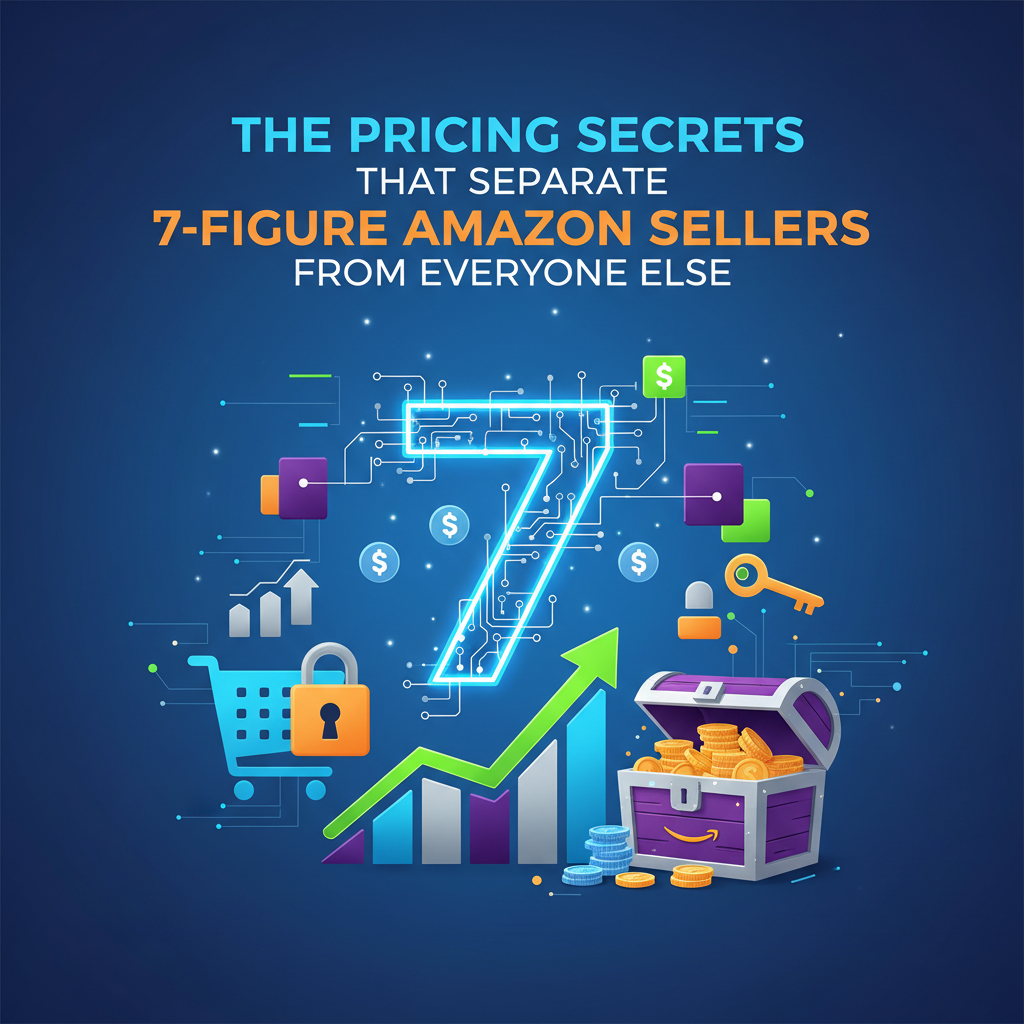
Here’s a number that should get your attention: the average Amazon FBA seller operates on 10-20% profit margins. That means a seller doing $500,000 in revenue might only be taking home $50,000-$100,000 in actual profit. Now consider this—sellers who crack the seven-figure code often achieve the same profit on half the revenue by mastering one critical skill: strategic pricing.
With third-party sellers now controlling over 60% of Amazon’s marketplace and fees continuing to climb (including the mid-2025 low-inventory surcharge that caught many sellers off guard), the margin for error has never been thinner. Yet some sellers continue to scale past seven figures while their competitors fight over scraps at the bottom of every listing.
What’s their secret? It’s not finding magical products or gaming the algorithm. It’s understanding that pricing is a strategic weapon—one that determines whether you build wealth or simply process volume.
After analyzing patterns from successful seven-figure sellers, we’ve identified the pricing secrets that make the difference. These aren’t theoretical concepts—they’re battle-tested strategies that separate sustainable businesses from revenue hamster wheels.
The Foundation: Understanding Your True Costs (Most Sellers Get This Wrong)
Before discussing advanced pricing strategies, we need to address the elephant in the room: most Amazon sellers don’t actually know their costs. They calculate COGS plus FBA fees and call it a day. Seven-figure sellers dig much deeper.
The real cost stack includes:
- Direct costs: Referral fees (15% for most categories), FBA fulfillment fees, standard storage ($0.87/cubic foot Q1-Q3, $2.40 in Q4)
- Hidden costs: Inbound placement fees, low-inventory surcharges, return processing fees, aged inventory fees (271-365 days), removal/disposal costs
- Allocated costs: Advertising spend per unit, photography and listing creation, product sampling and quality control
Seven-figure sellers use a comprehensive formula for minimum pricing:
Minimum Price = (COGS + Shipping + FBA Fees + Storage Allocation + Return Cost Factor + Ad Cost Allocation) ÷ (1 – Referral Fee %) ÷ (1 – Target Margin %)
This formula ensures every single sale contributes to actual profitability—not just top-line revenue that vanishes when you calculate true costs. Most sellers who stall at six figures are unknowingly losing money on “profitable” products because they ignore these hidden cost layers.
Pricing Secret #1: Premium Positioning Beats Race-to-Bottom
The most counter-intuitive pricing secret: seven-figure sellers often charge MORE than competitors, not less.
This works through several mechanisms:
Brand Differentiation
Private label products with genuine differentiation command 8-15% higher margins than generic alternatives. Unique bundling creates combinations competitors can’t easily replicate, with bundle margins typically running 8-12% higher than individual items.
Sustainability Certification Premium
Data shows Climate Pledge Friendly certified products enjoy 12% higher conversion rates and command 8-15% higher average selling prices. The certification provides algorithmic ranking advantages while signaling value to environmentally-conscious consumers.
Review Profile Pricing Power
Products with strong review profiles unlock premium pricing capability:
- Under 10 reviews: Must price 10-15% below established competitors
- 50-200 reviews: Can price 3-5% above market average
- 500+ reviews: Can sustain 8-12% premium pricing
The psychology is straightforward: when products offer genuine differentiation—whether through bundling, sustainability, features, or social proof—customers accept and even prefer higher prices. Perceived value exceeds price difference.
Pricing Secret #2: Portfolio Architecture (Stop Treating Every SKU Equally)
Seven-figure sellers don’t price products in isolation. They architect pricing across entire portfolios using what we call the Traffic-Profit Matrix:
Traffic Drivers (20% of SKUs)
- Purpose: Customer acquisition and search visibility
- Pricing: Competitive to aggressive
- Margin target: 8-12%
- Strategy: Heavy PPC investment, ranking focus
Profit Generators (30% of SKUs)
- Purpose: Primary profit contribution
- Pricing: Balanced competitive positioning
- Margin target: 20-28%
- Strategy: Convert traffic from Category A products
Premium Products (15% of SKUs)
- Purpose: Margin maximization
- Pricing: Premium positioning
- Margin target: 30-45%
- Strategy: Low competition niches, brand loyalists
Complementary Products (35% of SKUs)
- Purpose: Increase average order value
- Pricing: Bundling and cross-sell optimization
- Margin target: 15-25%
- Strategy: Frequently bought together, A+ Content promotion
The secret: trying to maximize margin on every SKU actually prevents scaling. Strategic pricing across categories—accepting lower margins on traffic drivers while capturing premium margins on unique products—enables sustainable seven-figure growth.
Pricing Secret #3: The Launch-Scale-Harvest Cycle
Seven-figure sellers sequence product launches with coordinated pricing strategies:
Phase 1: Penetration Launch (Days 1-30)
- Pricing: 15-20% below long-term target
- Goal: Build velocity, generate reviews, achieve ranking
- Accept: Break-even or small loss, high ACOS
Phase 2: Optimization (Days 31-90)
- Pricing: Gradual increases, 10% below target
- Goal: Find sweet spot between volume and margin
- Focus: Reduce ACOS, optimize efficiency
Phase 3: Harvest (Days 91+)
- Pricing: Full margin with intelligent repricing
- Goal: Maximize profitability while maintaining ranking
- Strategy: Organic dominance with PPC support
Most sellers make one of two mistakes: launching too cheap and creating price anchoring that prevents future increases, or launching too expensive and never building momentum. Strategic sequencing builds ranking at acceptable cost, then captures margin as organic rank supports volume.
Pricing Secret #4: Inventory-Aware Dynamic Pricing
One of the most sophisticated strategies involves real-time inventory integration:
High Inventory (60+ days stock): Aggressive pricing, reduced margin requirements. Move volume before long-term storage fees accumulate.
Medium Inventory (30-60 days): Standard competitive repricing. Maintain steady velocity with target margins.
Low Inventory (15-30 days): Gradual price increases, 5-8% above competitive baseline. Slow velocity, extend availability.
Critical Low (under 15 days): Significant premium pricing, 10-25% above normal. Prevent stockout ranking damage by stretching inventory until restock arrives.
Static pricing ignores your most important variable cost (storage) and most important risk (stockout). Dynamic inventory-aware pricing optimizes both margin protection and ranking preservation simultaneously.
Pricing Secret #5: Conversion Rate Creates Pricing Power
Here’s a connection most sellers miss: higher conversion rates enable higher prices.
When your listing converts at 15% while competitors convert at 10%, you can price 8-10% higher and still capture equivalent Buy Box share. Amazon’s algorithm factors conversion rate into Buy Box eligibility.
The formula: (Your Conversion Rate ÷ Competitor Conversion Rate) × Price Tolerance = Pricing Power
If you convert 50% better than competitors, you can typically price 8-12% higher while maintaining Buy Box competitiveness.
This is why seven-figure sellers invest heavily in listing optimization, A+ Content, and enhanced imagery. Every percentage point of conversion improvement translates directly into pricing power and margin expansion—without losing volume.
Pricing Secret #6: Multi-Channel Pricing Arbitrage
Amazon validates product-market fit at competitive pricing. But smart sellers don’t stop there.
The channel pricing strategy:
- Amazon: Competitive positioning for Buy Box (highest fees, often lowest price)
- Own Website: 10-15% higher (no referral/FBA fees, capture direct relationships)
- Retail Channels: 15-25% higher (different customer expectations, premium positioning)
- B2B/Wholesale: Volume-based tiers with different cost structures
One successful seller launched a cleaning brand on Amazon, scaled to seven figures, then expanded to 3,000+ retail stores. The same products generate 15-25% higher margins in retail while Amazon drives brand awareness and validates demand.
Pricing Secret #7: PPC as Ranking Engine, Not Cost Center
Traditional view: PPC drives sales, ACOS determines profitability.
Seven-figure view: PPC builds organic ranking, enabling premium pricing long-term.
The math tells the story:
- Product A: 70% organic traffic, 30% PPC at 20% ACOS = blended 6% ad cost
- Product B: 30% organic traffic, 70% PPC at 30% ACOS = blended 21% ad cost
Product A can price 15% higher with the same net margin because organic ranking reduces PPC dependency. Seven-figure sellers use PPC strategically to build ranking, then leverage that ranking for sustainable pricing power.
The Five Mistakes That Keep Sellers Stuck at Six Figures
Understanding what NOT to do is equally important:
- Revenue focus over profit focus: Celebrating revenue milestones while ignoring profitability depletes capital and prevents reinvestment
- Static pricing in dynamic markets: Set-and-forget pricing misses margin expansion opportunities and fails to respond to competitive pressure
- Competing on price alone: Race-to-bottom destroys margins and creates zero sustainable competitive advantage
- Treating every SKU equally: Missing portfolio economics means underinvesting in winners and overinvesting in losers
- Launching too many SKUs too fast: Capital spread too thin prevents achieving ranking or inventory efficiency on any product
Building Your Seven-Figure Pricing System
The path to seven figures requires pricing sophistication at every level: comprehensive cost accounting, portfolio-level strategy, dynamic inventory integration, conversion optimization, and multi-channel arbitrage. Manual management of these variables becomes impossible as you scale.
This is exactly why we built Zupricer.
Zupricer automates the pricing intelligence that seven-figure sellers use—margin protection floors, inventory-aware dynamic pricing, competitive positioning, and portfolio optimization—without requiring an army of analysts or constant manual intervention. Instead of hoping your pricing strategy works, you get data-driven decisions executing 24/7.
The sellers reaching seven figures aren’t working harder. They’re working smarter with systems that protect margins, capture opportunities, and scale without proportional time investment. Zupricer gives you those systems.
Ready to stop leaving money on the table and start pricing like a seven-figure seller? Your competition already is.