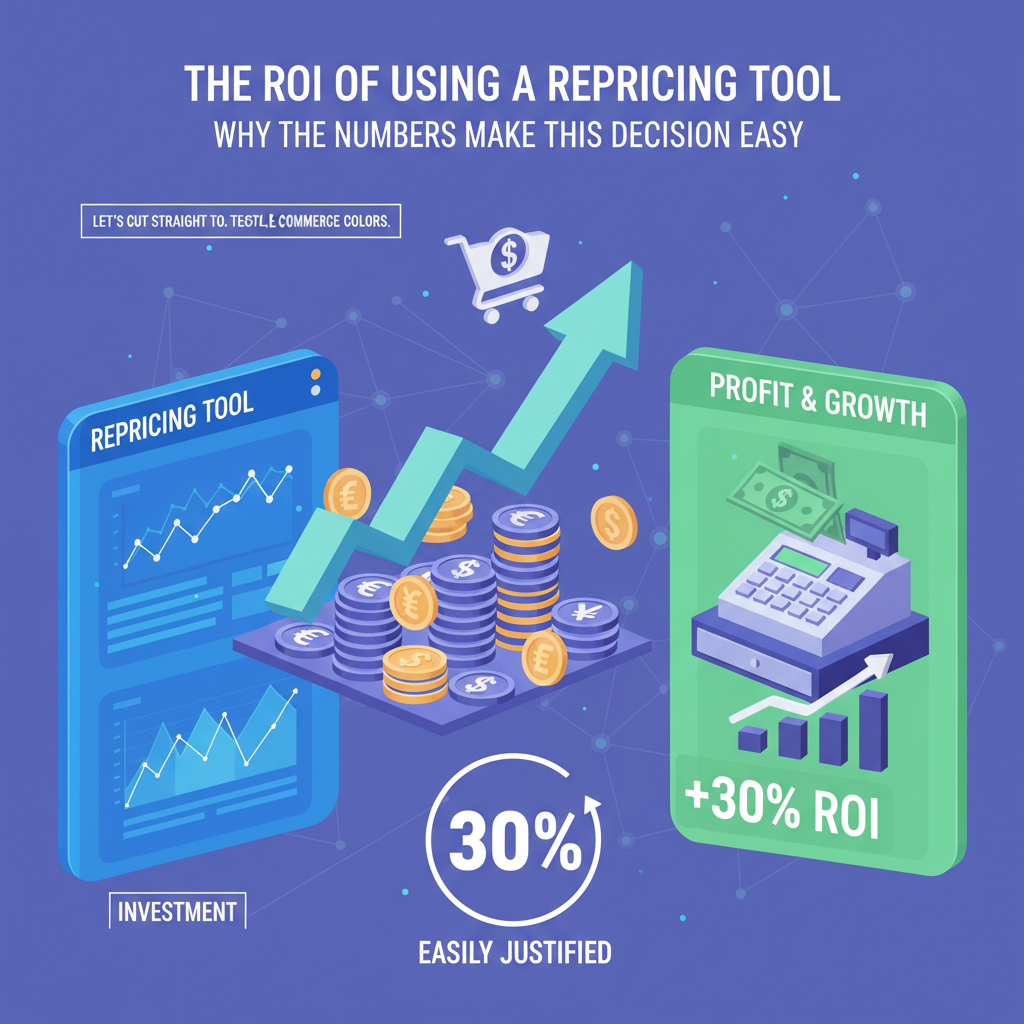
Let’s cut straight to the uncomfortable truth: if you’re still repricing manually on Amazon, you’re not saving money—you’re bleeding it. The math isn’t close. Sellers using automated repricing tools see returns of 1,000% to 3,000%+ annually on their software investment, with most recouping their costs within the first two weeks.
This isn’t marketing hyperbole. It’s what happens when you combine increased Buy Box wins, protected profit margins, eliminated pricing errors, and 10-20 hours of weekly time savings. The ROI compounds from every direction simultaneously.
The real question facing Amazon sellers today isn’t whether repricing tools deliver returns—the data settled that debate years ago. The question is how much you’re losing every week you delay implementation. Let’s break down exactly where the returns come from and what realistic numbers look like for sellers at different scales.
The Four Pillars of Repricing ROI
Understanding repricing ROI requires looking beyond a single metric. The returns stack across four distinct categories, each contributing meaningfully to your bottom line:
- Increased sales volume from better Buy Box capture rates
- Protected profit margins through intelligent pricing floors
- Time reclaimed from eliminating manual pricing tasks
- Error prevention that saves thousands in avoided mistakes
Most sellers focus exclusively on Buy Box improvements when evaluating repricers. That’s understandable—it’s the most visible benefit. But margin protection and time savings often deliver equal or greater value, especially for established sellers managing larger catalogs.
Buy Box Wins: The Primary Revenue Driver
The Amazon Buy Box captures 82-90% of all sales on a listing. On mobile devices—where most Amazon shopping happens—that percentage climbs even higher because viewing alternative offers requires extra effort most shoppers won’t make.
When you reprice manually, you’re fighting this battle with significant handicaps:
- Your response time is measured in hours or days, not minutes
- You can’t monitor competitor prices at 2 AM or during your daughter’s soccer game
- Competitors capture the Buy Box during every gap in your attention
- You consistently miss opportunities you never even knew existed
Automated repricers eliminate these disadvantages. Modern tools respond to competitor price changes within minutes—sometimes seconds—and operate continuously without human intervention. The algorithms find optimal Buy Box pricing while balancing competitiveness against profitability.
What the Numbers Actually Show
Based on current seller data, Buy Box win rate improvements of 15-40% are standard after implementing automated repricing. The improvements are most dramatic in competitive categories with multiple sellers on the same listing.
These Buy Box gains translate directly to revenue:
- A 15% Buy Box improvement typically drives 10-15% sales increases
- A 30% Buy Box improvement often delivers 20-25% revenue growth
- Even modest 10% improvements generate significant additional profit at scale
For a seller doing $50,000 monthly with a 40% Buy Box rate, moving to 60% Buy Box capture might add $6,000-8,000 in monthly revenue. At 20% margins, that’s $1,200-1,600 in additional monthly profit—from a single dimension of repricing ROI.
Margin Protection: Stopping the Race to the Bottom
Here’s where many sellers unknowingly destroy their businesses: manual repricing creates a dangerous psychological dynamic. You see a competitor drop their price, so you match it. Another competitor undercuts that, so you go lower. Repeat this cycle for months, and suddenly you’re wondering why growing revenue hasn’t translated to growing profits.
The race to the bottom happens because manual repricing lacks guardrails. Common mistakes include:
- Matching competitors who are liquidating inventory at unsustainable prices
- Failing to account for all Amazon fees when calculating floor prices
- Pricing below actual landed cost due to incomplete calculations
- Reacting emotionally to competitive pressure instead of strategically
Modern repricing tools solve this through dynamic profit floors that automatically calculate minimum profitable prices for each SKU. These calculations include all Amazon fees—referral, FBA, storage—plus product cost, shipping, and other expenses. The result: you literally cannot sell at a loss due to pricing errors.
The Margin Impact in Real Numbers
Sellers implementing proper profit floor protection report 5-15% margin improvements. More striking: many discover they were previously selling 10-30% of their catalog at a loss or break-even once all costs were properly calculated.
Consider a seller with $100,000 monthly revenue at 15% margins ($15,000 profit). An 8% relative margin improvement—achievable through proper profit floors—increases that margin to approximately 16.2%, adding $1,200 monthly to the bottom line. Subtract a $250 repricing tool cost, and you’re still netting nearly $1,000 additional monthly profit from margin protection alone.
Time Savings: The Hidden ROI Multiplier
Most sellers dramatically undervalue their time when calculating ROI. But time is the one resource you cannot manufacture more of, and manual repricing devours it.
For a seller managing 50-100 SKUs, realistic manual repricing demands:
- Checking competitor prices: 5-10 hours weekly
- Calculating appropriate adjustments: 2-3 hours weekly
- Making updates in Seller Central: 2-3 hours weekly
- Verifying changes took effect: 1-2 hours weekly
Total: 10-18 hours weekly, every week, forever. For larger catalogs, this scales proportionally until manual repricing becomes physically impossible—which is why many sellers with 200+ SKUs simply abandon it on portions of their inventory.
Automated repricing reduces this to 2-3 hours weekly for strategy review and optimization. That’s 8-15 hours reclaimed every single week.
Calculating Your Time Value
If your time is worth $50/hour—conservative for a business owner—those 12 saved weekly hours represent $600/week or $2,400/month in recaptured value. Annually, that’s $28,800.
Even at $25/hour, you’re looking at $14,400 annually in time value—which alone exceeds the cost of most repricing tools by 10x or more.
And this calculation ignores the opportunity cost: what could you accomplish with an extra 48-60 hours monthly? Product sourcing, supplier negotiations, inventory optimization, PPC management, customer service improvements, strategic planning. These high-value activities drive business growth in ways that manual price updates never will.
Error Elimination: Insurance Against Catastrophic Mistakes
Manual repricing is a breeding ground for expensive errors. The most common include:
- Data entry mistakes (entering $2.49 when you meant $24.90)
- Incomplete fee calculations leading to below-cost pricing
- Updating the wrong product listing
- Missing competitor price changes for extended periods
- Forgetting to readjust prices after promotions end
A single major error can cost thousands. Selling 100 units of a $50 product at $5 due to a decimal mistake? That’s $4,500 gone instantly. Pricing below cost on a high-velocity product? You’re losing money on every sale until you discover the problem—which might take days.
Automated repricing eliminates these risks through consistent calculations, built-in safeguards, and minimum/maximum price boundaries. The same logic applies every time, all fees are automatically included, and no data entry mistakes corrupt your pricing.
Even preventing 2-3 major errors annually—which most manual sellers experience—saves $1,000-6,000. The peace of mind alone justifies the investment for many sellers.
Real ROI Examples Across Seller Scales
Let’s examine realistic scenarios for different seller sizes:
Small Seller: 50 SKUs, $50K Monthly Revenue
Before automation: 18% margins ($9,000 profit), 45% Buy Box rate, 12 hours weekly on pricing.
After automation: Buy Box improves to 65%, revenue increases 12% to $56,000, margins improve to 20%. New monthly profit: $11,200—a $2,200 increase. Subtract $150 tool cost, and net benefit is $2,050 monthly plus 40 hours saved.
ROI: 1,367% annually. Payback period: 2 weeks.
Medium Seller: 200 SKUs, $150K Monthly Revenue
Before automation: 20% margins ($30,000 profit), 55% Buy Box rate, 20 hours weekly on pricing that still leaves gaps.
After automation: Buy Box improves to 70%, revenue increases 10% to $165,000, margins improve to 23%. New monthly profit: $37,950—a $7,950 increase. Subtract $300 tool cost, and net benefit is $7,650 monthly plus 64 hours saved.
ROI: 2,550% annually. Payback period: 1.2 weeks.
Large Seller: 500+ SKUs, $500K Monthly Revenue
Before automation: 22% margins ($110,000 profit), 60% Buy Box rate, manual repricing largely abandoned due to scale.
After automation: Buy Box improves to 78%, revenue increases 15% to $575,000, margins improve to 24%. New monthly profit: $138,000—a $28,000 increase. Subtract $500 tool cost, and net benefit is $27,500 monthly plus scalability that was previously impossible.
ROI: 5,500% annually. Payback period: 5 days.
The Cost of Staying Manual
Perhaps the most compelling ROI calculation is what you lose by not automating. For a $100K monthly seller:
- Lost sales from poor Buy Box capture: $15,000-40,000 monthly
- Margin erosion from race-to-bottom pricing: $1,000-3,000 monthly
- Time waste at $50/hour: $2,000-4,000 monthly
- Pricing errors: $100-500 monthly (averaged)
Total annual cost of NOT automating: $217,000-570,000. Compare that to repricing tool costs of $1,800-3,600 annually. The cost of staying manual is 60-316 times higher than the cost of automating.
Making the Decision: What Smart Sellers Are Doing
The ROI evidence is overwhelming. Repricing tools pay for themselves within weeks, deliver returns exceeding 1,000% annually, and free up hours weekly for higher-value activities. The benefits compound over time as algorithms learn and optimize, while manual sellers fall further behind.
The sellers winning on Amazon today aren’t debating whether to automate—they’re focused on choosing the right tool and optimizing their strategies. They understand that repricing automation isn’t an expense; it’s an investment with quantifiable, substantial, and sustained returns.
For sellers ready to stop leaving money on the table, Zupricer delivers the complete repricing solution that drives these returns. With intelligent profit floor protection, AI-powered competitive analysis, and real-time repricing that captures Buy Box opportunities around the clock, Zupricer transforms pricing from a time-consuming burden into a profit-generating advantage. The ROI math is clear—and Zupricer makes capturing those returns simple.