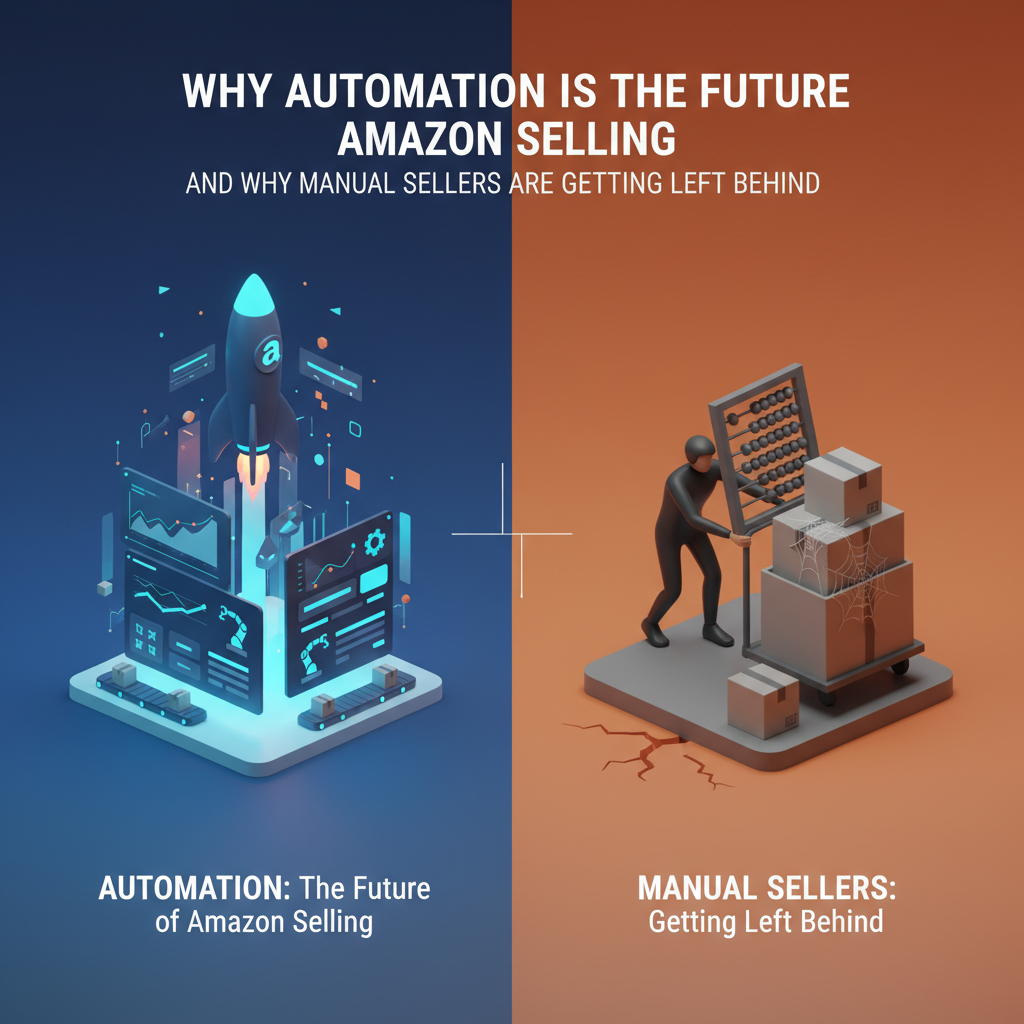
Here’s a reality check for Amazon sellers in 2025: if you’re still manually managing your pricing, advertising, and inventory, you’re not just working harder than your competitors—you’re actively losing to them.
This isn’t speculation. Amazon CEO Andy Jassy recently made it clear that AI and automation are fundamentally reshaping how the company operates, with efficiency gains expected to reduce workforce needs across routine tasks. If Amazon itself is betting everything on automation, what does that tell you about what it takes to succeed on their platform?
The sellers thriving right now aren’t necessarily smarter or better funded. They’ve simply recognized that the marketplace has become too complex, too fast-moving, and too competitive for human-speed decision making. Automation has shifted from “nice to have” to “non-negotiable.” Let’s break down exactly why—and what you need to do about it.
The Automation Shift: What’s Actually Happening in 2025
Automation adoption among Amazon sellers has hit a tipping point. The majority of competitive sellers now use automated tools across their core business functions:
- Repricing automation adjusts prices in real-time, sometimes every five minutes
- PPC automation has evolved from basic bid rules to AI-driven campaign optimization
- Inventory management systems predict demand and prevent costly stockouts
- Review management tools maintain seller reputation automatically
- Financial tracking provides real-time profitability insights per SKU
The result? Manual sellers face a structural disadvantage that grows wider every month. They’re slower to respond, limited in scale, and prone to errors that automated competitors simply don’t make.
Why Manual Management No Longer Works
Let’s be honest about what manual selling actually looks like in 2025. You’re logging into Seller Central multiple times daily. You’re checking competitor prices across dozens or hundreds of ASINs. You’re adjusting PPC bids based on yesterday’s data. You’re tracking inventory in spreadsheets and hoping you don’t miss a reorder point.
Here’s why this approach is failing:
Speed Mismatch
Competitor prices change multiple times per day. Amazon’s buy box algorithm evaluates sellers continuously. Your human response time—measured in hours or days—cannot compete with automated systems responding in minutes. By the time you notice a competitor’s price drop, they’ve already captured the sales you would have made.
Scale Limitations
Manual repricing becomes unsustainable around 50 SKUs. Manual PPC management breaks down around 100 SKUs. If you’re trying to grow beyond a small catalog—or expand to multiple Amazon marketplaces—manual processes create an impossible workload that scales linearly with every product you add.
Complexity Overload
Amazon’s ecosystem in 2025 involves multi-factor algorithms for Buy Box placement, constantly changing advertising options (Sponsored Products, Sponsored Brands, Sponsored Display, DSP), stricter performance standards, and faster fulfillment expectations. No human can monitor all these variables simultaneously across a meaningful product catalog.
Opportunity Cost
Every hour spent on manual price adjustments, bid management, and inventory tracking is an hour not spent on product sourcing, supplier relationships, brand development, or business strategy. You end up working in your business instead of on your business.
The Six Areas Where Automation Is Now Essential
1. Automated Repricing
Modern repricing tools use AI and machine learning to optimize prices based on Buy Box probability, competitor behavior, demand signals, and inventory levels. The best systems learn from outcomes rather than just following fixed rules—they adapt to what actually drives sales and profitability for your specific products.
The impact is measurable: sellers using automated repricing consistently report improved Buy Box win rates, 10-25% increases in sales volume, and 5-15% profit margin improvements. Manual repricing simply cannot achieve these results.
2. PPC Advertising Automation
Amazon advertising has become too complex for manual management. AI-driven tools now offer conversion-based bidding (optimizing for sales, not just clicks), real-time marketplace benchmarking, automated keyword discovery, day-parting strategies, and cross-platform optimization.
The difference shows up in your ACoS. Manual PPC managers miss bidding opportunities during off-hours, react too slowly to performance data, and can’t test and iterate at the pace required for optimization.
3. Inventory Management
Stockouts kill your sales velocity and rankings. Excess inventory incurs storage fees and ties up capital. Automated inventory systems use predictive analytics to forecast demand, trigger reorder alerts, and optimize stock levels across channels. This becomes impossible to manage manually once you’re handling more than a few dozen products with varying sales velocities.
4. Product Research and Sourcing
AI-powered tools now automate product discovery, sales estimation, competition analysis, and even supplier sourcing. They can identify profitable opportunities faster than any human researcher and flag potential issues like IP concerns or category restrictions before you make costly mistakes.
5. Review and Feedback Management
Amazon’s algorithm heavily weights reviews and ratings. Automated systems handle review requests (within Amazon’s Terms of Service), monitor sentiment, and provide competitive intelligence on how your products compare to alternatives. Manual review management doesn’t scale, and inconsistent follow-up hurts your seller metrics.
6. Financial Tracking
Between referral fees, FBA fees, storage costs, advertising spend, and product costs, understanding your true profitability per SKU requires sophisticated tracking. Automated financial tools integrate with your Amazon data to provide real-time profitability dashboards, automated expense tracking, and proper tax preparation.
The ROI Reality: What Automation Actually Costs and Returns
Let’s talk numbers. A comprehensive automation setup typically costs $300-800 per month for professional sellers, covering repricing, PPC management, and inventory tools.
What does that investment return?
- Sales increases of 10-25% from better Buy Box capture and advertising optimization
- Time savings of 10-20+ hours weekly reclaimed from manual tasks
- Error reduction that eliminates costly pricing mistakes and forgotten updates
- Scalability to manage 10x the catalog without proportional time investment
For a seller doing $50,000/month in revenue, a 10% sales increase generates $5,000 in additional monthly revenue. At a 20% profit margin, that’s $1,000 in additional profit—against a $400 automation cost. The payback period is typically less than one month.
And that calculation doesn’t even account for the strategic value of reclaimed time. Those 15+ hours weekly can go toward sourcing profitable products, building supplier relationships, or expanding to new marketplaces—activities that compound over time.
Common Automation Mistakes to Avoid
Automation isn’t magic. Implemented poorly, it can actually hurt your business. Here’s what to watch out for:
- “Set it and forget it” thinking: Automation requires ongoing oversight. Market conditions change, competitors evolve, and Amazon updates its algorithms. Review your automated performance weekly and adjust settings regularly.
- Automating before understanding: New sellers should spend 1-2 months managing manually to learn marketplace dynamics. Automation executes strategy—you still need to develop that strategy first.
- Missing guardrails: Always set minimum prices, maximum ACoS limits, and profit floors. Automation without boundaries can race to unsustainable prices or overspend on advertising.
- Tool fragmentation: Using too many disconnected tools creates data silos and workflow complexity. Prioritize integrated platforms or tools with strong API connections.
How to Transition: A Practical Roadmap
If you’re still primarily manual, here’s how to transition without overwhelming your business:
Phase 1 (Months 1-3): Start with repricing automation—it delivers the biggest immediate impact on sales and Buy Box performance. Add basic PPC automation and review request tools. Use conservative settings and monitor closely.
Phase 2 (Months 4-6): Expand to inventory management and advanced PPC optimization. Begin using product research automation and financial tracking. Compare automated performance to your manual baseline.
Phase 3 (Month 7+): Implement multi-marketplace automation if expanding internationally. Adopt advanced AI features like predictive analytics. Build custom integrations for seamless workflows. Develop a hybrid strategy with automated foundations and strategic manual oversight.
The Bottom Line: Adapt or Fall Behind
The Amazon marketplace of 2025 rewards speed, scale, and data-driven optimization. Manual processes deliver none of these. Your competitors—the ones winning Buy Box, capturing sales, and growing their businesses—have already automated their core operations.
This isn’t about replacing your judgment with algorithms. It’s about freeing yourself from repetitive execution so you can focus on strategy, differentiation, and growth. The best sellers combine automated efficiency with human creativity and market insight.
The gap between automated and manual sellers will only widen. The question isn’t whether to automate—it’s how quickly you can implement the right tools and start competing on equal footing.
For Amazon sellers ready to make this transition, Zupricer offers the intelligent repricing automation that forms the foundation of a competitive Amazon business. With real-time price optimization, built-in profit protection, and AI-driven strategies designed specifically for Buy Box dominance, Zupricer handles the complex, time-consuming work of competitive pricing—so you can focus on building the business you actually want to run. The future of Amazon selling is automated. Make sure you’re part of it.