When most Amazon sellers see their margins shrinking, their first instinct is to cut prices. More sales volume, they reason, will make up for the thinner margins. But here’s what actually happens: competitors match the lower price, everyone’s margins collapse further, and suddenly you’re working twice as hard for half the profit.
Marcus ran a $500,000 electronics accessories business on Amazon. His net margin sat at 12%—decent, but not great. After fees, advertising costs, returns, and all the hidden expenses, he was taking home about $60,000 annually. He knew he needed to improve profitability, but lowering prices in his competitive category would only accelerate the race to the bottom.
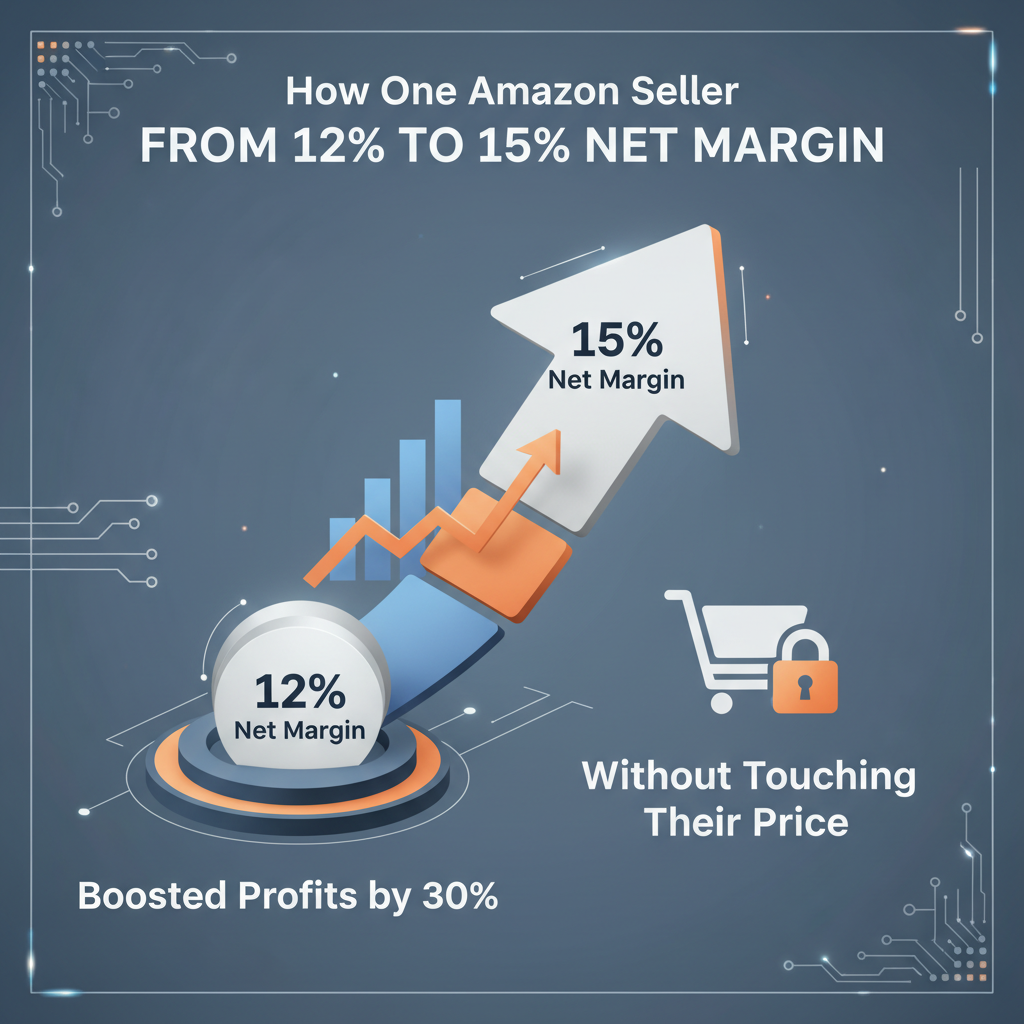
Ninety days later, his net margin hit 15%. Same products. Same (or slightly higher) prices. But $78,000 in annual profit instead of $60,000. That’s a 30% increase in take-home earnings without selling a single additional unit at a discount.
His approach wasn’t revolutionary—it was systematic. And it’s something any Amazon seller can replicate right now, during a period when margin pressure has never been higher. Sellers are facing skyrocketing fees, aggressive competition, and tighter policy enforcement. The sellers who thrive aren’t winning price wars. They’re optimizing every variable in the profit equation except price.
The Hidden Profit Killers Most Sellers Ignore
Before diving into solutions, let’s understand what’s actually eating your margins. Most sellers focus obsessively on price and sales volume while overlooking the real culprits:
- FBA fee tier inefficiencies: Products packaged just slightly too large, costing $1-3 extra per unit
- Wasted advertising spend: Ads running at 3 AM when nobody’s buying
- Supplier terms left on the table: Missing volume discounts and early payment savings
- Conversion rate gaps: Paying for traffic that doesn’t convert due to weak listings
- Return rate bleeding: Products coming back because descriptions didn’t set proper expectations
- Storage fee accumulation: Slow-moving inventory quietly draining profits
Marcus discovered that his 12% margin wasn’t being killed by competitive pricing. It was death by a thousand cuts—small inefficiencies across every part of his operation that added up to massive profit leakage.
Strategy 1: FBA Fee Optimization That Saved $2.50 Per Unit
Amazon’s fee structure is complex, but one principle is simple: size and weight determine your fulfillment costs. Marcus analyzed his top 10 SKUs and found that several were just barely crossing into higher fee tiers due to packaging choices made years ago without much thought.
The changes were surprisingly simple:
- Repackaged three products to fit into smaller size tiers, saving $2.50+ per unit
- Switched to own-box packaging where applicable, capturing $0.15-$0.40 per unit in savings
- Worked with suppliers to reduce product weight on two items, dropping them into lower fee brackets
- Removed excessive protective packaging that wasn’t actually preventing damage
The impact: FBA fees reduced by 8% across his optimized SKUs. On his volume, that translated to thousands in annual savings—money that went straight to his bottom line without changing a single price tag.
The Storage Fee Timing Trick
Marcus also discovered he’d been sending inventory at the worst possible times. Q4 storage rates ($2.40 per cubic foot) are nearly three times higher than Q1-Q3 rates ($0.87 per cubic foot). By pre-positioning inventory in September rather than October, and removing slow-moving stock before the 271-day aged inventory threshold, he cut storage costs by 30%.
Strategy 2: COGS Reduction Through Strategic Purchasing
Here’s where Marcus found his biggest single margin improvement. He’d been ordering inventory reactively—waiting for Amazon payouts, then placing orders based on when cash arrived rather than when economics were favorable.
The smarter approach involved stacking discounts:
- Volume discount: 10% for ordering 5x the minimum order quantity
- Early payment discount: 2% for paying within 10 days instead of Net 30
- Quarter-end timing: 3% promotional discount when suppliers were pushing to hit targets
Combined, these stacked discounts reduced his COGS by 15% on major orders. He achieved this by securing a small line of credit that let him separate his purchasing timeline from Amazon’s disbursement cycle. Instead of ordering when Amazon paid him, he ordered when suppliers offered the best terms.
The math was compelling: a 15% reduction in COGS on products where cost of goods represented 40% of revenue meant a 6% improvement in overall margin. That single change accounted for nearly half his total profit improvement.
Strategy 3: Advertising Efficiency Without Cutting Spend
Marcus was spending $8,000 monthly on PPC advertising with an ACOS (Advertising Cost of Sale) hovering around 28%. His instinct was to cut ad spend, but that would reduce sales volume. Instead, he focused on making every ad dollar work harder.
Dayparting: The Simple Fix Most Sellers Miss
Analysis of his hourly conversion data revealed a pattern: ads converting at 12% during evening hours (6-10 PM) but only 3% between 2-6 AM. Yet his budget was spread evenly across all hours.
The fix was straightforward:
- Increased bids 20% during peak conversion hours (6-10 PM)
- Reduced bids 40% during low-conversion periods (midnight to 6 AM)
- Paused campaigns entirely during the worst-performing hours on weekdays
Same monthly budget. Same sales volume. But ACOS dropped from 28% to 22%—a direct 2% improvement in net margin.
Negative Keywords and Search Term Mining
Marcus also discovered he was paying for clicks on search terms that never converted. Adding 200+ negative keywords eliminated wasted spend on irrelevant searches. Meanwhile, mining his search term reports revealed high-converting phrases that deserved dedicated campaigns with higher bids.
Strategy 4: Conversion Rate Optimization—The Multiplier Effect
Here’s the math that changed Marcus’s perspective on listing optimization: if you convert 10% of visitors and improve to 12%, that’s a 20% increase in sales from the same traffic. With fixed advertising costs, that improvement flows almost entirely to profit.
His listings were “good enough”—but good enough was leaving money on the table. The optimization focused on:
- Main images: Upgraded to professional photography with products filling 85% of frame
- Secondary images: Added lifestyle shots, size comparison graphics, and feature callout overlays
- Bullet points: Rewrote to lead with benefits rather than features, addressing common customer questions
- A+ Content: Created comparison charts and brand story modules for all listings
The results: conversion rates improved 15% across his top 10 SKUs. Combined with stable traffic, this meant 15% more sales from the same advertising investment. Industry data confirms this isn’t unusual—comprehensive listing optimization typically delivers 10-20% conversion improvements, with A+ Content adding another 3-10% lift.
Strategy 5: The SKU-Level Profitability Audit
This was Marcus’s most uncomfortable discovery. When he analyzed profitability at the individual SKU level—accounting for COGS, FBA fees, advertising costs, returns, and storage—he found that 10 of his 30 SKUs were actually losing money.
These products looked profitable on the surface. They generated revenue. They had decent sales velocity. But when every cost was allocated properly, they were subsidized by his 15 truly profitable SKUs.
The action plan was straightforward but required discipline:
- Discontinued 5 SKUs that couldn’t be fixed (negative margins with no optimization path)
- Reduced advertising on 10 low-margin SKUs (let them sell organically or not at all)
- Doubled down on the 15 high-margin products with increased inventory and marketing
- Bundled 3 slow-movers with fast-movers to improve their economics
Counter-intuitively, eliminating products increased profitability. His revenue dipped slightly in month one, then recovered as resources concentrated on winners. Complexity decreased. Cash flow improved. And overall margin jumped as the unprofitable drag disappeared.
Strategy 6: Returns Reduction—The 3% Margin Recovery
Marcus’s return rate sat at 7%—not terrible for electronics accessories, but costly. Each return meant lost shipping fees, potential inventory disposal, reduced seller metrics, and wasted customer acquisition cost.
The fix focused on expectation-setting rather than product changes:
- Added detailed dimension graphics to all listings (many returns were “smaller than expected”)
- Created compatibility FAQ sections addressing common purchase mistakes
- Included video demonstrations showing products in actual use
- Updated bullet points to explicitly state what was NOT included
Return rate dropped to 4.5%. That 2.5% reduction translated directly to margin improvement—fewer refunds, lower return processing fees, better seller metrics, and reduced inventory waste.
Strategy 7: Automation and Time Value Recognition
The final piece of Marcus’s transformation involved recognizing something most sellers ignore: his time had value, and he was spending it on low-leverage activities.
He calculated that he spent 20+ hours weekly on routine tasks—customer service responses, inventory monitoring, manual repricing, PPC bid adjustments, and competitor research. At his target hourly rate, that time was worth $2,000+ weekly. Yet he could automate or delegate most of it for $2,000 monthly.
The shift included:
- Repricing tools responding to market changes in minutes rather than his hours-delayed manual adjustments
- Inventory management software preventing stockouts and alerting to slow-movers
- Virtual assistant handling customer service inquiries
- Automated reporting dashboards replacing manual spreadsheet work
The freed time went to strategic work: sourcing two new high-margin products, negotiating better supplier terms, and optimizing his highest-potential listings. The ROI was substantial—$24,000 annual cost for automation and delegation, but $40,000+ in value created through strategic activities.
The 90-Day Results: Proof That Price Isn’t Everything
After three months of systematic optimization, here’s where Marcus landed:
- Starting position: $500,000 revenue, 12% net margin, $60,000 annual profit
- Ending position: $520,000 revenue, 15% net margin, $78,000 annual profit
- Improvement: 30% increase in profit ($18,000 additional annual take-home)
- Prices: Unchanged or slightly increased on some items
The margin improvement broke down across multiple levers: FBA fee optimization (+2.5%), COGS reduction (+4%), PPC efficiency (+2%), conversion improvement (+1.5%), returns reduction (+1%), SKU mix optimization (+2%), and operational efficiency (+1%).
No single change was transformational. But stacked together, small improvements across every variable in the profit equation created substantial results.
Turn Profit Optimization Into Automated Reality
Marcus’s story illustrates a fundamental truth: the most sustainable path to Amazon profitability isn’t winning price wars—it’s optimizing every controllable variable while maintaining healthy prices. The sellers thriving right now think systematically about profit, use data to drive decisions, and automate tactical work so they can focus on strategy.
One of the most impactful changes Marcus made was implementing automated repricing that responded to market conditions in real-time—protecting his margins during low-competition periods while staying competitive when it mattered. Manual repricing simply couldn’t match the speed or sophistication required.
Zupricer delivers exactly this capability for Amazon sellers serious about profitability. With intelligent repricing that protects your floor prices, responds to competitor changes instantly, and optimizes for profit rather than just sales volume, Zupricer transforms the pricing piece of your profit optimization strategy. Stop leaving money on the table with manual price adjustments. Stop racing to the bottom against competitors. Start pricing strategically, protecting your margins, and capturing opportunities that manual processes miss.
Ready to see what your margins could become? Try Zupricer today and join the sellers who’ve discovered that profit growth doesn’t require price cuts—it requires smarter systems.