Amazon Pricing Strategy: Best Pricing Tool and Rules 2026
Amazon Pricing Strategy: Best Pricing Tool and Rules 2026
Amazon changed more about how pricing works behind the scenes in the past year than in the previous five combined, and the pace of change shows no clear sign of slowing down. If you’re still thinking about amazon pricing strategy the way you did back in 2023 — set a price, watch a competitor, adjust manually — you’re already working with an outdated playbook. The platform itself has opened up new API-level capabilities that are reshaping what a modern pricing tool can actually do.
This guide walks through what’s changed, why it matters for sellers of every size, and how to build a pricing approach that takes advantage of these shifts instead of getting left behind by them as the competitive landscape keeps evolving.
How Does Amazon Pricing Work in 2026?
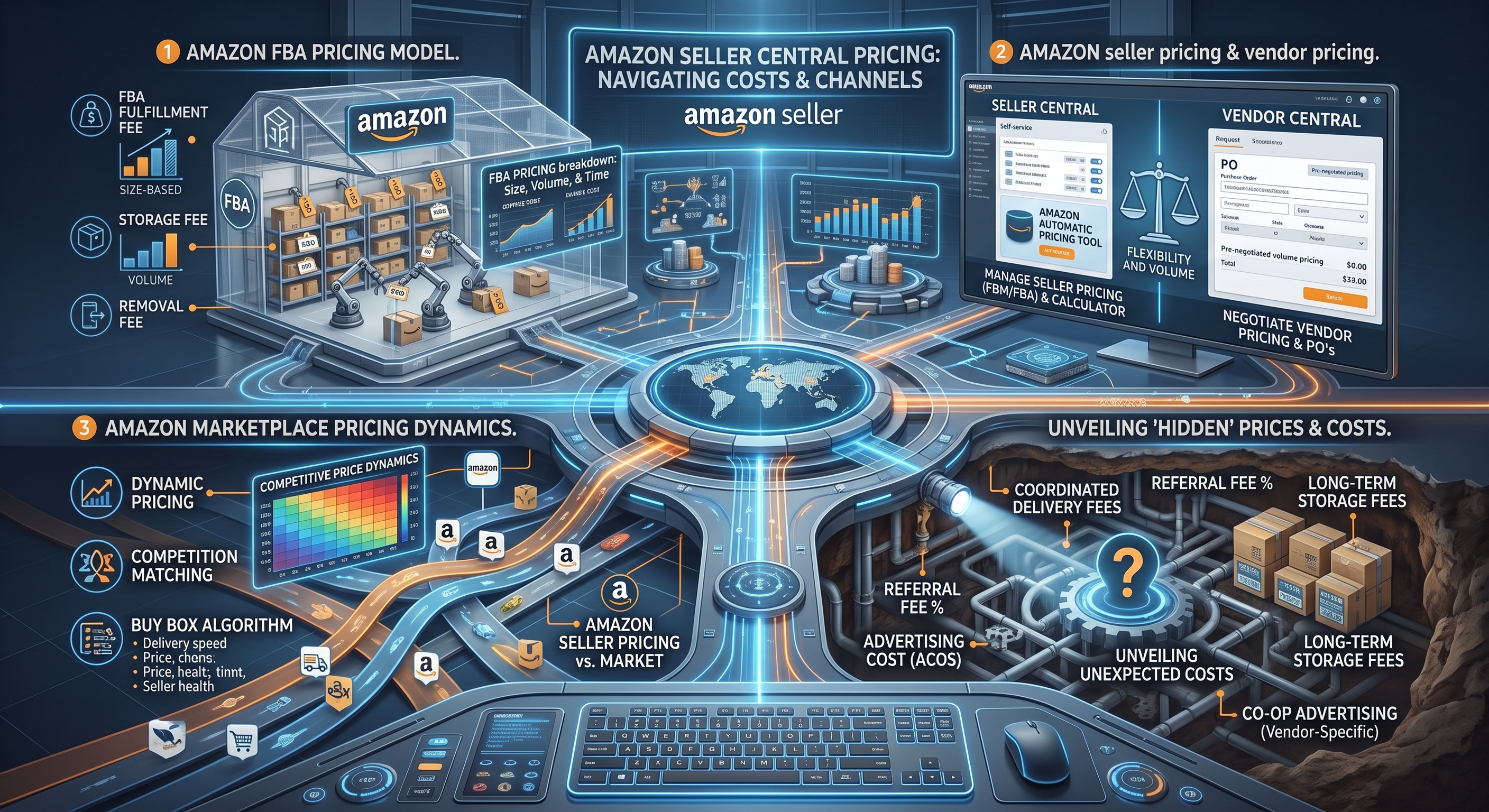
For years, the honest answer to how does amazon pricing work was messier than most sellers wanted to hear. Third-party repricing tools operated somewhat separately from Amazon’s own internal pricing engine, reacting to competitor changes from the outside rather than working directly with Amazon’s systems. That separation created friction — delays, occasional mismatches between what a repricer intended and what actually went live, and a general sense that sellers were working around Amazon’s system rather than with it.
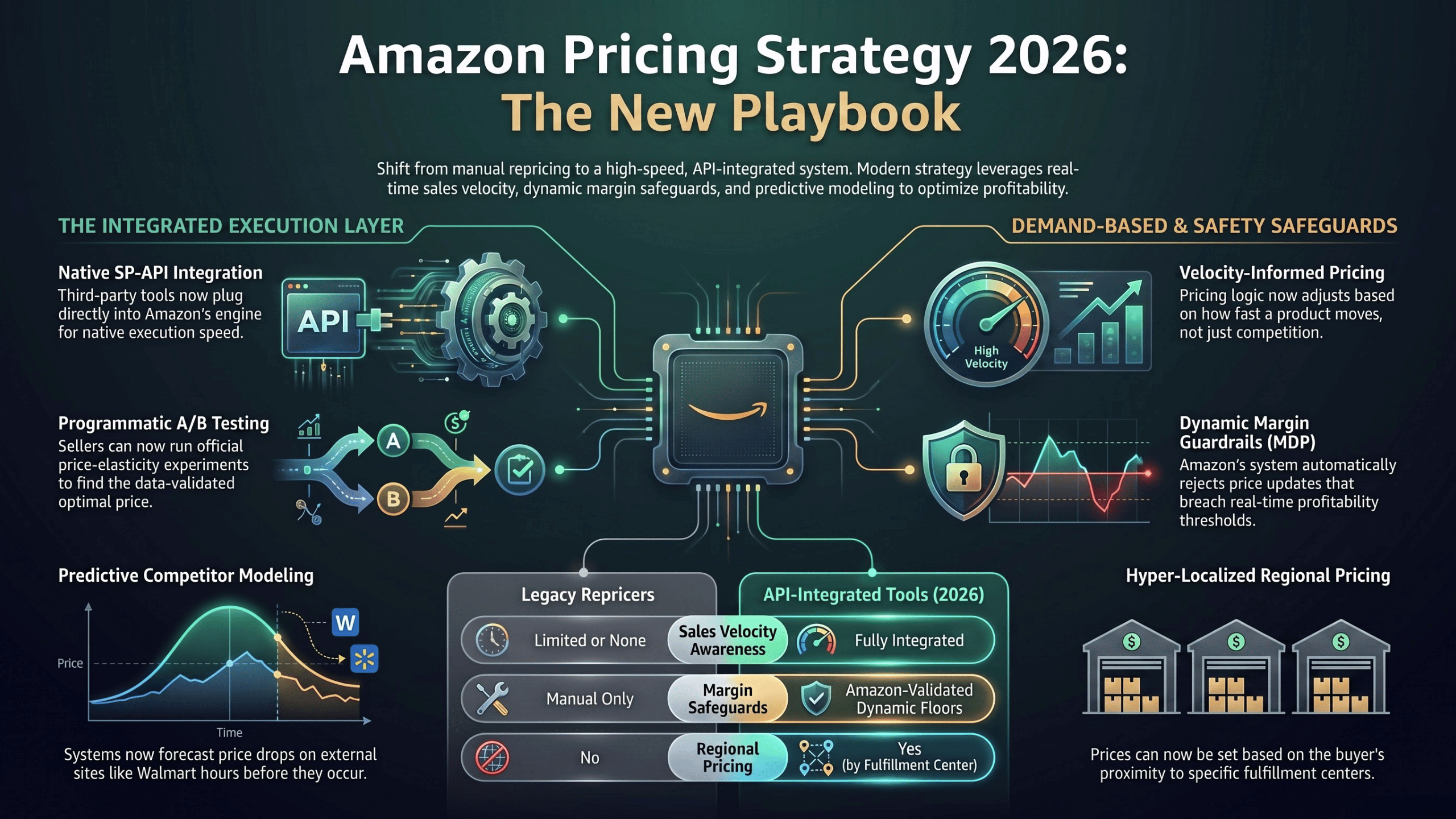
That’s no longer entirely true. Amazon has opened a new SP-API Pricing Rules endpoint that lets third-party pricing software amazon sellers rely on plug directly into Amazon’s native “Automate Pricing” engine. Instead of a repricer and Amazon’s own pricing tools working as separate, sometimes competing systems, a properly built pricing software amazon platform can now issue commands that Amazon’s internal engine executes natively. The practical result is repricing that moves at Amazon’s own internal speed while still following the complex, margin-aware logic a seller configured on the third-party side.
This is a meaningful shift. What used to be two separate layers — Amazon’s native pricing tools and independent third-party repricers — is starting to merge into something closer to a single coordinated system, with the third-party tool supplying the strategy and Amazon’s infrastructure supplying the execution speed.
Real-Time Sales Velocity Is Now Part of the Pricing Equation
One of the more significant additions this year is real-time sales velocity data becoming accessible directly through Amazon’s pricing APIs. Previously, most amazon pricing tool platforms based their logic almost entirely on competitor price tracking — watching what rivals were charging and reacting accordingly. That approach ignores a huge piece of the picture: how fast a product is actually moving off the virtual shelf.
With sales velocity now built into the pricing data available to repricers, a smarter approach becomes possible. A listing selling briskly can justify holding — or even raising — price, since demand is clearly there regardless of what a slower-moving competitor is charging. A listing with sluggish turnover might call for a different posture entirely, since matching a competitor’s price without addressing the underlying demand problem won’t necessarily move more units.
This shifts amazon pricing strategies away from being purely reactive to competitor behavior and toward something closer to genuine demand-based pricing. Instead of asking “what is my competitor charging right now,” the more useful question becomes “how fast is this actually selling, and does my current price reflect that.”
Programmatic Price-Elasticity Testing Changes How Sellers Find Their Optimal Price
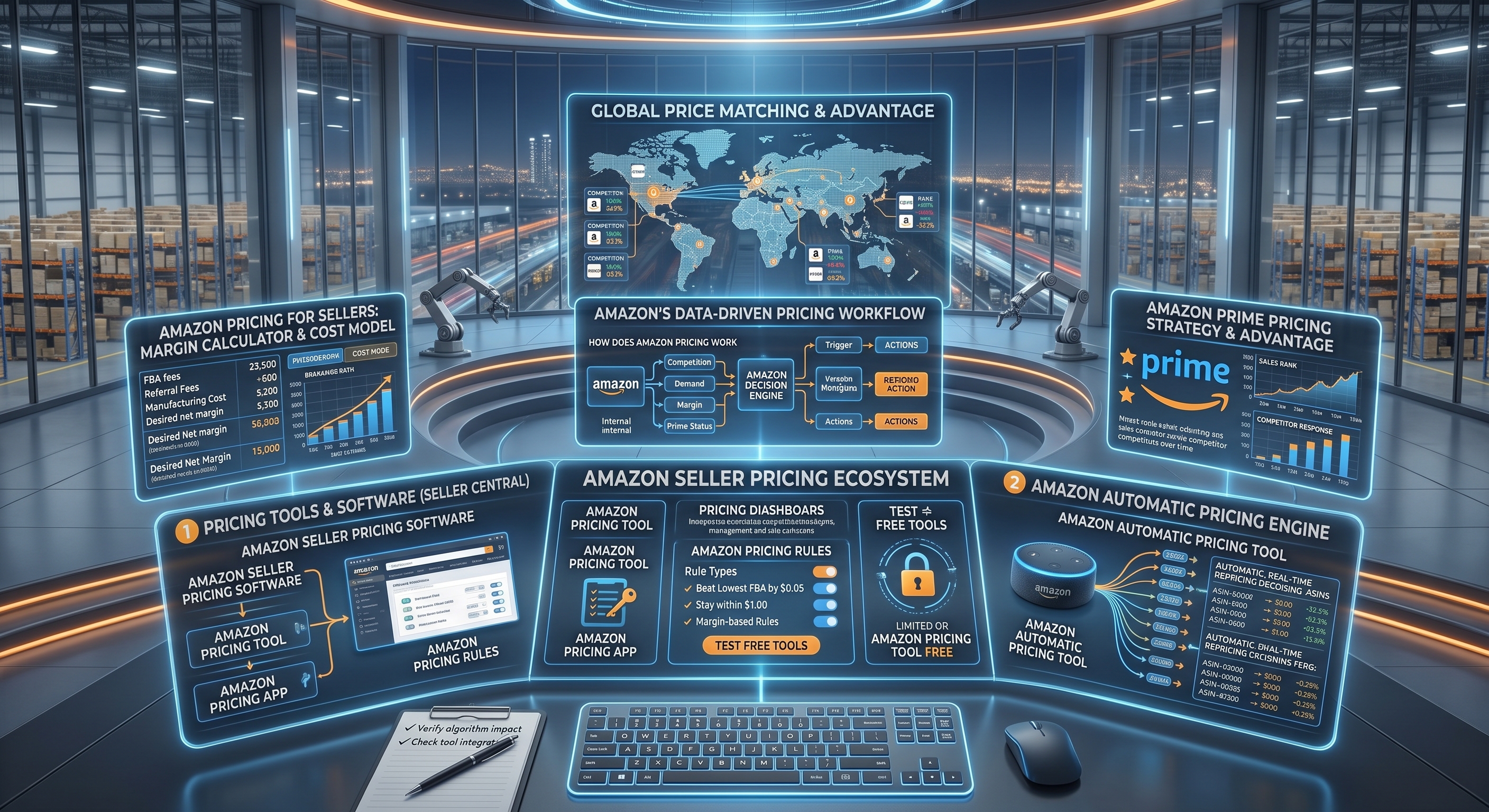
Amazon has also integrated price testing directly into its “Manage Your Experiments” API, which opens the door for genuine A/B testing on pricing at scale. Rather than guessing at the right price point or slowly nudging a price up or down over weeks and eyeballing the sales impact, sellers can now run structured price-elasticity experiments through Amazon’s own official testing framework.
This matters enormously for anyone serious about price optimization tools. Finding the actual point where a small price increase doesn’t meaningfully hurt conversion, or where a small decrease genuinely drives enough extra volume to offset thinner margins, has historically been more art than science for most sellers. Structured, programmatic testing through an official Amazon framework takes a lot of the guesswork out of that process, and reduces the risk of accidentally tanking Buy Box eligibility by testing prices outside of Amazon’s sanctioned experimentation tools.
For sellers managing large catalogs, this kind of testing at scale — running dozens of price experiments simultaneously across different SKUs — simply wasn’t practical before. Now it’s becoming a realistic part of an ongoing pricing strategy rather than an occasional manual project.
| Pricing Approach | Data Source | Decision Basis | Risk Level |
|---|---|---|---|
| Competitor-Only Repricing | Rival listing prices | Reactive price matching | Moderate to high |
| Velocity-Informed Pricing | Sales velocity + competitor data | Demand-adjusted pricing | Lower |
| Programmatic A/B Testing | Live experiment results | Data-validated optimal price | Lowest |
Dynamic Margin Guardrails Are Becoming an Amazon-Level Safeguard
One of the more protective changes rolling out is a set of dynamic minimum-margin guardrails built directly into the SP-API. Rather than relying purely on a seller or a third-party tool to configure a manual price floor, Amazon’s system can now dynamically calculate real-time floor margins based on fluctuating FBA fees and storage costs, and reject external repricing updates that would push a listing below a safe profitability threshold.
This is a fairly significant shift in responsibility. For years, if a repricer’s floor was misconfigured, or if fee structures changed without a seller noticing, prices could quietly slip into unprofitable territory before anyone caught it. With Amazon’s own infrastructure now capable of rejecting updates that breach dynamically calculated margin safety, there’s an additional layer of protection against the kind of race-to-the-bottom pricing spirals that have burned sellers in the past.
Closely related is a new safeguard called Minimum Declared Price, or MDP, which functions as an automated floor specifically designed to protect brand equity and prevent runaway downward pricing. Sellers working with private label or branded products in particular stand to benefit from this, since brand perception can take real damage when a product’s price collapses unpredictably during an automated pricing spiral. For any amazon pricing app or repricing platform, mapping and respecting these MDP values correctly is quickly becoming a baseline requirement rather than a nice-to-have feature.
Regional Pricing Controls Based on Fulfillment Center Proximity
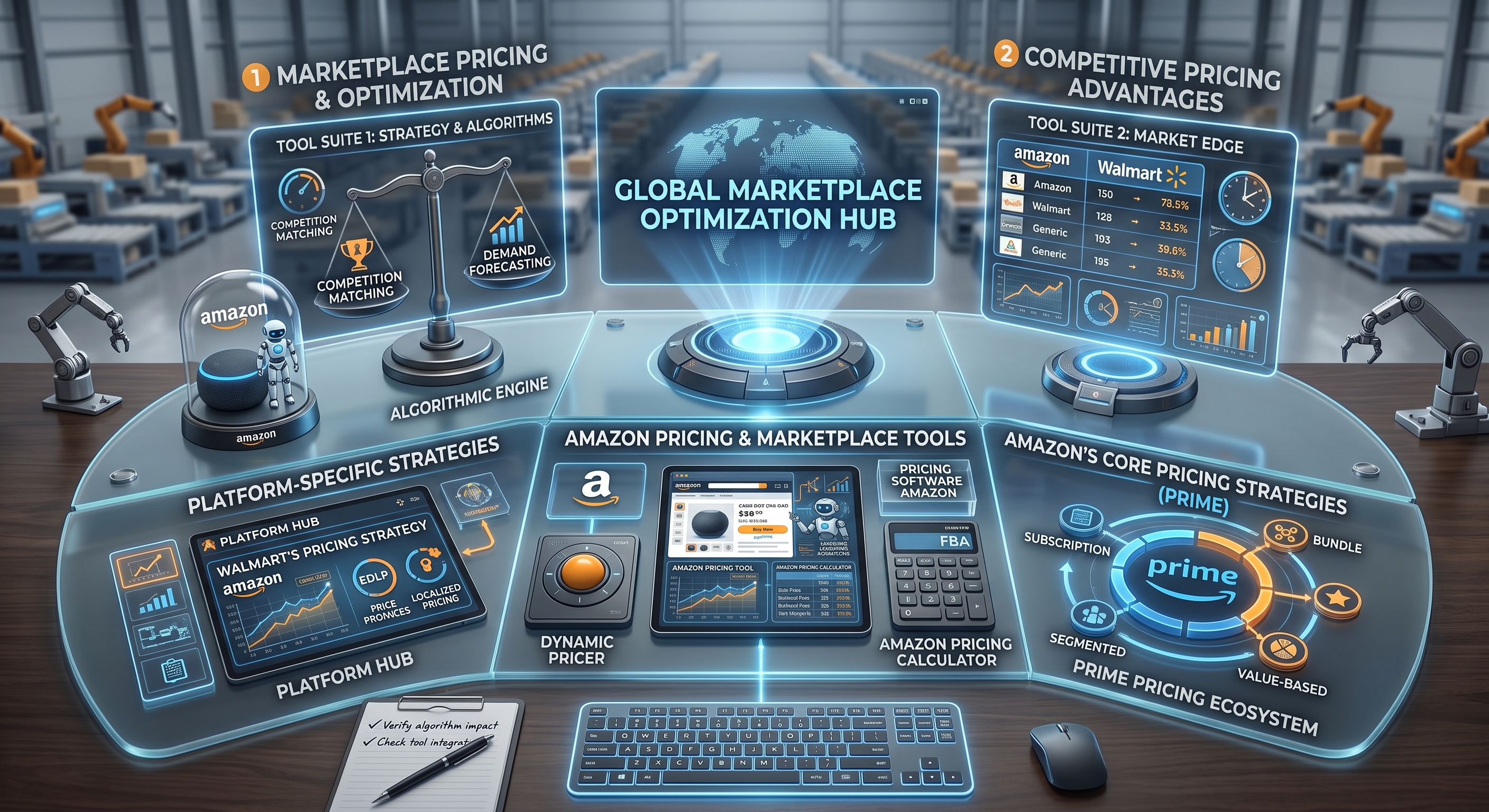
Another notable rollout is a regional pricing control endpoint that lets repricers set location-specific prices based on where a seller’s inventory physically sits relative to a buyer’s delivery region. This is a genuinely new lever for amazon marketplace pricing strategy, since it allows sellers to account for regional cost differences — transport distance, regional demand patterns, and localized competition — rather than applying one flat national price across every buyer.
For sellers with inventory spread across multiple fulfillment centers, this opens up the possibility of hyper-localized pricing, where a listing might carry a slightly different effective price depending on which fulfillment center is servicing a given order. Done well, this can help sellers dominate regional Buy Box contests more efficiently while keeping an eye on the actual transport cost tied to each region, rather than absorbing that cost uniformly across every sale nationwide.
Predictive Pricing: Amazon Is Starting to Look Beyond Its Own Marketplace
Perhaps the most forward-looking development is a piloted machine learning model sometimes referred to as a predictive competitor pricing engine. This system models price movements happening on external retail channels — think Walmart or Target — and attempts to forecast a drop hours before it actually happens, adjusting Amazon’s own competitive price threshold preemptively rather than waiting for the external price change to register after the fact.
This is a meaningful departure from how repricing has traditionally worked. Reactive repricing, by definition, always happens a step behind the market — a competitor moves, then the repricer responds. A predictive model flips that sequence, at least in principle, by trying to anticipate the move before it happens. For sellers, this means the smartest amazon pricing tools going forward will likely need to incorporate some form of predictive signal rather than relying purely on event-driven, reactive logic.
It’s still early days for this kind of predictive capability, and no tool is going to forecast the market with perfect accuracy. But the direction is clear: pure reaction-speed as a competitive advantage has a shelf life, and the next real edge is likely to come from anticipating moves rather than just responding to them faster than the next seller.
B2B Contract Pricing Opens a New Revenue Lane
A less-discussed but genuinely valuable update is a segmented B2B contract pricing endpoint that allows sellers to automate personalized, contract-based pricing for specific high-volume enterprise accounts, rather than relying on generic pricing tiers applied to every business buyer equally.
This creates a real opportunity for sellers doing meaningful volume through Amazon Business. Instead of a flat wholesale-style discount applied uniformly, sellers can now build customized pricing arrangements for specific corporate accounts, potentially undercutting competitors who are still relying on standard amazon seller pricing tools without any B2B-specific logic. For sellers who haven’t historically paid much attention to their Amazon Business channel, this update alone might be worth a second look.
What to Look for in an Amazon Pricing Tool Today
With all of these new capabilities rolling out at the API level, the bar for what counts as a genuinely useful amazon pricing tool has moved considerably. A few features now matter more than they used to:
- Direct SP-API integration with Amazon’s native pricing engine, not just external price monitoring
- Support for sales-velocity-informed pricing logic rather than pure competitor matching
- Automated margin-checking that respects Amazon’s own dynamic floor calculations
- Compatibility with MDP safeguards so brand pricing stays protected automatically
- Regional pricing flexibility tied to fulfillment center location
- Some level of predictive or forward-looking pricing signal, even if basic
- B2B contract pricing support for sellers active on Amazon Business
A tool that still only does basic competitor price-matching, without any of these newer capabilities, is going to look increasingly dated over the next year or two. The gap between a basic amazon automatic pricing tool and a genuinely modern one is widening fast, and that gap is only going to become more visible as more sellers adopt these deeper integrations across their own catalogs.
| Capability | Legacy Repricers | API-Integrated Tools (2026) |
|---|---|---|
| Native Pricing Engine Integration | No | Yes |
| Sales Velocity Awareness | Limited or none | Yes |
| Automated Margin Safeguards | Manual configuration only | Amazon-validated dynamic floors |
| Regional Pricing by Fulfillment Center | No | Yes |
| B2B Contract Pricing Automation | No | Yes |
Building an Amazon Pricing Strategy That Actually Holds Up
With this much new capability available, it’s worth stepping back and thinking about how to actually structure a pricing strategy rather than just turning on every new feature at once. A few principles are worth building around.
Start With Margin, Not Just Competitiveness
It’s tempting to chase every new capability that promises faster reaction times or sharper competitor matching. But none of that matters if the underlying floor isn’t grounded in real cost data. Before layering on velocity-based logic or predictive signals, make sure your baseline amazon pricing calculator math — true cost per unit including fees, storage, and returns — is accurate. Every advanced feature sits on top of that foundation, and a shaky foundation undermines everything built on it.
Treat Velocity Data as a Modifier, Not a Replacement
Sales velocity is a genuinely useful new signal, but it shouldn’t fully replace competitor awareness. The strongest approach uses velocity data to modify how aggressively you react to competitors, rather than ignoring competitors altogether. A fast-moving listing might justify holding price against a competitor’s small discount, while a slow-moving one might call for closer price matching to stay relevant.
Use Testing Frameworks Before Making Permanent Changes
With programmatic A/B testing now available through official channels, there’s less excuse for making large, permanent pricing changes based on gut feeling alone. Testing a price change on a subset of a catalog first, validating the impact, and then rolling it out more broadly is a far safer approach than adjusting amazon pricing for sellers across an entire catalog at once and hoping for the best.
Don’t Ignore Regional and B2B Opportunities
Many sellers default to a single national price and a single consumer-focused strategy, simply because that’s how things have always worked. With regional pricing controls and B2B contract pricing both now available at the API level, sellers who take the time to build out these secondary strategies have a real opportunity to capture revenue that competitors sticking with a one-size-fits-all approach are leaving on the table.
Amazon Seller Central Pricing Tools vs Third-Party Solutions
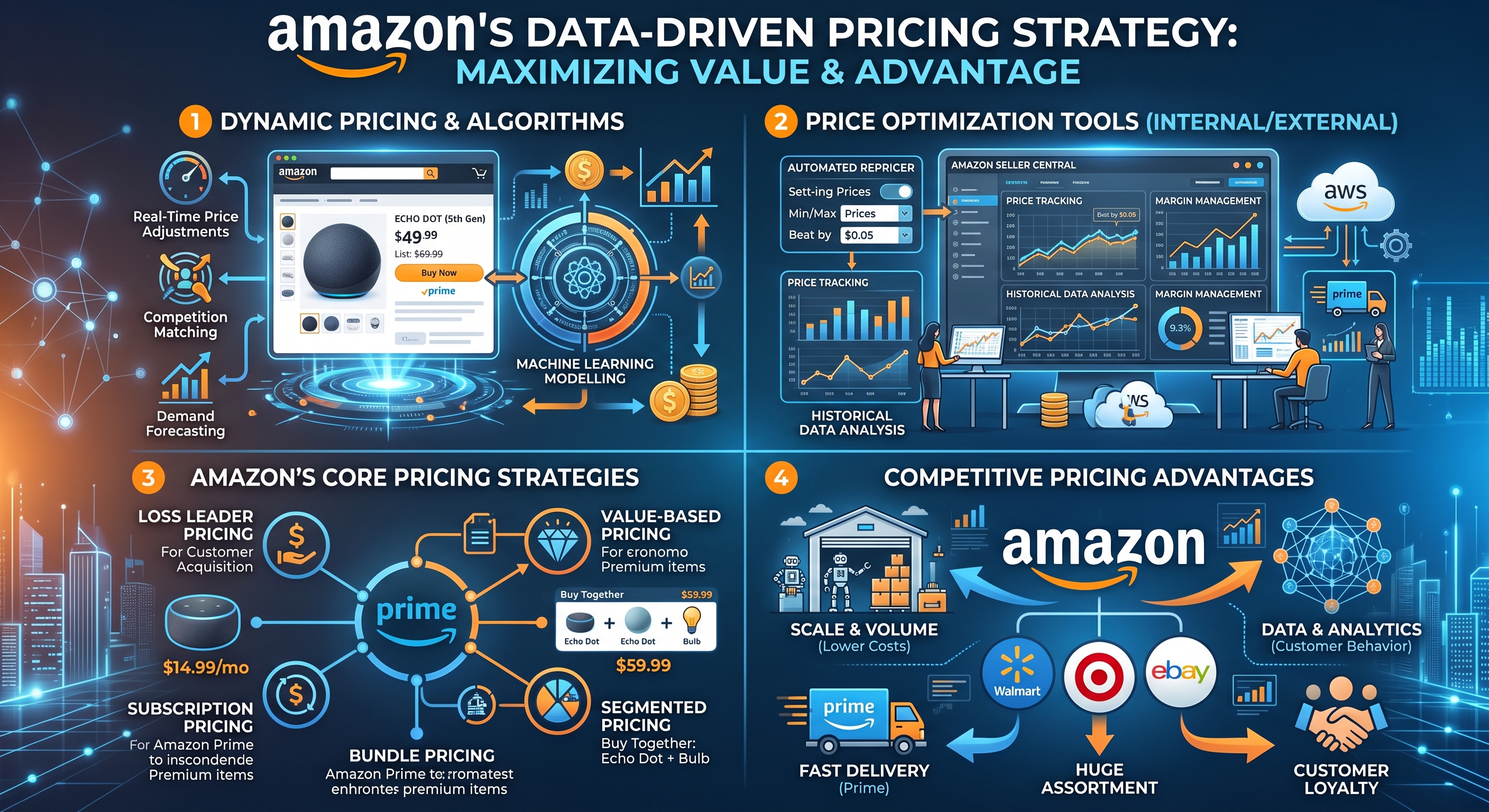
A fair question worth addressing directly: with Amazon building more pricing intelligence into its own native systems, do sellers still need a third-party tool at all? The honest answer is yes, at least for now. Amazon seller central pricing tools remain relatively basic in terms of strategic flexibility — they’re built to serve the average seller with straightforward needs, not to support complex, multi-variable pricing logic across a large or diverse catalog.
What’s changed isn’t that third-party tools are becoming unnecessary — it’s that the best ones are becoming deeply integrated with Amazon’s native systems rather than operating as a separate layer bolted on from outside. The sellers who benefit most going forward will be the ones using a third-party platform that plugs directly into these new API capabilities, rather than one still operating on the older, purely external model of price monitoring and manual rule-setting. This shift also means evaluating a pricing partner now involves asking different questions than it did a year or two ago — not just “how fast does it react” but “how deeply does it actually integrate with what Amazon has opened up.”
What This Means for FBA and Vendor Sellers
These changes affect FBA sellers and Amazon vendors somewhat differently. For FBA sellers, amazon fba pricing now has to account for dynamically fluctuating fees that feed directly into Amazon’s own margin guardrails. A pricing rule that made sense six months ago might not hold up today if fee structures have shifted underneath it, which makes automated, fee-aware floor calculation more valuable than ever.
For amazon vendor pricing, the picture is a bit different since vendors typically operate under a wholesale relationship with Amazon rather than a direct marketplace listing model. Even so, many of the underlying principles — margin awareness, demand-based adjustment, and avoiding blind price wars — still apply, even if the specific API mechanics differ somewhat from the seller-side tools discussed throughout this guide.
A Note on Amazon’s Hidden Pricing Signals
Sellers occasionally ask about amazon hidden prices — the idea that Amazon’s algorithm weighs certain pricing-adjacent signals that aren’t fully visible on the seller side. To be clear-eyed about this: Amazon has never published a complete, exhaustive list of every factor influencing Buy Box eligibility or search visibility tied to price. What is publicly documented, and what these API updates make explicit, is that sales velocity, fee structures, fulfillment location, and now predictive competitive signals all factor into the equation in some way.
Rather than chasing rumored hidden variables, sellers get more consistent results by focusing on the mechanisms Amazon has actually made visible and controllable through these new APIs — velocity-informed pricing, dynamic margin floors, regional adjustments, and structured testing — since these are the levers you can actually pull with confidence.
How to Migrate to an API-Integrated Pricing Tool Without Disruption
Switching to a more deeply integrated pricing platform naturally raises a practical question: how do you make that transition without risking your current Buy Box performance during the switchover? The safest path is a staged approach rather than an all-at-once cutover.
Start by running the new tool in a monitoring-only mode alongside your existing setup, letting it observe live SP-API data — sales velocity, margin calculations, competitor movement — without actually pushing price changes yet. This gives you a window to compare its recommended pricing decisions against what your current system is doing, and to catch any misconfiguration in your margin floors or velocity thresholds before they affect live listings.
Once the recommendations line up with expectations, move a small subset of lower-risk SKUs onto live automation first. Watch Buy Box win rate and margin performance on that subset for a week or two before expanding coverage further. Sellers who skip this staged rollout and flip their entire catalog over at once are the ones most likely to run into an unpleasant surprise, particularly if a margin floor was calculated incorrectly during setup.
Interpreting Sales Velocity Signals Correctly
Access to real-time sales velocity data is only useful if it’s interpreted correctly. A common mistake is treating any uptick in velocity as a green light to raise price immediately. Context matters here — a velocity spike driven by a temporary external promotion or a seasonal search trend behaves very differently from a spike driven by genuine, sustained demand growth.
A more careful approach separates short-term velocity spikes from sustained trend shifts before making pricing decisions. Reacting to every short-term blip by adjusting price can create a choppy, inconsistent pricing history that actually confuses repeat customers and can quietly erode trust in your brand’s pricing. Waiting for velocity data to hold steady across a slightly longer window before acting on it tends to produce steadier, more defensible pricing decisions over time.
It’s also worth cross-referencing velocity data against inventory depth. A fast-selling item with limited remaining stock might justify holding price high to stretch inventory across a longer selling window, while a fast-selling item with ample stock might instead benefit from a more moderate price to keep the momentum going without leaving units unsold at the end of a demand cycle.
Setting Up Price-Elasticity Tests the Right Way
With programmatic A/B testing now available at the API level, it’s tempting to run tests constantly across an entire catalog. In practice, a more disciplined approach produces better data. Testing too many variables at once, or running overlapping tests on the same SKU, makes it difficult to isolate what’s actually driving a change in conversion or Buy Box performance.
A cleaner method tests one price point change at a time, on a defined subset of traffic, over a consistent time window long enough to smooth out day-to-day noise. Weekend traffic patterns often differ meaningfully from weekday patterns, for example, so a test that only runs for two days risks drawing conclusions from an unrepresentative slice of the week. Running each test for a minimum of one full week, ideally two, tends to produce more reliable results.
Documenting test results consistently also pays off over time. A seller who’s run a dozen price-elasticity tests across a catalog and kept clear records of what worked builds a genuinely useful internal playbook, one that becomes more valuable than any single test result on its own.
Balancing Regional Pricing With Customer Trust
Regional pricing controls open real opportunity, but they come with a trust consideration worth thinking through carefully. Customers occasionally compare prices across regions, whether through friends, forums, or simply noticing a price difference when traveling. A regional pricing strategy that creates large, hard-to-justify gaps between nearby regions can generate customer frustration that outweighs the margin benefit.
A more measured approach uses regional pricing primarily to reflect genuine cost differences — transport distance, regional demand intensity, local competitive pressure — rather than pushing prices as high as each region will independently bear. Keeping regional price variation within a reasonable, cost-justified range tends to capture most of the available benefit without creating the kind of visible inconsistency that damages customer trust in the long run.
How MDP Safeguards Interact With Promotional Pricing
One nuance worth understanding is how Minimum Declared Price safeguards interact with legitimate promotional pricing. Sellers running a genuine limited-time discount or a coordinated deal event sometimes worry that automated margin floors will interfere with intentional short-term price drops that fall below their normal operating margin.
In practice, MDP is designed to catch unintentional, runaway pricing spirals rather than deliberate, time-boxed promotional pricing. A well-integrated amazon pricing app should allow sellers to define promotional windows explicitly, temporarily adjusting the effective floor for the duration of a planned deal rather than treating every price drop as a potential error. The distinction matters: a five-day flash sale priced intentionally below the usual floor is a strategic decision, while a price that silently drifts downward over three weeks due to a misconfigured competitor-matching rule is exactly the kind of spiral these safeguards exist to prevent.
Sellers should confirm their pricing platform makes this distinction cleanly before relying heavily on either promotional pricing or automated margin protection, since a tool that can’t tell the difference will either block legitimate promotions or fail to catch genuine pricing errors — neither outcome is acceptable.
Why Fee Volatility Makes Static Floors Risky
A pattern that catches sellers off guard is how frequently FBA fee structures can shift, sometimes with fairly limited advance notice. A price floor calculated against last quarter’s fee schedule can quietly become unprofitable the moment fees increase, even if the seller never touched the pricing rule itself. This is part of why Amazon’s move toward dynamically calculated margin floors, rather than static ones, represents such a meaningful improvement.
Sellers who were previously calculating floors manually and updating them only occasionally are particularly exposed to this risk. A floor set six months ago, based on fee data that’s since changed, can be silently eroding margin on every single sale without triggering any obvious alarm, since the price is still technically executing as configured — it’s just no longer profitable at the level originally intended.
Moving toward a system where floors recalculate automatically based on live fee data removes this blind spot entirely. Rather than relying on a seller to remember to periodically audit and update floor pricing across potentially hundreds of SKUs, the calculation simply stays current on its own, which is a meaningful operational relief for sellers managing large catalogs without a dedicated pricing analyst on staff.
Combining Multiple New Capabilities Into One Coherent Strategy
With so many new capabilities available simultaneously — native API integration, velocity data, programmatic testing, dynamic margins, regional pricing, predictive signals, and B2B contract pricing — it’s worth thinking about how these pieces fit together rather than treating each as an isolated feature to switch on independently.
A coherent strategy might look something like this: dynamic margin floors and MDP safeguards form the non-negotiable safety layer underneath everything else, ensuring no automated decision can push a listing into unprofitable territory regardless of what other logic is running. Sales velocity data then informs how aggressively to hold or adjust price above that floor, with fast-moving SKUs given more room to hold firm and slow-moving SKUs treated more flexibly. Programmatic testing runs periodically on top of this baseline to validate whether the current price points are actually optimal, rather than just profitable. Regional pricing and predictive signals then act as refinements layered on top of an already-solid foundation, capturing incremental gains rather than serving as the primary strategy.
Sellers who try to implement every capability at once, without this kind of layered structure, often end up with rules that conflict or overlap in confusing ways. Building the safety layer first, then adding sophistication incrementally, tends to produce a far more stable and genuinely profitable result than switching everything on simultaneously and hoping the pieces sort themselves out.
What Sellers Without Technical Resources Should Prioritize
Not every seller has the technical bandwidth to configure a fully layered, API-integrated pricing strategy from scratch. For sellers without a dedicated technical resource, the priority order matters. Getting accurate margin floors in place should come first, since this is the single change most likely to prevent a costly pricing mistake, and it doesn’t require sophisticated technical setup — just accurate cost data and a platform capable of respecting it.
After that, sales-velocity-informed pricing tends to offer the next best return relative to effort, since most modern amazon pricing tool platforms now surface this data in a usable format without requiring custom configuration. Programmatic testing, regional pricing, and predictive signals are genuinely valuable but represent more advanced layers that can reasonably wait until the fundamentals are solidly in place.
This kind of staged prioritization matters more than trying to adopt every new capability simultaneously. A seller with accurate margin floors and reasonable velocity-based logic will generally outperform a seller who’s technically using every available feature but has misconfigured floors underneath it all.
Looking Ahead: What’s Likely to Change Next
Given how much has shifted in a relatively short window, it’s reasonable to expect continued evolution in how Amazon’s pricing infrastructure develops. Predictive pricing signals are still in a pilot phase, and it’s likely the underlying models will improve in accuracy as more data accumulates from real seller usage. Sellers who start incorporating even basic predictive indicators now will likely have an easier transition as these models mature, compared to sellers waiting until the capability is fully proven before engaging with it at all.
Regional pricing and B2B contract automation also seem likely to expand in scope over time, potentially extending to more granular geographic segmentation or more flexible contract structures than what’s currently available. Sellers building their pricing infrastructure around flexible, API-integrated tools today are better positioned to adopt these extensions as they roll out, compared to sellers relying on rigid, manually configured systems that would require a rebuild to accommodate new capabilities.
The broader trend across all of these updates points in one clear direction: Amazon is investing heavily in making its pricing infrastructure more sophisticated, more automated, and more tightly integrated with third-party tools rather than treating repricers as an external workaround to be tolerated. Sellers who align their own pricing strategy with this direction, rather than continuing to operate as if pricing were still a purely manual, competitor-watching exercise, are the ones most likely to benefit as these capabilities continue to mature over the months ahead.
Frequently Asked Questions
What is the best amazon pricing tool for 2026?
The strongest tools this year are the ones directly integrated with Amazon’s SP-API pricing endpoints, capable of leveraging sales velocity data, dynamic margin guardrails, and regional pricing controls rather than relying purely on external competitor tracking.
Do amazon pricing rules still need a manually set price floor?
Yes, even with Amazon’s new dynamic margin guardrails acting as a safety net, sellers should still configure their own floors based on accurate cost data. Amazon’s guardrails are a backstop against major errors, not a replacement for a deliberately calculated pricing strategy.
Is a free amazon pricing tool enough for small sellers?
A free or entry-level tool can work for sellers with small, simple catalogs and low competition. As catalog size and competitive pressure grow, the newer capabilities around velocity data, testing frameworks, and regional pricing tend to justify a more capable paid platform.
How does sales velocity data change pricing decisions?
It shifts pricing away from being purely reactive to competitors and toward reflecting actual demand. A fast-selling item can often support holding or raising price, while a slow-moving item may need a different approach entirely, regardless of what competitors are charging.
Can third-party repricers still add value now that Amazon has more native pricing tools?
Yes. Amazon’s native tools remain relatively basic for complex, multi-variable strategies. Third-party platforms that integrate directly with the new API capabilities offer far more strategic flexibility than Amazon’s built-in options alone.
Why Amazon’s Own Pricing Rules Aren’t Enough on Their Own
It’s worth being direct about something here: Amazon’s native amazon pricing rules engine, even with these new API capabilities layered on top, is still designed to serve a broad, generic use case. It handles the basics well — price matching, simple floor and ceiling logic — but it wasn’t built to run the kind of nuanced, multi-condition strategy that a seller managing a diverse catalog across FBA, wholesale, and private label typically needs.
This is exactly the gap that a properly configured price optimization tools platform fills. Rather than replacing Amazon’s native rules engine, the strongest approach layers a more sophisticated third-party strategy on top of it, using the new API access to execute at native speed while retaining the flexibility to configure rules Amazon’s own system was never designed to handle out of the box.
Should sellers wait for predictive pricing to mature before using it?
Not necessarily. While the predictive competitor pricing engine is still in a pilot phase, sellers who start incorporating even basic forward-looking indicators now tend to adapt more smoothly as the technology matures, compared to those who wait until it’s fully proven and then face a steeper learning curve all at once.
What’s the difference between MDP and a standard price floor?
A standard price floor is typically set manually by a seller or a repricing tool based on cost calculations. MDP is an Amazon-level safeguard specifically designed to protect brand equity by preventing runaway downward pricing spirals, functioning as an additional layer of protection on top of whatever floor a seller has already configured.
Getting Your Pricing Strategy Ready for What Comes Next
Amazon’s pricing infrastructure is evolving faster than it has in years, and the sellers who adapt early tend to be the ones who benefit most before these capabilities become table stakes across the board. Building a strategy around margin-aware automation, velocity-informed logic, and structured testing today puts you ahead of competitors still running yesterday’s playbook.
Zupricer is built to keep pace with exactly these kinds of platform-level changes, combining deep Amazon API integration with the margin-aware, rule-based control sellers need to price confidently across a growing catalog. Whether you’re managing FBA, vendor, or B2B accounts, Zupricer helps you turn Amazon’s evolving pricing infrastructure into a genuine competitive advantage. Try it free for 14 days, no credit card required, and see how a properly integrated pricing strategy performs against the market — and how much smoother a well-structured, layered approach feels compared to juggling disconnected rules and manual checks across a growing catalog.