Competitive Price Tool: Your Guide to Competitive Price Monitoring
If you’re selling on Amazon and still manually checking competitor prices, you’re already behind. The marketplace moves fast — like, really fast — and the sellers who are winning right now are the ones using a smart competitive price tool to stay ahead of every market shift. This guide is going to walk you through everything you need to know about competitive price monitoring and why it’s the single biggest lever you can pull in 2026.
Why Competitive Price Monitoring and Competitive Pricing Advantages Matter More Than Ever
Amazon’s marketplace in 2026 is more competitive than it’s ever been. Thousands of sellers are fighting for the same Buy Box, and the algorithm is constantly evaluating who deserves it. Price is one of the most influential factors. If your price isn’t competitive, you simply won’t win — and if you’re not winning the Buy Box, your visibility tanks almost instantly.
Here’s something that surprises a lot of newer sellers: the Buy Box isn’t just about having the lowest price. It’s about having the most competitive price relative to your fulfillment method, seller health metrics, and overall account standing. That’s exactly why competitive price monitoring goes so much deeper than just watching what your rivals charge.
The Real Competitive Pricing Advantages You’re Missing
Let’s talk about what you actually gain when you embrace smart pricing strategies. The competitive pricing advantages aren’t just about winning a sale here and there. They compound over time. When you consistently hold the Buy Box, your conversion rates go up, your sales velocity increases, and Amazon’s algorithm rewards you with even more visibility. It becomes a beautiful cycle — but only if you’re equipped with the right tools.
Consider what happens when a competitor drops their price at 2 AM. If you’re relying on manual checks, you won’t even know until morning — and by then, you’ve already lost hours of potential sales. An automated repricing system, on the other hand, responds instantly. It’s the difference between being reactive and being proactive.
| Pricing Approach | Speed of Response | Buy Box Win Rate | Profit Protection |
|---|---|---|---|
| Manual Pricing | Hours or Days | Low | Unpredictable |
| Basic Rule-Based Repricing | Minutes | Medium | Moderate |
| AI-Powered Competitive Tool | Real-Time | High | Strong |
How a Competitive Price Tool Actually Works
Setting Up Your Competitive Price Monitoring: A Week-by-Week Implementation Plan
Most sellers make the mistake of trying to monitor everything at once, which leads to overwhelm and abandonment. The smart approach is to scale gradually. In your first week, focus on your top five competitors and your ten best-selling products. Set up basic price alerts and connect your monitoring to a simple dashboard or Google Sheets. This gives you immediate visibility without drowning in data.
During week two, expand your monitoring to include keyword ranking alongside pricing. Add seasonal competitors who only appear during peak periods, and set up inventory tracking so you know when competitors go out of stock. Configure Slack or email notifications for price changes exceeding five percent — this threshold filters out noise while catching meaningful shifts.
By week three, you’re ready to implement bulk monitoring across your entire catalog. Create category-wide tracking to spot broader market trends, and if you sell internationally, set up cross-marketplace monitoring. This is when automated reports become essential, because you’re now tracking hundreds or thousands of data points daily.
Week four is about adding the finishing touches: review monitoring to track competitor feedback changes, MAP compliance tracking if you carry branded products, and competitor response workflows that trigger specific actions based on predefined scenarios. At this stage, your competitive price tool becomes a complete intelligence system rather than just a price tracker.
How Often Should You Actually Monitor Competitor Prices?
The monitoring frequency question trips up nearly every seller. Manual weekly checks simply don’t cut it anymore, especially in high-volume categories where prices shift multiple times daily. For fast-moving consumer goods, hourly updates are often necessary to stay competitive. Even in slower categories like durable goods, daily monitoring is the minimum viable frequency.
The best tools connect directly to Amazon’s Selling Partner API rather than scraping rendered pages. This API connection provides the most accurate data because it reads marketplace information at the source. Real-time monitoring capabilities mean your system can detect a competitor price change and respond within minutes, not hours or days. For sellers managing large catalogs, the difference is dramatic: automated dashboards can monitor ten thousand ASINs simultaneously while a human might realistically track fifty products manually.
Real Competitive Scenarios and How to Respond
Here’s a scenario that costs sellers thousands every month: an FBM competitor with seventy-three percent feedback and a twelve-day shipping estimate appears on your listing. Your repricing tool immediately drops your price to match. Wrong move. FBA sellers should ignore FBM competitors entirely and set their competitive set to only include FBA sellers with healthy feedback and stock on hand. Every price drop triggered by an irrelevant competitor is margin you didn’t need to sacrifice.
Another common situation involves velocity-based repricing. You source eight units of a product; five sell quickly at eighteen dollars and fifty cents, then the competitive price drops to fourteen dollars and eighty cents. Holding your price indefinitely on the remaining three units leads to storage fees and dead inventory. The smart response: if an ASIN hasn’t sold in the past fourteen days, lower the price by five percent toward your floor during your weekly review. Fast stock gets priced toward your ceiling; slow stock moves toward your floor.
Private label sellers face a particularly frustrating scenario when unauthorized sellers hijack their listings at lower prices. If your brand is priced at thirty-four ninety-nine and a hijacker appears at twenty-eight dollars, your repricing tool might drop to twenty-seven ninety to undercut them. This degrades your brand’s intended retail price using your own automation. The fix: exclude unauthorized sellers from your competitive set by setting minimum feedback requirements — typically ten feedbacks with ninety percent positive ratings.
The Biggest Implementation Mistakes That Cost Real Money
Setting your minimum price too low or not setting one at all is the most expensive mistake. At five hundred daily units and a fifty-cent floor error, you’re losing two hundred fifty dollars per day or roughly ninety-one thousand dollars annually. Calculate your floor properly: take your cost of goods plus prep costs plus FBA fees, then divide by one minus your referral fee rate minus your target margin rate.
Amazon raised FBA fulfillment fees by an average of eight cents per unit starting January fifteenth, twenty twenty-six. Small items in the ten to fifty dollar price band increased by twenty-five cents per unit; items above fifty dollars jumped fifty-one cents. If you haven’t recalculated your floors since that fee change, you’re likely selling below your actual break-even point on many products. Recalculate floors quarterly at minimum, and immediately after every Amazon fee announcement.
Using the same repricing rules for every product guarantees wrong logic on most of your catalog. A private label product requires completely different strategy than competitive wholesale or clearance inventory. Segment your catalog by product type and assign appropriate strategies to each group. Then review your top twenty SKUs by revenue monthly to catch Buy Box win rate changes before they significantly impact your bottom line.
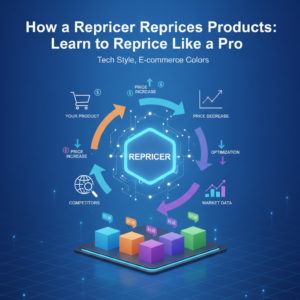
A good competitive price tool does far more than just scan prices. It continuously monitors competitor pricing, Buy Box ownership, fulfillment types, and market conditions — all at the same time. Then it uses that data to adjust your prices automatically within the guardrails you set, like your minimum and maximum price thresholds.
The most advanced tools even use scenario-based strategy engines, meaning they can adapt their repricing logic depending on the context. For example, if you’re the only FBA seller on a listing, the tool might hold a higher price because you have a fulfillment advantage. If competition heats up, it responds accordingly. This kind of intelligent nuance is what separates modern repricing from the old set-it-and-forget-it rules.
For sellers looking to sharpen their overall approach, understanding the full landscape of Amazon pricing strategy and price optimization tools is a fantastic starting point for building a sustainable competitive edge.
What to Look for in a Repricing Tool
Not all tools are built the same. When evaluating your options, you want to look for Buy Box intelligence, profit guardrails that protect your margins, real-time monitoring, and support for both FBA and FBM sellers. An amazon repricer uk solution should also be able to scale across your entire catalog without slowing down or missing price changes in high-traffic windows.
Understanding the Role of a Seller Running Repricer
Any seller running repricer software knows that the biggest fear is a race to the bottom — constantly undercutting until there’s no margin left. The best tools prevent this by enforcing minimum price floors so you never sell below your acceptable profit threshold, no matter how aggressive competitors get.
Repricer Settings That Actually Protect You
When configuring a repre-pricing strategy, the most important settings involve your floor price, your ceiling price, and your Buy Box targeting mode. These three parameters essentially define your competitive boundaries. Set them thoughtfully and your repricing tool becomes a 24/7 profit guardian rather than a liability.
| Setting | Purpose | Recommended Default |
|---|---|---|
| Floor Price | Prevent below-cost selling | Cost + minimum margin % |
| Ceiling Price | Avoid price gouging flags | Market-based max |
| Buy Box Mode | Target or match Buy Box price | Enabled for most listings |
Frequently Asked Questions About Competitive Price Tools
Is competitive price monitoring only useful for large sellers?
Absolutely not. Even if you’re managing a small catalog of 20 to 50 products, automated price monitoring saves you time and helps you compete on equal footing with much larger sellers who have entire teams dedicated to pricing strategy.
Can a competitive price tool hurt my margins?
Only if you configure it without proper floor pricing. With guardrails in place, a quality tool actively protects your margins while keeping you competitive. It’s not about being the cheapest — it’s about being the smartest.
How quickly do good repricing tools respond to price changes?
The best tools operate in real time, scanning competitor prices and adjusting your listings within minutes or even seconds of a market change. In a platform as dynamic as Amazon, that speed is genuinely priceless.
Does repricing work for both FBA and FBM sellers?
Yes, though the strategy differs slightly. FBA sellers often get a Buy Box advantage due to Prime eligibility, while FBM sellers need to compensate with price competitiveness and strong seller metrics. A smart tool accounts for both scenarios.
If you’re serious about competing on Amazon in 2026, sitting on the sidelines with manual pricing is simply not an option anymore. Zupricer is built specifically for Amazon sellers who want to win the Buy Box, protect their profits, and automate repricing across their entire catalog — whether they’re FBA or FBM. With a 4.9/5 rating on Trustpilot and Capterra and a 14-day free trial with no credit card required, there’s genuinely nothing to lose. Head over to Zupricer and start your free trial today — your competitors already have.