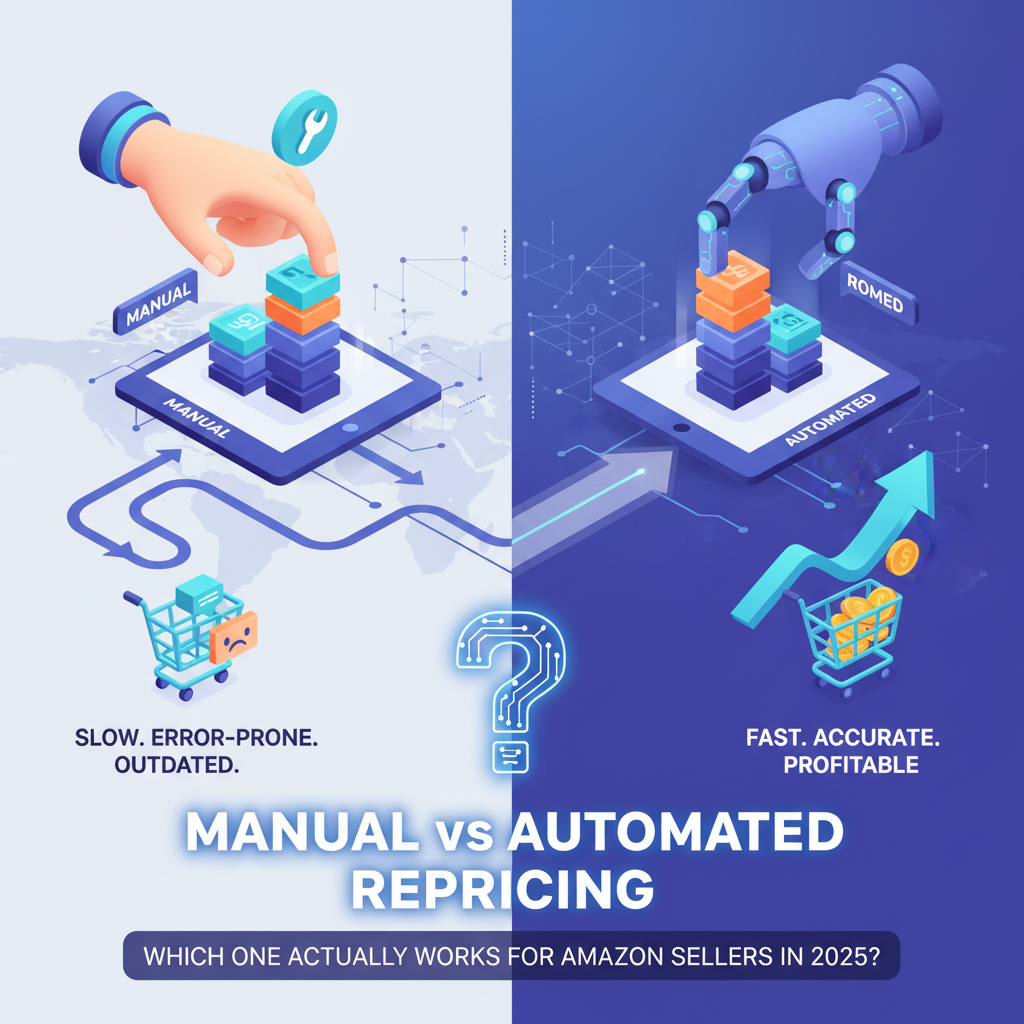
If you’ve been selling on Amazon for more than a few weeks, you’ve probably asked yourself this question: should I keep adjusting my prices manually, or is it time to let software handle it?
It’s a fair question. Manual repricing feels safe—you’re in control, you know exactly what’s happening, and there’s no monthly subscription eating into your margins. But here’s the thing: while you’re sleeping, eating dinner, or handling other parts of your business, your competitors using automated repricing tools are adjusting their prices and snatching Buy Box ownership right from under you.
In 2025, with competitor prices shifting multiple times daily and Amazon’s Buy Box algorithm growing more sophisticated, this isn’t just a theoretical debate anymore. It’s a decision that directly impacts your revenue, your time, and your ability to scale. Let’s break down what actually works.
Understanding the Two Approaches
Manual repricing is exactly what it sounds like. You log into Seller Central, check what your competitors are doing, and adjust your prices one listing at a time. Maybe you track everything in a spreadsheet. Maybe you’ve got a system of browser tabs and sticky notes. Either way, you’re the one making every pricing decision.
Automated repricing uses software that connects to Amazon’s API, monitors your competition in real-time, and adjusts your prices automatically based on rules you set. You define your minimum and maximum prices, your profit margins, and your competitive strategy—then the software executes it around the clock.
Both approaches have the same goal: keeping your products competitively priced to win sales and capture the Buy Box. The difference lies in how they get there.
When Manual Repricing Still Makes Sense
Let’s be fair to manual repricing—it’s not completely obsolete. There are specific situations where hands-on price management can work:
- Brand new sellers (first 1-3 months): When you’re just starting out, manually adjusting prices teaches you how Amazon’s marketplace actually works. You learn how competitor pricing affects your sales, what price points drive conversions, and how the Buy Box algorithm responds to different strategies.
- Very small catalogs: If you’re selling fewer than 10 products in stable, low-competition categories, manual repricing might be manageable without consuming your entire day.
- Unique or proprietary products: When you’re the only seller of a product (or one of very few), dynamic repricing becomes less critical since there’s minimal price competition.
But here’s the honest truth: these scenarios represent a small fraction of Amazon sellers. For everyone else, manual repricing creates problems that compound over time.
The Real Limitations of Manual Repricing
Manual repricing breaks down fast—and the cracks show up in several critical areas:
The Scalability Problem
Every SKU you add multiplies your workload. Checking and adjusting even a moderate catalog requires hours daily, and competitor prices don’t change just once—they shift multiple times throughout the day. Sellers attempting manual repricing on catalogs beyond 50 listings often find themselves falling behind, with inventory sitting unsold while faster competitors capture sales.
The Reaction Time Gap
This is where manual repricing really falls apart. Your reaction time is measured in hours or days. Automated competitors respond in minutes—some tools update prices every five minutes. By the time you manually adjust, the market has already moved again. You’re perpetually behind, losing sales during every delay.
The Buy Box Blind Spot
You simply cannot monitor Buy Box ownership 24/7. When competitors temporarily lose the Buy Box at 2 AM, you miss the opportunity. When you lose it during your lunch break, you respond too slowly to recapture it. Without continuous monitoring, you lack the data to understand what pricing actually maximizes your Buy Box percentage.
Human Error and Inconsistency
Typos happen. Decimal points get misplaced. You forget to reprice during busy periods, weekends, or vacations. Emotional decisions creep in during competitive pressure. These mistakes—nearly impossible with properly configured automation—cost real money.
Why Automated Repricing Has Become the 2025 Standard
Professional automated repricers in 2025 operate through a continuous cycle that human sellers simply can’t match:
- Continuous monitoring: Software tracks competitor prices, Buy Box ownership, and market metrics in real-time through Amazon’s API
- Rule application: Your predefined strategies, price boundaries, and profit requirements are evaluated against current data
- Automatic adjustment: Prices update on your listings based on the analysis
- Repetition: Advanced tools complete this cycle every few minutes, around the clock
The benefits compound across every metric that matters:
- Speed: React to competitor changes in minutes instead of hours
- Consistency: Apply strategies uniformly without fatigue or oversight
- Scalability: Handle 50 SKUs or 5,000 with equal efficiency
- Profit protection: Built-in safeguards prevent selling below your minimum margins
- 24/7 operation: Your pricing continues optimizing while you sleep, travel, or focus on growing your business
Types of Automated Repricing Strategies Available
Not all automation is created equal. Here’s what’s available in 2025:
Rule-based repricing uses fixed rules you configure—”stay $0.50 below the lowest competitor” or “match the buy box price minus 2%.” This approach offers predictable behavior and precise control for sellers who understand their markets well.
AI-driven repricing analyzes real-time data including competitor behavior, demand signals, sales velocity, and inventory levels. Using machine learning and game-theory algorithms, it optimizes across multiple variables simultaneously. This works best for sellers wanting maximum optimization with minimal manual intervention.
Hybrid approaches combine both methods, allowing different strategies for different product categories with manual override capabilities when needed. This has become the standard for experienced sellers seeking both efficiency and strategic control.
How Automated Pricing Actually Differs From Manual Pricing (And a Manual Revenue Manager)
It’s worth spelling out the core distinction one more time, because the differences aren’t always obvious from the outside. So how does automated pricing differ from manual pricing in practice? It comes down to the four-step cycle described in the previous section — continuous monitoring, rule application, automatic adjustment, and repetition — running every few minutes without a human touching a keyboard. Manual pricing, by contrast, runs that same cycle at human speed: hours or days between checks, filtered through whatever attention and energy the person doing it has left that day.
This distinction matters even more once you bring a human revenue manager into the comparison. Is automated pricing more effective than using a revenue manager manually? For most catalogs, yes — not because a skilled revenue manager lacks judgment, but because even a talented human is still bound by the same reaction-time and scalability limits covered in “The Real Limitations of Manual Repricing” above. A revenue manager checking prices a few times a day is making the same category of decision an automated system makes every five minutes, just far less often. The strategic thinking a revenue manager brings is valuable — which is exactly why the hybrid approach mentioned above, combining automated execution with human-set rules and override capability, tends to outperform either pure manual management or fully hands-off automation on its own.
For sellers who’ve outgrown Amazon’s own basic Automate Pricing feature in Seller Central, the natural next question is what an amazon automate pricing alternative actually needs to offer to be worth switching to. Based on everything covered in this guide, the answer is the same three things repeatedly: real Buy Box intelligence beyond simple price-matching, profit guardrails that go deeper than a flat minimum, and the AI-driven or hybrid strategy options described above rather than one rigid rule applied to an entire catalog.
Addressing Common Concerns About Automation
If you’ve hesitated to automate your repricing, you’ve probably had one of these concerns:
“I’ll lose control over my pricing.” You won’t. You maintain complete control through the rules you set, your minimum and maximum prices, and override capabilities. Automation executes your strategy faster—it doesn’t replace your decision-making.
“Automated repricers cause price wars.” Poorly configured tools can contribute to price wars, but intelligent automation includes safeguards like minimum floors and velocity limits. Ironically, manual sellers often lack these protections when competitive pressure builds.
“The cost isn’t justified for my business.” Consider the full picture: time savings, improved Buy Box rates, increased sales, and reduced errors. The opportunity cost of manual repricing typically exceeds subscription costs within the first month.
“My business is too small.” If you have 20+ SKUs or spend more than a few hours weekly on pricing, automation typically pays for itself. Many tools offer affordable plans specifically designed for smaller sellers.
Making the Right Decision for Your Business
The question isn’t really “manual or automated?” It’s “when should I transition from manual to automated?”
Consider your catalog size: Under 20 SKUs, manual might be manageable. Between 20-50, automation becomes highly beneficial. Beyond 50, automation is essentially required to compete.
Evaluate your competition intensity: Low competition might allow manual approaches temporarily. Moderate to high competition makes automation a necessity—you can’t keep pace with automated competitors using manual methods.
Assess your business goals: If you’re in a learning phase, manual provides education. If you’re focused on growth, automation enables scaling. If you’re running a professional operation, automation is standard practice for a reason.
The Verdict: What Actually Works in 2025
The data is clear: automated repricing works better for the overwhelming majority of Amazon sellers. The combination of speed, scalability, Buy Box optimization, and time savings makes it the definitive winner for anyone operating a competitive Amazon business.
Manual repricing serves a legitimate but narrow purpose—as a learning tool for complete beginners or for sellers with tiny catalogs in non-competitive niches. For everyone else, the question isn’t whether to automate, but which solution fits your business best.
That’s where Zupricer comes in. Built specifically for Amazon sellers who are serious about winning the Buy Box without sacrificing their margins or their sanity, Zupricer combines intelligent automation with the control and flexibility you need. Whether you’re managing dozens of SKUs or thousands, Zupricer’s advanced repricing algorithms work around the clock to keep you competitive—while you focus on what actually grows your business. Ready to stop fighting a losing battle against automated competitors? It’s time to let Zupricer handle your pricing strategy.