So you want to start selling on amazon. Maybe you’ve heard success stories about regular people building six-figure businesses from their living rooms. Maybe you’re looking for a side income that could eventually replace your day job. Or perhaps you’ve already got a product idea burning a hole in your notebook.
Whatever brought you here, you’re in the right place—but let’s be honest with each other from the start. Amazon in 2025 isn’t the Wild West it was five years ago. The platform has matured, professional sellers dominate most categories, and the barrier to entry has risen significantly. That’s not meant to discourage you. It’s meant to prepare you.
Because here’s the thing: beginners who approach Amazon as a serious business venture—not a get-rich-quick scheme—still have tremendous opportunities. This guide will walk you through everything you need to know to selling on amazon the right way, from account setup to winning the Buy Box.
Choosing Your Business Model and Setting Up Your Account
Before you rush to create a seller account, you need to make some fundamental decisions about how you’ll operate. Your business model will shape everything that follows.
The most common approaches include:
- Private Label: Creating your own branded products (most profitable long-term)
- Wholesale: Buying existing products in bulk from manufacturers
- Retail Arbitrage: Reselling discounted products from retail stores
- Dropshipping: Selling products without holding inventory
Private label tends to generate the best margins and build actual equity, but it requires more upfront investment and carries higher risk. Choose based on your capital, risk tolerance, and long-term goals.
For your seller account, you’ll choose between two plans. The Individual Plan charges per item sold with no monthly fee—ideal if you’re testing the waters with fewer than 40 units monthly. The Professional Plan costs $39.99 per month but unlocks advanced features and becomes more economical at higher volumes.
Have your documentation ready: business information, tax ID (EIN if you’re U.S.-based), and bank account details. While forming an LLC isn’t mandatory for selling on Amazon USA, it offers liability protection and easier logistics—especially for FBA sellers.
Understanding FBA vs. FBM: The Fulfillment Decision
This choice will fundamentally affect your operations, costs, and competitiveness. Let’s break down both options.
Fulfillment by Amazon (FBA)
With FBA, you ship inventory to Amazon’s fulfillment centers. They store your products, pick, pack, and ship orders, and handle customer service and returns. Your products automatically become Prime-eligible.
FBA fees in 2025 range from approximately $3.22 to $137+ per unit depending on size and weight, plus monthly storage fees that spike during Q4. The benefits are substantial: access to Prime buyers, higher Buy Box win rates, and truly hands-off fulfillment. But those fees add up, and slow-moving inventory can become a cash drain.
Fulfillment by Merchant (FBM)
FBM means you handle everything: storage, packing, shipping, and customer service. You control costs and can use branded packaging, making it ideal for large, fragile, or low-margin products. However, you’ll need to maintain strict performance metrics and won’t automatically qualify for Prime.
The Hybrid Approach
Many successful sellers use both methods strategically—FBA for fast-moving, high-margin items and FBM for oversized or specialty products. This provides flexibility and risk diversification.
Optimizing Your Product Listings for Maximum Visibility
Your listing is your storefront. Get this wrong, and even great products will languish in obscurity. Amazon’s A10 algorithm evaluates multiple factors to determine rankings, and your listing optimization directly influences most of them.
Product Titles
Your title is the most critical element for Amazon SEO. Include your primary keyword near the beginning, add key features, and follow Amazon’s style guidelines for your category. Keep it under 200 characters (limits vary by category), include your brand name, and avoid ALL CAPS or promotional language.
Bullet Points
These are your second most important field for keywords and directly influence conversion rates. Use all five bullets available. Start each with a capitalized benefit, address customer pain points, and keep each under 200 characters for readability.
Product Images
Your main image determines whether shoppers click through from search results. Requirements are strict: white background, product filling 85% of the frame, no text or graphics. For secondary images, include lifestyle shots, infographics highlighting features, multiple angles, and size comparisons. Use all 7-9 available slots with high-resolution images (minimum 1000×1000 pixels).
Backend Search Terms
These invisible keywords are indexed by Amazon’s algorithm. Use all 249 bytes available, include misspellings and synonyms, and don’t repeat words from your title or bullets.
Winning the Buy Box: Why Pricing Matters More Than You Think
Here’s a statistic that should get your attention: approximately 82% of Amazon sales go through the Buy Box. That’s the section on the right side of product pages containing the “Add to Cart” and “Buy Now” buttons. If you’re not winning the Buy Box, you’re fighting over scraps.
The Buy Box algorithm considers multiple factors:
- Price competitiveness (the most important factor)
- Fulfillment method (FBA has an advantage)
- Seller performance metrics
- Shipping time and cost
- Inventory availability
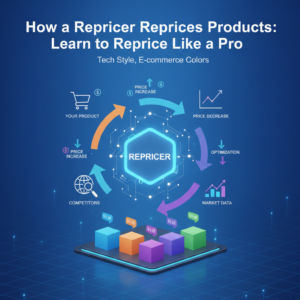
Notice that price is listed first. That’s not an accident. To compete effectively, you need to research competitor pricing thoroughly, factor in all costs (COGS, Amazon fees, shipping, advertising), and understand your break-even point. Many successful sellers use dynamic repricing to stay competitive without constantly monitoring prices manually.
Building Reviews and Credibility
New products face a chicken-and-egg problem: you need reviews to drive sales, but you need sales to get reviews. Here’s how to solve it legitimately.
Legitimate review generation methods include:
- Using Amazon’s “Request a Review” button (free and automated)
- Enrolling in Amazon Vine Program (requires Brand Registry)
- Providing excellent products and customer service
- Including compliant product inserts
Never incentivize reviews or violate Amazon’s Terms of Service. Account suspensions are devastating, and Amazon’s detection systems are increasingly sophisticated. Play the long game.
Amazon Advertising Basics for New Sellers
Here’s a reality check: launching products without an advertising budget is almost guaranteed to fail in 2025. You need paid visibility to generate initial sales velocity and organic ranking momentum.
Start with Sponsored Products campaigns—they’re the most straightforward for beginners. Begin with automatic campaigns to gather keyword data, then use that intelligence to build manual campaigns targeting your best performers.
Monitor your ACoS (Advertising Cost of Sale) closely. Set daily budgets you can actually afford, and be patient—optimization takes time. Remember, advertising should support organic ranking growth, not replace it. The goal is eventually reducing ad dependency while maintaining sales momentum.
Avoiding Common Beginner Mistakes
Most new seller failures aren’t dramatic blow-ups. They’re death by a thousand paper cuts. Here are the mistakes to avoid:
- Inventory mismanagement: Stockouts devastate rankings; over-ordering ties up capital
- Listing violations: No contact details, external links, or promotional text in listings
- Ignoring performance metrics: Keep Order Defect Rate under 1%, Late Shipment Rate under 4%
- Underestimating costs: Factor in ALL fees before calculating profitability
- Neglecting customer service: Respond within 24 hours, always
Check your Listing Quality Dashboard regularly. Amazon may suppress listings that violate guidelines, and you won’t always receive notification.
Your Path Forward: Turning Knowledge Into Action
Success on Amazon requires treating it as what it is: a real business. That means thorough product research before investing, complete listing optimization from day one, data-driven decision making, and patience. The sellers who thrive in 2025 focus on fundamentals rather than shortcuts.
Among those fundamentals, pricing strategy deserves special attention. With 82% of sales flowing through the Buy Box and price competitiveness being the primary ranking factor, manual price monitoring simply doesn’t cut it anymore. You need to stay competitive while protecting your margins—a balancing act that becomes impossible as your catalog grows.
This is exactly where Zupricer becomes invaluable for Amazon sellers. Zupricer’s intelligent repricing technology automatically adjusts your prices based on competitor movements and market conditions while respecting your minimum margin thresholds. Instead of spending hours monitoring competitors or racing to the bottom on price, you can focus on sourcing products, optimizing listings, and scaling your business—while Zupricer ensures you’re always competitively positioned for Buy Box wins.
Starting an amazon business in 2025 isn’t easy, but it’s absolutely achievable with the right approach, adequate preparation, and smart tools in your corner. Now you have the knowledge. The next step is yours.