Master Repricer Amazon: Your Dynamic Repricing Pricer System
Selling on Amazon in 2026 is not for the faint of heart. Prices shift constantly, competitors react in seconds, and the Buy Box feels like a moving target. If you are still manually adjusting prices, you are already behind. The good news? A smart pricer system can do the heavy lifting for you — automatically, accurately, and around the clock.
This article breaks down everything you need to know about automated repricing on Amazon, how it works, why it matters, and how tools like Zupricer are changing the game for both FBA and FBM sellers in 2026.
What Is a Repricer Amazon Tool and Why Do You Need One?
An Amazon repricer is software that monitors competitor prices and automatically adjusts your listings to stay competitive — without you lifting a finger. Think of it like having a full-time pricing analyst working 24/7, except it never takes a break, never makes emotional decisions, and reacts in real time.
In 2026, Amazon’s marketplace has become even more competitive. Thousands of sellers are fighting for the same Buy Box at any given moment. Without automation, you simply cannot keep pace. That is where repricers come in — they analyze market data, detect Buy Box shifts, and update your prices automatically based on rules or AI-driven strategies you define.
How Dynamic Repricing Works on Amazon
At its core, dynamic repricing means your prices are never static. Instead of setting a price and forgetting it, your listings automatically adjust based on real-time signals — competitor pricing, Buy Box ownership, inventory levels, and even time of day.
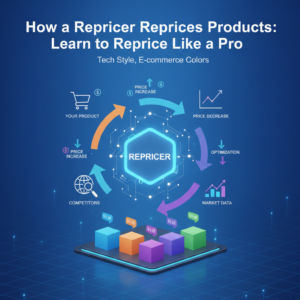
Here is a simple breakdown of the process:
- The repricer scans your competitors’ prices continuously
- It compares those prices against your defined minimum and maximum thresholds
- It calculates the optimal price to win or maintain the Buy Box
- It updates your listing price automatically — often within seconds
- It logs performance data so you can refine your strategy over time
The best part? You stay profitable throughout. A quality tool always respects your minimum price floor, so you never accidentally sell at a loss chasing a competitor.
| Repricing Type | Speed | Strategy Flexibility | Best For |
|---|---|---|---|
| Manual Repricing | Slow | High (human control) | Very small catalogs |
| Rule-Based Repricing | Fast | Moderate | Sellers with clear pricing rules |
| AI Dynamic Repricing | Real-time | Very High | Scaling sellers, large catalogs |
Choosing the Right Pricer System for Your Amazon Business
Not all repricing tools are created equal. When evaluating your options, you want to think beyond just speed. You want accuracy, profit protection, and strategy depth. The best Amazon repricer tools for dynamic repricing in 2026 combine Buy Box intelligence with built-in profit guardrails — so your margins are always protected.
Some sellers gravitate toward tools like the channel max repricer because of its multi-channel focus. Others prefer the fastest amazon repricer options available, especially when speed is the main priority in highly competitive categories. Whatever your preference, the core question is: does this tool match my catalog size, strategy goals, and profit requirements?
Key Features to Look for in a Repricer
- Real-time price monitoring across all competitors
- Buy Box tracking and ownership alerts
- Minimum and maximum price guardrails
- Scenario-based strategy engine
- Support for both FBA and FBM sellers
- Transparent reporting and analytics dashboard
Frequently Asked Questions About Amazon Repricing
How fast do repricers update prices?
Most modern repricers update prices within seconds of detecting a change. The fastest amazon repricer solutions can react almost instantly, giving you a competitive edge in categories where prices change dozens of times per hour.
Will a repricer always lower my prices?
Not necessarily. Good repricing tools are built to raise prices when competition drops off too. The goal is not just to be the cheapest — it is to be the most strategically priced seller at any given moment.
Is repricing safe for my Amazon account?
Yes, as long as you use a reputable tool that respects Amazon’s pricing policies and terms of service. Always set appropriate minimum and maximum price thresholds to stay compliant and protected.
| Feature | Zupricer | Basic Repricers |
|---|---|---|
| Buy Box Intelligence | Yes | Limited |
| Profit Guardrails | Yes | Sometimes |
| Scenario-Based Strategies | Yes | No |
| FBA + FBM Support | Yes | Varies |
| Free Trial | 14 Days, No Card | Varies |
Why Zupricer Stands Out in 2026
Zupricer is built specifically for Amazon sellers who are serious about scaling. It combines Buy Box intelligence, profit guardrails, and a scenario-based strategy engine that lets you automate repricing across your entire catalog — without sacrificing margins. Whether you are running 50 listings or 50,000, Zupricer keeps you competitive around the clock.
Rated 4.9 out of 5 on both Trustpilot and Capterra, it is clear that real sellers are seeing real results. The platform continuously monitors competitor prices, Buy Box status, and market conditions to automatically adjust prices in real time. It works seamlessly for both FBA and FBM sellers — a flexibility that many tools simply do not offer.
And if you are wondering about commitment — there is none required upfront. Zupricer offers a 14-day free trial with no credit card needed, so you can see the results for yourself before spending a single dollar.
If you are ready to stop guessing on pricing and start winning the Buy Box consistently, now is the time to give Zupricer a try. Head over to the signup page, start your free trial today, and experience what truly intelligent repricing feels like for your Amazon business in 2026.
What Makes a Smart Repricer Different from Basic Repricing Tools
The term smart repricer has become increasingly important in 2026 as sellers seek tools that go beyond simple if-then logic. While basic repricing software executes predefined rules — such as “if competitor price drops to $15, set my price to $14.99” — a smart repricer uses machine learning and predictive algorithms to analyze dozens of variables simultaneously and make profit-aware decisions without requiring explicit configuration for every possible scenario.
Rule-based repricers are transparent and predictable, making them suitable for sellers with small, stable catalogs who want full control over every pricing decision. However, they remain static and cannot adapt to new market patterns without manual intervention. In contrast, AI-powered smart repricers learn from historical outcomes, identify subtle patterns in competitor behavior, and adjust strategies dynamically based on real-time conditions such as Best Sellers Rank trends, time-of-day Buy Box rotation patterns, and competitor price velocity.
According to research from McKinsey on AI-driven dynamic pricing, businesses implementing machine learning pricing models achieve five to ten percent margin improvement over rule-based approaches — and importantly, that improvement comes largely from pricing higher when conditions allow, not from racing to the bottom.
How AI and Machine Learning Power Smart Repricing Decisions
Advanced smart repricers apply game theory principles to pricing strategy. Rather than simply reacting to every competitor price change, these tools analyze whether a competitor’s behavior is sustainable or likely to revert. For example, when a competitor matches your price, a smart repricer can identify the highest price point that competitor is willing to maintain and raise your price to that level, allowing both sellers to share the Buy Box at a higher margin instead of triggering a destructive price war.
The multi-variable analysis conducted by AI repricers includes competitor price history and velocity of change, offer count trends across the listing, time-of-day and day-of-week patterns in Buy Box allocation, demand velocity signals from BSR movement, and your own historical win rate and average selling price at each price point. This holistic approach identifies pricing opportunities that would be impractical to capture through manual rule configuration.
Some platforms use a two-stage predictive model: first, they generate an expected profit curve at each potential price point given current market conditions; second, they model how competitors will likely respond and what that means for profit over the next several repricing cycles. This forward-looking approach helps sellers avoid short-term wins that trigger long-term margin erosion.
Scenario-Based Intelligence and When Smart Repricers Shine
Smart repricers excel in specific scenarios where basic tools struggle. High SKU counts make manual rule management unmanageable — configuring and maintaining hundreds of unique rule sets becomes a full-time job. Thin-margin products cannot absorb aggressive undercutting, so profit-aware pricing becomes essential. Volatile categories where competitor prices shift frequently throughout the day require real-time adaptation that only AI can deliver at scale.
Advanced repricing platforms evaluate products through sequential rule engines that can include sixteen or more decision points executed every sixty seconds. These rules handle stale inventory pricing adjustments, profit margin guards, sales velocity-based pricing, stock-level triggers, Buy Box hold and lift strategies, suppressed Buy Box recovery tactics, uncontested price climb logic, and differentiated responses when Amazon itself is a competitor versus third-party sellers.
The most sophisticated smart repricers coordinate pricing decisions with other business systems. Profit-aware repricing integrates real margin data, current inventory position, PPC performance metrics, and listing health signals. When inventory drops below three weeks of cover, the system raises prices to slow velocity and prevent stockouts. When PPC cost-per-click increases on a specific ASIN, the repricer adjusts the price to protect margin after ad spend. This coordinated approach treats pricing as one function within a connected business system rather than an isolated decision.
Hybrid Approaches: Combining Rules and AI for Maximum Control
Many experienced sellers find that a hybrid approach outperforms pure rule-based or pure AI strategies. In this model, sellers use rules to define commercially critical boundaries — minimum price floors, maximum ceilings, and competitive set definitions — while AI optimizes pricing within those guardrails. This provides transparency where it matters most while capturing the performance benefits of machine learning pattern recognition.
Some platforms offer safe mode features that allow AI configurations to run as simulations against real market data before any live prices change. Sellers can run the AI configuration in safe mode for seven to ten days alongside their current rule setup, compare performance metrics, and make an informed decision before committing. This reduces the risk of transitioning to AI repricing and builds seller confidence in the technology.