Repricer Express: Top Amazon Repricers & Amazon Seller Repricer Guide
Selling on Amazon in 2026 is a completely different game than it was even a few years ago. Competition is fiercer, margins are tighter, and the Buy Box is more contested than ever. If you’re still adjusting prices manually, you’re essentially bringing a knife to a gunfight. That’s where automated repricing tools completely change the equation for sellers who want to stay competitive and profitable at the same time.
This guide digs deep into the world of Amazon repricing — what it is, how it works, and why finding the right tool matters more than most sellers realize. Whether you’re a seasoned FBA veteran or just getting your feet wet, there’s something here for you.
Understanding Repricer Express, Amazon Repricers, and What Every Amazon Seller Repricer Should Do
Before we get into the specifics of any particular tool, let’s build a foundation. Repricing on Amazon isn’t just about lowering your price to beat the competition. It’s a nuanced, data-driven process that involves understanding market dynamics, your competitors’ behavior, your own profit margins, and the ever-shifting Buy Box algorithm. The best amazon repricing strategies combine speed, intelligence, and profit awareness — all working together automatically.
What Makes a Great Repricer for Amazon Sellers
Not all repricing tools are created equal. Some are glorified spreadsheet helpers that make minor price tweaks on a delay. Others are genuinely powerful platforms that monitor competitor prices in real time, track Buy Box ownership, and adjust your prices based on custom rules you define. The difference between these two types of tools can literally be thousands of dollars in monthly revenue.
A truly great repricer for seller accounts should offer things like real-time competitor monitoring, customizable repricing rules, profit floor protection so you never accidentally sell below cost, and seamless integration with both FBA and FBM setups. Speed matters too — in fast-moving categories, a tool that updates prices every few minutes could be the difference between winning and losing the Buy Box.
| Feature | Basic Repricers | Advanced Repricers |
|---|---|---|
| Price Update Speed | Every few hours | Real-time or near real-time |
| Profit Guardrails | Basic min/max rules | Dynamic profit floor protection |
| Buy Box Intelligence | Limited or none | Full Buy Box tracking and strategy |
| Competitor Monitoring | Periodic snapshots | Continuous real-time monitoring |
| FBA & FBM Support | Often FBA only | Both FBA and FBM |
When you look at that comparison, it becomes crystal clear why investing in a more capable tool pays off. The best fba repricer software doesn’t just save you time — it actively makes you money by keeping you competitive around the clock, even when you’re asleep.
The Role of Buy Box Intelligence in Modern Repricing
The Buy Box is where the vast majority of Amazon sales happen. Studies consistently show that somewhere around 80-90% of purchases go through the Buy Box, which means if you’re not owning it regularly, you’re leaving serious money on the table. Smart amazon repricers understand this deeply and build their entire strategy engine around Buy Box dynamics rather than just raw price comparisons.
What does Buy Box intelligence actually look like in practice? It means the tool knows when you’re already winning the Buy Box and holds your price steady instead of racing to the bottom. It means the system recognizes when a competitor drops out of the market and allows your price to rise accordingly. This kind of nuance is what separates sophisticated repricing platforms from basic automation tools, and it’s exactly what experienced sellers should be looking for in 2026.
Repricer Express and How It Fits in the Landscape
When sellers talk about repricer express options, they’re usually referring to tools that combine speed with strategy. Express-style repricing emphasizes rapid price adjustments that keep pace with fast-moving market conditions. In highly competitive categories on Amazon, prices can shift dozens of times per hour, and only tools with genuinely fast update cycles can keep up effectively.
The concept of express repricing also aligns closely with what sellers need when they’re managing large catalogs. Manual management at scale is simply impossible. You might have hundreds or thousands of SKUs, each with its own competitive landscape, margin profile, and demand pattern. An express approach means automation handles all of that simultaneously without you needing to babysit individual listings.
FAQ: Common Questions About Amazon Repricing Tools
Is automated repricing safe for my Amazon account?
Yes, when done correctly. Reputable tools follow Amazon’s guidelines and use the official Selling Partner API. The key is setting proper profit floors and min/max price boundaries so the tool never takes actions that could harm your account or profitability.
How quickly should a good repricer update prices?
In competitive categories, near real-time updates are ideal. Tools that check prices every few minutes are far more effective than those that run hourly or daily cycles, especially during peak shopping hours.
Can repricing tools help both FBA and FBM sellers?
Absolutely. The best platforms support both fulfillment methods and even account for the fulfillment cost differences when calculating competitive pricing. This is especially important when you’re competing against sellers using different fulfillment models.
Will a repricer always push my prices down?
Not if it’s built properly. Intelligent tools raise prices when competition drops or demand increases, protecting your margins rather than constantly eroding them.
Choosing the Right Amazon Seller Repricer in 2026
The market for repricing tools has matured significantly, and sellers now have more options than ever. That said, more options also means more room for confusion. When evaluating any amazon seller repricer, you should be looking beyond the feature list and asking practical questions: How easy is it to set up? Does it have proper profit protection built in? Can it scale with your catalog? What does customer support look like?
Pricing is another factor worth considering carefully. Some tools charge a flat monthly fee regardless of your sales volume, while others scale with your revenue. Neither model is inherently better — it depends entirely on your business size and growth trajectory. The important thing is that the cost of the tool is clearly justified by the revenue lift it generates. If your repricer is winning you more Buy Box time and protecting your margins, it should pay for itself many times over.
| Seller Type | Key Repricing Priority | Recommended Focus |
|---|---|---|
| New Seller (Under 100 SKUs) | Ease of use, quick setup | Simple rule-based repricing |
| Growing Seller (100-1000 SKUs) | Buy Box win rate | Buy Box intelligence + profit floors |
| Large Catalog Seller (1000+ SKUs) | Scale and automation depth | Scenario-based strategies at scale |
| Private Label Seller | Price positioning without Buy Box pressure | Demand-based dynamic pricing |
Understanding your seller profile helps you zero in on which features matter most. For sellers who want to explore what dynamic repricing for Amazon really looks like in a modern tool, it’s worth digging into platforms that go beyond simple rule-based automation and embrace market-responsive pricing logic.
Why Zupricer Stands Out as a Top Choice for Amazon Sellers
Zupricer was built from the ground up specifically for Amazon sellers — not adapted from some generic pricing software. It combines Buy Box intelligence, genuine profit guardrails, and a scenario-based strategy engine that lets you build repricing logic tailored to your actual business goals. Whether you’re FBA, FBM, or running both, Zupricer handles your catalog automatically, monitoring competitor prices and Buy Box status continuously to make smart adjustments in real time.
The platform carries a 4.9 out of 5 rating on both Trustpilot and Capterra in 2026, which is a strong signal that real sellers are seeing real results. That kind of community trust doesn’t happen by accident — it’s earned through consistent performance and genuinely good customer support. And with a 14-day free trial that requires no credit card, there’s genuinely no risk in seeing what it can do for your business.
If you’re serious about staying competitive on Amazon in 2026 and you want a repricing solution that works as hard as you do, head over to Zupricer and start your free trial today at app.zupricer.com/signup. Your Buy Box win rate — and your bottom line — will thank you.
What Is a Repricer? A Clear Definition for Beginners
If you’re new to Amazon selling, you might be wondering what is a repricer in the first place. At its core, a repricer is software that automatically adjusts your product prices on Amazon based on competitor activity and rules you define. But it’s more than just a tool for changing numbers — it’s a system for winning the Buy Box while protecting your profit margins. Manual price monitoring becomes impossible as your business scales, and that’s exactly where repricing automation delivers its greatest value.
A repricer continuously analyzes competing offers on your listings, evaluates market conditions, and adjusts your prices according to your strategic goals. Every time a competitor changes their price or stock status, the repricer evaluates whether your listing needs an update. The best tools set minimum and maximum price boundaries so you never sell at a loss or price yourself out of the market. These guardrails are essential — your minimum price acts as a safety net based on your actual costs, while your maximum prevents Amazon from suppressing your listing for being unreasonably expensive compared to market norms.
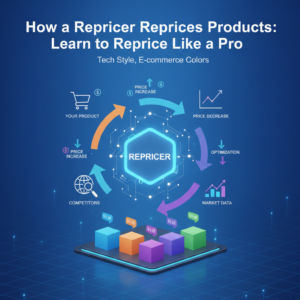
How Amazon Repricers Work: The Technical Process Explained
Understanding how does Amazon repricer work technically helps you appreciate why speed and accuracy matter so much. Modern repricing tools connect to Amazon through the Selling Partner API, which provides real-time access to marketplace data. The process follows five distinct steps that typically complete in under 90 seconds from start to finish.
First, the repricer detects changes in the competitive landscape. Amazon’s Simple Queue Service feed notifies the tool whenever a monitored competitor adjusts their price, changes stock status, or loses the Buy Box. Second, the system evaluates whether this change requires a response based on your configured rules. Third, it calculates a new optimal price within your defined minimum and maximum boundaries. Fourth, the updated price is submitted back to Amazon via the SP-API. Finally, the event and your response are recorded in your analytics dashboard for tracking and optimization.
This entire cycle happens continuously throughout the day. In competitive categories where prices shift dozens of times per hour, response speed becomes critical. Tools that check prices every few minutes capture far more Buy Box opportunities than those running hourly updates. The technical infrastructure behind quality repricing platforms processes billions of price changes monthly, ensuring your listings stay competitive even during peak shopping periods when market conditions change rapidly.
How to Use Amazon Repricer: A Practical Setup Guide
Knowing how to use Amazon repricer tools effectively starts with proper setup and configuration. The first critical step happens before you even connect the software — you need to calculate accurate costs for every SKU. This means your landed cost plus FBA fees plus Amazon’s referral fee rate. Many sellers make the mistake of using invoice prices instead of true landed costs, which understates expenses by $0.30 to $1.50 per unit when freight and handling are factored in.
Once you have accurate cost data, calculate your minimum price floor using this formula: divide your total costs by one minus your referral fee rate minus your target margin rate. For example, if your landed cost plus FBA fee totals $11.68, your referral fee is 8%, and you want a 20% margin, your floor becomes $16.22. This ensures every sale generates your required profit even after all Amazon fees are deducted.
Next, set your maximum ceiling based on historical market data. Pull your 90-day price high from tools like Keepa to understand what the market has supported recently. This ceiling prevents your repricer from pricing too aggressively high during temporary competitor stockouts. After boundaries are set, configure your repricing strategy — whether you want to match the Buy Box, undercut by a specific amount, or use more sophisticated logic. Most advanced sellers start with a small test group of 5-10 high-revenue ASINs, run the repricer in simulation mode for several days to verify the logic works as expected, then gradually expand to their full catalog over 2-4 weeks.
Amazon Repricer Comparison: Framework for Evaluation
When conducting an Amazon repricer comparison, you need a structured framework rather than just comparing feature lists. Start by categorizing tools into three repricing method types: manual, rule-based, and algorithmic AI-driven systems. Manual repricing gives you complete control but becomes inefficient beyond a few dozen SKUs. Rule-based automation executes your predefined logic consistently but lacks market adaptability. AI-driven repricing analyzes real-time market patterns and balances profitability against competitive positioning automatically.
Evaluate repricing speed as a core technical requirement. How quickly does the tool detect competitor changes and update your prices? In fast-moving categories, tools that respond within 2-5 minutes capture significantly more Buy Box time than those updating hourly. Pricing models matter too — some platforms charge flat monthly fees regardless of sales volume, while others use percentage-based commission structures. Neither is inherently superior; your choice depends on catalog size and revenue scale.
Consider the quality of profit protection features. Can you set dynamic floors that adjust based on cost changes? Does the tool prevent you from racing to the bottom during price wars? Analytics depth is another differentiator — the best platforms show you Buy Box win rate trends, average selling price movements, and competitor behavior patterns over time. Finally, assess customer support quality and contract flexibility. Tools offering month-to-month agreements with responsive support teams reduce risk compared to annual commitments with limited assistance. Testing multiple platforms through free trials gives you hands-on experience with interface usability and actual performance before making a long-term commitment.