Here’s a reality check that might sting: most of your Amazon catalog is probably losing you money. Not just underperforming—actively destroying value while you pour resources into keeping those products alive.
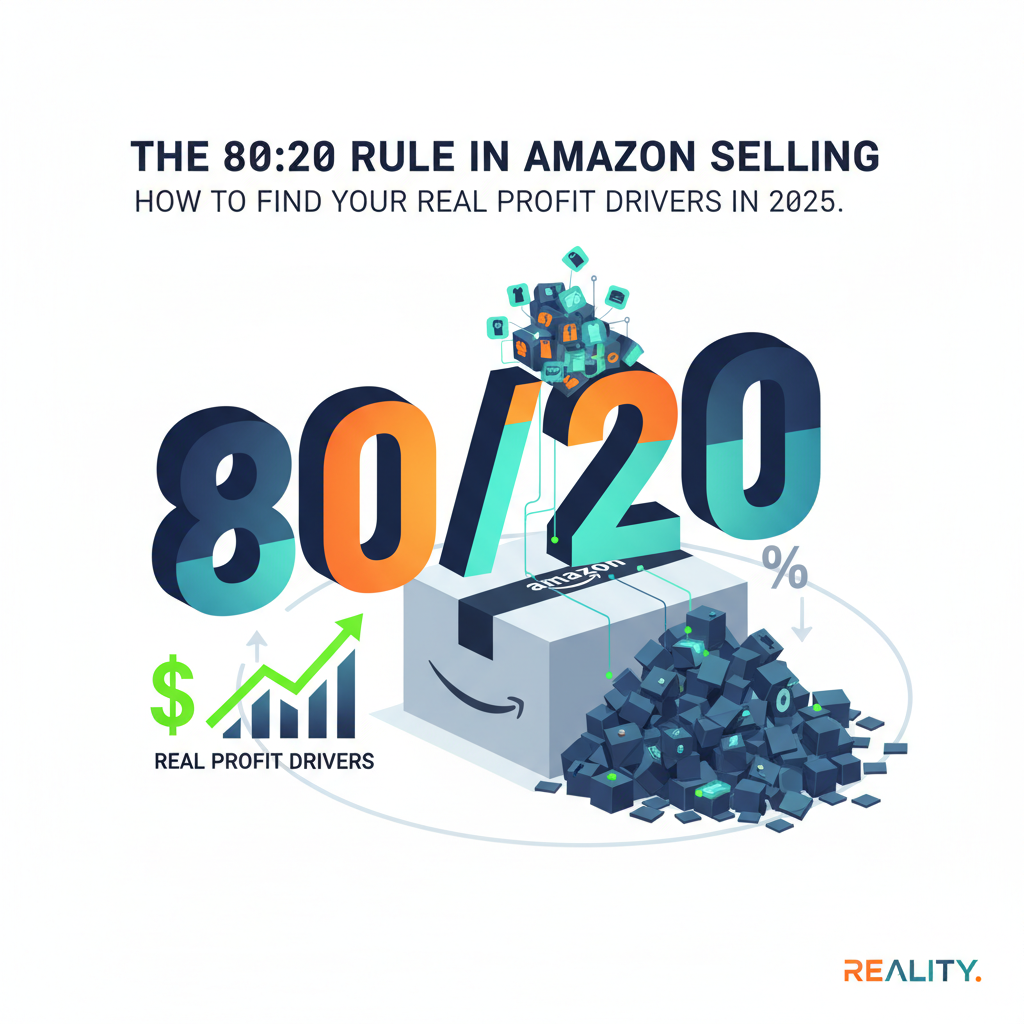
The 80/20 rule, also known as the Pareto Principle, reveals an uncomfortable truth that applies to virtually every Amazon business: roughly 20% of your products generate 80% of your results. The flip side? The remaining 80% of your SKUs are competing for scraps while draining your capital, attention, and warehouse space.
In April 2025, with amazon fees at historic highs and marketplace competition fiercer than ever, understanding this principle isn’t optional—it’s survival. Sellers who identify and double down on their true profit drivers are thriving. Those spreading resources evenly across bloated catalogs are watching margins evaporate.
Let’s break down exactly how the 80/20 rule works in Amazon selling and how you can use it to transform your business.
How the 80/20 Rule Actually Shows Up in Your Business
The Pareto Principle isn’t just theory—it’s a mathematical pattern that emerges consistently across Amazon seller accounts. Here’s where you’ll find it:
Revenue concentration: If you have 100 SKUs, approximately 20 of them are generating 80% of your sales. The other 80 products are fighting over the remaining 20% of revenue. Many sellers are shocked when they actually run the numbers.
Profit distribution (often more extreme): While revenue might follow 80/20, profit concentration is frequently even more dramatic. It’s common to discover that 20% of products generate 90-95% of actual profit, while a significant portion of your catalog actively loses money after accounting for all costs.
Problem concentration: Here’s the kicker—80% of your customer service headaches, returns, and operational problems typically come from just 20% of your products. These high-maintenance SKUs destroy profitability in ways that don’t show up on simple revenue reports.
The pattern holds because Amazon’s algorithm amplifies what already works. Top sellers rank better, gain more visibility, and sell even more—creating a compounding effect that concentrates results in a small percentage of your catalog.
The Hidden Cost of Catalog Complexity
One industry expert put it bluntly: “The 80-20 rule is brutal but clarifying. A small set of styles end up doing the heavy lifting, and everything else quietly blocks working capital and warehouse space.”
Most sellers dramatically underestimate what their underperforming SKUs actually cost them:
- Storage fees: Monthly and long-term storage costs accumulate on slow-moving inventory, eating into already thin margins
- Tied-up capital: Money sitting in dead inventory could be funding more units of your winners
- Mental bandwidth: Every SKU requires attention—PPC management, listing maintenance, inventory planning, supplier communication
- Complexity costs: More products mean more campaigns to manage, more tracking, more decisions, more opportunities for mistakes
- Opportunity cost: Every hour spent on a bottom-tier product is an hour not spent scaling your stars
The bottom 20% of your catalog frequently destroys value through these hidden costs while generating minimal revenue. Yet most sellers keep feeding these products because they’ve never calculated the true cost of maintaining them.
SKU Rationalization: Turning Analysis Into Action
SKU rationalization is the systematic process of deciding which products to keep, optimize, or eliminate. This is where the 80/20 rule becomes actionable rather than just interesting.
Step 1: Identify Your True Top 20%
Critical distinction: rank by profit contribution, not revenue. A high-revenue product with 5% margins contributes less real value than a moderate seller with 35% margins. Many sellers get this wrong and end up protecting the wrong products.
Step 2: Analyze the Middle 60%
This is your gray zone. Some of these products can be optimized into profitability. Others serve strategic purposes—gateway products, bundle components, review generators. Many should be eliminated but get kept through inertia or emotional attachment.
Step 3: Evaluate the Bottom 20%
Calculate true profitability including all hidden costs. Most of these are clear elimination candidates. A few might be fixable with price adjustments or cost reductions, but be ruthless—the default should be elimination unless there’s compelling evidence otherwise.
Use this categorization framework for decisions:
- Stars (high profit + high velocity): Scale aggressively—more inventory, more PPC budget, premium listing optimization
- Cash Cows (high profit + low velocity): Maintain presence without heavy investment; good for margin stability
- Question Marks (low profit + high velocity): Dangerous—they look successful but aren’t making money. Fix pricing, reduce costs, or eliminate
- Dogs (low profit + low velocity): Liquidate and don’t look back
Practical 80/20 Applications Beyond Inventory
Once you understand the principle, apply it everywhere:
PPC Budget Allocation
Your top 20% of products likely deserve 60-80% of your advertising spend. These products have proven demand and conversion rates—advertising simply amplifies what’s already working. Meanwhile, PPC on poor performers often just accelerates losses.
The compound effect is powerful: higher PPC investment in top performers drives more sales, which improves organic ranking, which reduces advertising dependency, which improves margins further. It’s a virtuous cycle—but only for products that deserve the investment.
Listing Optimization Priority
Your top 20% should have flawless listings: professional photography, video content, comprehensive A+ Content, perfect copy. These investments pay off because the products have proven demand.
Your bottom tier? They don’t need better listings—they need to be eliminated. Don’t waste hours perfecting a listing for a product that shouldn’t exist in your catalog.
Supplier Negotiations
Focus negotiation energy on suppliers for your top performers. Volume discounts and better terms have immediate profit impact on high-velocity items. The supplier for your worst-selling product isn’t worth a three-hour negotiation call.
Time Management
80% of your business results come from 20% of your activities. Product selection, top SKU optimization, and strategic pricing decisions are high-leverage. Minor listing tweaks on poor performers and excessive reporting are not. Allocate your time accordingly.
The Five Fatal Mistakes Sellers Make
Even sellers who understand the 80/20 concept often implement it poorly:
Mistake 1: Using revenue instead of profit. Your highest-revenue product might have razor-thin margins while a moderate seller has excellent profitability. Always rank by profit contribution.
Mistake 2: Cutting without strategic consideration. Some lower-margin products serve purposes—they attract new customers, complete bundles, or drive reviews. Apply 80/20 analysis, but think strategically before eliminating.
Mistake 3: One-time analysis instead of continuous monitoring. Your top 20% today might not be your top 20% in six months. Markets shift, competition evolves, trends change. Quarterly analysis is the minimum; monthly is better for larger catalogs.
Mistake 4: Ignoring complexity costs. When calculating whether to keep a marginal product, factor in the mental bandwidth, system complexity, and opportunity cost—not just direct profitability.
Mistake 5: Emotional attachment. “This was our first product” or “I really believe in this item” aren’t valid business reasons to keep an unprofitable SKU. Let data override emotions.
What Successful Implementation Looks Like
Sellers who properly apply 80/20 analysis typically see dramatic improvements:
- 15-30% increase in overall profit margins
- 20-40% reduction in storage costs
- 10-25% improvement in PPC efficiency
- Significant reduction in customer service burden
- Faster inventory turnover and improved cash flow
- Reduced operational complexity and decision fatigue
The transformation isn’t just financial—it’s psychological. Sellers report feeling more confident, less stressed, and clearer about where to invest their time and money. Running a focused 50-SKU business is fundamentally different from managing a sprawling 200-SKU operation where most products drain more than they contribute.
The Mindset Shift: From More to Better
The 80/20 rule challenges the “more is better” mentality that traps many Amazon sellers. Success doesn’t come from having the largest catalog—it comes from having the right products and supporting them properly.
Embrace subtraction as strategy. Every product you eliminate frees up capital and attention for what actually matters. Celebrate focus over diversification. Master your top 20% before even considering expansion.
Think of your catalog like an investment portfolio. You wouldn’t keep holding a stock that consistently underperforms—you’d reallocate that capital to your winners. Apply the same logic to your Amazon business.
Protecting Your Winners With Smart Pricing
Identifying your top 20% is only half the battle. The other half is protecting and maximizing those profit drivers in a competitive marketplace where pricing shifts constantly.
Your star products face continuous pressure: competitors adjusting prices, Buy Box algorithms evaluating offers around the clock, and market dynamics that change faster than any human can monitor. Once you’ve done the work to identify your real profit drivers, you need systems that protect their performance automatically.
This is where Zupricer becomes essential to your 80/20 strategy. While you focus on the strategic work of portfolio optimization and product development, Zupricer handles the tactical pricing decisions that keep your top performers competitive and profitable. It monitors competitor moves in real-time, adjusts your prices to maintain Buy Box ownership while respecting your margin floors, and ensures your winners keep winning without constant manual intervention.
The 80/20 rule tells you where to focus. Intelligent repricing automation like Zupricer ensures that focus translates into sustained profits, protecting your best products 24/7 while you build the business that your data says you should be running.