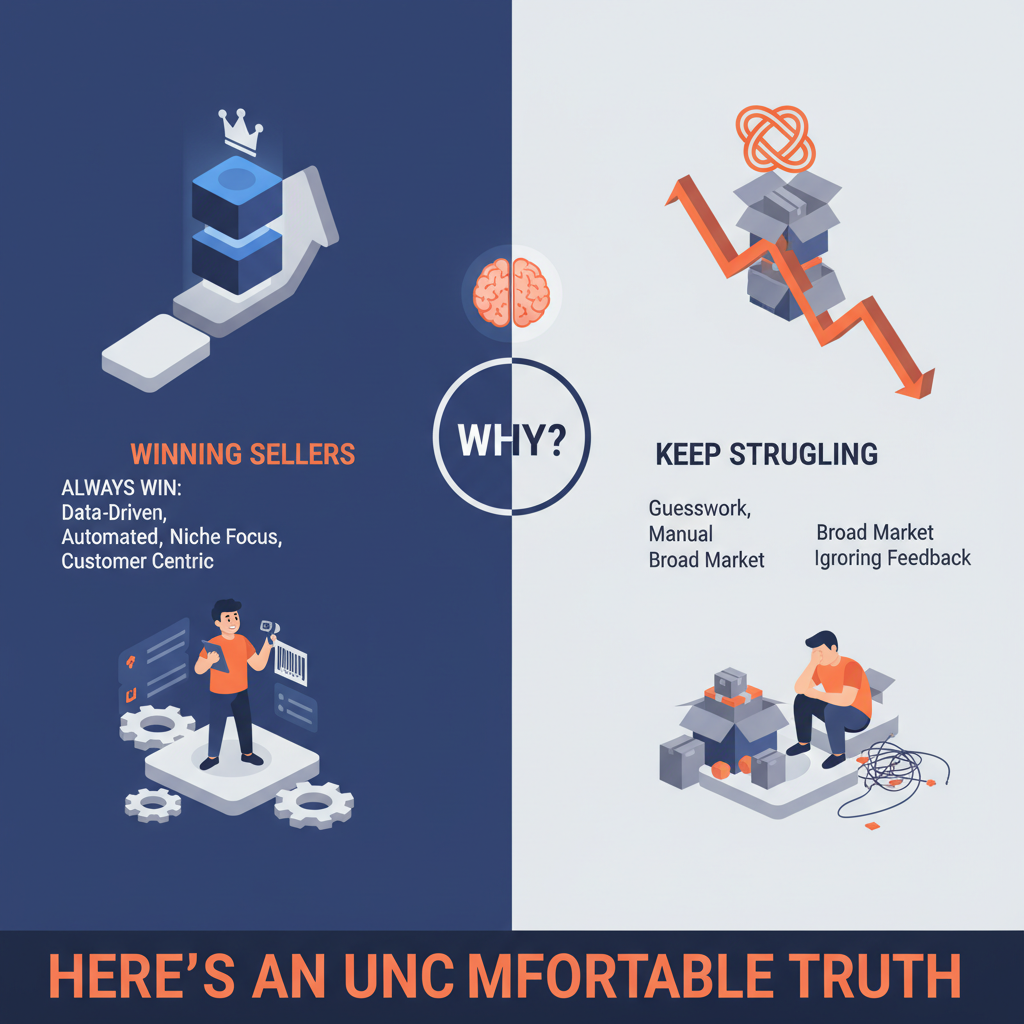
Here’s an uncomfortable truth most sellers don’t want to hear: the gap between winning and losing on Amazon has never been wider. And it’s getting worse every month.
It’s not about luck. It’s not about finding some magical product nobody else discovered. And it’s definitely not about working more hours than everyone else.
The sellers crushing it right now have built systematic advantages that struggling sellers either don’t understand or refuse to implement. They’ve figured out that Amazon doesn’t work the way it used to—and they’ve adapted while others keep doing what stopped working two years ago.
Today’s shoppers discover products through TikTok, podcast recommendations, and AI-driven suggestions long before they type anything into Amazon’s search bar. The brands winning aren’t guessing anymore. They’re leveraging data, technology, and operational excellence in ways that create compounding advantages their competitors simply cannot match.
So what exactly separates the winners from everyone else? Let’s break it down.
Winners Make Decisions Based on Data, Not Gut Feelings
The most fundamental shift separating successful sellers from struggling ones is how they make decisions. Winners have moved from intuition-based choices to data-driven strategies—and the profit impact is substantial.
Implementing data-driven amazon pricing strategies alone can deliver an 8% profit margin increase. That’s not theoretical. It’s achievable for any seller willing to invest in the right infrastructure.
Here’s what data-driven sellers do differently:
- Predictive analytics: They anticipate demand fluctuations before they happen, not after inventory runs out
- Customer segmentation: They identify high-value customer segments and target marketing spend accordingly
- Multi-touch attribution: They understand which marketing channels actually drive conversions across the entire customer journey
- Inventory optimization: They use predictive models to maintain optimal stock levels without tying up excessive capital
Meanwhile, struggling sellers are still checking competitor prices once a day, making pricing decisions based on “feeling,” and wondering why their margins keep shrinking.
The Multichannel Advantage Is No Longer Optional
Relying solely on Amazon creates dangerous vulnerabilities. One algorithm change, one policy update, one new competitor—and your entire business can crater overnight.
The data here is compelling: brands selling on three or more marketplaces experience 104% growth in Gross Merchandise Value compared to single-channel sellers. That’s not a marginal improvement—it’s a complete transformation of growth trajectory.
Expanding across multiple channels delivers:
- Access to new customer segments who shop primarily on other platforms
- Enhanced brand visibility and recognition
- More stable, diversified revenue streams
- Reduced platform-specific risk
But here’s where most sellers fail: they try to expand without the operational infrastructure to support it. Successful multichannel sellers maintain consistent product data across all platforms, unified inventory management, platform-specific optimization, and coordinated pricing strategies. Without these foundations, expansion creates chaos rather than growth.
Product Data Has Become a Competitive Weapon
As AI increasingly mediates product discovery, the quality of your product data determines whether potential buyers ever see your listings. Structured, enriched product data decides which products get surfaced—and which get buried.
Winners treat product data as a strategic asset:
- Titles: Concise, descriptive, front-loaded with critical information
- Features: Key benefits highlighted in scannable bullet points that answer customer questions proactively
- Images: High-quality photography including main product shots, lifestyle images, infographics, and detail close-ups
- Technical specs: Complete, accurate, and properly formatted for both human readers and algorithms
Retailers who fail to manage and optimize their product data are falling behind rapidly. Accurate, well-managed product data directly impacts search visibility, conversion rates, return rates, and advertising efficiency. Neglect it, and you’re essentially invisible to the algorithms that drive discovery.
Automation Separates Scalable Businesses from Overwhelmed Operators
Here’s the hard truth: sellers still managing operations manually cannot compete in 2025. The market moves too fast, competitors respond too quickly, and the data volume simply overwhelms human analysis capacity.
Winning sellers automate:
- Inventory synchronization across all channels
- Price adjustments based on real-time competitive intelligence
- Order processing and fulfillment workflows
- Customer communication and support responses
- Product listing creation and optimization
The benefits compound over time: reduced manual errors, faster response to market changes, lower operational costs, and—crucially—scalability without proportional cost increases. Winners free their time for strategic initiatives while losers drown in operational busywork.
Leading sellers now manage 300+ advertising campaigns in just 30 minutes per week. That’s not superhuman efficiency—it’s automation doing the heavy lifting while humans focus on strategy.
External Traffic Has Become Table Stakes
Over 40% of Amazon sellers now drive external traffic from social media, blogs, or influencer campaigns. This isn’t a nice-to-have anymore—it’s essential for growth.
Winners have expanded their traffic sources beyond Amazon’s ecosystem:
- TikTok product discovery campaigns reaching new audiences
- Podcast sponsorships targeting niche communities
- Content marketing driving organic search traffic
- Email marketing for customer retention and reactivation
Sellers relying exclusively on Amazon’s internal traffic face higher advertising costs, limited audience reach, zero brand equity outside the platform, and complete vulnerability to algorithm changes. External traffic creates independence that single-source sellers will never achieve.
The Failure Patterns That Keep Losers Losing
Understanding why winners win is only half the equation. Recognizing the patterns that trap struggling sellers matters just as much.
Reactive Instead of Strategic
Struggling sellers respond to problems after they occur. They adjust prices only after losing the Buy Box. They optimize listings after sales decline. They address inventory issues after stockouts happen. Winners anticipate and prevent; losers react and recover.
Manual Processes in an Automated World
If you’re still checking competitor prices manually once a day, adjusting prices platform by platform, creating listings individually without templates, or analyzing performance in spreadsheets—you’re bringing a knife to a gunfight.
Single-Channel Dependency
Algorithm changes can devastate visibility overnight. Policy changes can eliminate entire product categories. Competitive intensity increases when all your eggs sit in one basket. Revenue concentration creates business-ending risk.
Poor Product Data Management
Inconsistent, incomplete, or inaccurate product data causes lower search visibility, higher return rates, wasted advertising spend, and slower expansion capabilities. It’s the silent killer of Amazon businesses.
The Technology Flywheel Winners Have Built
Technology investment separates winners from losers more than any other single factor. But it’s not just about having tools—it’s about how those tools create compounding advantages.
The technology flywheel works like this:
- Better data leads to more accurate insights
- Better insights enable smarter decisions
- Smarter decisions produce superior results
- Superior results generate more resources for technology investment
- More technology creates even better data
This cycle accelerates over time. Sellers without technology struggle with manual processes, making it impossible to compete with rivals riding this flywheel. The gap widens every single day.
Winners invest in competitive intelligence platforms for real-time market monitoring, dynamic pricing engines that respond to conditions automatically, inventory management systems with unified visibility across channels, analytics dashboards providing actionable insights, and AI-powered tools for content creation at scale.
The Bottom Line: Execution Beats Knowledge Every Time
Here’s what frustrates me about most advice for Amazon sellers: everyone focuses on what to do while ignoring how to actually do it. Many sellers understand they should optimize listings, implement dynamic pricing, expand channels, and automate operations. But knowledge without execution creates zero competitive advantage.
Winners distinguish themselves through systematic execution—building best practices into daily operations through technology, processes, and team capabilities. They invest strategically in tools that create sustainable advantages rather than chasing short-term tactics. They adapt continuously based on data, not assumptions.
The gap between winners and everyone else will only widen as technology, data, and operational sophistication become more critical to success. The question isn’t whether you understand what winners do differently—it’s whether you’ll actually execute before your competitors do.
For sellers ready to stop struggling and start winning, pricing represents the highest-leverage opportunity available. Dynamic, intelligent repricing transforms your competitive position instantly—but only if you have the right tools.
That’s exactly why Zupricer exists. Our intelligent Amazon repricing platform automates the pricing decisions that winning sellers make, ensuring you capture Buy Box opportunities, respond to competitive moves in real-time, and protect your margins around the clock. While your competitors manually check prices once a day, Zupricer keeps you ahead of every market shift—automatically.
Stop playing catch-up. Start winning. Zupricer turns pricing from your biggest vulnerability into your strongest competitive advantage.