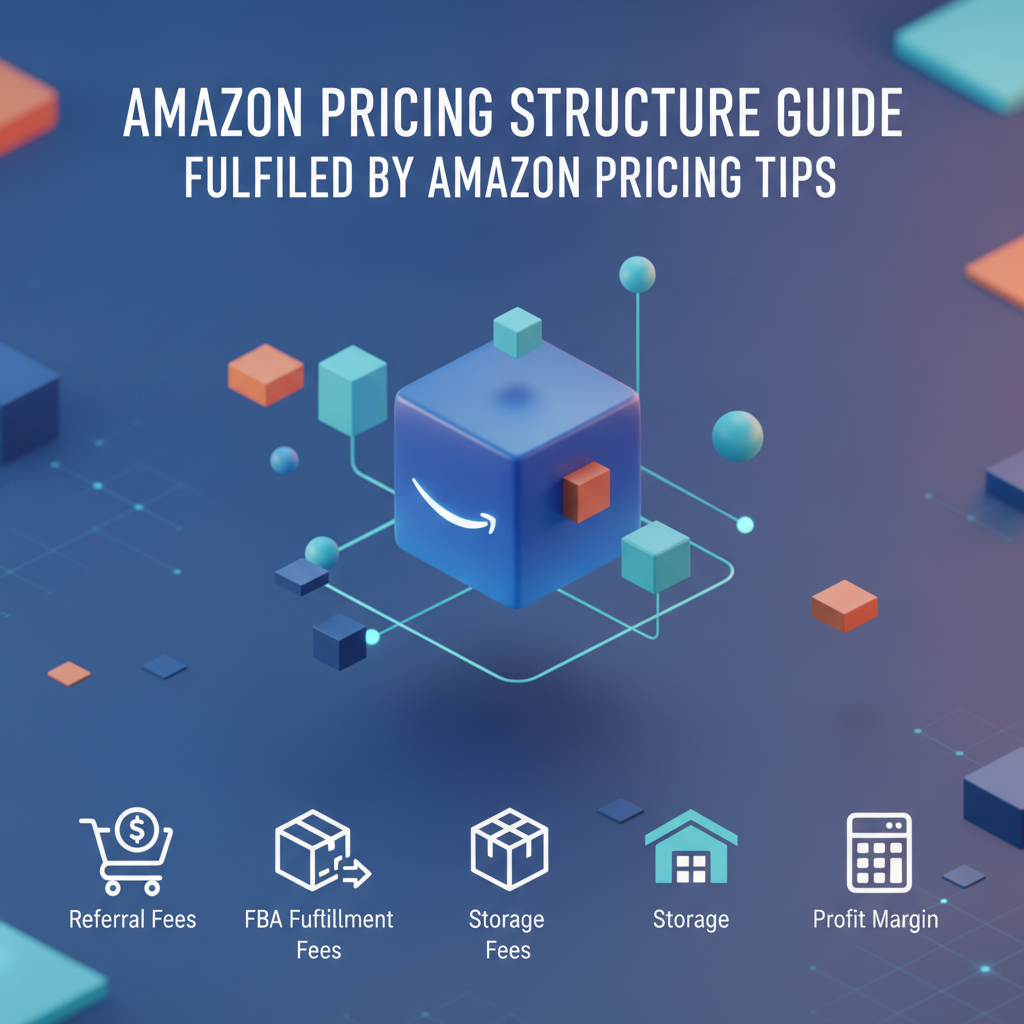
Amazon Pricing Structure Guide: Everything You Need to Know About Fulfilled by Amazon Pricing
If you have been selling on Amazon for any amount of time, you already know that fees can feel like a maze with no exit. One minute you think you have your margins figured out, and the next, a new charge shows up that you never accounted for. Understanding amazon pricing is not just helpful — it is absolutely essential if you want to survive and thrive on the platform in 2026.
This guide is going to break down the full picture: from the basics of the amazon pricing structure to the latest fee updates that are shaking up seller profitability right now. Whether you are just getting started or you are a seasoned seller trying to tighten up your margins, there is something here for you. Let us dive in.
Why the Amazon Pricing Structure Matters More Than Ever
The honest truth? A lot of sellers are watching their revenue climb while their actual profits shrink. That is the paradox of selling on Amazon in 2026. The platform gives you access to hundreds of millions of buyers, but it also takes a cut at almost every step of the journey. Understanding where your money is going is the first step toward keeping more of it.
The amazon storefront fees alone can catch new sellers completely off guard. These include referral fees, subscription fees, and various fulfillment-related charges that stack up fast. Add in the newer fees Amazon has been rolling out across its global marketplaces, and the picture gets even more complex.
| Fee Type | Who It Affects | Typical Range |
|---|---|---|
| Referral Fee | All sellers | 6% – 45% of sale price |
| FBA Fulfillment Fee | FBA sellers | Varies by size and weight |
| Monthly Storage Fee | FBA sellers | Seasonal rate per cubic foot |
| Low-Inventory Fee | FBA sellers with low stock | Per unit charge |
| Inbound Placement Fee | FBA sellers shipping to EU/US | Per unit based on destination |
| Return Processing Fee | High-return-rate ASINs | Category-defined threshold |
Breaking Down Fulfilled by Amazon Pricing in 2026
The fulfilled by amazon pricing model has always had layers, but 2026 has added a few more that sellers need to understand immediately. Amazon has been expanding its fee structure in ways that directly impact your pricing floor — the minimum price you can set before you start losing money.
Inbound Placement Fees Are Now Global
One of the biggest shifts happening right now is Amazon’s expansion of Inbound Placement Fees to European marketplaces. This means that sellers shipping inventory into FBA warehouses across Europe are now facing a per-unit fee unless they choose to distribute inventory across multiple regional fulfillment centers themselves. For international sellers, this adds a new layer of cost of fulfillment by amazon that has to be baked into every single pricing decision you make.
If you are sending inventory into a single Amazon warehouse in Germany and relying on Amazon to move stock around, you will pay for that convenience. The smarter play is to understand your options and adjust your floor prices accordingly so you are never selling at a loss without realizing it.
AWD Integration Is Creating a Competitive Split
Here is something that does not get talked about enough. Amazon has exempted sellers using its Amazon Warehousing and Distribution service from Low-Inventory Fees entirely. That is a massive deal. If you are using AWD for automated FBA replenishment, you can price more aggressively because one of the penalty fees has been taken off the table for you.
But if you are not using AWD, you need to factor Low-Inventory Fees into your minimum price thresholds. This is creating a two-tier competitive landscape where AWD sellers can undercut non-AWD sellers while still maintaining healthy margins. If you are noticing that some competitors seem to be pricing lower than you think should be possible, this might be exactly why.
Return Processing Fees Are Now Category-Wide
Amazon has also extended its return processing fee beyond just apparel. In 2026, any product across any category that exceeds a category-defined historical return rate threshold is now subject to this fee. That means if your ASIN has a higher-than-average return rate, you will be charged a fee on top of everything else every time a customer sends something back.
This is a huge reason why sellers are finding amazon seller fees high compared to just a couple of years ago. The fees are not just growing in size — they are growing in number and scope. You need to know your return rates by ASIN and adjust your pricing minimums for those products before you get hit with charges you were not expecting.
FAQ: Amazon Fees and Pricing for Sellers
What are the main fees Amazon charges sellers?
Amazon charges referral fees, FBA fulfillment fees, monthly storage fees, inbound placement fees, low-inventory fees, and return processing fees. The exact amounts depend on your product category, size, weight, and fulfillment method.
How do I avoid the Low-Inventory Fee?
Maintaining healthy stock levels is the primary way to avoid it. If you are using Amazon’s AWD service for automated replenishment, you are fully exempt from this fee as of 2026. Otherwise, keep your inventory above the threshold Amazon defines for your product.
Are Inbound Placement Fees charged in Europe too?
Yes. Amazon has expanded Inbound Placement Fees to major European marketplaces in 2026. You can reduce or eliminate this fee by choosing to distribute your inventory across multiple regional warehouses yourself rather than sending everything to a single location.
What is the return processing fee and who does it affect?
It is a per-return charge applied to products that exceed a category-specific historical return rate. It now applies across all categories, not just apparel. If your product has a high return rate, you need to raise your minimum price to absorb this cost.
| Scenario | Fee Impact | Recommended Action |
|---|---|---|
| Using AWD for replenishment | Exempt from Low-Inventory Fee | Price more aggressively at lower floor |
| Not using AWD | Low-Inventory Fee applies | Raise minimum price threshold |
| Shipping to single EU warehouse | Inbound Placement Fee applies | Distribute inventory or adjust floor price |
| High-return-rate ASIN | Return Processing Fee applies | Increase minimum price per ASIN |
Putting It All Together: Amazon Pricing That Actually Protects Your Margins
Everything covered above — the fee tables, the AWD split, the category-wide return charges — points to the same conclusion. Getting amazon pricing right in 2026 isn’t about knowing one fee in isolation; it’s about knowing how all of them stack together for your specific catalog. A seller juggling return rates, inbound placement choices, and AWD status manually is essentially trying to solve a moving equation with a static calculator.
This is exactly why pricing amazon listings has shifted from a once-a-week task to something that needs to run continuously in the background. Zupricer was built to absorb that complexity directly into its pricing logic, so every price it sets already accounts for the fee profile specific to that ASIN — not a generic, one-size-fits-all floor.
How Smart Repricing Keeps You Profitable Amid Rising Fees
Here is the thing — you cannot manually track all of these fee changes across your entire catalog and still run a business at the same time. That is where automated repricing becomes not just useful but genuinely necessary. The sellers who are winning in 2026 are the ones who have set up intelligent pricing floors that automatically account for their specific fee profile.
If your repricing tool does not know your return rate per ASIN, your AWD status, your inbound shipping choices, and your referral fee percentage, it is working with incomplete information. And incomplete information leads to prices that look competitive on the surface but are quietly eating into your margins every single day.
Why Zupricer Was Built for Exactly This Moment
Zupricer is an Amazon repricing tool built specifically for sellers who are serious about protecting their profits. It combines Buy Box intelligence, profit guardrails, and a scenario-based strategy engine to automate repricing across your entire catalog at scale. It continuously monitors competitor prices, Buy Box status, and market conditions to automatically adjust your prices in real time — so you can win and hold the Buy Box without ever sacrificing margin.
Whether you are running FBA, FBM, or a mix of both, Zupricer works for you. And with all the fee complexity that 2026 is throwing at sellers, having a tool that builds those costs into your pricing logic from the ground up is not a luxury — it is a survival strategy.
Zupricer is rated 4.9 out of 5 on both Trustpilot and Capterra. You can start a 14-day free trial with no credit card required at https://app.zupricer.com/signup. Stop letting rising fees quietly drain your profits. Get the repricing intelligence your catalog deserves.