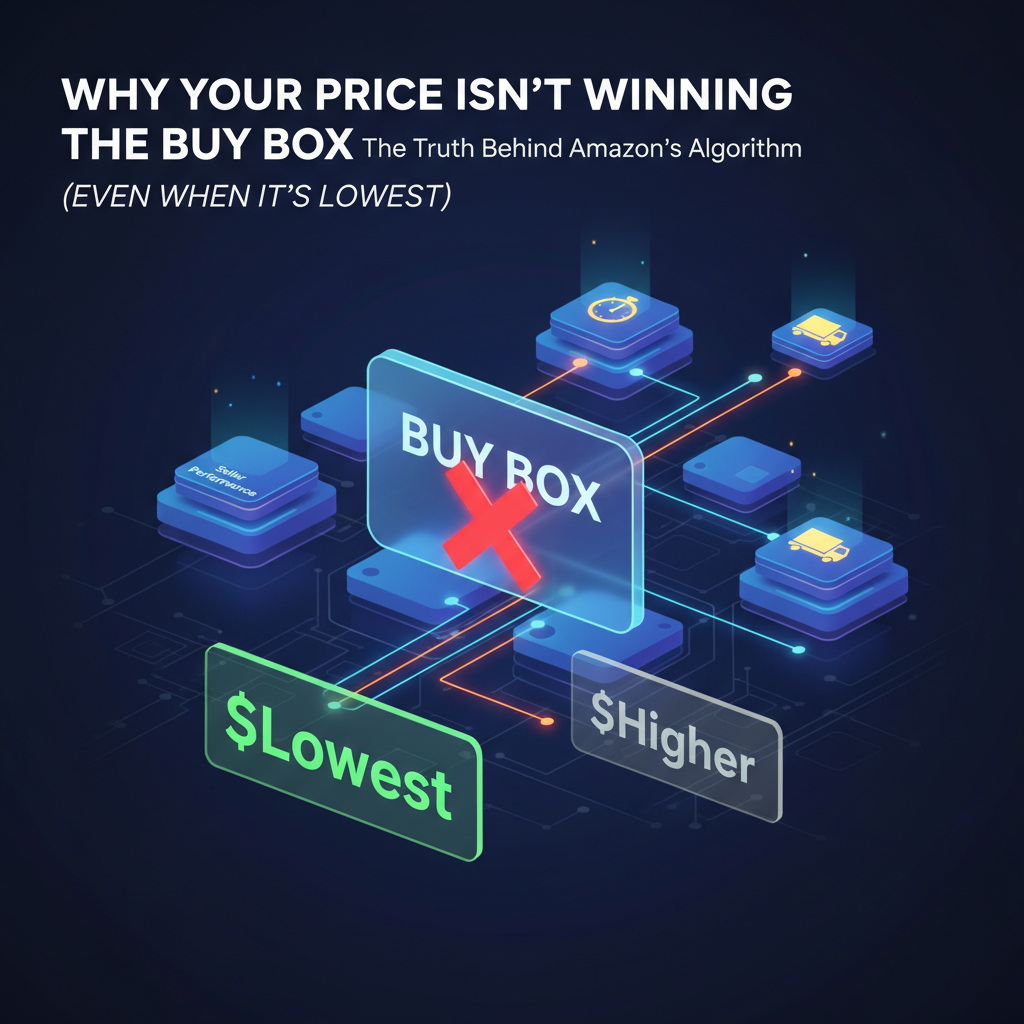
You’ve done the math. You’ve slashed your margins. You’re offering the absolute lowest price on that product listing—and yet, somehow, you’re still not winning the Buy Box. Sound familiar?
If you’ve been selling on Amazon for any length of time, you’ve probably experienced this frustrating scenario. You watch competitors with higher prices consistently capture that coveted “Add to Cart” button while your rock-bottom offer sits invisible in the “Other Sellers” section. It feels unfair. It feels broken. And it makes you question everything you thought you knew about Amazon selling.
Here’s the uncomfortable truth that many sellers learn the hard way: having the lowest price on Amazon doesn’t guarantee you’ll win the Buy Box. In fact, price is just one piece of a much larger puzzle—and it’s often not even the most important piece.
With approximately 82-83% of all Amazon sales flowing through the Buy Box, understanding why your low price isn’t converting to buy box wins isn’t just interesting—it’s essential for your business survival. Let’s break down exactly what’s happening behind the scenes and, more importantly, what you can do about it.
The Buy Box Myth That’s Costing You Money
There’s a persistent myth in the Amazon seller community that refuses to die: the belief that the lowest price always wins. This misconception has sent countless sellers into destructive price wars, eroding margins and destroying profitability—all while failing to achieve the Buy Box dominance they were chasing.
The reality is that Amazon’s Buy Box algorithm is a sophisticated system that weighs multiple factors simultaneously. Think of it less like an auction where the lowest bidder wins, and more like a job interview where Amazon is evaluating candidates across numerous criteria. Price matters, sure—but so does your experience, reliability, and ability to deliver results.
Amazon’s primary goal isn’t to showcase the cheapest products. Their primary goal is customer satisfaction. They want buyers to have seamless, positive experiences that keep them coming back to the platform. This fundamental priority shapes everything about how the Buy Box algorithm works.
When you understand this shift in perspective—from “lowest price wins” to “best customer experience wins”—suddenly the algorithm’s behavior starts making a lot more sense.
Seller Performance Metrics: The Hidden Gatekeepers
If price isn’t the primary factor, what is? The answer lies in your seller performance metrics—a collection of data points that Amazon uses to evaluate how reliably you serve customers.
Here are the key metrics that directly influence your Buy Box eligibility:
- Order Defect Rate (ODR): This encompasses negative feedback, A-to-Z claims, and credit card chargebacks. Amazon expects this rate to stay below 1%. Exceed that threshold, and your Buy Box chances plummet regardless of your pricing.
- Valid Tracking Rate: The percentage of your orders that include valid tracking information. Amazon needs to know packages are actually moving toward customers.
- On-Time Delivery Rate: Late shipments are one of the fastest ways to tank your Buy Box performance. Even a few late deliveries can significantly impact your standing.
- Pre-Fulfillment Cancel Rate: Canceling orders before shipment signals to Amazon that you may have inventory management issues—a red flag for Buy Box consideration.
- Customer Response Time: How quickly you respond to buyer messages matters. Slow responses suggest poor customer service.
Here’s what makes this tricky: Amazon doesn’t publicly disclose the exact thresholds for Buy Box eligibility across all these metrics. The algorithm operates as something of a “black box,” and the weights given to different factors can vary by product category. What we know for certain is that sustained excellent performance across all these areas dramatically improves your Buy Box win rate.
A seller with a slightly higher price but stellar metrics will often beat a seller with rock-bottom pricing and mediocre performance scores. Amazon trusts the reliable seller to deliver a better customer experience—and that trust translates directly into Buy Box wins.
The FBA Advantage: Why Fulfillment Method Matters More Than You Think
One of the most significant factors in Buy Box competition has nothing to do with your price or even your performance history—it’s how you fulfill your orders.
Fulfillment by Amazon (FBA) sellers enjoy a substantial advantage over Fulfillment by Merchant (FBM) sellers in Buy Box competition. This isn’t Amazon playing favorites arbitrarily; it’s a logical extension of their customer-first philosophy.
When you use FBA, Amazon controls the fulfillment process. They know exactly how quickly orders will ship, they guarantee Prime delivery speeds, and they handle customer service for fulfillment-related issues. This predictability and reliability makes FBA offers inherently less risky from Amazon’s perspective.
Consider these advantages FBA provides:
- Automatic Prime eligibility: Prime badges significantly influence both customer behavior and Buy Box algorithm preferences.
- Guaranteed fast shipping: FBA items ship from Amazon’s warehouses with established, reliable delivery timeframes.
- Built-in customer service: Amazon handles returns and fulfillment-related inquiries, ensuring consistent customer experience.
- Automatic metric improvement: FBA essentially outsources the operational elements that impact your seller metrics to Amazon’s world-class fulfillment network.
This doesn’t mean FBM sellers can never win the Buy Box—they absolutely can, especially with Seller Fulfilled Prime. However, FBM sellers need to work significantly harder to match the performance metrics and shipping speeds that FBA provides automatically.
If you’re consistently losing the Buy Box despite competitive pricing and you’re currently using FBM, switching to FBA for your key products might be the single most impactful change you can make.
Shipping Speed: When Fast Beats Cheap
In 2025’s Amazon marketplace, delivery speed has become increasingly critical to Buy Box success. We’ve entered an era where customers expect fast shipping as a baseline, not a luxury—and Amazon’s algorithm reflects this expectation.
Here’s a scenario that plays out constantly: Seller A offers a product for $24.99 with 5-7 day shipping. Seller B offers the same product for $27.99 with next-day Prime delivery. Who wins the Buy Box? In most cases, Seller B—despite being $3 more expensive.
This happens because Amazon has data showing that customers are often willing to pay more for faster delivery. More importantly, faster delivery correlates with higher customer satisfaction, fewer “where is my package” inquiries, and lower return rates. From Amazon’s perspective, the slightly higher price with faster shipping represents the better customer outcome.
The implications for sellers are significant:
- Shipping speed can outweigh price differences: Don’t assume your low price will compensate for slow shipping times.
- Regional fulfillment matters: Having inventory positioned closer to customers enables faster delivery and improves Buy Box performance.
- Promised delivery dates must be met: Overpromising and underdelivering is worse than setting realistic expectations from the start.
If you’re an FBM seller, investing in logistics improvements that reduce your delivery times may yield better ROI than continually lowering your prices.
The Account Age Factor: Why New Sellers Struggle
If you’ve been selling on Amazon for less than six months and wondering why you can’t seem to crack the Buy Box despite competitive pricing, here’s your answer: Amazon doesn’t fully trust you yet.
Account age and selling history function as a form of credibility in Amazon’s system. New sellers, regardless of how competitively they price their products, often find themselves excluded from Buy Box consideration until they’ve established a track record.
This makes sense from Amazon’s risk-management perspective. A brand-new seller with no history could potentially:
- Fail to fulfill orders properly
- Provide subpar customer service
- Sell counterfeit or misrepresented products
- Disappear after collecting payments
By requiring sellers to prove themselves over time, Amazon protects customers from these risks. The downside for new sellers is that this creates a chicken-and-egg situation: you need sales history to win the Buy Box, but you need the Buy Box to generate sales efficiently.
The path forward for newer sellers involves:
- Patience: Accept that the first several months require building credibility.
- Perfect execution: Every order matters when you’re establishing your track record. Ship fast, communicate well, and resolve issues quickly.
- Professional account status: Individual seller accounts are not Buy Box eligible. A Professional Seller account is mandatory.
- Consider FBA: Leveraging Amazon’s fulfillment can help compensate for your lack of seller history.
Buy Box Suppression: When Nobody Wins
Sometimes the issue isn’t that another seller is winning the Buy Box—it’s that the Buy Box has been suppressed entirely. This is a situation where Amazon removes the Buy Box from a listing, showing only a “See All Buying Options” link instead.
Buy box suppression can happen even when you have the lowest price on Amazon, and understanding the triggers is essential:
- Price parity violations: Amazon’s algorithms continuously scan the internet for pricing. If they find the same product (including from your own website) priced lower elsewhere, they may suppress the Buy Box. Amazon doesn’t want to appear uncompetitive.
- Pricing above list price: If your offer is more than approximately 5% higher than the “list price” Amazon has recorded in their catalog, suppression may occur. If multiple sellers are all priced too high, the entire listing loses its Buy Box.
- Incomplete product data: Listings missing critical information like images, descriptions, or key attributes may experience Buy Box suppression.
- Low-performing seller offers: When all sellers on a listing have poor performance metrics, Amazon may suppress the Buy Box rather than feature any of them.
If you’re experiencing Buy Box suppression and believe your pricing should be competitive, it’s worth reaching out to Seller Support to investigate. Document that your price is competitive both on Amazon and across other platforms, and request clarification on why the Buy Box is suppressed.
Understanding Buy Box Rotation
Here’s another critical concept many sellers miss: even when you’re Buy Box eligible and competitive, you won’t win 100% of the time. Amazon rotates the Buy Box among eligible sellers.
This rotation system means that multiple sellers with strong metrics and competitive pricing will share the Buy Box over time. The exact distribution depends on how closely matched the sellers are across all relevant factors.
Some key points about rotation:
- It’s not equal: A seller with slightly better metrics or pricing may win the Buy Box 70% of the time while a competitor gets it 30%.
- It fluctuates: Your share can change as your metrics, pricing, and inventory levels change—and as competitors’ factors change.
- Amazon Retail dominates: When Amazon itself is selling a product, they typically capture the majority of Buy Box time, regardless of third-party pricing.
Understanding rotation helps set realistic expectations. Even doing everything right, you may not win the Buy Box constantly—but you can optimize your share through consistent excellence across all factors.
Stock Availability: The Often-Overlooked Factor
Inventory management directly impacts Buy Box performance in ways many sellers underestimate. Running low on stock doesn’t just risk stockouts—it actively reduces your Buy Box share before you even hit zero inventory.
Amazon’s algorithm includes what’s sometimes called “in-stock head start”—a preference for sellers who maintain consistent inventory availability. The logic is straightforward: Amazon wants the Buy Box winner to be able to fulfill orders. A seller frequently running low or out of stock represents a risk.
The practical implications:
- Maintain healthy inventory levels: Don’t let stock dip too low, especially on competitive listings.
- Use inventory management tools: Forecast demand and reorder proactively.
- Consider your restock timeline: Factor in lead times for manufacturing and shipping when planning inventory levels.
- Stockouts remove you entirely: Once you’re out of stock, you’re immediately out of the Buy Box rotation until inventory is replenished and available.
The Strategic Path Forward: Winning Without the Lowest Price
By now, it should be clear that winning the Buy Box requires a multi-faceted approach. Focusing exclusively on price—or worse, engaging in race-to-the-bottom price wars—is a losing strategy that destroys margins without guaranteeing results.
Here’s what a winning Buy Box strategy actually looks like:
- Competitive, not cheapest, pricing: Your price needs to be in the competitive range, but being the absolute lowest often isn’t necessary. Price to protect your margins while staying competitive.
- Operational excellence: Invest in fulfillment quality, shipping speed, and customer service. These elements directly impact the metrics Amazon cares about.
- Smart fulfillment choices: Evaluate whether FBA makes sense for your products. The Buy Box advantage it provides may outweigh the fees.
- Inventory discipline: Maintain stock levels that keep you in the Buy Box rotation consistently.
- Continuous monitoring: Track your metrics religiously and address issues before they compound.
How Zupricer Helps You Win the Buy Box Intelligently
Implementing a sophisticated Buy Box strategy manually is incredibly time-consuming and prone to error. With prices and competitive conditions changing constantly, you need automation that understands the full picture—not just price matching.
This is exactly where Zupricer comes in. Unlike basic repricing tools that simply chase the lowest price (often destroying your margins in the process), Zupricer takes an intelligent approach to Buy Box optimization.
Zupricer’s advanced algorithms consider the same factors Amazon’s Buy Box algorithm weighs, helping you find the optimal price point that maximizes your Buy Box win rate while protecting your profitability. Instead of racing to the bottom, you’re pricing strategically—staying competitive enough to win while keeping enough margin to actually run a sustainable business.
The platform also helps you monitor the key metrics that impact Buy Box eligibility, giving you visibility into performance issues before they cost you sales. With real-time repricing that responds to market conditions intelligently, you can compete effectively without constantly babysitting your listings.
Stop leaving money on the table with prices that are too low, and stop losing the Buy Box with a single-minded focus on being cheapest. With Zupricer, you get the sophisticated repricing strategy that 2025’s Amazon marketplace demands—one that recognizes winning the Buy Box is about much more than just price.
Ready to transform your Buy Box performance? Discover how Zupricer can help you win smarter, not just cheaper.