Dynamic Repricing Made Simple: The Pricer System Sellers Trust
If you sell on Amazon, you already know the price on your listing rarely stays still for long. Competitors undercut you at 2 a.m., Buy Box eligibility shifts without warning, and a single missed price change can quietly drain your margin over a weekend. This is exactly the problem repricing software was built to solve — but not all repricing is created equal, and understanding the difference can save you real money.
In this guide, we’ll walk through what modern dynamic repricing actually means, how a well-built pricer system thinks about cost and profit (not just competitor prices), and why the newest generation of AI-driven pricing tool platforms are changing what sellers should expect in 2026. We’ll also look at where a repricer app fits into a bigger pricing strategy, whether you’re a solo FBA seller or running a full B2B catalog with dozens of SKUs and multiple pricing tiers.
By the end, you should have a much clearer picture of what separates a basic price-matching bot from a genuinely intelligent pricing system — and what questions to ask before you commit to one for your business.
What Is Dynamic Repricing and Why It’s Different From Competitive Repricing
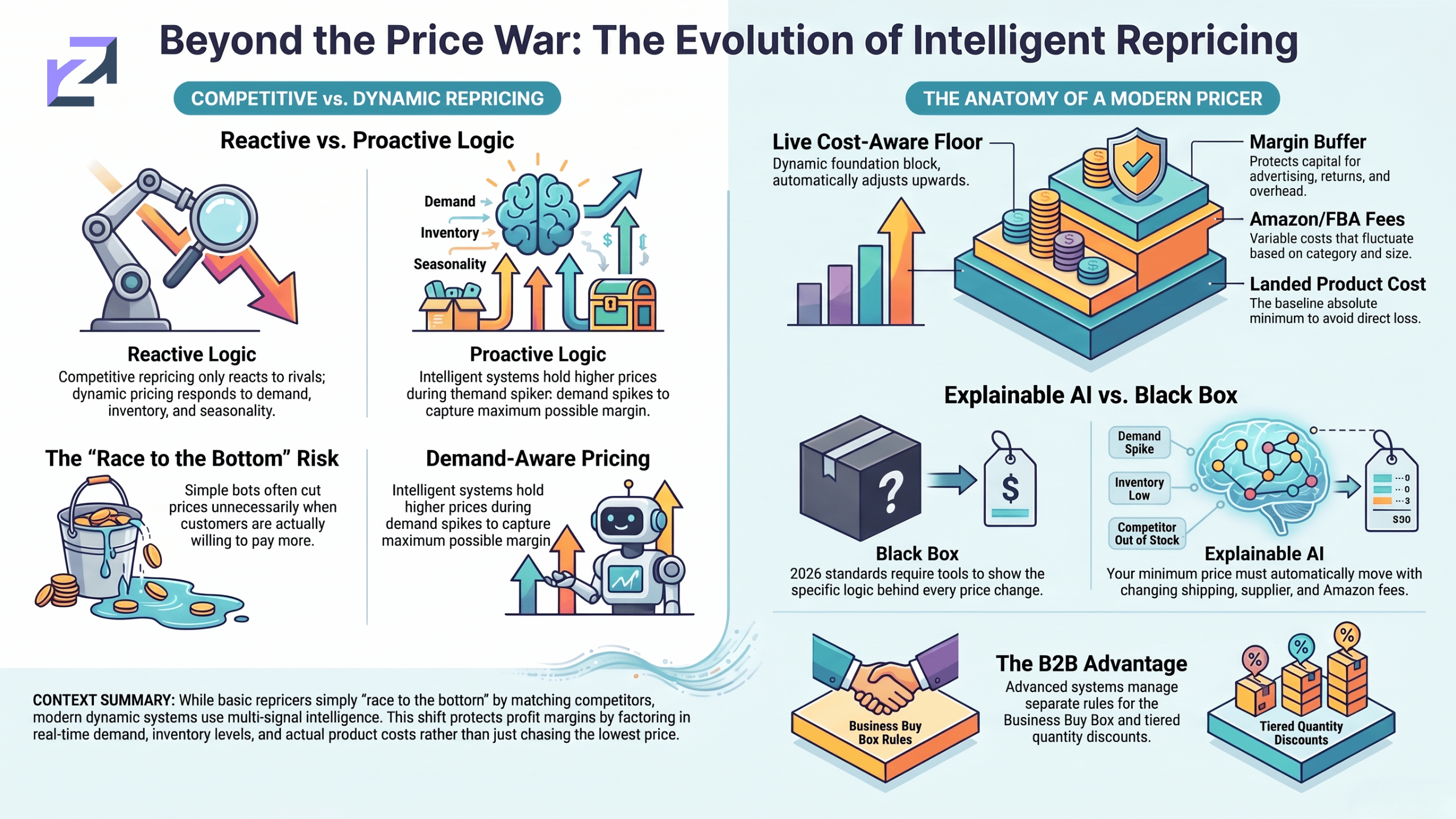
A lot of sellers use “dynamic pricing” and “competitive repricing” as if they’re interchangeable. They’re not, and the distinction matters more than it might seem at first glance. Competitive repricing reacts to what other sellers are doing — if a rival drops their price, your tool drops yours to match or beat it. Dynamic pricing, on the other hand, responds to demand signals: how fast a product is selling, how much inventory you have left, seasonality, and even time of day.
Industry commentary from mid-September 2026 has been pushing back on the habit of treating these as the same thing. The argument is straightforward: if you only ever chase competitor prices without factoring in demand, you can end up racing to the bottom on a product that’s actually selling just fine at a higher price — or missing out on demand spikes where you could safely charge more.
Think of it this way: competitive repricing asks “what is everyone else charging?” Dynamic pricing asks “what should I be charging right now, given everything happening in this market?” The second question is harder to answer, but it’s the one that actually protects your margin over time.
The Core Idea Behind Dynamic Repricing
A more precise definition that’s gained traction recently frames dynamic repricing not as a synonym for “AI pricing,” but as any pricing approach that continuously updates in response to changing market conditions — competitor moves, inventory levels, and demand together. Under that definition, even a well-configured rule-based repricer counts as dynamic, as long as it’s actually adjusting to more than one input.
That’s a useful mental model to keep. You don’t necessarily need a black-box AI to get the benefits of dynamic repricing — you need a system that’s looking at the right combination of signals and updating fast enough to matter. A seller running fifty SKUs with clear demand patterns might do perfectly well with straightforward rules, as long as those rules account for more than just “what’s the lowest price right now.”
Why Confusing the Two Costs You Money
When sellers set up a reprice rule that only tracks the lowest competitor price, they’re vulnerable to two failure modes: getting dragged into unnecessary price wars on items with soft competition, and failing to capture upside when demand is genuinely high. A properly tuned pricing strategy treats competitor price as one input among several, not the only one.
Picture a seasonal product — say, a home organization item that spikes every January. A pure competitive repricer sees three other sellers and matches the lowest one, even during the two weeks when demand is at its annual peak and customers would happily pay more. A demand-aware system recognizes the seasonal spike and holds price higher, capturing margin that a simpler tool would have given away for nothing.
Real-World Examples of the Difference in Action
Consider two sellers with an identical product. Seller A runs a strict competitive rule: always be one cent below the lowest competitor. Seller B runs a dynamic strategy that also checks inventory velocity and Buy Box win rate. When a competitor goes out of stock, Seller A’s tool doesn’t notice — it just keeps matching whatever price is currently lowest among remaining sellers. Seller B’s system recognizes the drop in competitive pressure and lets the price drift upward slightly, capturing extra margin during the window before the competitor restocks.
Over a full year, these small differences compound. It’s rarely one dramatic moment that separates a well-optimized pricing strategy from a mediocre one — it’s dozens of small missed opportunities and unnecessary price cuts adding up quietly in the background.
How a Modern Pricer System Actually Works
Underneath the dashboard, a modern pricer is pulling in several streams of data at once: your current Buy Box status, competitor pricing, your minimum and maximum price boundaries, and — in the better tools — your actual product costs. It then applies a strategy (a set of rules or an algorithm) to decide what your new price should be, and pushes that update to Amazon, often within minutes of a trigger event.
From Rule-Based Logic to AI-Driven Decisions
The earliest repricing tools were purely rule-based: “if competitor price drops below X, match it minus one cent.” That’s still a valid strategy for straightforward catalogs, but the market has been shifting toward richer automation. Recent platform commentary describes 2026-era pricing software as expected to combine competitor data, pricing rules, and AI-driven workflows together, rather than treating automated repricing as just “a tool that changes prices.”
This shift matters because rule-based logic, while predictable, can be brittle. A rule written for normal conditions can behave strangely during a flash sale, a sudden stockout across the category, or a holiday demand surge. AI-assisted systems are generally better at recognizing when conditions have shifted outside the “normal” range the original rules were written for.
Real-Time Signals That Matter
A well-built repricing engine typically watches for:
- Buy Box ownership changes and eligible offer counts
- Competitor price movement, including out-of-stock competitors
- Your defined minimum and maximum price floor and ceiling
- Inventory levels and velocity
- Underlying product cost, fees, and shipping where available
- Seasonal and time-of-day demand patterns
- Account health signals that could affect Buy Box eligibility
The more of these signals a tool can factor in simultaneously, the less likely you are to end up with a price that looks reasonable on paper but is actually working against you — either bleeding margin or losing sales you could have won.
Setting Up Your First Repricing Strategy
For sellers new to automated repricing, the temptation is to set overly aggressive rules right out of the gate — chase the Buy Box at nearly any cost. This usually backfires. A more sustainable approach starts with a conservative minimum price tied to real cost data, a reasonable maximum that still lets you capture demand spikes, and a moderate reaction speed rather than the fastest possible setting. You can always tighten the strategy once you’ve watched it perform for a few weeks.
The Rise of Cost-Aware Repricing
One of the more important shifts in the repricing space over the past several weeks has been a stronger emphasis on cost awareness. It’s easy to set a minimum price once and forget about it — but supplier costs, freight rates, and Amazon fees change constantly. When those change and your reprice floor doesn’t move with them, you can end up selling at a loss without realizing it until you check your margins weeks later.
Why Ignoring Cost Changes Is Risky
Recent commentary from repricing specialists has flagged this exact blind spot: if supplier cost, freight, or Amazon fees shift and the floor price in your repricer stays static, the tool keeps “successfully” winning the Buy Box at a price that’s quietly unprofitable. The fix being pushed across the industry is to tie your pricing floor directly to real, current cost data rather than a number you set once and forgot about.
This is also showing up in newer product launches. One repricing tool’s September update specifically improved how its algorithm calculates cost, aiming to keep price changes better matched to real product cost and reduce the risk of the automation drifting into unprofitable territory. Separately, a newer profit-aware repricer approach folds in COGS, Amazon fees, VAT, and profit targets directly into the pricing decision — instead of leaving sellers to manually recalculate their minimum price every time a cost input changes.
How Zupricer Keeps Your Pricing Floor Accurate
This is precisely the philosophy behind a dependable pricer system: your floor price should never be a “set it and forget it” number. It should move with your actual costs, so that even in a fast reprice war, you’re protected from accidentally selling below break-even. Sellers who build this discipline into their setup tend to sleep a lot better during high-competition periods like Q4.
A Simple Framework for Calculating Your True Floor
A practical floor price should account for landed product cost, Amazon referral and fulfillment fees, storage costs where relevant, and a minimum acceptable margin — not just zero profit, but enough to justify tying up inventory and working capital. Sellers who skip the margin buffer often find themselves technically profitable on paper but effectively working for free once advertising spend and returns are factored in.
| Cost Component | Why It Belongs in Your Floor |
|---|---|
| Landed product cost | The baseline you can never price below without losing money |
| Amazon referral fee | Typically a percentage of sale price, varies by category |
| FBA fulfillment fee | Fixed cost per unit shipped, changes with size and weight tiers |
| Storage and long-term storage fees | Often overlooked, especially for slow-moving inventory |
| Minimum acceptable margin | Buffer for advertising spend, returns, and business overhead |
Explainable AI: The New Standard for Pricing Tools
For years, one of the biggest complaints about automated repricing was the “black box” problem — a price would change, and the seller had no clear idea why. That’s starting to change. Sector coverage this September has repeatedly pointed to explainable AI pricing as the direction the industry is moving, meaning tools that can show a category manager (or a solo seller) the actual reasoning behind a price change, not just the new number.
Moving Beyond the Black Box
The push toward explainability isn’t just a nice-to-have. When you can see why your pricing tool chose a specific price — because a competitor went out of stock, because inventory velocity spiked, because a cost input changed — you can actually trust the system enough to let it run unattended. Without that visibility, most sellers end up babysitting their repricer constantly, which defeats the point of automating in the first place.
Explainability also matters when something goes wrong. If a price drops further than expected and you can trace exactly which rule or signal triggered it, fixing the issue takes minutes. If the logic is opaque, you’re left guessing, disabling the whole system out of caution, or worse, ignoring the problem until it shows up in your monthly profit report.
What Sellers Should Expect From a Pricing Tool in 2026
Alongside explainability, web price tracking and MAP (Minimum Advertised Price) monitoring have increasingly become baseline expectations for multi-channel sellers, rather than optional add-ons. If you’re evaluating a new pricer platform, it’s worth checking whether these capabilities are built in or bolted on as an afterthought.
MAP monitoring in particular has become important for brands and resellers alike. If you’re a brand owner, unauthorized sellers undercutting your minimum advertised price can damage both your margins and your relationships with authorized retail partners. Tools that can flag MAP violations automatically save hours of manual price-checking every week.
Questions Worth Asking Any Pricing Tool Vendor
- Can I see the specific reason behind any individual price change?
- Does the tool track competitor stock status, not just price?
- How quickly does a price change propagate after a trigger event?
- Is MAP monitoring included, or is it a separate paid feature?
- Can I set different strategies for different product categories?
| Approach | How It Decides Price | Best Fit |
|---|---|---|
| Rule-based repricing | Fixed if/then logic against competitor price | Small, simple catalogs with predictable competition |
| Dynamic (AI-assisted) repricing | Combines competitor moves, demand, inventory, and cost | Larger catalogs, seasonal demand, multiple competitors |
| Cost-aware repricing | Anchors the price floor to live cost and fee data | Sellers with fluctuating supplier costs or fee structures |
| Predictive pricing | Forecasts using multiple signals ahead of price changes | High-volume sellers with rich historical sales data |
Predictive Pricing vs Simple Repricing: Which Fits Your Catalog?
Predictive pricing tools take things a step further than standard dynamic repricing by trying to anticipate price movement rather than just reacting to it, weighing competitor price, demand, and inventory together to forecast where price should go next. It sounds like an obvious upgrade — but it isn’t automatically the right choice for every seller.
When Predictive Pricing Makes Sense
Analysis circulating this September makes a fair point: predictive tools need enough historical data to actually predict well. If you’re running a large catalog with a solid sales history, this extra layer of intelligence can genuinely outperform simpler approaches. It shines especially in categories with volatile demand, where reacting a step too late means losing sales you’ll never get back.
Sellers with several years of consistent sales history, high order volume, and products with clear seasonal patterns tend to get the most value from predictive approaches. The forecasting models have more signal to work with, and the payoff from anticipating a demand spike a day or two early can be substantial during peak periods.
When a Straightforward Repricer Is Still the Smarter Choice
On smaller catalogs or in low-data-volume situations, a simpler rule-based repricer can actually be more reliable than an overbuilt predictive system. There’s also a regulatory nuance worth knowing: personalized pricing (adjusting price by customer) is a legally different territory from market-based dynamic pricing (adjusting by market conditions for all customers), and the two shouldn’t be treated as the same thing when you’re choosing a strategy.
New sellers, or sellers launching a brand-new product with no sales history, are usually better served starting with clear, simple rules. There’s simply not enough data yet for a predictive model to learn from, and an overconfident forecast built on thin data can do more harm than a conservative rule-based floor and ceiling.
B2B Repricing: A Different Ballgame
If you sell through Amazon Business, standard consumer-facing repricing rules may not be doing you any favors. Amazon Business has grown into a genuinely large channel — its annualized sales volume has climbed past $60 billion, serving more than 11 million business customers across 11 countries. That’s not a niche side-channel anymore; for many sellers it’s a meaningful revenue stream in its own right.
Why Standard Rules Fall Short for Business Buyers
The problem is that B2C-oriented repricing rules generally aren’t built to handle quantity discounts, tiered business pricing, or the separate Business Buy Box that Amazon Business uses. A reprice strategy tuned only for individual consumer purchases can leave real money on the table — or worse, price you out of bulk orders that would have been genuinely profitable.
Business buyers often purchase in much larger quantities than typical consumers, and they expect pricing that reflects that scale. A seller offering flat, single-unit pricing to a buyer looking to order five hundred units is either missing an opportunity to win that order with a competitive tiered rate, or worse, winning it at a price that erodes margin far more than a standard consumer sale would.
Building a Repricing Marketplace Strategy Across B2B and B2C
Sellers active in both channels increasingly need their repricing setup to distinguish between the two audiences rather than applying one blanket rule everywhere. That might mean separate minimum prices, separate quantity-based tiers, or simply making sure your tool is aware that a Business Buy Box exists and behaves differently from the standard one.
Practical Steps for Managing Both Channels
Start by reviewing whether your current tool even distinguishes between consumer and business offers. Many sellers discover their repricing software has been treating both channels identically for months, quietly leaving quantity-discount revenue unclaimed. From there, set up separate pricing tiers for common bulk order sizes, and monitor Business Buy Box win rate as its own metric rather than lumping it in with standard Buy Box performance.
AI Agents and the Future of the Repricer App
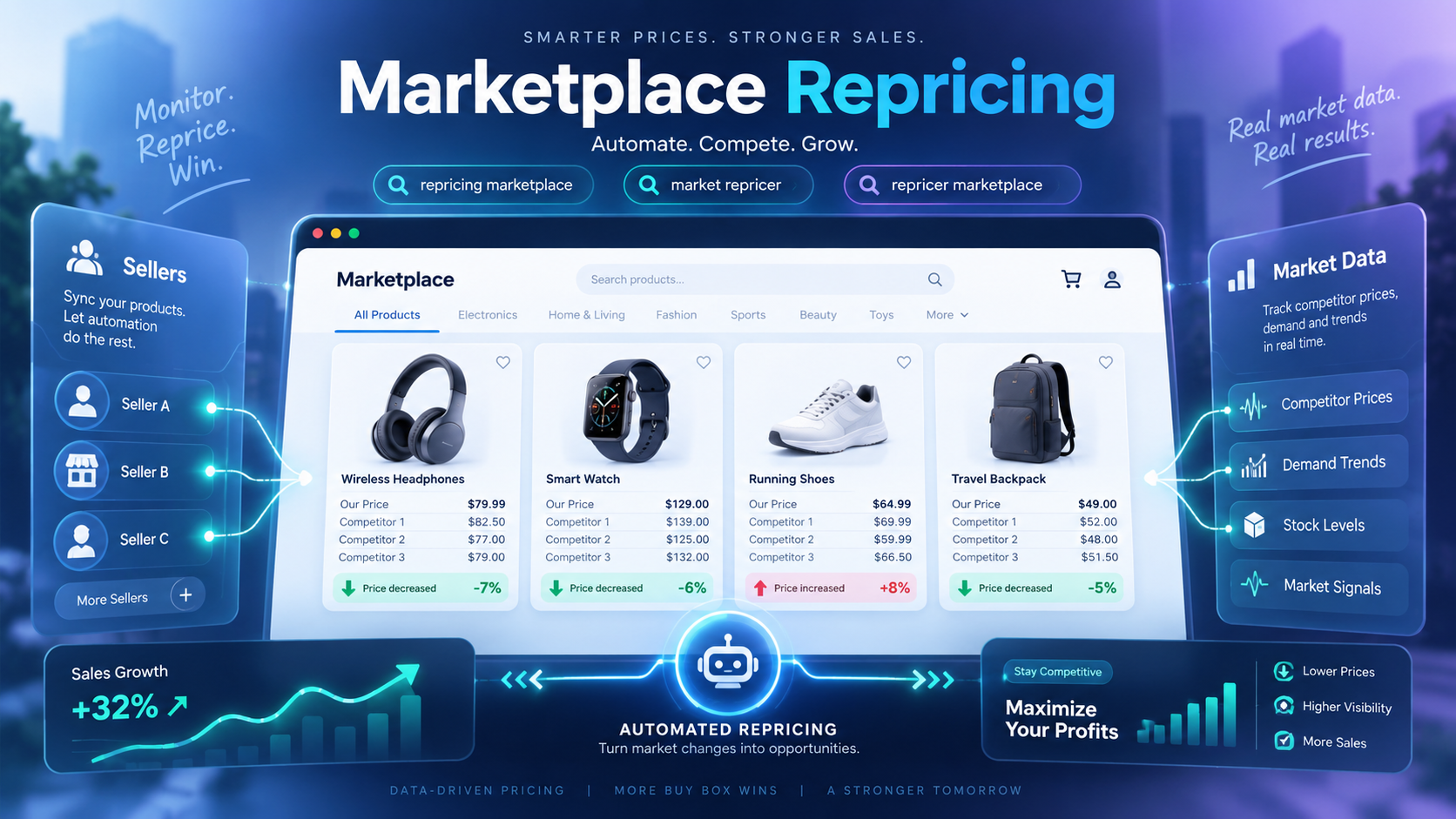
One of the more interesting shifts happening right now is how sellers are starting to interact with their repricing tools in the first place. Instead of logging into a traditional dashboard, some platforms are moving pricing control into AI-agent interfaces — conversational tools where you can ask about SKU costs, toggle a repricer on or off for a specific product, or adjust minimum, maximum, and MAP prices through natural language.
Controlling Your Repricer Through Conversational AI
This isn’t a far-off concept. One seller tool recently expanded its AI-agent integration from 17 tools to 34, giving users the ability to manage repricing decisions directly through an AI interface rather than clicking through settings menus. It’s an early signal of where repricer app design is heading — from static dashboards toward AI-agent-controlled pricing.
What This Means for Everyday Sellers
For most sellers, the practical upside is speed. Instead of digging through nested settings to change a minimum price on one SKU during a busy sales period, you’ll increasingly be able to just ask. It won’t replace strategy — you still need to know what you want your pricing to accomplish — but it will lower the friction of actually implementing it.
Balancing Automation With Oversight
As pricing control shifts toward AI agents, the question of oversight becomes more important, not less. A conversational interface makes it easier to make quick changes, but it also makes it easier to make quick mistakes if you’re not paying attention. The sellers who benefit most from this shift are the ones who still review their pricing strategy regularly, using the AI interface as a faster way to execute decisions rather than a replacement for making them.
Choosing the Right Repricing Marketplace Partner
With so many options available, picking a pricing tool partner comes down to a handful of practical questions rather than chasing the flashiest feature list.
Key Features to Look For
| Feature | Why It Matters |
|---|---|
| Cost-aware floor pricing | Protects your margin as supplier costs and fees change |
| Buy Box + Business Buy Box logic | Handles both consumer and B2B pricing correctly |
| Transparent, explainable rules | Lets you trust and audit every automated price change |
| Flexible min/max controls | Prevents runaway price wars on either end |
| Fast reaction time | Keeps you competitive without manual monitoring |
| MAP monitoring | Protects brand equity and authorized reseller relationships |
Red Flags to Watch For
Not every tool marketed as a full pricer platform actually delivers on cost awareness or explainability. Watch out for tools that only offer a single “match lowest price” strategy with no cost inputs, dashboards that show a new price with no explanation of why it changed, or platforms with no clear way to separate B2B and B2C pricing logic if you sell through both channels.
Where Zupricer Fits In
Zupricer was built around exactly this list. Rather than treating repricing as a single “match the lowest price” switch, it combines cost awareness, Buy Box logic, and clear, understandable rules so you’re never guessing why a price changed. Whether you’re managing a small catalog or juggling B2B and B2C pricing at once, the goal is the same: keep your prices competitive without ever losing sight of your actual margin.
The Market Is Growing Fast — What It Means for You
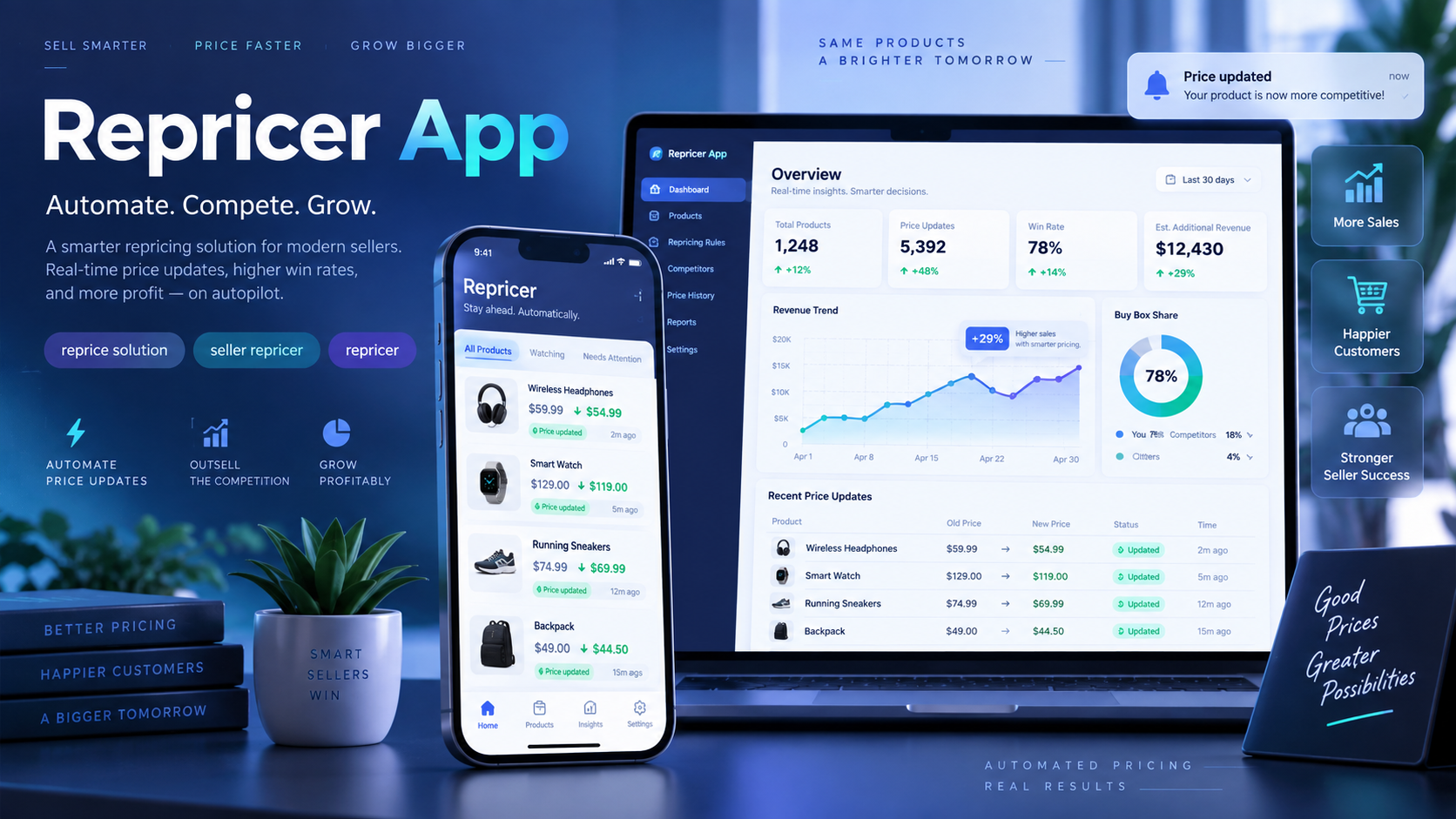
This isn’t a niche corner of e-commerce anymore. AI-driven price optimization, as a market, is projected to grow from roughly $2.61 billion in 2025 to around $5.61 billion by 2030, driven largely by e-commerce expansion, real-time pricing adoption, and growing use of predictive analytics. In practical terms, that means the tools available to sellers are only going to get more capable — and sellers who adopt a solid pricer system now will have a head start over those still adjusting prices by hand.
Staying Ahead as the Category Evolves
The gap between sellers who automate intelligently and sellers who don’t is likely to widen, not narrow, as these tools keep improving. Manual price adjustments, or basic rule-based tools with no cost or demand awareness, will increasingly look like using a spreadsheet in a world that’s moved on to something faster and smarter. The sellers who invest time now in understanding what a good system actually does — rather than just turning on the first repricer they find — will be the ones best positioned as the category matures.
Frequently Asked Questions
Is dynamic repricing the same as competitive repricing?
No. Competitive repricing reacts only to competitor price changes, while dynamic repricing also factors in demand, inventory, and other market signals. Many tools do both at once, but they’re conceptually different approaches.
Do I need AI for effective repricing?
Not necessarily. A well-configured rule-based repricer can work well for smaller, simpler catalogs. AI-driven and predictive approaches tend to add the most value for larger catalogs with rich sales history and more volatile demand.
Why should my pricing floor change over time instead of staying fixed?
Your costs — supplier pricing, freight, and marketplace fees — change regularly. If your floor price doesn’t move with them, your repricer can keep “winning” sales at a price that’s no longer profitable.
Is repricing different for Amazon Business (B2B) sales?
Yes. B2B pricing involves quantity discounts and a separate Business Buy Box, which standard consumer-facing repricing rules usually aren’t built to handle well.
What should I look for in a repricer app in 2026?
Prioritize cost-aware floor pricing, explainable (not black-box) logic, support for both standard and Business Buy Box scenarios, and fast reaction time to competitor and market changes.
How fast should a repricing tool react to competitor price changes?
Reaction speed should be fast enough to stay competitive for Buy Box eligibility, typically within minutes, but not so aggressive that it triggers unnecessary price wars on products with limited competition.
Can predictive pricing work for a brand-new product with no sales history?
Generally not well. Predictive models rely on historical data to forecast accurately, so new products with little or no sales history are usually better served by simpler, rule-based pricing until enough data accumulates.
Ready to Put Your Pricing on Autopilot?
Repricing in 2026 isn’t just about reacting to the lowest competitor price anymore — it’s about combining cost awareness, demand signals, and transparent logic into one system you can actually trust. If you’re ready to move past manual price checks and spreadsheet-based minimums, Zupricer gives you a pricer system built for exactly that: fast, explainable, and anchored to your real margins.
Explore Zupricer’s plans and see which fits your catalog on the pricing tool page, or get started today and let your prices work for you around the clock.