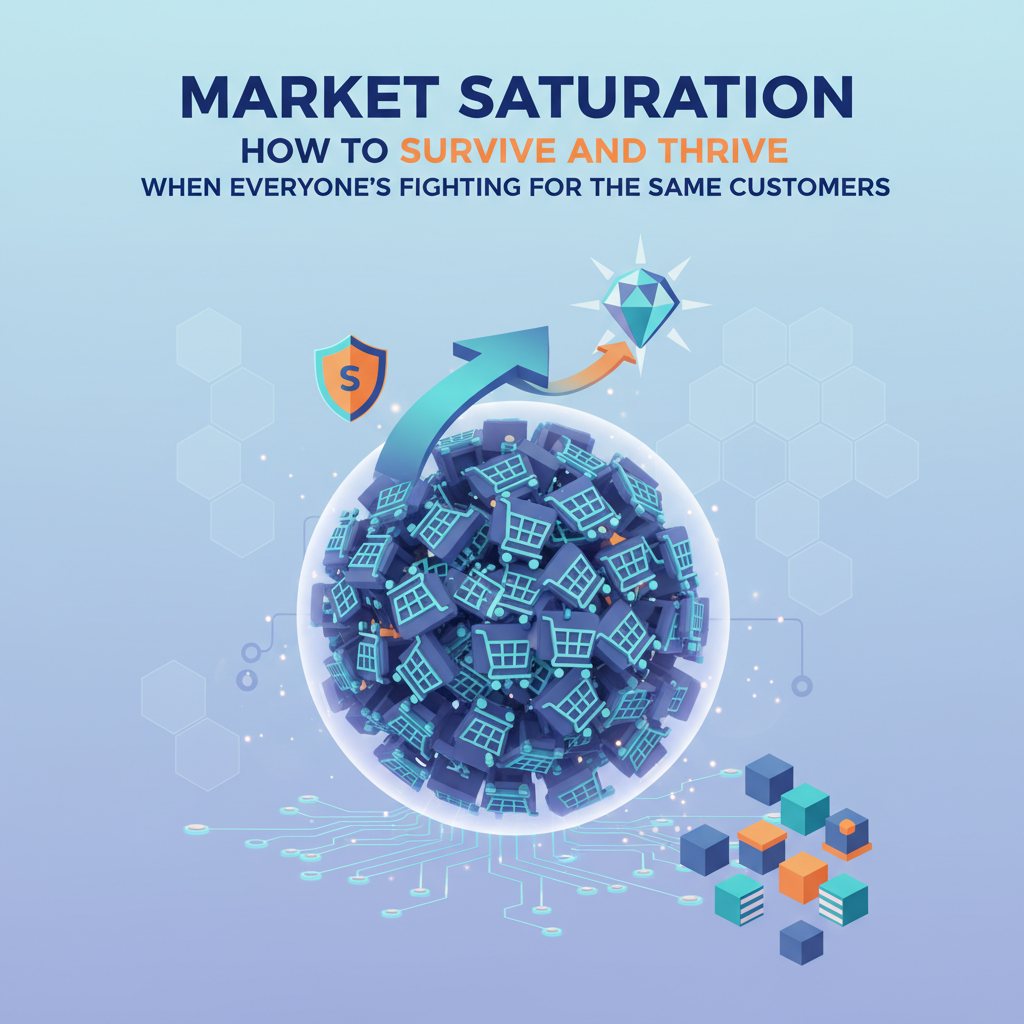
Here’s a reality check that might sting a little: the global e-commerce market has crossed $7 trillion, yet growth has slowed from 7.7% to 6.8%. The gold rush phase is over. What we’re experiencing now is something far more challenging—market saturation at scale.
If you’re an e-commerce seller feeling the squeeze, you’re not imagining things. Customer acquisition costs are climbing. Margins are thinning. And it seems like every time you find a profitable niche, ten competitors pop up overnight offering the same products at lower prices.
But here’s what separates businesses that fade away from those that flourish: saturation doesn’t mean opportunity has disappeared. It means the easy opportunities have. The sellers who adapt their strategies, sharpen their operations, and get smarter about differentiation aren’t just surviving—they’re building stronger businesses than ever before.
Let’s break down exactly how to do that.
Understanding What Market Saturation Really Means in 2025
Market saturation isn’t just about having lots of competitors. It’s a specific market condition where growth slows despite increasing overall scale, price pressure compresses margins, and differentiation becomes genuinely difficult.
In e-commerce specifically, saturation manifests through several distinct challenges:
- AI-assisted shopping features have become expected rather than impressive
- Social platforms now function as full transaction environments, not just discovery channels
- Delivery speed and returns policies directly impact conversion rates
- Sustainability claims increasingly influence both loyalty and cart abandonment
- Mobile commerce dominates every stage of the sales funnel
The companies struggling most are those still operating with 2020 playbooks. They’re treating e-commerce as the growth experiment it used to be, rather than the mature operating system it’s become. Stores are now fulfillment nodes, experience centers, and acquisition touchpoints—not just transaction channels.
Saturation Meaning in Business: A Clear Definition and Real Example
Before diving into strategy, it helps to pin down saturation meaning in business precisely, since the term gets used loosely. In the simplest terms, saturation in market conditions occurs when the total available demand for a category has largely been captured by existing supply, so each additional competitor is fighting over existing customers rather than finding new ones. Growth doesn’t stop entirely — it just shifts from expansion to a zero-sum fight for share.
A concrete market saturation example makes this easier to picture: imagine a product category where five sellers served the entire demand two years ago, and today fifty sellers are chasing that same demand pool, which itself has only grown modestly. That’s saturation market conditions in action — supply outpacing demand growth, margins compressing as a direct result, and differentiation becoming the only real lever left to pull.
This dynamic plays out differently depending on scope. Saturation of domestic markets tends to happen first in mature, high-visibility categories where barriers to entry are low and success is easy to copy — which is exactly why so many e-commerce niches saturate faster than traditional brick-and-mortar categories ever did.
Understanding whether you’re dealing with a fully saturated market, a market that’s in the process of saturating, or one where competitors are actively working to saturate the market through aggressive expansion changes your strategic response considerably. A market that has already saturated the market calls for the differentiation-first strategies covered throughout this guide. A market that’s still in the process of saturating market conditions — where the trend is visible but not yet locked in — gives you a narrower window to establish positioning before the space becomes a genuinely saturated marketplace.
It’s also worth distinguishing organic saturation from deliberate saturation marketing tactics, where a brand intentionally floods a category or channel with aggressive pricing and volume to push out smaller competitors before the space naturally reaches saturation on its own. Recognizing which one you’re up against — organic market saturation versus a competitor actively trying to saturate market share through brute-force tactics — determines whether patience or urgency is the right response.
Strategy #1: Ruthlessly Refine Your Brand Positioning
In saturated markets, positioning is everything. Generic messaging gets ignored. “Quality products at great prices” means nothing when every competitor claims the same thing.
Winning brands in 2025 are taking bold positions:
- They conduct thorough brand audits to identify genuine differentiation opportunities
- They refine messaging to address specific, unmet customer needs
- They position based on value delivered rather than price alone
- They develop brand narratives that create emotional resonance
- They establish clear points of difference that competitors can’t easily copy
The key insight? Companies that differentiate through added value maintain margins and customer loyalty despite intense competition. Those competing purely on price enter a race to the bottom that rarely ends well.
Finding Your Positioning Sweet Spot
Ask yourself: What can you offer that your competitors cannot easily replicate? Maybe it’s specialized expertise, unique sourcing relationships, superior customer service, or a brand story that genuinely connects. Whatever it is, make it central to everything you communicate.
Strategy #2: Make Data Your Competitive Weapon
Gut instinct had its moment. In saturated markets, data-driven decision making separates winners from also-rans.
Successful sellers are building robust analytics capabilities that include:
- Clear KPIs established before launching campaigns, not after
- Real-time tracking of financial metrics, customer satisfaction, and organic traffic
- Sophisticated audience segmentation for targeted marketing
- Rapid campaign performance assessment with quick pivot capabilities
- Competitive intelligence monitoring to spot market shifts early
The advantage is speed. Businesses making data-driven decisions respond to market shifts faster than competitors still relying on monthly reports or intuition. When margins are tight and competition is fierce, that speed translates directly to profitability.
Strategy #3: Obsess Over Customer Experience
When products become commoditized, experience becomes the differentiator. This isn’t soft thinking—it’s strategic reality.
Customer experience in 2025 encompasses far more than friendly service emails. It means:
- Seamless omnichannel experiences that feel consistent across every touchpoint
- Personalized interactions powered by customer data you’ve thoughtfully collected
- Streamlined delivery and returns that exceed rising expectations
- Mobile-optimized experiences from first awareness through post-purchase support
- AI-powered shopping assistance that actually helps rather than frustrates
Consider this: voice-assisted shopping is reaching $82 billion in global sales this year, growing over 20% annually. Convenience isn’t just appreciated—it’s expected. Companies prioritizing experience over pure price competition are building sustainable advantages that commodity sellers simply can’t match.
Strategy #4: Embrace AI and Automation Strategically
Here’s a stat that should grab your attention: companies using new technologies are 58% more likely to be market leaders. That’s not a slight edge—it’s a dramatic advantage.
But the key word is “strategically.” Successful businesses aren’t adopting AI because it’s trendy. They’re focusing on high-impact applications:
- AI-powered customer support that handles routine inquiries efficiently
- Automated inventory management and demand forecasting
- Dynamic pricing systems that respond to market conditions in real-time
- Personalization engines that improve product recommendations
- Process automation that reduces operational costs without sacrificing quality
The shift from AI experimentation to operational integration has become a defining characteristic of successful businesses. Those still treating automation as a future consideration are already falling behind.
Strategy #5: Innovate Your Operations, Not Just Your Products
Product innovation gets all the attention, but operational innovation often delivers bigger competitive advantages in saturated markets.
Companies investing in process improvement are 30% more likely to retain customers in mature markets. Why? Because operational excellence translates to better pricing power, faster fulfillment, fewer errors, and improved margins.
Focus areas that deliver results:
- Supply chain optimization that reduces costs and improves reliability
- Inventory management systems that minimize both stockouts and carrying costs
- Fulfillment capabilities that meet customer expectations for speed
- Internal process streamlining that eliminates waste and redundancy
The goal is creating cost advantages that you can either pass to customers as competitive pricing or retain as improved margins—ideally a strategic mix of both.
Strategy #6: Build Multi-Channel Resilience
Dependency on a single platform is a vulnerability, not a strategy. Resilient businesses in 2025 are diversifying across multiple dimensions:
- Multiple revenue streams and sales channels to reduce platform dependency
- Geographic expansion into markets with growth potential
- Product line expansion within core competencies
- Agile operations that can pivot quickly when conditions change
- Adaptable supply chains with multiple sourcing options
Social commerce has become particularly important, with platforms strengthening their role as full transaction environments. Brands are leveraging live streams, influencer partnerships, and in-app catalogs to turn social followers into customers—creating revenue streams that don’t depend entirely on marketplace algorithms.
The Pricing Challenge That Ties Everything Together
Every strategy we’ve discussed connects back to one critical capability: pricing intelligence. In saturated markets with razor-thin margins, your ability to price competitively while protecting profitability determines whether you survive or thrive.
Manual pricing approaches simply can’t keep pace with market dynamics in 2025. Competitors adjust prices constantly. Market conditions shift hourly. Customer expectations for competitive pricing have never been higher.
This is precisely where Zupricer transforms how Amazon sellers compete. Instead of reacting to price changes after you’ve already lost the Buy Box, Zupricer’s intelligent repricing engine monitors your competitive environment continuously and adjusts your pricing in real-time based on the strategic rules you define.
You’ve invested in brand positioning, customer experience, and operational excellence. Zupricer ensures your pricing strategy executes flawlessly around the clock—protecting your margins while keeping you competitive when it matters most. In saturated markets where every percentage point of margin counts, that’s not just helpful. It’s essential.
Ready to stop leaving money on the table? Let Zupricer handle the pricing complexity while you focus on building the differentiated business that thrives regardless of how crowded your market becomes.
Customer Retention: The Most Underrated Weapon Against Market Saturation
While most sellers obsess over acquiring new customers in a saturated market, the smartest operators have shifted their focus to retention—and the economics explain why. Acquiring a new customer costs 5 to 7 times more than retaining an existing one, and a 5% increase in retention lifts profit by 25% to 95%. In markets where customer acquisition costs have surged 40% since 2023, retention isn’t just smart—it’s survival.
The average e-commerce customer acquisition costs now sits between $68 and $84, with some channels pushing well above $100. Google Ads cost per lead reached $70.11 in 2025, up 5.13% year-over-year, while Meta’s CPM jumped 20% to $13.48. When every new customer costs this much to acquire, losing them after a single purchase destroys profitability.
Retention Benchmarks That Separate Winners From Losers
Understanding where you stand requires knowing the benchmarks. A repeat purchase rate of 20-30% is healthy for most verticals, while anything below 15% signals serious retention problems. Your LTV:CAC ratio should hit at least 3:1 for sustainability, with top performers achieving 4:1 to 6:1. For direct-to-consumer brands, CAC payback periods should fall within 90-120 days—any longer and you’re burning cash faster than you’re building equity.
The subscription model has emerged as one of the most effective responses to e-commerce market saturation. Subscription e-commerce is projected to surpass $450 billion in 2026, up from just $15 billion in 2019. The reason is simple: subscribers generate 4.4x more profit than one-time buyers in many categories. By shifting from acquisition-dependent economics to retention-driven models, subscription brands reduce their vulnerability to rising acquisition costs while building predictable revenue streams.
Geographic Expansion: Finding Growth Beyond Saturated Domestic Markets
When saturation of domestic markets squeezes margins at home, smart sellers look abroad. But not all international markets are created equal—customer acquisition costs vary dramatically by region, creating arbitrage opportunities for those willing to adapt their operations.
Australia’s CAC runs 20-35% higher than the United States, making it a challenging expansion target despite cultural similarities. Southeast Asia, by contrast, offers CAC that’s 40-60% lower than US markets, with India growing at 21% CAGR and representing one of the fastest-expanding e-commerce markets globally. Latin America is growing at 12.2% annually, with Brazil’s Pix payment system and region-specific logistics solutions opening doors that were closed just years ago.
The key to successful geographic expansion isn’t just translating your website—it’s adapting your entire operation to local market conditions. Voice commerce adoption varies wildly by region, with some markets embracing AI-assisted shopping while others remain skeptical. Payment preferences, delivery expectations, and even brand positioning strategies that work domestically often require substantial modification for international success.
Real Brands That Beat Saturation: Case Studies Worth Studying
Theory is helpful, but examples are better. Duradry, an antiperspirant brand operating in a commoditized category, reduced CAC by 29% through creator and affiliate programs that turned customers into advocates. Instead of competing purely on price in a saturated marketplace, they built a community that did their marketing for them.
BMC Software achieved a 49.5% conversion rate through sophisticated database segmentation, proving that even in mature B2B markets, targeting precision beats broad-reach campaigns. An ADHD coaching platform cut CAC by 4x using Reddit automation to reach highly specific audiences where they naturally congregate, demonstrating that saturation marketing tactics fail when niche targeting succeeds.
What these examples share is a refusal to accept commodity status. Each found a dimension of competition—community building, segmentation precision, channel specialization—where they could establish advantage despite operating in mature, competitive markets. The lesson isn’t to copy their specific tactics, but to identify which dimension of competition in your market remains underexploited and own it completely.