Disclosure: this guide is published by Zupricer, which makes Amazon repricing software. Fees are for Amazon.com (US), taken from Amazon’s pricing pages and fee announcements, and checked on November 17, 2026. FBA rate-card rows come from Amazon’s 2026 rate card as reported by multiple sources — always confirm your exact fee in Amazon’s Revenue Calculator or your Fee Preview report.
Quick answer: Selling on Amazon costs a plan fee ($39.99/month Professional or $0.99 per item Individual), a referral fee on every sale (15% in most categories, $0.30 minimum) and — if you use FBA — a per-unit fulfillment fee (about $3.96–$5.04 for a typical 1 lb item priced $10–$50 in 2026) plus a 3.5% fuel and logistics surcharge, storage and inbound placement fees. For a typical $25 item, Amazon’s fees come to roughly 35–42% of the price before advertising.
Key takeaways
- Referral fees are a percentage of the total price (including shipping you charge); FBA fees are fixed per unit — so fees take a much bigger share of cheap items.
- Since 2026, FBA fees depend on price band (under $10, $10–$50, over $50) as well as size and weight.
- Q4 is expensive: peak fulfillment fees and storage at about three times the January–September rate.
- Amazon has already announced 2027 changes starting January 15 and February 1, 2027.
Amazon seller fees at a glance (US, 2026)
| Fee | Who pays | How much (2026) |
|---|---|---|
| Selling plan | Everyone | Professional $39.99/month or Individual $0.99 per item sold |
| Referral fee | Everyone | % of total price by category (15% in most), $0.30 minimum in most categories |
| Closing fee | Media sellers | $1.80 per book, music, video, DVD or software item |
| FBA fulfillment fee | FBA | Per unit by size, weight and price band (e.g. $5.04 for a 1–1.25 lb large standard item at $10–$50) |
| Fuel & logistics surcharge | FBA | 3.5% of the fulfillment fee (since April 2026) |
| Monthly storage | FBA | $0.78/cu ft Jan–Sep, $2.40/cu ft Oct–Dec (standard size), plus utilization surcharge if stock is high |
| Aged inventory surcharge | FBA | From $0.50/cu ft after 181 days up to $7.90/cu ft after 456 days |
| Inbound placement | FBA | $0 with Amazon-optimized splits; about $0.14–$0.60 per unit with minimal splits |
| Low-inventory-level fee | FBA | Per unit when stock covers less than 28 days (e.g. $0.32–$0.97 for standard size) |
| Returns processing | FBA | Apparel and shoes on every return; other categories only above a return-rate threshold |
| Refund administration | Everyone | Lesser of $5.00 or 20% of the referral fee on refunded orders |
| Advertising | Optional | Pay per click, no fixed fee |
Plan and referral fees are from Amazon’s pricing page; 2026 FBA changes from Amazon’s 2026 fee announcement.
Free Amazon fee and profit calculator
Enter your price and costs to see what Amazon keeps and what you keep. The defaults reproduce the $25 worked example below.
Amazon fee & profit calculator
See what Amazon keeps and what you keep at a given price. Figures are estimates — confirm your FBA fee in Amazon's Revenue Calculator or Fee Preview report.
Show the formula
Net profit = price − referral fee − FBA fee − storage − ads − returns allowance − landed cost − other
Referral fee = max(price × referral %, $0.30) · Break-even price = (landed cost + FBA fee + storage + ads + other) ÷ (1 − referral % − returns %). "Amazon fees" here means referral + FBA + storage (not ads). Sales tax is collected separately in the US.
Referral fees: the percentage on every sale
Amazon charges a referral fee on the total sales price — including any shipping or gift-wrap charges the buyer pays — or the category minimum, whichever is greater. That matters for FBM sellers who charge shipping separately: the fee applies to that too.
| Category | Referral fee |
|---|---|
| Most categories (Home & Kitchen, Toys, Sports, Tools, Office, Pet, Everything Else) | 15% |
| Clothing & Accessories | 5% up to $15 · 10% $15–$20 · 17% above $20 |
| Beauty, Health & Personal Care, Baby | 8% up to $10 · 15% above $10 |
| Grocery | 8% up to $15 · 15% above $15 |
| Consumer Electronics, Computers | 8% |
| Electronics Accessories | 15% up to $100 · 8% on the portion above $100 |
| Furniture | 15% up to $200 · 10% on the portion above $200 |
| Jewelry | 20% up to $250 · 5% on the portion above $250 |
| Automotive, Industrial | 12% |
Amazon didn’t change referral percentages for 2026. Watch the tier edges: in Clothing, the rate depends on the price band and applies to the whole price, so a $20.01 item pays 17% on everything, while a $19.99 item pays 10%. New brands may qualify for referral fee credits in their first year (Amazon).
FBA fees in 2026: size, weight — and now price
Since January 15, 2026, FBA fulfillment fees are set by size tier, shipping weight and price band. Amazon said fees rose by an average of $0.08 per unit. Examples for non-apparel, non-dangerous items outside the holiday peak:
| Size tier / weight | Under $10 | $10–$50 | Over $50 |
|---|---|---|---|
| Small standard, 2 oz or less | $2.43 | $3.32 | $3.58 |
| Small standard, 14–16 oz | $2.95 | $3.96 | $4.22 |
| Large standard, 4 oz or less | $2.91 | $3.73 | $3.99 |
| Large standard, 12–16 oz | $3.78 | $4.60 | $4.86 |
| Large standard, 1–1.25 lb | $4.22 | $5.04 | $5.30 |
| Large standard, 2.75–3 lb | $5.85 | $6.67 | $6.93 |
Before the 3.5% fuel and logistics surcharge. Apparel, dangerous goods and bulky items have separate rates. Confirm with Amazon’s Revenue Calculator.
- Price-band cliffs: moving a $10.00 item to $9.99 lowers the FBA fee; moving $50.00 to $50.01 raises it. A repricer should know these edges rather than crossing them by a cent.
- Fuel and logistics surcharge: 3.5% of the fulfillment fee (not of the price) for FBA in the US since April 17, 2026. Amazon has said it continues into 2027.
- Holiday peak (October 15, 2026 – January 14, 2027): fulfillment fees are about $0.32 per unit higher on average — the surcharge applies on top.
Storage, inbound and inventory fees
- Monthly storage: $0.78 per cubic foot January–September and $2.40 October–December for standard-size items. Sellers holding many weeks of supply also pay a storage utilization surcharge (up to $2.66/cu ft off-peak); new sellers and small accounts are exempt.
- Aged inventory surcharge: starts at $0.50/cu ft after 181 days and climbs to $6.90 (366–455 days) and $7.90 (456+ days, new for 2026).
- Inbound placement: free if you let Amazon split shipments across fulfillment centers; minimal-split shipping costs extra per unit.
- Low-inventory-level fee: charged per unit when your stock covers less than 28 days of sales — so you’re squeezed between too little stock (low-inventory fee) and too much (utilization and aged surcharges). See our inventory management guide.
- Returns, removal and disposal: apparel and shoes pay returns processing on every return; other categories only when their return rate exceeds a category threshold.
Worked example: what a $25 item really earns
A $25 Home & Kitchen item, about 1 lb, large standard size (10 × 8 × 4 in), FBA. Assumptions: product cost $7.00, freight to Amazon $0.60, about two months in stock, minimal-split inbound, advertising at 10% of price, no returns.
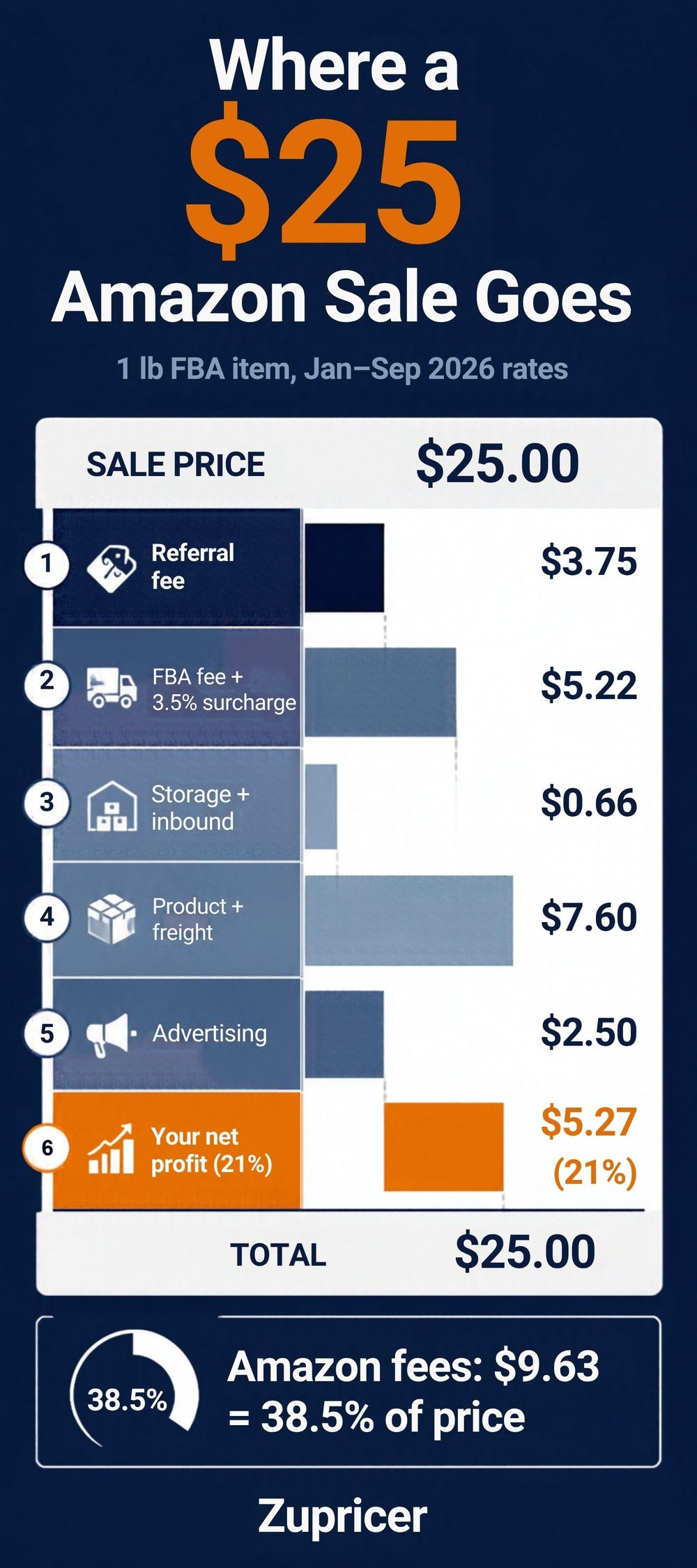
| Line | Jan–Sep 2026 | Holiday peak (Oct–Dec) |
|---|---|---|
| Referral fee (15%) | $3.75 | $3.75 |
| FBA fulfillment fee | $5.04 | $5.34 |
| Fuel & logistics surcharge (3.5%) | $0.18 | $0.19 |
| Inbound placement (minimal split, estimate) | $0.37 | $0.37 |
| Storage (0.185 cu ft × 2 months) | $0.29 | $0.89 |
| Amazon fees total | $9.63 (38.5%) | $10.54 (42.2%) |
| Product + freight | $7.60 | $7.60 |
| Advertising (10%) | $2.50 | $2.50 |
| Net profit per unit | $5.27 (21.1%) | $4.36 (17.4%) |
If the same item fitted small standard size (14–16 oz, very thin packaging), fees would drop to about $8.21 and profit would rise to about $6.69 — packaging can be worth more than a price change.
Why fees hit cheap items hardest
The referral fee scales with price, but the FBA fee doesn’t. On a $10 item, a $4–5 fulfillment fee alone is close to half the price; on a $50 item it’s around a tenth. That’s why low-priced products need either very low costs, bundling or FBM.
From fees to your minimum price
Because the referral fee is a percentage and the other fees are fixed, your floor price has to be solved, not just added up:
Minimum price = (landed cost + FBA fee × 1.035 + storage + inbound + target profit) ÷ (1 − referral % − ad %)
In the example above, break-even is about $17.97 with 10% advertising, or $15.86 without. For a 15% margin, the floor is about $22.47. (The calculator above treats advertising as a fixed amount per unit, so its break-even price comes out slightly higher.) Calculate yours with our minimum price calculator and set it in your repricer — see how to set min and max price rules. Floors that ignore fees are the fastest way to end up in an Amazon price war you can’t win.
FBA vs FBM: how fees differ
FBM sellers skip FBA, storage and inbound fees but pay their own shipping, packaging and returns — and the referral fee still applies to shipping charged to the buyer. Compare both in our FBA vs FBM guide.
2026 and 2027 fee timeline
| Date | Change |
|---|---|
| January 15, 2026 | FBA fees by price band (+$0.08/unit average); new 456+ day aged inventory tier; low-inventory fee measured per FNSKU |
| April 17, 2026 | 3.5% fuel and logistics surcharge on FBA fulfillment fees (US and Canada) |
| October 15, 2026 – January 14, 2027 | Holiday peak fulfillment fees (about +$0.32/unit average) |
| January 15, 2027 | FBA fees rise by an average of $0.19 per unit (about 0.8% of average selling price); surcharge unchanged |
| February 1, 2027 | Storage utilization surcharge removed; aged inventory merged into an age-based storage rate; low-inventory fee measured on recent and upcoming shipments |
Source for 2027: Amazon’s 2027 US fee announcement (November 2026). Detailed 2027 rate cards are published in Seller Central.
How much of your revenue goes to Amazon?
It depends heavily on price and category. Marketplace Pulse estimated that a typical private-label seller paid 50–60% of sales to Amazon in 2023 once advertising is included (Marketplace Pulse). In Jungle Scout’s 2025 seller survey, shipping costs, product costs and advertising costs were among sellers’ top challenges (Jungle Scout). Be wary of a single “average Amazon margin”: your own Fee Preview report and calculator above are more reliable.
8 ways to lower your Amazon fees
- Right-size packaging to drop a size tier or weight band.
- Price with the bands in mind — avoid crossing $10 or $50 by a few cents.
- Use Amazon-optimized inbound splits where possible to avoid placement fees.
- Keep more than 4 weeks of stock but well under 22 weeks: enough to avoid low-inventory fees, not so much you pay utilization or aged surcharges.
- Clear slow stock before Q4 storage rates and before day 181.
- Audit fees: check Fee Preview for wrong dimensions or weights and claim reimbursements for lost or damaged inventory.
- Consider FBM for oversized, slow-moving or very low-priced items.
- Use new-seller credits and exemptions Amazon offers in your first year.
More tactics in how to reduce Amazon fees.
Keep fees inside your repricing rules
Fees change by season, price band and year, so a floor you set in January can be wrong by October. Zupricer lets you set cost-based floors per SKU with bulk cost import, minimum-margin protection and min/max limits, so automated price changes never go below what your fees allow. Every feature is included on every plan from $79/month — see our guide to the best Amazon repricers and repricing rule recipes.
Frequently asked questions
How much does it cost to sell on Amazon?
A Professional plan is $39.99 per month (or $0.99 per item on the Individual plan), plus a referral fee on each sale (usually 15%) and, with FBA, per-unit fulfillment, storage and inbound fees. For a typical $25 FBA item, fees are roughly 35–42% of the price before advertising.
What is Amazon’s referral fee?
A percentage of the total sales price, including shipping and gift wrap, set by category — 15% in most categories, with lower or tiered rates in some and a $0.30 minimum in most.
How much are FBA fees in 2026?
They depend on size, weight and price band. For example, a 1–1.25 lb large standard item priced $10–$50 costs $5.04 to fulfill outside the holiday peak, plus the 3.5% surcharge.
What is the 3.5% Amazon fuel surcharge?
A fuel and logistics surcharge Amazon added in April 2026: 3.5% of the FBA fulfillment fee (not the sale price) for US and Canadian FBA orders. Amazon has said it continues into 2027.
Why are Amazon fees higher in Q4?
Holiday peak fulfillment fees apply from mid-October to mid-January, and monthly storage costs about three times more October–December.
Are Amazon fees changing in 2027?
Yes. FBA fees rise by an average of $0.19 per unit from January 15, 2027, and storage and low-inventory rules change from February 1, 2027.
Does Amazon charge a fee on shipping?
Yes — the referral fee applies to the total price the buyer pays, including shipping you charge as an FBM seller.
Is the Individual or Professional plan cheaper?
Individual costs $0.99 per item sold, so it’s cheaper below about 40 sales a month. Professional ($39.99/month) adds tools most growing sellers need, such as advertising, bulk listing and reports, and Amazon’s Automate Pricing.
How do I check my exact Amazon fees?
Use Amazon’s Revenue Calculator before listing and the Fee Preview report in Seller Central for existing products.
What is a good profit margin on Amazon?
It varies by category and model, but many sellers aim for at least 15–20% net after all fees and advertising. Use the calculator above with your real costs.
Turn your fee math into profitable prices
Start a 14-day free trial of Zupricer, import your costs and let every price change respect your fee-inclusive floor.