Disclosure: this guide is published by Zupricer, which makes Amazon repricing software. Facts come from Amazon’s seller resources, Seller Forums announcements and developer documentation, plus reputable trade press where Amazon’s pages require a login — checked on November 16, 2026. Secondary-source items are labelled.
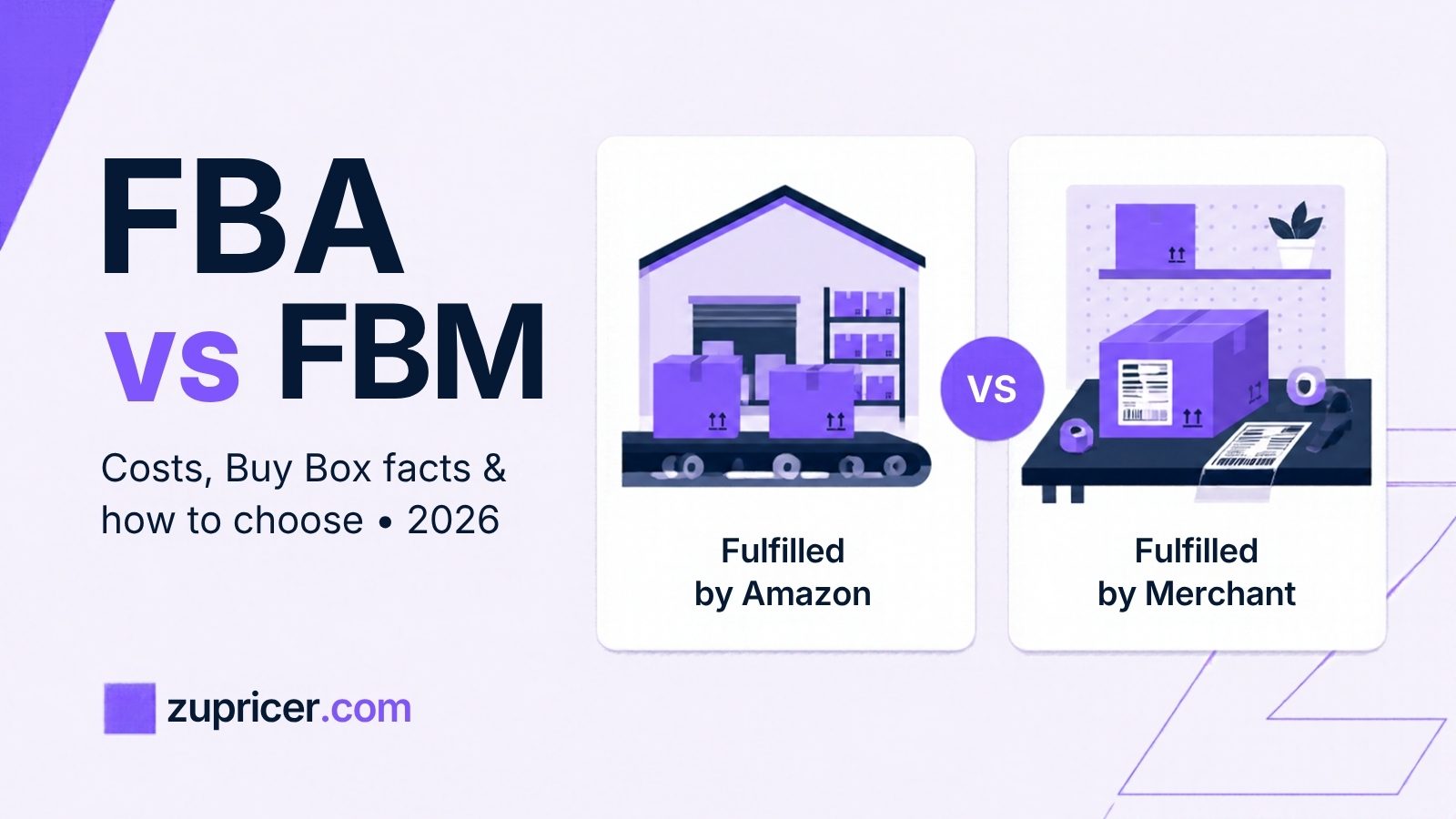
Quick answer: FBA (Fulfillment by Amazon) means Amazon stores, ships and handles returns for you; FBM (Fulfilled by Merchant) means you do. FBA usually suits small, fast-selling products and sellers who want hands-off logistics; FBM often suits bulky, slow-moving or high-margin items and sellers with their own fast shipping. FBA does not automatically win the Buy Box — Amazon says a seller-fulfilled offer can be just as effective when delivery is fast and reliable. Most growing sellers end up using both.
Key takeaways
- Amazon weighs total price, delivery speed and reliability, order experience and stock — not the fulfillment label itself.
- 2026 changed the math on both sides: higher FBA fees and a fuel surcharge, the end of Amazon prep services in the US, and prepaid return labels for FBM.
- Decide per SKU, not per account — size, velocity, return rate and margin point to the right method.
- Reprice against total landed price and delivery promise, with separate floors for FBA and FBM costs.
FBA vs FBM at a glance
| FBA | FBM | |
|---|---|---|
| Who ships | Amazon, from its fulfillment centers | You or your 3PL |
| Main costs | Fulfillment fee (by size and price band), storage, inbound placement, your own prep and labels | Labor, packaging, shipping labels, return labels, your own storage |
| Prime badge | Yes, automatically | Only through Seller Fulfilled Prime |
| Customer service & returns | Handled by Amazon | Handled by you (prepaid return labels required in the US — see below) |
| Control | Less control over stock location and packaging | Full control over inventory and packing |
| Best for | Small/standard, fast-moving items | Bulky, slow, high-value or customizable items |
FBA vs FBM and the Buy Box: what Amazon actually says
Most guides claim “FBA always wins the Buy Box” — often with precise-sounding percentages and algorithm weights. Amazon has never published such weights. In April 2026 Amazon stated that the Featured Offer depends on a competitive total price including shipping, fast and free delivery with high-certainty dates, a good order experience and being in stock — and that fulfilling orders yourself can be just as effective at increasing your chances (Amazon). An Amazon staff post on the Seller Forums after the July 2026 eligibility change added that fulfillment method and the Prime badge on their own are not selection factors.
Why FBA often wins anyway: FBA offers come with fast, high-certainty delivery promises by default. An FBM offer that matches them — short handling time, fast free shipping, accurate delivery dates — competes on equal terms. An FBM offer with slow handling usually doesn’t, whatever its price.
Full details on how the Featured Offer is chosen are in our Amazon Buy Box guide.
What changed in 2026 for FBA and FBM
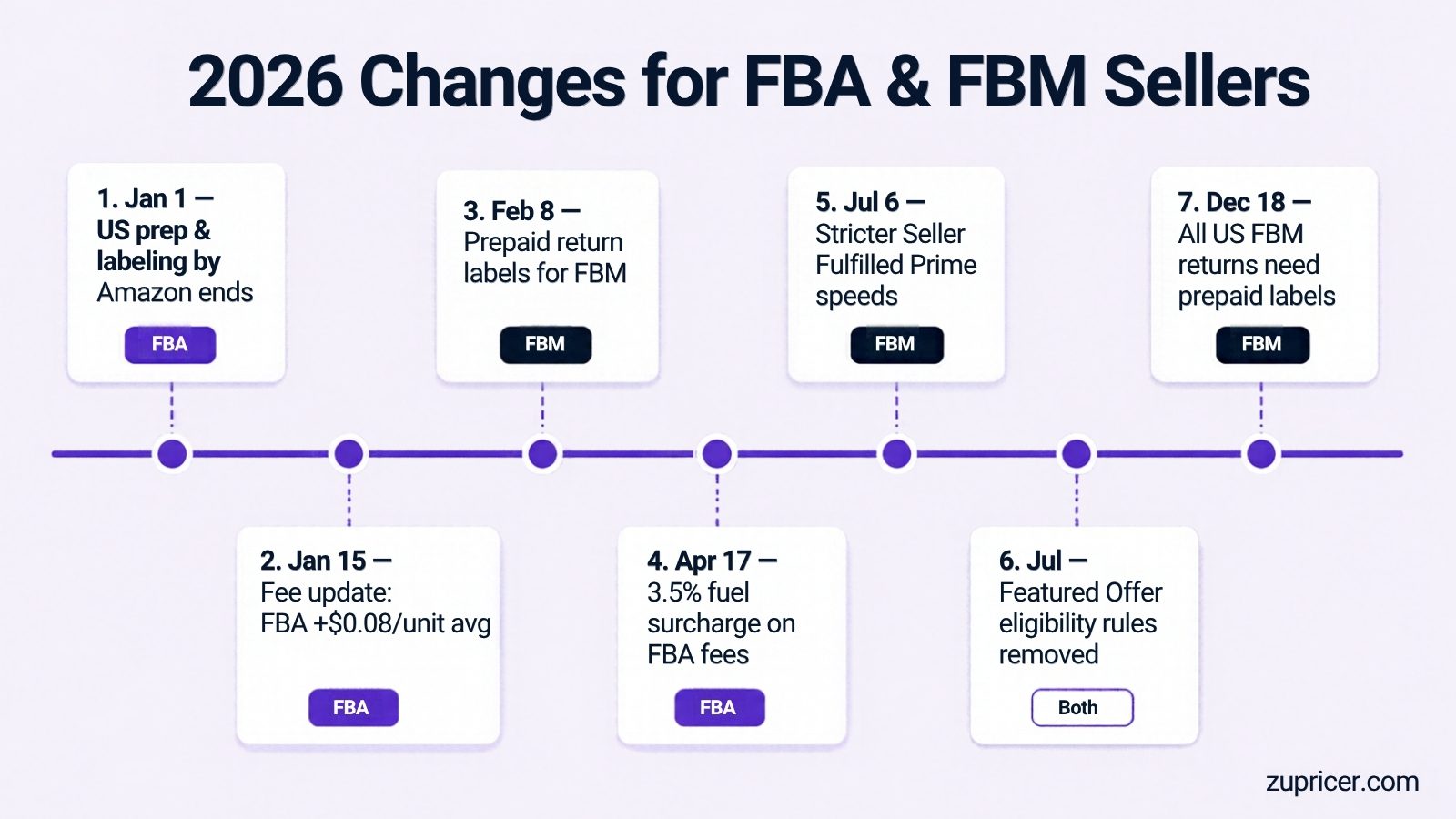
| Date | Change | Affects | Source |
|---|---|---|---|
| Jan 1, 2026 | Amazon ends prep and labeling services at US fulfillment centers — sellers must prep and label FBA inventory themselves | FBA | Amazon SP-API changelog |
| Jan 15, 2026 | Annual fee update: FBA fees up about $0.08 per unit on average, with price-band adjustments; no new FBA fee types; MCF up about $0.30 | FBA, MCF | Amazon announcement |
| Feb 8, 2026 | US seller-fulfilled returns move to Amazon prepaid return labels (reported) | FBM | Trade press |
| Apr 17, 2026 | Temporary 3.5% fuel and logistics surcharge on FBA fulfillment fees (US/CA); from May 2 for MCF and Buy with Prime. Amazon estimated about $0.17 per unit on average. | FBA, MCF | Amazon announcement |
| Jul 6, 2026 | Stricter Seller Fulfilled Prime delivery-speed expectations (reported) | FBM (SFP) | Trade press |
| Jul 2026 | Amazon begins removing seller eligibility requirements for the Featured Offer | Both | Our Buy Box guide |
| Dec 18, 2026 | All US seller-fulfilled returns require prepaid labels; sellers that don’t provide one in time may see returnless refunds (reported; heavy/bulky temporarily exempt) | FBM | Trade press |
Last reviewed: November 16, 2026. “Reported” items come from trade press summaries of Amazon emails or Seller Central pages; confirm in Seller Central.
What FBA really costs
- Fulfillment fee per unit, by size tier and (since 2026) price band — plus the 3.5% surcharge while it applies.
- Monthly storage by cubic foot, higher from October to December.
- Aged inventory surcharge on stock that sits too long.
- Inbound placement service fee, depending on how many fulfillment centers you ship to.
- Low-inventory-level fee when stock runs too low relative to sales (with exemptions such as new sellers).
- Returns processing on products with high return rates.
- Your own prep and labeling — no longer done by Amazon in the US.
Get exact figures for each product from Amazon’s Revenue Calculator and the Fee Preview report in Seller Central.
What FBM really costs
- Pick, pack and labor (or 3PL fees).
- Packaging.
- Outbound shipping labels — buying through Amazon’s Buy Shipping can protect your metrics and give access to negotiated rates; retail label prices vary by carrier, zone and season.
- Return labels and restocking — now a firmer cost with prepaid return labels.
- Your own storage and overhead.
- The cost of speed — weekend shipping or faster services if you aim for Seller Fulfilled Prime or want to match FBA delivery promises.
Cost comparison worksheet
Use real numbers for your product — not industry averages:
| Per unit | FBA | FBM |
|---|---|---|
| Fulfillment / shipping | Fulfillment fee × 1.035 (surcharge) | Label cost (your Buy Shipping quote) |
| Storage | Cubic feet × monthly rate × months held | Your warehouse cost per unit |
| Inbound / handling | Inbound freight + placement fee + your prep | Pick, pack, packaging |
| Returns | Return rate × returns processing | Return rate × (return label + restock) |
| Risk | Low-inventory and aged-inventory fees | Account-health risk from late shipments |
Add the total to your landed cost and plug it into our Amazon minimum price calculator to compare the floor price each method needs.
FBA or FBM? A per-SKU decision framework
| If your product is… | Lean towards | Why |
|---|---|---|
| Small/standard size, sells steadily every week | FBA | Fast delivery promise by default; fees spread across high volume |
| Bulky, heavy or oversized | FBM or SFP | Storage and fulfillment fees grow quickly with size |
| Slow-moving (months of stock on hand) | FBM | Avoids storage and aged-inventory fees |
| High return rate | Compare carefully | FBA returns-processing fees vs. FBM prepaid labels and handling |
| Customizable, fragile or bundled to order | FBM | Needs your own packing and quality control |
| Strong seller with fast own shipping | FBM / SFP | Can match FBA delivery promises at lower cost |
| Fast seller that sometimes stocks out | Hybrid | FBA primary offer with an FBM backup |
FBA vs FBM for beginners
FBA is usually simpler to start: no warehouse, no shipping setup, customer service handled. FBM has a lower entry cost and less financial risk on unproven products. Many new sellers test a product with FBM in small quantities, then move winners to FBA.
The hybrid strategy
- FBA for fast movers, FBM for the rest. Bulky, slow or high-return products often make more money with FBM.
- FBM backup offer. Keep an FBM offer on the same ASIN so you stay in the running when FBA stock runs out — priced within the same rules, so it remains eligible for the Featured Offer.
- Seller Fulfilled Prime. If you can consistently meet Amazon’s speed and reliability expectations, SFP gives FBM offers the Prime badge. Amazon requires a prequalification and trial period and reviews performance weekly (Amazon SFP).
- Multi-Channel Fulfillment. Use FBA inventory to fulfill orders from your own store or other marketplaces. See our multi-channel fulfillment guide.
FBM metrics to protect
FBM sellers carry the delivery risk, so Account Health matters more. Amazon tracks late shipment rate, pre-fulfillment cancellation rate, valid tracking rate, on-time delivery and order defect rate — commonly cited targets are under 4% late shipments, under 2.5% cancellations, at least 95% valid tracking and under 1% order defects. Check Account Health in Seller Central for the current thresholds that apply to you.
How repricing differs for FBA and FBM competitors
- Compare total landed price and delivery promise, not item price. An FBM offer at $24.49 + $3.99 shipping with 5-day delivery is not cheaper than an FBA offer at $26.99 with free 2-day delivery.
- Don’t race slow offers. If your offer already wins on delivery speed, matching a slower competitor’s price gives margin away.
- Use separate floors per channel. FBA and FBM costs differ, so the same SKU can need different minimum prices.
- React when the FBA competitor stocks out. That’s often your best moment to raise prices.
Zupricer’s strategies can treat FBA and FBM competitors differently, react in real time through Amazon’s SP-API and keep prices inside cost-based minimum-margin guardrails — so FBA fees and the surcharge flow into your floor. It doesn’t guarantee the Buy Box; it keeps you competitive without selling below your numbers. Compare repricers in our guide to the best Amazon repricers and see the wider plan in our Amazon pricing strategy guide.
See scenario-by-scenario rules, including FBA-only comparisons and when to ignore slow FBM offers, in our Amazon repricing strategies guide.
Frequently asked questions
Is FBA or FBM better for beginners?
FBA is easier to run; FBM is cheaper to start and lower risk for unproven products. Many beginners test with FBM and move proven products to FBA.
Does FBA always win the Buy Box?
No. Amazon says seller-fulfilled offers can be just as effective when they offer fast, reliable delivery. FBA often wins because its delivery promise is fast by default.
How much lower does an FBM price need to be to beat FBA?
There’s no fixed percentage. Compare total price including shipping and the delivery promise; a slow FBM offer may not win even when cheaper.
Can I run FBA and FBM offers on the same product?
Yes. Many sellers keep an FBM backup offer for when FBA stock runs out. Both offers must still meet Amazon’s pricing rules to be featured.
Is FBM cheaper for oversized or heavy items?
Often, because FBA storage and fulfillment fees rise steeply with size — but compare your own shipping costs before switching.
How much did FBA fees change in 2026?
Amazon’s January 15, 2026 update raised FBA fees by about $0.08 per unit on average, and a temporary 3.5% fuel and logistics surcharge on fulfillment fees started April 17, 2026 in the US and Canada.
Does Amazon still prep and label FBA inventory?
Not in the US. Amazon ended its prep and labeling services at US fulfillment centers on January 1, 2026; sellers or their prep partners now do it.
Do I have to pay return shipping on FBM orders now?
US seller-fulfilled returns are moving to prepaid return labels, with all returns covered from December 18, 2026 according to reports — budget for return labels in your FBM costs.
Is Seller Fulfilled Prime still available?
Yes, Amazon still lists SFP with prequalification, a trial period and weekly performance reviews; speed expectations were tightened in 2026.
Should I use MCF or a 3PL for my other sales channels?
MCF lets you use FBA stock for other channels with Amazon handling delivery; a 3PL may be cheaper or more flexible for some products. Compare per-order costs and delivery speeds.
Price smarter on both channels
Start a 14-day free trial of Zupricer to set separate floors for FBA and FBM and reprice against what really matters: total price and delivery promise.