Disclosure: this guide is published by Zupricer, which makes Amazon repricing software. It draws on Amazon’s seller resources, peer-reviewed pricing research and reporting on Amazon’s 2026 policy changes, checked on November 13, 2026. Where a rule comes from secondary reporting, we say so — confirm it in Seller Central before acting.
Quick answer: There is no single best Amazon pricing strategy — the right one depends on who you are (brand owner, wholesaler, arbitrage seller) and the situation on the listing (launch, crowded Buy Box, sole seller, aging stock, peak season, rising costs). Start every strategy from a cost-based floor, compete on total price and delivery rather than price alone, keep a stable regular price so Amazon’s reference-price rules work for you, and automate the parts that change faster than you can watch.
Key takeaways
- Pick the strategy by situation, not by habit — use the decision matrix below.
- Every strategy needs a floor based on landed cost, fees and target profit.
- Dynamic pricing wins on shared listings; static pricing often wins for sole-seller brands.
- Since 2026, frequent discounting can cost you your “Was” price — plan promotions in 90-day windows.
The Amazon pricing strategy decision matrix
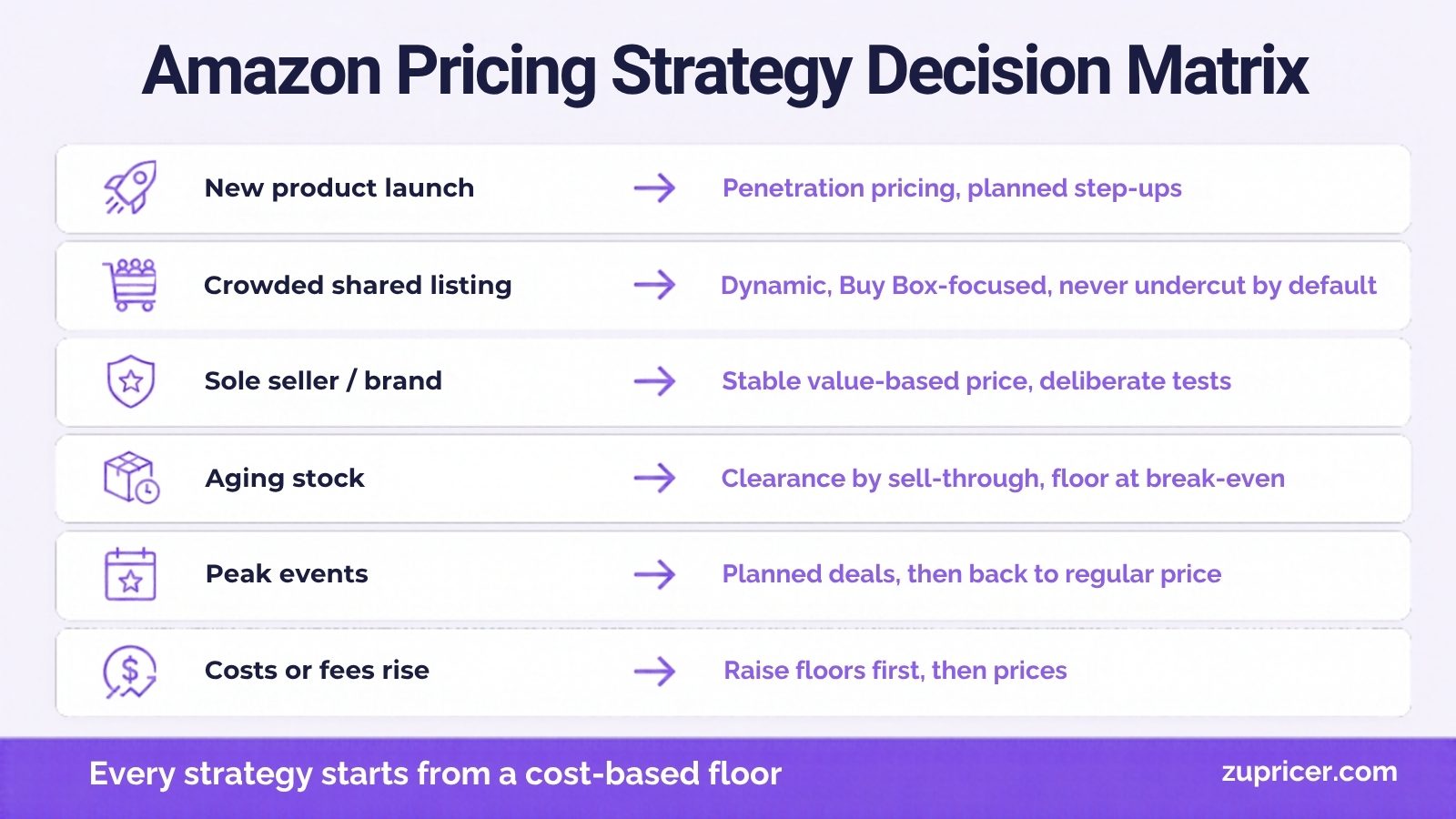
| Situation | Strategy | Guardrail | How to execute |
|---|---|---|---|
| New product launch (no reviews) | Penetration pricing: a modest introductory price, then step up as reviews and sales rank build | Never below your floor; plan the step-ups in advance | Manual schedule or coupons; avoid deep cuts that reset your typical price |
| Crowded shared listing (several sellers) | Dynamic, Buy Box-focused pricing: match or hold rather than undercut; raise prices when rivals stock out | Cost-based minimum; sensible maximum | Real-time repricer reacting to Featured Offer changes |
| Sole seller / brand owner | Value-based, mostly static pricing; test prices deliberately | Stay at or below major off-Amazon prices | Fixed price + scheduled tests; watch Pricing Health |
| Aging or slow stock | Clearance pricing tied to sell-through, before storage fees bite | Floor may drop to break-even, not below | Automate Pricing’s sales-based rule or repricer schedules |
| Peak events (Prime Day, BFCM) | Planned promotions: deals, coupons or Prime-exclusive discounts | Check fees and reference-price eligibility first | Book deals early; return to your regular price afterwards |
| Costs or fees rise | Cost-plus repricing: lift floors first, then prices gradually | Recalculate every floor after fee updates | Minimum price calculator + bulk cost update |
By seller type
- Private label brands: protect your price. Compete on listing quality and reviews, keep a stable regular price, and react quickly if another seller appears on your listing.
- Wholesale and resellers: you share listings with other sellers, so the Featured Offer is your battleground. Real-time, rule-guarded repricing pays off here — see how the Amazon Buy Box works.
- FBA or FBM? Your fulfillment method changes your costs and floors — see FBA vs FBM in 2026.
- Online and retail arbitrage: costs differ for every unit you source. Floors must follow your actual cost, and turnover matters more than squeezing the last cent.
- Brands with authorized resellers: Amazon has no program that enforces MAP; brands manage it through reseller agreements and brand-protection tools. Your Amazon price should reflect your MAP policy.
The core Amazon pricing strategies explained
1. Cost-plus pricing (the foundation)
Start from landed cost, add Amazon fees and your target profit, and you have your minimum price. Every other strategy sits on top of this floor. Because the referral fee is a percentage of the price, divide by (1 − referral %) rather than adding a flat fee — or use our free minimum price calculator.
2. Competitive pricing
Price relative to other offers on the listing and to major retailers off Amazon. Amazon evaluates the total price including shipping and compares it with external prices, so being cheapest on Amazon but pricier than a big outside retailer can still hurt. Competing doesn’t have to mean undercutting — matching or holding at a slightly higher price with faster delivery can win.
3. Dynamic pricing
Prices move automatically with competition, demand and stock. It’s the norm on shared listings: research by MIT economist Alberto Cavallo found that online competition roughly doubled how often multichannel US retailers change prices, from about 15% to 30% of products per month between 2008–10 and 2014–17 (NBER working paper 25138).
4. Value-based and premium pricing
Price on what customers are willing to pay rather than on competitors — workable when you’re the only seller and your listing, reviews and brand justify it. Test carefully and keep an eye on external prices.
5. Penetration pricing
A lower introductory price to build sales velocity and reviews, followed by planned increases. Avoid launching with an artificially high “regular” price followed by a big discount — Amazon’s reference-price rules are designed to catch that pattern.
6. Psychological pricing
Prices ending in .99 work mainly when they change the leftmost digit: $19.99 reads as meaningfully cheaper than $20.00, while $19.49 vs. $19.99 makes little difference (Thomas & Morwitz, Journal of Consumer Research, 2005). Field data from 25 US supermarket chains shows shoppers react to a one-cent move above .99 as if it were a much larger increase (Strulov-Shlain, Review of Economic Studies, 2023), and catalog experiments found $9 endings lifted demand, especially for new items (Anderson & Simester, 2003). More in why $19.99 outsells $20.
7. Bundling and quantity pricing
Multi-packs and bundles create a unique listing you control. Keep the per-unit price of a multi-pack at or below the single-unit price — Amazon’s fair pricing policy flags multi-packs that cost more per unit. For business buyers, Amazon offers business prices and quantity discounts.
Static vs. dynamic pricing: which should you use?
| Static pricing | Dynamic pricing | |
|---|---|---|
| How it works | You set a price and change it deliberately | Prices update automatically with the market |
| Wins when | You’re the sole seller, sell under MAP, or want a stable regular price for reference-price eligibility | You share listings, competitors move often, or stock levels swing |
| Risk | Missing price changes and stock-outs by rivals | Price wars and visible “whiplash” if unguarded |
| Tools | Manual updates, scheduled tests | Automate Pricing or a repricer with floors |
Research on price fairness shows customers judge price differences seen in a short time window as unfair (Haws & Bearden, Journal of Consumer Research, 2006) — another reason dynamic pricing should move within sensible limits rather than swing wildly. Deeper comparison: dynamic vs. static pricing.
2026 constraints every pricing strategy must respect
- Fair Pricing Policy: Amazon names misleading reference prices, prices significantly higher than recent prices, multi-packs priced above the single-unit price and excessive shipping as harmful; penalties range from losing the Featured Offer to account action (Amazon).
- Reference (“Was”) prices: according to reporting on Amazon’s 2026 updates, a List Price must now be backed by real sales or recent prices at other retailers, and the “Typical Price” is based on the median non-promotional price over 90 days. Discount too often and the strikethrough can disappear. Verify the current rules in Seller Central.
- Promotion fees: deals and coupons carry fees (widely reported as a daily fee plus a percentage of deal sales for Lightning/Best Deals, and a fixed fee plus a percentage for coupons). Check current fees in Seller Central before planning a promotion.
- Fee updates: Amazon’s January 2026 fee update changes your floors — recalculate them.
Last reviewed: November 13, 2026.
How to plan promotions without losing your reference price
- Set a sustainable regular price you can sell at most of the time.
- Plan promotions in 90-day windows — keep most days at your regular price so your typical price stays where you want it.
- Choose the right tool: coupons for steady conversion, Prime-exclusive discounts and deals for events; compare their fees with the extra margin you expect.
- Return to the regular price right after the event.
- Check that every promotional price stays above your floor.
How Amazon itself prices — and what sellers should take from it
You’ll often read that “Amazon changes prices every 10 minutes”. We couldn’t find a study behind that line; it appears to trace back to press coverage. The most-cited data point is a 2013 vendor report claiming Amazon made over 2.5 million price changes per day across its whole catalog — old, catalog-wide and without published methodology. The more reliable finding is Cavallo’s research: online competition made retailers change prices far more often and made prices more uniform across locations. The lesson for sellers isn’t to change prices constantly — it’s to react quickly when the market moves, within rules you’ve set.
Executing your strategy: Amazon’s free tools vs. a repricer
| Strategy | Amazon Automate Pricing (free) | Where a repricer adds value |
|---|---|---|
| Competitive / Buy Box | Rules to match or beat the Featured Offer or lowest price | Strategies using Buy Box ownership, competitor count, seller rating and stock; raising price when rivals stock out |
| Cost-plus floors | One minimum price per SKU, entered by you | Floors calculated from cost and margin, updated in bulk |
| Clearance | Sales-based rule lowers price when stock doesn’t sell | Clearance schedules within break-even floors |
| External price competitiveness | Rule based on the competitive external price | Monitoring and alerts alongside Buy Box strategy |
| Business pricing | Business price and quantity-discount rules | — |
| Analysis | Pricing Health, Business Reports | Buy Box win rate and full price-change history per SKU |
Zupricer handles the execution side for Amazon-only sellers: real-time repricing through SP-API, Buy Box strategies, cost-based minimum-margin guardrails with bulk cost imports, and price history — with every feature on every plan from $79/month. For a small catalog with simple rules, Amazon’s free tool may be enough. Compare options in our guide to the best Amazon repricers, and see how to keep tabs on rivals in competitive price monitoring.
Turning a strategy into day-to-day repricer rules? Our repricing strategies guide covers rule priority, match vs. hold vs. undercut and how to test changes safely.
Common pricing strategy mistakes
- Undercutting by default — it triggers competitors’ repricers; see why undercutting kills profits.
- One strategy for the whole catalog — launch, sole-seller and crowded listings need different rules.
- Inflated “regular” prices to show big discounts — now likely to remove your strikethrough and breach fair pricing rules.
- Forgetting external prices — a lower price at a major retailer can undercut your Amazon offer.
- Never revisiting floors after cost or fee changes.
More in 7 pricing mistakes draining Amazon profits and how to price for maximum profit.
Frequently asked questions
What is the best pricing strategy for Amazon sellers?
It depends on the listing. Shared listings need dynamic, Buy Box-focused pricing within cost-based floors; sole-seller brands usually do better with stable, value-based prices and deliberate tests.
What’s the difference between static and dynamic pricing?
Static prices change only when you change them; dynamic prices update automatically with competitors, demand and stock. Static suits sole sellers and MAP products; dynamic suits crowded listings.
How should I price a new product with no reviews?
Use a modest introductory price above your floor and plan step-ups as reviews and sales build. Avoid inflating the regular price to show a big launch discount.
Should I match the lowest price or the Buy Box price?
Usually the Featured Offer, not the lowest price — Amazon weighs total price with delivery and performance, so matching the cheapest slow offer can give away margin for nothing.
Why did my “Was” price disappear?
Amazon’s 2026 reference-price updates require list prices to be backed by real sales or outside prices and base the typical price on recent non-promotional prices. Frequent discounts can remove it.
Does .99 pricing work on Amazon?
Research shows .99 endings help mostly when they change the leftmost digit, like $19.99 vs. $20.00. They’re worth using as long as they stay above your floor.
Does Amazon enforce MAP pricing?
No. Amazon has no MAP enforcement program; brands enforce MAP through reseller agreements and brand-protection tools.
Can I raise prices without losing sales or the Buy Box?
Often, yes — especially when competitors go out of stock or you offer faster delivery. Raise gradually, stay below major external prices and watch your Featured Offer percentage.
What profit margin should Amazon sellers target?
There’s no universal number; it depends on category, fees and turnover. Set a target per SKU and build it into your floor so automation never sells below it.
Is Amazon’s Automate Pricing enough?
For simple rules on a small catalog, it can be. A repricer adds cost-based floors, Buy Box strategies, faster reactions and price history across many SKUs.
Turn your strategy into rules
Start a 14-day free trial of Zupricer, set floors from your real costs and let your strategy run 24/7.