Repricing Express: Your Repricer Amazon Tool to Amazon Reprice
If you’re an Amazon seller trying to stay competitive without losing your mind over manual price changes, you’ve landed in the right place. Pricing on Amazon moves fast — like, really fast — and if you’re not keeping up, you’re probably handing over Buy Box wins to your competitors without even realizing it. That’s where a solid repricing express solution can genuinely change the game for you.
In this post, we’re going to walk through what repricing actually means, why it matters in 2026, and how the right tools can do the heavy lifting so you don’t have to refresh your listings every hour. Let’s dig in.
What Is a Repricer Amazon Tool and Why Do You Need One in 2026?
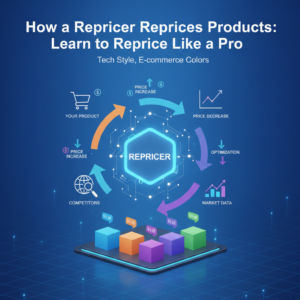
An Amazon repricer is software that automatically adjusts your product prices in response to competitor activity, Buy Box status, and market changes — all without you having to lift a finger. Think of it as your pricing assistant that never sleeps.
Back in the day, sellers would manually track competitors and tweak prices one by one. That’s basically impossible to do at scale now, especially if you’re managing hundreds or thousands of SKUs. The marketplace has gotten sharper, competition has gotten fiercer, and buyers have gotten smarter. A reprice it amazon strategy built on automation is no longer optional — it’s essential.
Amazon itself has been rolling out new features inside Seller Central to help sellers understand their pricing position better. In fact, Amazon now surfaces new and relevant pricing data directly in Manage Inventory under “Pricing Status,” giving sellers clearer visibility into how their prices compare to competitors and Featured Offer benchmarks. While that’s a helpful step, it still doesn’t replace the speed and intelligence of a dedicated repricing tool.
| Manual Repricing | Automated Repricing |
|---|---|
| Time-consuming, done listing by listing | Handles thousands of SKUs simultaneously |
| Reaction time: hours or days | Reaction time: seconds or minutes |
| High risk of human error | Rule-based accuracy and consistency |
| No profit floor protection | Built-in minimum price guardrails |
| Difficult to scale | Scales with your catalog effortlessly |
How Amazon Reprice Works at a Basic Level
When you set up an amazon reprice strategy, the tool monitors your competitors’ prices in real time, compares them to your current price, and automatically adjusts yours based on the rules or strategies you’ve defined. The goal is almost always the same: win the Buy Box without racing straight to the bottom.
The best tools go beyond basic min/max rules. They factor in things like fulfillment method (FBA vs FBM), seller feedback score, shipping speed, and Buy Box ownership history. That’s where strategy-based repricing starts outperforming simple rule-based systems.
Understanding the Best Amazon API for Repricing Tools
At the technical core of every repricer is its connection to Amazon’s data feeds. The best amazon api for repricing tools allows software to pull real-time pricing data, competitor listings, Buy Box status, and inventory signals to make smart, fast decisions. Not all repricers are built on equally robust API integrations, so this is worth paying attention to when you’re comparing options. A repricer that’s slow to pull data is a repricer that’s missing windows of opportunity constantly.
What Makes Amazon Automated Pricing Software Actually Good?
There’s a lot of repricing software out there in 2026, and honestly, a chunk of it is pretty basic. Good amazon automated pricing software should do more than just undercut competitors. It should protect your margins, give you visibility into why prices changed, and let you build intelligent strategies based on real market conditions.
Here’s what you should be looking for:
- Real-time competitor monitoring — not just hourly syncs
- Buy Box intelligence built into the strategy logic
- Profit guardrails so you never price below your floor
- Support for both FBA and FBM sellers
- Transparent repricing history and reporting
- Easy setup that doesn’t require a tech degree
Scenario-Based Strategies vs. Simple Rules
Simple rule-based repricers say things like “always be 2 cents below the lowest price.” That sounds fine until you’re the only seller on a listing and you’ve just undercut yourself for no reason. Scenario-based strategies are smarter — they adapt based on context. If you already own the Buy Box, a good repricer will hold your price or even nudge it up to protect your margin. That’s a meaningfully different approach.
FAQ: Common Questions About Amazon Repricing
-
Is repricing safe for my Amazon account?
Yes, as long as you’re using a repricer that operates within Amazon’s policies. Reputable tools use official API connections and don’t violate any terms of service. Just make sure your minimum prices aren’t set so low that you risk selling at a loss.
-
Will a repricer hurt my profit margins?
Not if it’s set up correctly. A good repricer lets you define profit floors, so you’re never dropping below what’s acceptable for your business. The goal is to be competitive without being reckless.
-
How quickly does repricing happen?
With top-tier tools, repricing happens in real time or near-real time — often within seconds of a competitor price change. That speed is what makes automated repricing so powerful compared to manual adjustments.
-
Does it work for both FBA and FBM sellers?
Most quality repricers support both fulfillment methods. Some even factor in fulfillment type when calculating competitive price positions since Amazon weights FBA sellers differently in Buy Box eligibility.
| Feature | Basic Repricers | Advanced Tools Like Zupricer |
|---|---|---|
| Buy Box intelligence | Limited or none | Full Buy Box strategy engine |
| Profit guardrails | Basic min price only | Multi-layer margin protection |
| Strategy types | Simple rule-based | Scenario-based and adaptive |
| FBA + FBM support | Sometimes FBA only | Both supported natively |
| Reporting transparency | Minimal | Detailed repricing history |
Choosing the Right Repricer Amazon Solution for Your Store
When you’re shopping around for a repricer amazon solution, the price of the tool itself matters less than what it helps you earn. A repricer that costs a bit more but wins you the Buy Box consistently is going to pay for itself many times over. Think ROI, not just monthly subscription cost.
Also consider how easy the tool is to actually use. If you need to hire a consultant just to configure your repricing rules, that’s a red flag. The best tools are intuitive enough for individual sellers but powerful enough for large catalog operations.
What to Expect During Your First Week of Repricing
The first week with any new repricing tool is about calibration. You’ll want to watch how your prices move, check your Buy Box ownership rates, and make sure your minimum prices are set correctly. Most sellers see a noticeable improvement in Buy Box percentage within the first few days once things are dialed in.
Don’t Forget Your Pricing Status Data Inside Seller Central
Amazon’s updates to Manage Inventory now give you more context on how your prices stack up, including Pricing Status labels that flag when you’re not the Featured Offer or when your price is too high relative to the competitive range. While this data is useful for understanding your position, it’s reactive — it tells you what happened, not what to do next. A repricing tool acts on that data automatically, which is where the real value lies.
Pairing Amazon’s native Pricing Status insights with a smart repricer gives you the best of both worlds: visibility plus automation. You’ll understand what’s happening and have a tool that’s already responding to it before you even log in.
Ready to Take Control of Your Amazon Pricing?
If you’ve made it this far, you already know that manual pricing is holding you back. The Amazon marketplace in 2026 rewards speed, strategy, and consistency — all things that automated repricing delivers. Whether you’re an FBA seller trying to dominate a niche or an FBM seller juggling a complex catalog, the right repricing tool makes a real difference to your bottom line.
Zupricer is built exactly for this. It combines Buy Box intelligence, profit guardrails, and a powerful scenario-based strategy engine to automate repricing across your entire catalog at scale. It works for both FBA and FBM sellers, takes minutes to set up, and comes with a 14-day free trial — no credit card required. Sellers love it too, with a 4.9 out of 5 rating on both Trustpilot and Capterra.
Go ahead and give it a try at app.zupricer.com/signup and see the difference smart repricing can make for your store. Your future Buy Box wins are waiting.
How FBA and FBM Sellers Should Approach Repricing Differently
Not all repricing strategies work the same way for every fulfillment method. If you’re using amazon fba repricing, you already have a built-in advantage: Amazon’s algorithm favors FBA sellers for Buy Box eligibility, even when your price is slightly higher than a competitor’s. FBA products automatically qualify for Prime, which drives 82% of Buy Box wins according to recent marketplace data. That Prime badge alone can boost conversion rates by 5-10x compared to FBM sellers.
For FBA sellers, repricing strategy should focus on protecting margins rather than racing to the lowest price. Since you have fulfillment credibility baked in, you can often hold a higher price point and still win the Buy Box. Your repricer should be configured to test price ceilings, not just floors. Factor in your FBA fees—currently around $3.22 per unit for a standard one-pound item—when setting your minimum acceptable price. A repricer that doesn’t account for these fees will erode your profitability fast.
FBM sellers face a different challenge. Without the Prime badge, you’re competing on price and delivery speed simultaneously. Zero-day handling time can significantly boost your Buy Box share if you can deliver it consistently. Your repricing strategy needs to be more aggressive on price while still protecting a viable margin. Consider your landed price—the product price plus shipping cost—because that’s what Amazon’s algorithm evaluates. If your shipping costs are high, your product price needs to compensate to stay competitive.
Seller Fulfilled Prime (SFP) sellers sit in the middle. As of June 2025, Amazon lowered the on-time delivery requirement to 93.5%, making SFP more accessible. If you qualify for SFP, your repricing strategy can mirror FBA tactics since you get the Prime badge without using Amazon’s warehouses.
Understanding Amazon Repricing API Limitations and Speed
Behind every repricer is the amazon repricing api that connects to Amazon’s data. The SP-API has specific rate limits that directly affect how fast your prices can update. The Product Pricing API allows a burst of 10 requests with a restore rate of 5 per second. For a catalog of 50,000 ASINs, even at full speed, scanning competitive pricing takes measurable time.
These API constraints mean that not all repricers can deliver the same speed. When a tool claims “real-time” repricing, what they really mean is “as fast as Amazon’s API allows.” The practical limit for most implementations is price updates roughly every 2 minutes under optimal conditions. That’s still dramatically faster than manual repricing, but it’s not instantaneous.
Amazon changes prices over 2.5 million times per day across the marketplace. The Buy Box can rotate dozens of times daily on competitive listings. A repricer that updates every 15 minutes will miss the majority of intraday Buy Box windows during peak shopping hours. This is why repricing speed matters—it’s the difference between capturing those brief windows of opportunity and watching competitors take them instead.
Mobile Repricing and On-the-Go Price Management
Most sellers manage their repricing from a desktop dashboard, but mobile functionality is becoming increasingly important. An amazon repricing app lets you monitor price changes, adjust strategy rules, and respond to competitive moves without being tied to your computer. This matters because 53% of Amazon traffic now comes from mobile devices, and shopping behavior on mobile is different—the Buy Box is even more dominant since viewing alternative sellers requires extra taps most shoppers never make.
While most repricing tools offer mobile-responsive web dashboards, true native mobile apps are less common. The best mobile repricing interfaces let you quickly check Buy Box status, review recent price changes, and temporarily pause repricing on specific SKUs when needed. If you’re managing inventory across multiple channels or traveling frequently, mobile access to your repricing controls becomes essential rather than optional.
Why Repricing Speed Determines Your Buy Box Share
Speed isn’t just a nice-to-have feature—it’s a competitive necessity. The fastest repricer tools update prices in under 30 seconds, with some premium options hitting 10-second update cycles on high-priority listings. Standard repricers operate on 2-15 minute cycles, while free or throttled tiers may only update every 15-60 minutes.
The difference is measurable. Sellers using 15-minute repricing cycles can lose 20-60% of their Buy Box share during the critical 6-10 PM shopping window compared to sellers using sub-minute repricing. When 82% of Amazon sales go through the Buy Box, that lost share translates directly to lost revenue. On competitive listings where the Buy Box rotates frequently, slow repricing means you’re consistently arriving late to price changes that have already happened.
Repricing speed benchmarks matter because they reveal how seriously a tool takes Buy Box capture. A repricer updating every 10 seconds can react to competitor moves before most shoppers even see the price change. A repricer updating every 15 minutes is essentially showing up to a race after it’s already finished. The gap between 48% Buy Box win rate with basic tools and 78% win rate with advanced repricers often comes down to nothing more than response speed.