Disclosure: this guide is published by Zupricer, which makes Amazon repricing software. It draws on Amazon’s seller documentation, peer-reviewed research and standard break-even math, checked on November 17, 2026. It is about price wars between marketplace sellers on the same listing, not retail price wars between Amazon and other stores.
Quick answer: An Amazon price war is a loop where sellers on the same listing keep undercutting each other — often bot against bot — until prices sit near everyone’s cost. You avoid it by setting a fully loaded price floor, matching or holding instead of undercutting, reacting only to competitors who can actually win the Featured Offer, and competing on delivery and seller performance. Before you follow any cut, check how many extra sales you’d need just to stay even: at a 20% margin, a 5% price cut needs about 27% more units.
Key takeaways
- Price cuts cost more than they look: thin margins turn small cuts into large profit losses.
- Research on Amazon shows undercut-only repricers drive market prices down, while strategies that periodically reset prices upward can lift them.
- The lowest price is not automatically the Featured Offer — target the Buy Box price, not the cheapest offer.
- Not every price drop is a war: separate liquidators, one-off drops and bot loops before you react.
What is an Amazon price war?
A price war starts when one seller lowers the price and others respond by going lower. On Amazon it accelerates because many sellers use rules like “beat the lowest price by $0.01”. Two such rules react to each other within minutes: $24.48, $24.47, $24.46… until one or both hit their minimum — or, without a minimum, their cost.
Economists call this Bertrand competition: when products are identical, competing on price alone pushes prices toward cost even with only two sellers. It is also a prisoner’s dilemma — each seller is tempted to cut, and everyone ends up earning less. The two classic ways out are differentiation and not reacting mechanically, which is exactly what the rest of this guide covers.
Why price wars start on Amazon
- Penny-undercut rules with no floor or with floors set too low.
- Liquidators clearing overstock or aged inventory before storage fees rise.
- New sellers buying their first sales with aggressive entry prices.
- Different cost structures: an arbitrage seller who bought at clearance can profit at a price that is a loss for you.
- Chasing the lowest price rather than the Featured Offer — including slow FBM offers that rarely win it.
- More offers in contention: Amazon announced that from July 2026 it is removing separate seller eligibility requirements for the Featured Offer, while saying the selection itself isn’t changing (Amazon announcement). More offers being considered can mean more price pressure on shared listings.
What research says about repricers and price wars
- Undercut bots lower prices for everyone. A study published in Management Science found that sellers adopting repricing software cut their prices by about 17% and market prices fell by about 10%. But where sellers used “resetting” strategies — regularly raising prices, for example overnight — competitor and market prices eventually rose by about 11% (Musolff, “Algorithmic Pricing, Price Wars and Tacit Collusion”).
- The cheapest offer doesn’t always win. Northeastern University researchers tracking about 1,600 best-sellers found that algorithmic sellers won the Buy Box more often, many while priced above the lowest offer, and that seller feedback let some sellers charge more and still win (Chen, Mislove & Wilson, WWW 2016).
- Bots without economic limits fail in both directions. In 2011 two sellers’ algorithms priced a biology textbook off each other until it was listed at about $23.7 million (The Making of a Fly). Same failure as a race to the bottom, just upward: rules that react only to each other, with no floor or ceiling tied to real costs.
Amazon itself says Featured Offer prices are commonly at or below the lowest alternatives, but that fast, free shipping and a good customer experience also increase the chances of being featured (Amazon). Price matters — it just isn’t the only lever. More in our Amazon Buy Box guide.
The real cost of a price cut: break-even table
Before following a competitor down, ask how many extra units you’d need just to make the same profit. The basic formula is required extra volume = price cut ÷ (margin − price cut). On Amazon, the referral fee is a percentage of price, so part of each cut is absorbed by a lower fee (about 0.85 × the cut at a 15% referral fee). The table uses that fee-adjusted version.
| Net margin before cut | 1% cut | 2% cut | 5% cut | 10% cut |
|---|---|---|---|---|
| 10% | +9% | +20% | +74% | +567% |
| 15% | +6% | +13% | +40% | +131% |
| 20% | +4% | +9% | +27% | +74% |
| 25% | +4% | +7% | +21% | +52% |
| 30% | +3% | +6% | +17% | +40% |
Extra units needed to keep the same total profit, assuming a 15% referral fee and other per-unit costs unchanged. Formula: 0.85c ÷ (m − 0.85c), with c = price cut and m = net margin, both as % of price.
Example: you sell a $30 item with a 20% net margin ($6 profit). A competitor drops to $28.50 (5% lower). If you follow, your profit falls to about $4.73 per unit, so you need roughly 27% more sales to stay level — and in a price war, the competitor usually responds again before those sales appear.
The same math explains why pricing discipline matters so much: a classic McKinsey analysis published in Harvard Business Review estimated that, for an average company, a 1% price improvement raised operating profit by about 11% (Marn & Rosiello, 1992). On thin Amazon margins, the effect of a cut can be even larger.
Are you actually in a price war? Diagnose before you react
| What you see | What it likely is | Best response |
|---|---|---|
| Two offers changing price many times a day, one cent apart | Bot-vs-bot loop | Match or hold; stop undercutting on that ASIN |
| One seller drops sharply and stays there with limited stock | Liquidation | Hold at or above floor; wait for sell-out |
| Brief dip that bounces back within hours | Noise or a reset strategy | Don’t react; let it pass |
| Steady downward slope over weeks, several sellers following | Real price war | Floor, hold, differentiate — or exit the listing |
| Buy Box price falls but your units don’t rise | Low price sensitivity | Stop cutting; you’re giving margin away |
| Many of your SKUs sitting at their floor | Price war or floors set wrong | Recheck costs and rules |
Tools like Keepa’s price and stock history help you see the pattern; competitive price monitoring shows it across your catalog.
Should you respond? A decision flow
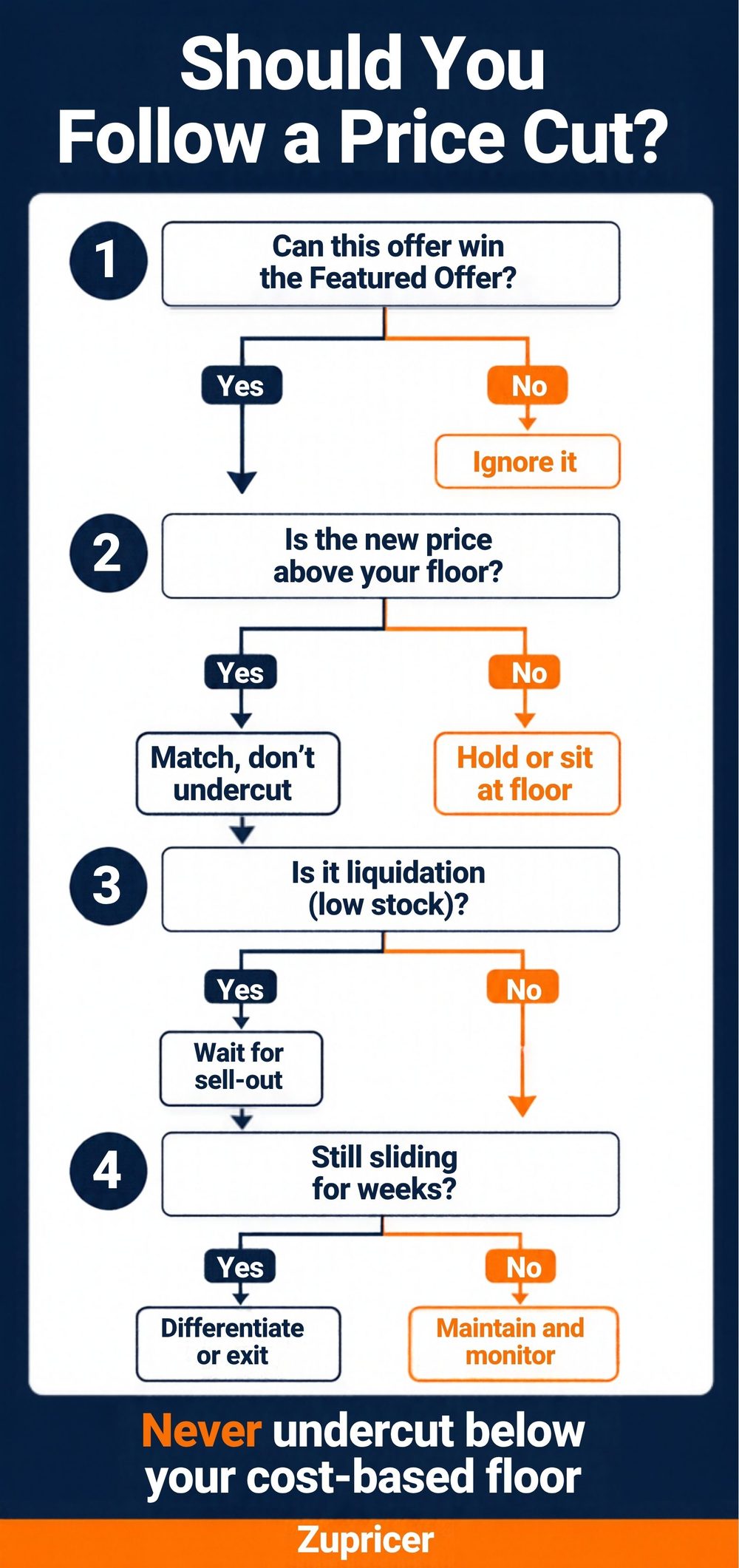
- Can this offer actually win the Featured Offer? A slow FBM offer or a seller with weak feedback may be cheaper without being a real threat. If not, ignore it.
- Is the new price above your floor? If yes, match (don’t undercut). If no, don’t follow — hold your price or sit at your floor.
- Is it liquidation? Check stock depth. Limited stock usually means waiting is cheaper than fighting.
- Is it permanent? If prices keep sliding for weeks and units don’t recover, the listing may no longer be worth it at your cost — differentiate or exit.
Cost of holding vs. cost of following
Holding loses some sales while the competitor is cheaper. Following loses margin on every unit — usually for longer. Compare: (units you’d lose while holding × your current profit per unit) against (all units you’d sell × profit lost per unit, plus extra storage time if prices stay low). For short-lived liquidations, holding almost always wins.
9 ways to avoid or exit a price war
- Set a fully loaded floor: product cost, inbound shipping, FBA or fulfillment cost, storage, returns allowance and ad cost per unit, plus target profit — divided by (1 − referral %). Check current fees in our 2026 Amazon seller fees guide, use our minimum price calculator and see how to set min and max price rules.
- Match or hold, don’t undercut. Holding when you already have the Featured Offer stops the loop from your side. Rule recipes are in our Amazon repricing strategies guide.
- Filter who you react to: ignore out-of-stock offers, slow FBM offers and low-feedback sellers, and target the Buy Box price rather than the lowest price. See FBA vs FBM.
- Compete on non-price factors: Prime eligibility, delivery speed, stock availability and strong seller metrics.
- Wait out liquidators: track their stock and recover when they sell out.
- Test upward resets: periodically try a higher price (for example overnight) and step back up gradually after a war, staying within your Seller Central min/max and below recent and external price references to avoid Pricing Health issues. Always set prices independently — never coordinate with competitors.
- Differentiate the offer: bundles, private label or a unique ASIN take you out of identical-product competition.
- Protect your brand: Brand Registry and Amazon’s Transparency program help block counterfeit units; authorized resellers undercutting you are a distribution and agreement issue, not something Amazon enforces.
- Choose listings carefully: before buying stock, check 90–180 days of Buy Box price history, the number of FBA offers and whether Amazon sells on the listing.
Price war advice by seller type
- Wholesale and arbitrage (shared listings): floors per batch cost, match rather than undercut, wait out liquidators, avoid listings with unstable price history.
- Private label facing copycats: compete on brand, reviews and content; don’t follow lower-quality alternatives on price.
- Brand owners facing hijackers: hold your price, report infringements through Brand Registry and control distribution.
Price war myths and unverified statistics
Many articles repeat numbers that don’t have a public source — for example “82% of sales go through the Buy Box” (an old industry estimate Amazon never confirmed), “price is one of 14 Buy Box factors” or “a 1% price cut lowers profit by more than 10%” (a distortion of the McKinsey figure above, which was about price increases at an average company). Use your own data and the break-even math instead.
How Zupricer helps you stay out of price wars
Zupricer is built around the guardrails above: cost-based floors with bulk cost import, min/max and minimum-margin protection, rules that match or hold instead of undercutting, and competitor filters by fulfillment method, seller rating, stock and Buy Box ownership. It reacts in real time and shows Buy Box win rate and price-change history, so you can see a price war forming and test your response. Every feature is included on every plan from $79/month. Compare options in our guide to the best Amazon repricers, and for choosing an overall approach see our Amazon pricing strategy decision matrix.
Frequently asked questions
What is a price war on Amazon?
A cycle where sellers on the same listing keep undercutting each other, often through automated rules, until prices approach cost and profits disappear for everyone.
Why does my Amazon price keep dropping?
Usually because your repricer is set to beat the lowest price and a competitor’s repricer is doing the same. Switch to match or hold, filter out irrelevant offers and check your floor.
Can I win the Buy Box without the lowest price?
Yes. Amazon also weighs delivery speed, availability and customer experience, and research has found sellers winning the Buy Box while priced above the lowest offer.
Does a price floor make me lose the Buy Box?
Sometimes, temporarily — but a floor stops you from selling at a loss. When the cheaper competitor sells out or stops cutting, you can win it back at a profitable price.
Should I match or undercut competitors?
Match or hold in most cases. Undercutting invites another cut; matching keeps you competitive without starting the loop.
Do repricers cause price wars?
Repricers set to undercut can, and research links them to lower market prices. Repricers set to match, hold and reset upward with proper floors can do the opposite.
How do I end a price war on Amazon?
Stop undercutting, hold at or above your floor, wait out liquidators, then step prices back up gradually. If the listing stays unprofitable, differentiate or exit.
How long do Amazon price wars last?
It depends on the cause: liquidation-driven drops usually end when stock runs out, while bot-vs-bot loops last until someone changes their rules.
What should I do if a seller undercuts me by a lot?
Check whether they can actually win the Featured Offer and how much stock they have. A large, sudden drop with little stock is usually liquidation — holding is often cheaper than following.
Is it legal to raise prices after a price war?
Yes, if you set prices independently. Avoid sharp spikes above recent or external prices, which can trigger Amazon’s pricing checks, and never agree prices with competitors.
Stop racing, start protecting margin
Start a 14-day free trial of Zupricer, set your floors and switch one product group from undercut to match-and-hold this week.