Disclosure: this guide is published by Zupricer, which makes Amazon repricing software. Amazon facts come from Amazon’s seller pages and Selling Partner API documentation, checked on November 19, 2026.
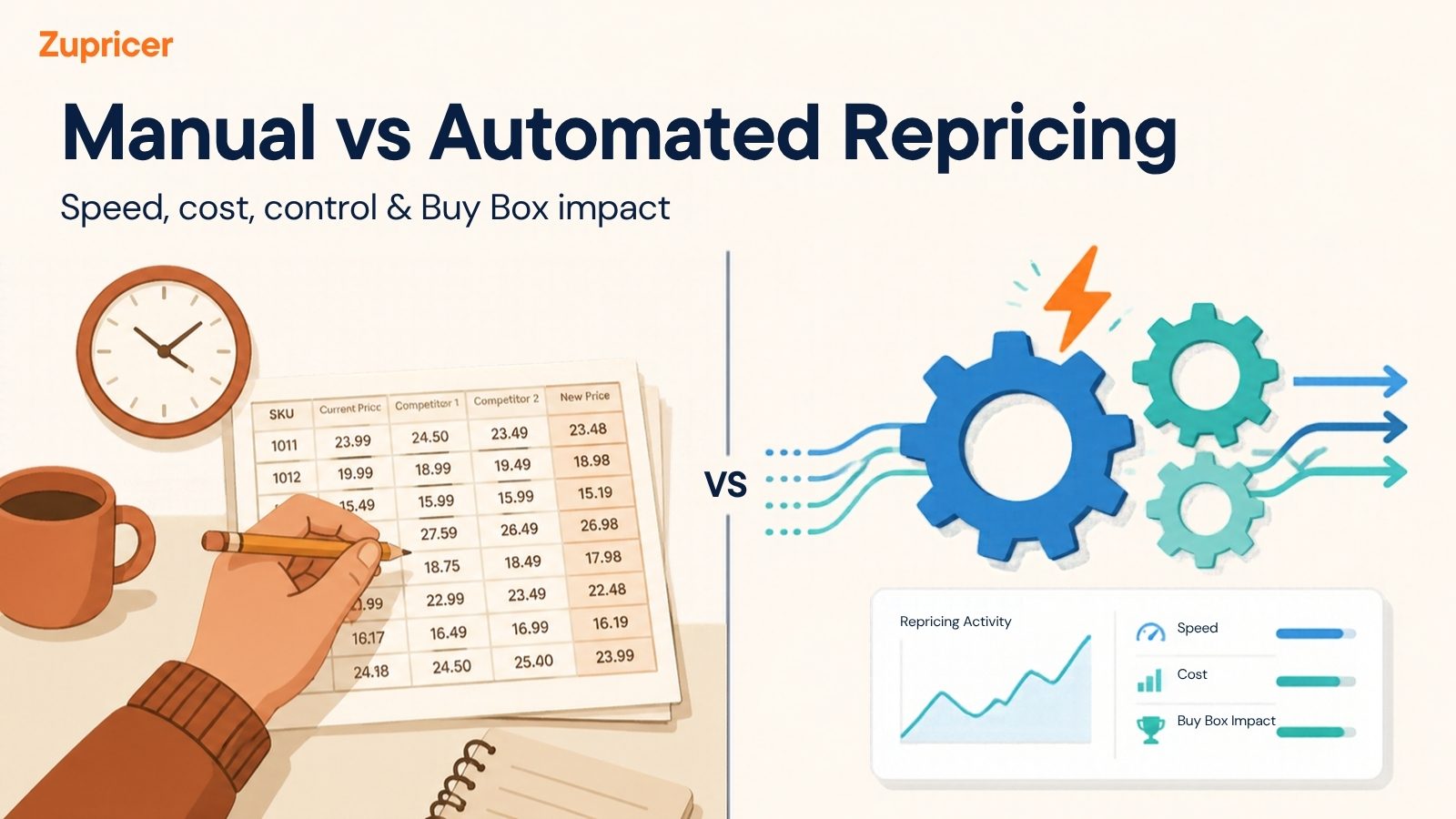
Manual vs automated repricing: with manual repricing, you check competing offers and edit your prices by hand. With automated repricing, software does it for you. It can be rule-based, like Amazon’s free Automate Pricing, or algorithmic. It reacts to offer changes within minutes, around the clock, and stays inside the minimum and maximum prices you set. Manual repricing gives you total control. Automation gives you speed and scale.
Key takeaways
- This is less a contest than a growth path: most sellers start manual, move to rules, then to smarter automation.
- Amazon’s free Automate Pricing sits in the middle. It’s real automation, but limited to fixed rules.
- Automation helps you win the Buy Box when price is the problem. It can’t fix stock-outs, slow delivery or weak account health.
- Whatever you choose, a fee-aware floor price is what protects your margin.
What is manual repricing?
Manual repricing means you look at the offers on your listings, decide on a new price and change it yourself. You can do that in Seller Central, through a spreadsheet upload, or with a list of SKUs you check each morning. Most manual sellers check a few times a day at best.
That works while the catalog is small and competitors move slowly. The limits show up as you grow. Every extra SKU adds checking time. Prices can change at night or on weekends while nobody is watching. A typo in a price field can cost real money before anyone notices. An experienced person pricing by hand often makes better calls than a simple rule. Pace and volume are what hold them back.
What is automated repricing?
Automated repricing uses software, usually called a repricer, to change prices for you. If you’re new to the term, start with what an Amazon repricer is. There are two broad kinds.
Rule-based repricing
You write if-then rules, for example “match the Featured Offer, but never go below $18.” Amazon’s own Automate Pricing works this way. It’s free with the Professional selling plan ($39.99 a month plus selling fees). It needs a minimum price for every SKU, and a maximum price is optional. Amazon says updates to existing rules usually apply in under 15 minutes. New rules or changed settings can take up to an hour to reach every SKU. Rules can target the Featured Offer, the lowest price or an external price, or follow your sales. Many third-party tools also offer rule-based repricing, with more exceptions and filters. For a wider view, see our guide to Amazon pricing tools.
Algorithmic repricing
Algorithmic repricers weigh several signals at once instead of following a single rule. Through the Selling Partner API, Amazon notifies a repricer whenever any of the top 20 offers on a product changes, or when the Featured Offer winner or price changes. A separate alert fires if your offer loses Featured Offer eligibility. The repricer can also ask Amazon for the Featured Offer Expected Price: the price at which your offer can expect to become the Featured Offer (Amazon SP-API). With that information, a good algorithm can raise prices as well as cut them, for example when a competitor runs out of stock. Ready-made setups are in our Amazon repricing strategies guide.
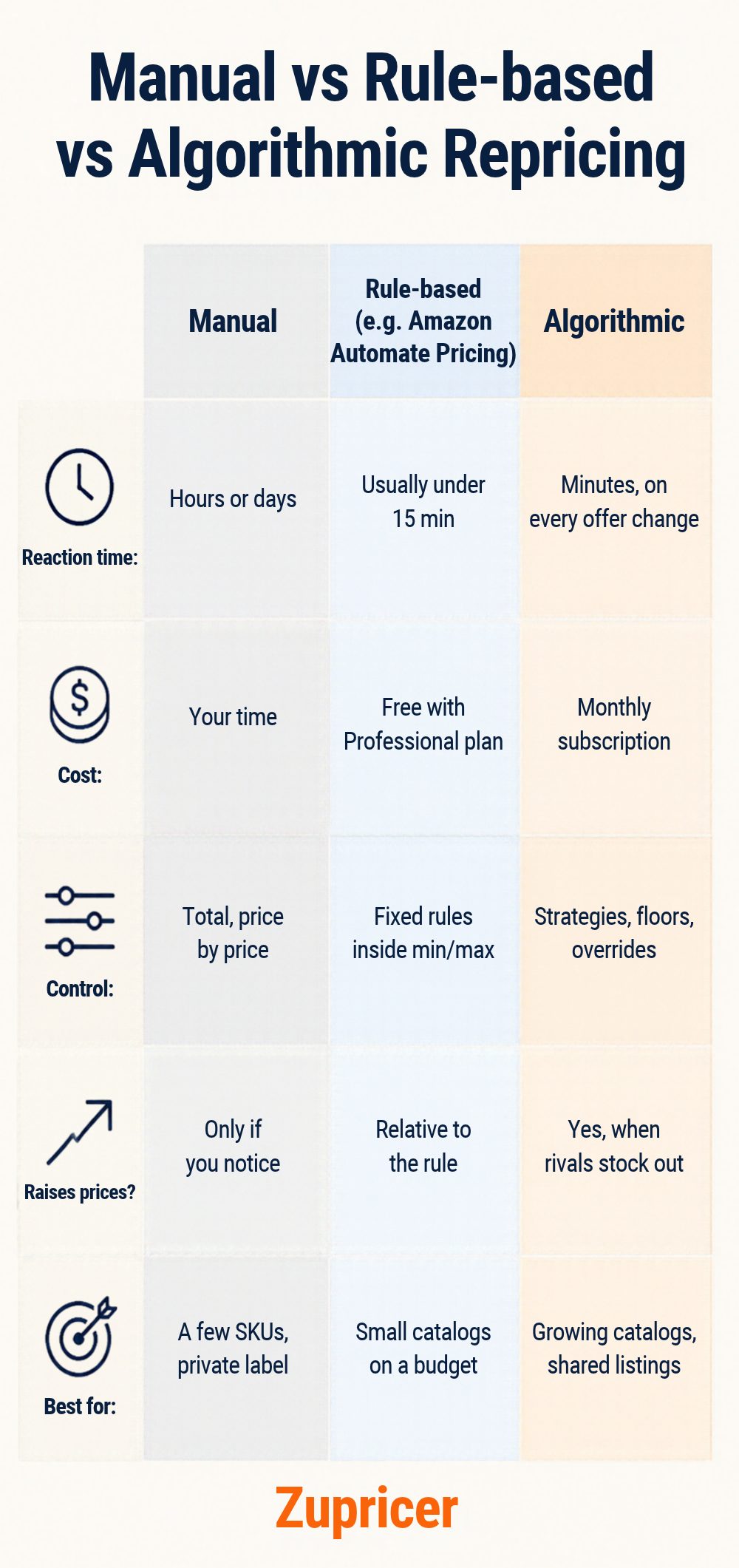
Manual vs rule-based vs algorithmic: side by side
| Manual | Rule-based (e.g. Amazon Automate Pricing) | Algorithmic repricer | |
|---|---|---|---|
| Reaction time | Whenever you next check: hours or days | Usually under 15 minutes; new rules up to 1 hour (Amazon) | Minutes, triggered by Amazon’s offer-change notifications |
| Cost | No software cost, but your time | Free with the Professional plan | Monthly subscription |
| Control | Total, price by price | Fixed rules inside your min/max | Strategies, floors and ceilings, per-SKU overrides |
| Raises prices? | Only if you notice the chance | Only relative to the rule’s reference price | Yes, when competitors drop out or run out of stock |
| Main risk | Slow reactions, missed nights, typos | Mechanical undercutting down to the floor | Poorly set floors; still needs monitoring |
| Best for | A handful of SKUs, private label, MAP items | Small to mid catalogs trying automation on a budget | Growing catalogs on listings shared with other sellers |
The “best for” row is a rule of thumb, not a hard threshold. Catalog size matters less than how often your competitors change their prices.
How automated pricing differs from manual pricing
- Speed: a repricer reacts to an offer change in minutes. A manual seller reacts the next time they open Seller Central.
- Coverage: software works at 2 a.m. If the Featured Offer winner runs out of stock overnight, an automated seller can step in, and raise the price, before a manual seller wakes up.
- Consistency: rules apply the same logic every time. People get tired, rush, or panic-cut prices after a bad day.
- Direction: manual repricing tends to go one way, down. Automation is just as quick to move prices back up when competition eases.
- Time: every hour spent checking prices is an hour not spent sourcing, improving listings or managing stock.
Does automated repricing win more Buy Box?
It can, when price is what’s holding you back. Amazon says the Featured Offer (the Buy Box) goes to offers with a competitive total price including shipping, fast delivery, good account performance and stock on hand (Amazon). Price is the factor a repricer controls, and it reacts much faster than a person can.
Competition for that slot grew in 2026. Amazon began removing the seller-eligibility step for the Featured Offer in July 2026, so more offers can now compete. The selection still weighs price, delivery speed and performance, and when no offer is clearly better the Featured Offer may rotate between sellers. More on this in our Amazon Buy Box guide.
Two honest caveats:
- Amazon itself says Automate Pricing doesn’t guarantee the Featured Offer. No repricer can fix an out-of-stock offer, slow delivery or poor account health.
- Buy Box uplift figures online come from repricer vendors, not independent studies. Treat them as marketing until you test on your own listings.
When you test, track your Buy Box win rate and your average selling price together. If you win more Buy Box but your average price drops, you’re buying share with margin.
Risks of each approach and how to control them
Manual pricing risks: slow reactions, missed evenings and weekends, typing errors and emotional undercutting.
Automated pricing risks:
- Race to the bottom: two repricers that only undercut can drive each other down to cost. Use match or hold rules and a hard floor. See how to avoid an Amazon price war.
- Floors that ignore fees: a floor must cover your product cost, referral fee, fulfillment fees and the profit you want. Work them out with our Amazon seller fees guide.
- Pricing-error flags: Amazon can make an offer ineligible for the Featured Offer when its price is far too high or too low. It may also ask you to confirm a suspected low-price error. Amazon’s Fair Pricing Policy also prohibits prices that are much higher than recent prices on or off Amazon. A sensible maximum price keeps automation away from that line.
When manual repricing still makes sense
- You’re the only seller on the listing. With private label or your own brand, there’s no one to reprice against, so price is a positioning decision. Our Amazon pricing strategy guide covers how to set it.
- MAP or brand-sensitive products, where you must not go below a set price.
- Launches, clearance, bundles and one-off promotions that need human judgment.
- Your first weeks on a product, while you learn how competitors behave before you write rules.
- A tiny, quiet catalog where one check a day is enough.
In practice, most growing sellers end up with a hybrid: they automate the bulk of the catalog and exclude these SKUs or give them their own rules.
What an automated Buy Box management tool should do
If you’ve outgrown manual pricing, or Automate Pricing’s fixed rules, look for:
- Minimum and maximum prices, ideally calculated from cost and fees for each SKU.
- Rules that react to Featured Offer ownership, not just the lowest price.
- Competitor filters by fulfillment method, seller rating and stock.
- The ability to raise prices when you’re the only seller or competitors stock out.
- Per-SKU overrides and exclusions for the items you keep manual.
- A price-change history and alerts, so you can see why each price moved.
We compare the main options in our guide to the best Amazon repricers. Zupricer, for example, reprices in real time through the SP-API with scenario-based strategies and cost-based floors, and includes every feature on every plan.
How to switch from manual to automated repricing
- Rebuild your floors from landed cost plus Amazon fees and a minimum profit, and set a maximum for each SKU.
- Start small: pick a group of contested SKUs, perhaps 20 to 50, and leave the rest as they are.
- Run it for two to four weeks so you see weekdays, weekends and at least one competitor reaction.
- Compare Buy Box win rate, units sold and average selling price against the period before.
- Expand to more of the catalog, keeping manual exclusions for the SKUs listed above.
Frequently asked questions
Is manual repricing still viable on Amazon?
Yes, for a small catalog, for listings where you’re the only seller and for MAP-restricted items. On listings shared with other sellers, it’s hard to keep up with competitors that reprice within minutes.
How does automated pricing differ from manual pricing?
Automated pricing reacts to offer changes within minutes, 24/7, using rules or algorithms inside your price limits. Manual pricing happens only when you check, and it relies on your judgment for each change.
Does automated repricing win more Buy Box?
It can, when price is the deciding factor, because it reacts faster than a person. It can’t make up for missing stock, slow delivery or weak account performance, which Amazon also weighs.
Is Amazon’s Automate Pricing enough?
For many small sellers it’s a good free start. Sellers often move to a third-party repricer when they need competitor filters, cost-based floors, price increases and better reporting.
How often does Amazon Automate Pricing change prices?
It runs continuously. Amazon says updates usually apply in under 15 minutes, and new rules or changed settings can take up to an hour.
Is using a repricer allowed on Amazon?
Yes. Amazon offers its own repricing tool and lists third-party repricers in its Selling Partner Appstore. Your prices must still follow Amazon’s pricing policies.
Can automated repricing start a price war?
It can, if your rules only undercut. Match or hold rules, a fee-aware floor and a sensible maximum prevent both price wars and pricing-error flags.
How many SKUs before I should automate?
There’s no fixed number. Automate once you can no longer check your contested listings as often as your competitors change their prices. For some sellers that’s 20 SKUs; for others it’s 200.
Move from manual to automated, safely
Start a 14-day free trial of Zupricer. Plans start at $79 a month, with every feature included. Set your floors, automate a test group and compare the results with your manual prices.