Disclosure: this guide is published by Zupricer, which makes Amazon repricing software. Technical details come from Amazon’s Selling Partner API documentation and seller pages, checked on November 19, 2026.
What is an Amazon repricer? An Amazon repricer is software that automatically changes your product prices in response to competing offers. Connected to your seller account through Amazon’s Selling Partner API, it watches price changes on your listings, applies the rules or strategy you choose, and sets a new price — always within the minimum and maximum limits you define — to win the Buy Box without giving away margin.
Key takeaways
- “Reprice” simply means setting a new price; a repricer does it for you, automatically and continuously.
- Repricers react to real Amazon signals — mainly notifications when any of the top 20 offers on your product changes.
- Amazon’s free Automate Pricing is itself a basic rule-based repricer; third-party repricers add filters, margin logic and analytics.
- Your floor price is what keeps a repricer profitable — without it, automation can start a race to the bottom.
Repricer meaning in plain words
To reprice is to set a new price for something you already sell. On Amazon, many sellers often offer the same product, and the one chosen as the Featured Offer (the “Buy Box”) gets most of the sales. Prices on shared listings can change many times a day, so checking and updating them by hand doesn’t scale. A repricer automates that loop. Academic research has documented automated pricing on Amazon since at least 2016, when Northeastern University researchers found algorithmic sellers winning the Buy Box more often — sometimes without the lowest price (Northeastern University).
How does an Amazon repricer work?
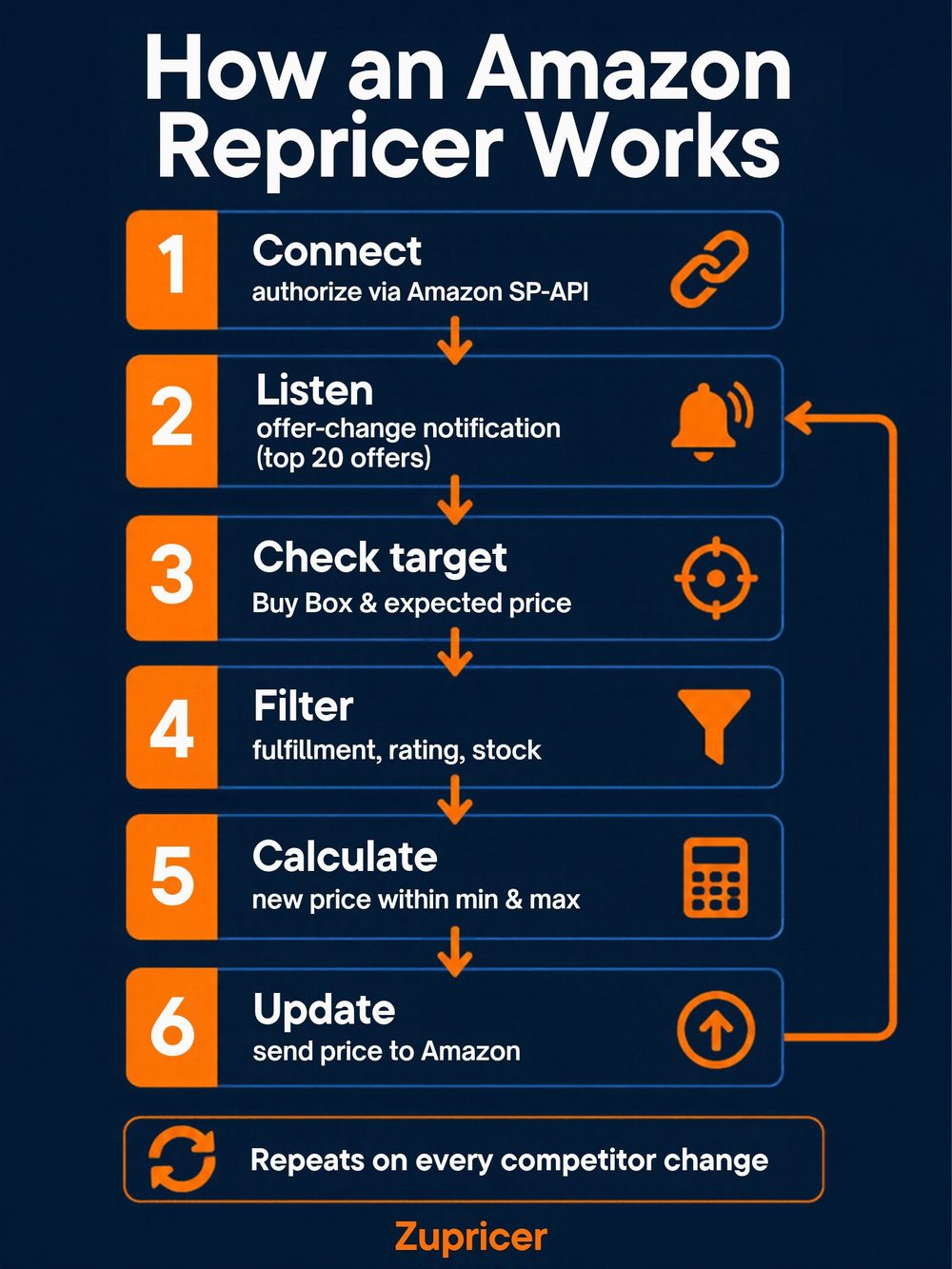
- Connect: you authorize the repricer in Seller Central through Amazon’s Selling Partner API (SP-API). Repricers are also listed in Amazon’s Selling Partner Appstore.
- Listen: Amazon sends an offer-change notification when any of the top 20 offers on a product you sell changes, or when the Buy Box winner or price changes. Offers are ranked by landed price (price plus shipping) (Amazon SP-API). Amazon also sends a Pricing Health notification when your price makes an offer ineligible for the Featured Offer.
- Check the target: many repricers also look up the Featured Offer Expected Price — the price at or below which your offer can expect to become the Featured Offer — rather than simply chasing the lowest price.
- Filter competitors: rules decide which offers matter — for example, ignoring slow FBM offers, out-of-stock sellers or low-rated sellers. See FBA vs FBM for why fulfillment matters.
- Calculate: the repricer computes a new price from your strategy (match, hold, raise or undercut) and clamps it between your minimum and maximum.
- Update: the new price is sent to Amazon through the Listings API, and the loop starts again with the next change.
For how the Featured Offer is chosen — and Amazon’s July 2026 change that put every seller’s offers in the running — see our Amazon Buy Box guide.
Types of Amazon repricers
| Type | How it decides | Best for | Watch out for |
|---|---|---|---|
| Rule-based | If-then rules you set (e.g. match the Featured Offer, never below $X) | Sellers who want full control and predictable behavior | Rules that only undercut can start price wars |
| Algorithmic / AI | Weighs several signals at once (competition, Buy Box status, sales, stock) and often raises prices when it can | Large catalogs on competitive shared listings | Less transparent — harder to see why a price changed |
| Hybrid | Strategies or scenarios on top of rules, with hard guardrails | Sellers who want automation without a black box | Needs a little setup to map strategies to product groups |
Ready-made rules for common situations are in our Amazon repricing strategies guide.
Repricer vs Amazon Automate Pricing
Does Amazon have its own repricer? Yes. Automate Pricing is free for Professional sellers and is a rule-based repricer. Here’s how it compares with a dedicated tool:
| Amazon Automate Pricing | Third-party repricer | |
|---|---|---|
| Cost | Free with the Professional plan | Monthly subscription |
| Rules | Competitive (Featured Offer, lowest price, external price), sales-based, business pricing | Adds exceptions such as sole seller, Amazon on listing, low stock |
| Speed | Usually under 15 minutes; new or edited rules up to an hour (Amazon) | Varies by tool; many react to each offer change |
| Competitor filters | Limited | Fulfillment method, seller rating, stock, Buy Box ownership |
| Margin protection | Minimum and optional maximum price | Cost-based floors and minimum margin per SKU |
| Analytics | Basic | Buy Box win rate, price-change history, profit views |
Do you need a repricer?
You probably do if:
- Other sellers offer the same products as you (wholesale, arbitrage, resellers).
- You lose the Featured Offer on price or get Pricing Health alerts.
- Your catalog is too large to check prices by hand every day.
- You know your costs well enough to set a floor price per product.
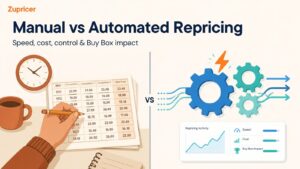
You probably don’t — yet — if you’re the only seller on your private-label listings. There’s no one to reprice against, although a repricer can still alert you when a new seller appears or help test prices. Very small catalogs can also start with Automate Pricing. Still weighing it up? Compare manual vs automated repricing side by side.
Risks and how to avoid them
- Race to the bottom: two repricers undercutting each other can push prices toward cost. Use match or hold rules and a hard floor — see how to avoid an Amazon price war.
- Floors that ignore fees: a floor must include referral and FBA fees. Check them in our Amazon seller fees guide.
- Prices that are too high: Amazon can mark offers ineligible for the Featured Offer when prices are uncompetitive against reference prices, so set sensible maximums too.
How repricers are priced
Repricers usually charge a flat monthly fee, a fee tiered by number of SKUs, or a fee tiered by your monthly sales. Entry plans in the market range from about $25 to $100 per month, often with limits on listings or features. Compare current options in our guide to the best Amazon repricers.
Where Zupricer fits
Zupricer is a hybrid, Amazon-only repricer: it reacts in real time through the SP-API, uses scenario-based strategies built on Buy Box ownership, fulfillment method, seller rating, competitor count and stock, and enforces min/max and minimum-margin guardrails with cost-based floors. Every feature is included on every plan from $79/month. To place repricing inside your wider approach, see our guides to Amazon pricing strategy and Amazon pricing tools.
Frequently asked questions
What does reprice mean?
To reprice is to set a new price for an item you already sell. On Amazon, it usually means adjusting your price in response to competing offers.
What is an Amazon repricer?
Software that automatically updates your Amazon prices based on competitor activity and your rules, staying between the minimum and maximum prices you set.
Does Amazon have a free repricer?
Yes. Automate Pricing is free for Professional sellers and offers competitive, sales-based and business pricing rules with a minimum price.
Is using a repricer allowed on Amazon?
Yes. Amazon offers its own repricing tool and lists third-party repricers in its Selling Partner Appstore. Your prices still have to follow Amazon’s pricing policies.
How fast does a repricer update prices?
It depends on the tool. Amazon says Automate Pricing changes usually apply in under 15 minutes; many third-party repricers react to each offer-change notification.
Can a repricer raise prices?
Yes. Good repricers raise prices when competitors run out of stock, when you’re the only seller or when you already hold the Buy Box — up to your maximum.
Do private label sellers need a repricer?
Usually not while they’re the only seller on their listings. It becomes useful if other sellers or hijackers appear, or for structured price testing.
How much does a repricer cost?
Most charge a monthly fee, flat or tiered by SKUs or sales. Entry plans typically range from about $25 to $100 per month.
Try repricing with guardrails
Start a 14-day free trial of Zupricer, set your floors and see how real-time repricing works on your own listings.