Disclosure: this guide is published by Zupricer, which makes Amazon repricing software. Amazon program details and fees come from Amazon’s seller pages and Seller Forums announcements, checked on November 20, 2026. Terms change often, so confirm them in Seller Central.
How do small sellers compete with big sellers on Amazon? Don’t fight on their terms. Pick narrow niches where big ad budgets don’t matter, and build a brand that large catalogs can’t copy. Claim Amazon’s new-seller credits. Keep fulfillment fast and your account metrics clean. Price inside a profitable range instead of chasing the lowest price.
Key takeaways
- Big sellers win on ad spend, catalog size and unit cost. Small sellers win on focus, speed and brand.
- Amazon’s New Seller Incentives can cover a meaningful part of your early ad, review and FBA costs, but most have deadlines.
- Since July 2026, every offer is considered for the Featured Offer (Buy Box). Price, delivery speed and performance decide who wins.
- Matching every price drop is the fastest way for a small seller to lose money.
Can small sellers still compete on Amazon?
Yes, though not everywhere. Amazon says more than 60% of sales in its store come from independent sellers, most of them small and medium-sized businesses (Amazon). Costs did rise in 2026. FBA fees went up by an average of $0.08 per unit in January, and a 3.5% fuel and logistics surcharge on fulfillment fees followed in April. The playing field isn’t level, but it isn’t closed either. The trick is to choose the parts of it where size doesn’t help.
Where small sellers win, and where they don’t
| Area | Big sellers’ edge | Small sellers’ edge | What to do |
|---|---|---|---|
| Ads on broad keywords | They can outbid you | None | Avoid broad terms; go long-tail |
| Narrow niches | Often not worth their overhead | You can own small, specific searches | Pick sub-niches and bundles |
| Speed of decisions | Slow approvals | You can change a price or listing the same day | Test listings and prices every week |
| Unit cost | Volume discounts | None | Compete on difference, not on cost |
| Brand and service | Often generic | A real story and personal replies | Use A+ Content; answer messages fast |
| Featured Offer | Strong metrics at scale | Since 2026, considered on equal terms | Keep metrics clean and delivery fast |
| Catalog breadth | Hundreds of SKUs | None | Go deep on a few products |
7 ways to compete with big sellers on a small budget
1. Choose a niche big catalogs ignore
Big sellers chase high-volume searches. That leaves specific, lower-volume searches, such as a size, a use case or a bundle, where a focused product can rank without a huge ad budget. Before you commit, run a quick competitive analysis. Look for listings with weak images, thin content or recurring complaints in reviews. Those are the gaps you can fill.
2. Turn your product into a brand
Selling the same product as everyone else puts you in a price fight on one listing. Your own brand gets you out of it. Brand Registry is free, but you need a registered or pending trademark. It unlocks A+ Content, Brand Stores, Sponsored Brands, Vine, Brand Analytics and brand protection tools. Read competitors’ critical reviews and fix their most common complaints in your product, images and copy.
3. Claim every new-seller credit
This is the biggest small-budget lever, and few small sellers use all of it. Amazon’s New Seller Incentives for Professional sellers in the US include:
- Brand Referral Bonus: 10% back on your first $50,000 of branded sales, then 5% on the next $950,000, during your first year. Enroll your brand within six months of your first eligible listing.
- Vine credit: $200 toward Vine enrollment fees, with time limits.
- Sponsored Products credits: up to $1,000 in tiers, matched to your own ad spend. Start a campaign within 90 days of listing.
- Coupon credit: $50 toward coupon fees.
- FBA credits: discounts on inbound shipping and placement, plus the FBA New Selection program (free storage, liquidations and returns processing for eligible new products).
Most of these run on 90-day or six-month clocks from your first listing. Plan your launch around them.
4. Get early reviews the compliant way
Reviews are where big sellers’ head start shows most. Amazon Vine sends your product to trusted reviewers. It’s for brand-registered FBA products with fewer than 30 reviews. US fees are free for up to 2 units, $75 for 3–10 units and $200 for 11–30 units per parent product, charged only after the first review is published (Amazon). Use the “Request a Review” button for every order too. Never offer anything in exchange for a review.
5. Run lean ads
Sponsored Products are pay-per-click with no upfront fee, and you set the bid and daily budget. A small-budget routine:
- Start with an automatic campaign on your one to three best products.
- Move search terms that convert into manual campaigns.
- Add negative keywords every week.
- Bid on specific long-tail terms instead of broad ones.
Judge ads by TACoS (ad spend divided by total sales), not only ACoS, so you can see whether ads are growing your organic sales.
6. Win on speed and service
Delivery speed and account performance count toward the Featured Offer, and since 2026 they shape the ranking directly. FBA gives you Prime delivery without your own logistics. FBM can work just as well if you ship fast. Seller Fulfilled Prime is demanding, and Amazon tightened its speed requirements in July 2026. Compare the options in FBA vs FBM. Reply to customer messages quickly. It’s an easy edge over large, slow teams.
7. Price inside a range, not at the bottom
Small sellers lose margin in two ways. Some match every price drop by hand and slide into a price war. Others never adjust and quietly lose the Featured Offer. The fix is a range:
- A floor for each SKU: landed cost plus Amazon fees plus your minimum profit.
- A ceiling, so you don’t price yourself out or trigger Amazon’s pricing policy.
- Room in between to compete against the Featured Offer price.
Our Amazon pricing strategy guide explains how to set each one. Amazon’s free Automate Pricing tool can handle basic rules. A third-party repricer becomes useful when you need to react in real time, ignore certain competitors or raise prices when rivals run out of stock. See manual vs automated repricing for when to switch, and repricing strategies that protect margin for ready-made rules.
What the 2026 Featured Offer change means for small sellers
In July 2026, Amazon began removing the seller-eligibility requirements for the Featured Offer, with the rollout completing by the end of the year. Amazon says it isn’t changing how the Featured Offer is selected. It still weighs competitive pricing, delivery speed and performance, and being considered doesn’t guarantee you’ll be featured. For small and new sellers, that’s good news: you’re in the running by default. But you now compete directly on those three factors from day one. Read more about how the Buy Box (Featured Offer) works.
Know your numbers before you scale
Growth that loses money per unit only makes you lose money faster. For every SKU, know the referral fee, the FBA fee (including the 3.5% surcharge), storage, ad cost per unit and returns. Then check your margin. Our full Amazon seller fee breakdown includes a calculator. Watch cash flow as closely as profit: reordering stock before revenue arrives is where many small sellers run into trouble.
A 90-day growth plan for small sellers
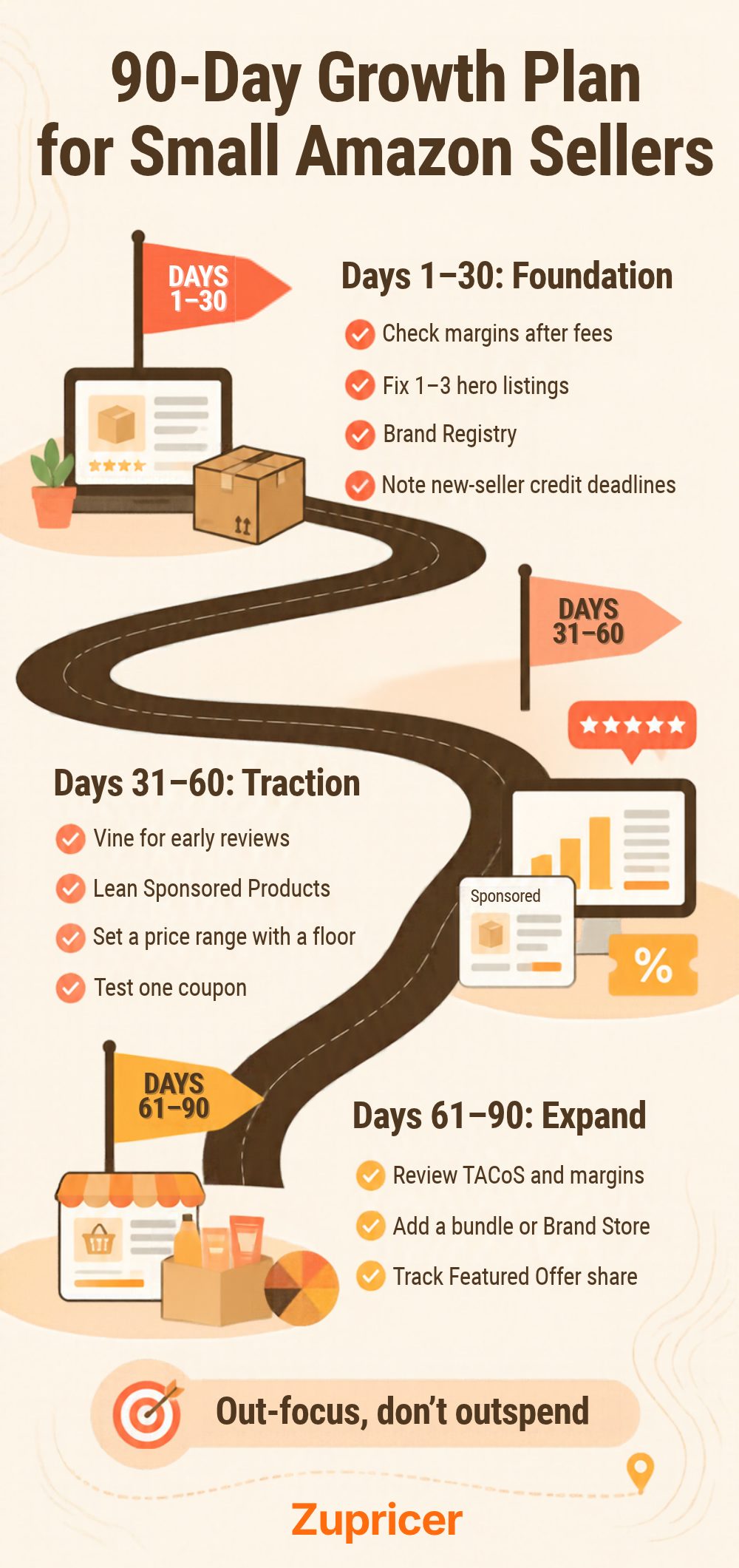
Days 1–30: foundation
- Confirm the margin on each SKU after all Amazon fees.
- Pick one to three hero products and fix their listings: title, images, bullets, backend keywords.
- File your trademark and enroll in Brand Registry.
- Note the deadlines for each New Seller Incentive.
- Choose FBA or FBM for each SKU.
Days 31–60: traction
- Enroll hero products in Vine if they have fewer than 30 reviews.
- Launch an automatic Sponsored Products campaign and move winning terms into manual campaigns.
- Set a price range with a cost-based floor for each SKU. Our guide to Amazon pricing tools covers the options.
- Test one coupon using your coupon credit, and add A+ Content.
Days 61–90: expand
- Review TACoS and margin for each SKU.
- Add a complementary product or a virtual bundle, and build a Brand Store.
- Check account health and Featured Offer share every week.
- Decide your next ad budget based on profit, not revenue.
Then repeat the cycle. Growth on Amazon comes from compounding small wins.
Frequently asked questions
Can a small seller still compete on Amazon?
Yes, in the right niches. Amazon says independent sellers, mostly small and medium-sized businesses, make up more than 60% of sales in its store. Avoid head-to-head fights on broad keywords and unit cost.
How do big sellers stay on top of Amazon search?
Sales history, review volume and ad budgets reinforce each other: more sales improve rank, and better rank brings more sales. Small sellers break in through specific searches where that cycle is weaker.
How much should a small seller spend on Amazon ads?
There’s no fixed number. Start small on your best products, use Amazon’s Sponsored Products credits and increase spend only when TACoS shows ads are profitable.
Do I need Brand Registry to compete with big brands?
It isn’t required to sell, but it’s hard to build a defensible business without it. It unlocks A+ Content, Vine, Brand Stores, Sponsored Brands and the Brand Referral Bonus.
Is FBA or FBM better for a small seller?
FBA is simpler and gives you Prime delivery. Amazon notes it can be more cost-effective once you sell around 40 or more items a month. FBM works if you can ship fast and reliably.
Do I need the lowest price to win the Buy Box?
No. Amazon weighs competitive pricing, delivery speed and performance. A slightly higher price with faster delivery and strong metrics can win. You can compare Amazon repricers if you want to automate this.
What changed with the Featured Offer in 2026?
Amazon started removing seller-eligibility requirements in July 2026, so every offer is considered. The selection criteria stayed the same.
How long does it take to grow an Amazon business?
It depends on your category and competition. Plan in 90-day cycles, and measure progress in profit and repeat sales, not just revenue.
Compete smarter, not cheaper
Zupricer helps small sellers hold the Featured Offer without giving away margin. It reprices in real time through Amazon’s SP-API, with scenario-based strategies and cost-based floors. Plans start at $79 a month with every feature included. Start a 14-day free trial.